
Part of the job of doing a PhD is to make connections between things. I’m at the stage of my doctorate where my brain is swimming with loads of data — with hundreds of hours of interview transcripts, countless books and academic papers, theories coming out of my ears. And my task is to make sense of it. To draw throughlines, find the red thread, synthesise it, expand on it, and present it to my readers in a new way. In my case, to bring things together that may not have been brought together before, and by juxtaposing them, shed new light on each. So, my mind is in this ‘mode’ at the moment, and I find myself doing the same thing in other areas of my life. I’d like to tell you a story about ‘presenting well’, and how this can be extremely dangerous. By working through this, I will also weave in some of the things I’m thinking about the chapter I’m currently writing.
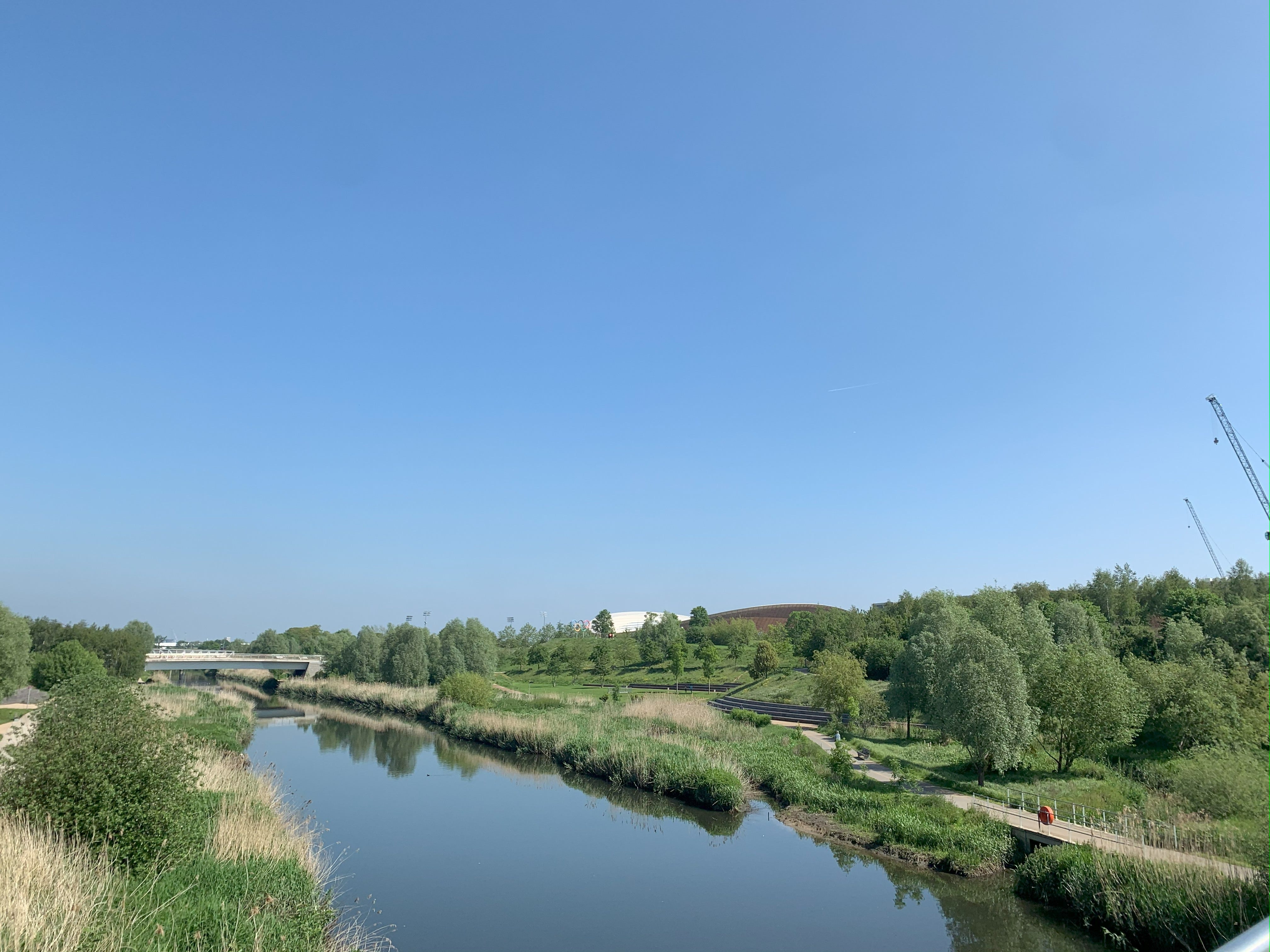
Let me set the scene. It’s a gloriously sunny June day in 2021. The plan is to cycle to my friend’s house in Walthamstow for lunch. My partner and I decide we will take the long way round, zig-zagging across East London so we can catch the waterways, parks and greenways, and see parts of the city we haven’t explored before. It’s one of those magnificent blue-skied London days that makes everyone smile and chat to each other; the kind of day that makes visitors want to live here. Skylarks are flying overhead, dipping and singing to us, and all seems right with the world. We’re about half way on our journey when suddenly I have an overwhelming urge to sleep. One moment I’m cycling along a lane by a lake, and the next moment I want to crumple down, to fall off my bike and sleep on the floor. It’s a feeling I’ve never felt before, and it frightens me. We decide to skip the last couple of parks and press on to our destination.
Now, despite my best efforts, there is a part of me that is still terribly British, so when we get to my friend’s house, I politely accept their hospitality and we all have lunch in the garden. I’m feeling awful though, and all I want to do is lay down. Once they realise that I’m not quite right, they take my temperature, which is a whopping 39 degrees. A visit to the bathroom reveals a huge red rash all over my right leg and torso. A phone call to my host’s partner (a palliative care nurse) makes our decision: call the ambulance.
You’d think that years of being treated for two cancers would have taught me how to self-advocate, to assert myself in medical situations and get what I need. But no. When the ambulance arrives, I apologise profusely, convinced I’m wasting their time. They take my temperature — by this time I’m shivering, which they tell me is a common response to a fever. We don’t know what’s wrong with me, but they say they’ll take me to the hospital anyway. They drive me to Newham Hospital, but as they’ve decided I’m not an urgent case, they don’t ‘blue light me in’, so we sit in East London traffic for an alarmingly long time, with me apologising and meekly making conversation. Residual covid rules mean my partner can’t join me, and, once admitted, I struggle on the uncomfortable plastic chairs in the A&E waiting room, alone, for 5 and a half hours, my phone battery running down, too scared to leave to go to the toilet or get something to eat, in case my name is called. The pain and the heat in my body increases. I’m shivering, I’m hot, I’m in agony, and I don’t even have any paracetamol with me. I start to cry, and a nurse huffily tells me they can’t give me any pain relief and I have to ‘wait my turn’. I think about how the NHS is crumbling before our very eyes, that this costs lives.
Finally, after almost 6 hours, a doctor calls my name, and I go into the examining room. He examines my body, where the redness is raging with heat and spreading, but he tells me that my bloods are fine, there’s nothing wrong with me and I should go home. The tears start to fall again. He sits me down, admonishes me, telling me it’s just a rash and why on earth am I so upset. I tell him it’s not nothing, I know this, but I don’t know why. I mention my lymphoedema, I’ve heard of cellulitis but my brain doesn’t make the connection. He’s sceptical, but asks a consultant to come and double check.
I’ll never forget the look on the consultant’s face when he sees my leg and torso. When he looks pointedly at the other doctor and says “so obviously we need to get IV antibiotics in this lady immediately, don’t we?”, and the look on the doctor’s face when he realises he’s royally screwed up. The hours I’ve spent eating lunch, stuck in traffic, and languishing in A&E are crucial. They mean the difference between cellulitis and sepsis. This is a medical emergency, and the consultant is the first person to have recognised this. Once I’m hooked up to an IV the original doctor comes to check over things. He’s clearly the kind of guy who covers up his own mistakes by blaming others. He growls, “the thing is, you present well”.
You present well. You present well. What does that even mean? I have hours to ponder this, as I lay on a trolley in a corridor in Newham Hospital, day ticking over into night. You present well. So, because I’m conscious, articulate, apologetic, because I seem fine, that means I’m hiding the fact that I’m actually not very well at all? There’s more than a whiff of victim blaming to this. I didn’t seem sick enough to warrant care? I didn’t seem sick enough to warrant a blue light in the ambulance? I didn’t seem sick enough to be actually seriously sick?
At 5am I realise I haven’t eaten since lunch the previous day, and hunger consumes me. I’m nodding in and out of sleep by this stage, but a kind nurse hands me a cheese sandwich. I’m just about to tuck in when someone barks at me that I’m not to eat anything as I might have to go into surgery. Wait, what? Surgery? I ask him why on earth I would need to go into surgery, and the poor guy, sleep deprived on a night shift with no energy to fob me off or fabricate a response, says that they suspect I have necrotising fascitis, and that I will need to have part of my leg and torso cut away. What, the, actual…? I can’t even google it as my phone battery has died. I get wheeled to another part of the hospital to have a scan, and on the way he says that my flesh is trying to eat itself, it’s over-reacting to the infection, and the only way to stop this is to cut the flesh away. I’m astonished. Really? I’ve been through all the shit I’ve been through over the last few years, and it’s come to this? My flesh is eating itself? And the reason why it’s got to this stage is because I ‘present well’, so my care has been delayed, denied, deferred.
As it turned out, I didn’t have necrotising fascitis, so I escaped the flesh-eating monster. They finally found me a bed, and I stayed at Newham for a week. At first I had my own room, which seemed pretty fancy, until I realised that this was because they were really worried about me. It took 5 days for my temperature to get below 39 degrees, but eventually the antibiotics started to work and I was moved onto the ward. My partner brought me my laptop and I worked from hospital (no sick leave when you’re a freelancer). The consultant from the first day came to visit me. He didn’t elaborate on his diagnosis, but I could see his relief that I was recovering, and not dead from sepsis. I struggled to sleep on the ward as my roommates were noisy and nurses woke me every couple of hours to take obs and ask me my date of birth, so I asked to go home with oral antibiotics. They reluctantly discharged me and I headed home.
But this story isn’t about my brush with cellulitis, nor is it about the 5 times I’ve had it since then. It’s about the accusation, and it was an accusation, that I ‘present well’, and thus somehow sabotaged myself into a potentially dangerous, life-threatening situation. And the upshot was that by ‘presenting well’ I was denied care — care that could have been life-saving had things been worse. I was lucky, but I had jeopardised that luck, through no fault of my own. How could I avoid ‘presenting well’ in the future? In future situations where I might not be so lucky?
And then it made me think about other parts of my life where ‘presenting well’ is a hindrance rather than a help. Not only in the context of an acute medical emergency, but broadly when it comes to having an invisible disablity. To look at me, you don’t realise I have lymphoedema, you don’t realise I’m grappling with cancer-related fatigue, you don’t realise the pain and discomfort that living with a chronic illness brings, or the adjustments I’ve devised to help me get through the days without overwhelming struggle. So when I am in a meeting that trips over the hour, and I ask for a comfort break, or when I’m at a conference and have to put my right leg up on a chair, or when I use the disabled loo in a venue, I know that people look, they judge, they don’t think I need such adjustments. I ‘present well’. When I first started the PhD it took over a year to persuade the universit to get me a footrest that allowed me to put my legs up horizontally, something that’s vital if I’m to get through the day. And that was the only request I made that was granted (begrudgingly), the others are left unfulfilled. So I spend most of my time working from home, because my set-up at home is much more comfortable, and this means I miss out on the cameraderie of working with colleagues in the office at uni. I miss out on the collective care that forming strong bonds with my fellow PhD students would bring. I miss out on those casual conversations that can enrich and augment one’s research, because I only spend a day or two at most each week on campus. I ponder, is self-advocacy the antidote to ‘presenting well’? But self-advocacy requires so much labour, so much energy, and when you ‘present well’ people just think you’re being too demanding, and sometimes it’s easier to let things slide.
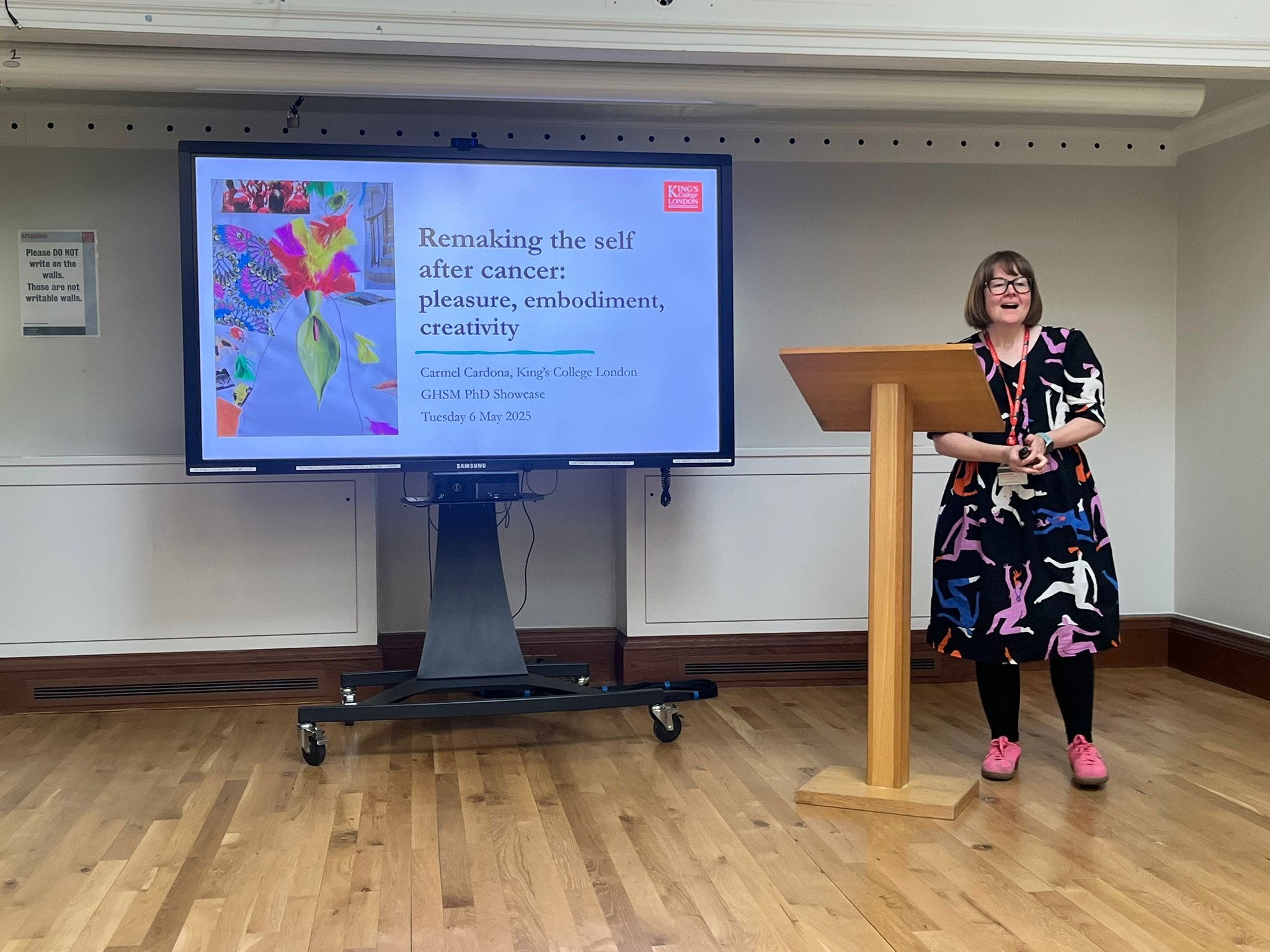
Last week I presented at the department’s PhD showcase. This is the third time I’ve done this — once in my first year, when I was still shaping the project, once in my second year, when I had conducted some background interviews, and this week, for my final time, now that I have carried out all my ‘fieldwork’. I had 7 minutes, so I shared a whistlestop trip through the 8 chapters I plan to write in the coming months. And it went well! I received a couple of questions, but nothing too taxing. I presented well. I have ‘presented well’ throughout my 2.5 years of the PhD so far. I’m older than your average PhD student, I’ve had a career outside of academia, I’m organised, I’m used to juggling lots of clients, different demands and deadlines, I have skills that are easily transferrable to this new context. So people think I don’t need care. They forget that I’m a baby academic, that in reality I have no idea what I’m doing, and that this world is completely baffling to me. I’ve been in tears in the past, wondering how I can respond to feedback about my theoretical framework, my disciplinary location, not understanding what was being demanded of me. I accidentally spent 2 years tackling my literature searches in the worst way possible, lacking fundamental knowledge and understanding of the invisible, unwritten rules of academia. I feel as though I’m travelling through the PhD blindfolded. But I ‘present well’. I sound confident. I can talk with the lecturers and professors in the department with ease. I can convince an audience in 7 minutes that I’m capable of writing 100,000 words, and that I have something to say. But am I? Do I?
I’m not going to call this ‘imposter syndrome’ as I think that term is too loaded and contentious, but it’s very difficult for me to retain the belief that I’m capable of doing this, when I think that people only believe I can do it because I ‘present well’. And that, when it comes down to it, I really have no idea what I’m doing. I haven’t read enough, and I have nothing novel to say.
There are, of course, days when I don’t think this. When I think my research is vital, innovative, fresh and amazing, and I have so much to say it will take a lifetime to say it. But oof it’s hard to keep hold of that on this rollercoaster that is the PhD!
My current chapter is about cancer and the labour of self-advocacy, which is partly where some of these thoughts arose. Hopefully I’ll present it well in my writing.
Comments
Nothing yet. Say the first thing.
Sign in to join the conversation.