
It’s been a while! After my last post I plunged myself into my fieldwork, conducting workshops and interviewing my participants (more about that later), and now I’m deep in the world of data analysis. It’s all been going really well, better than I could ever have anticipated, and my brain is fizzing with all the great ideas that have come up from my research conversations.
As well as data analysis, I’m also switching into writing mode, with a book chapter and a magazine article both due in the next couple of weeks. And I’m preparing for my upcoming research trip to Australia where I’ll be delivering talks and seminars about my research in Sydney, Melbourne, Canberra and Adelaide.
So it’s all go! But I thought I’d come back here to share some of my thinking as I’ve been navigating where I stand as an ‘insider-outsider researcher’. This is something I reflect on constantly, as it impacts all aspects of my work, and it’s something I really can’t ignore. So in this piece I will try to unpick what this actually means, some of the different theories about it, and the challenges and opportunities it presents for my research.
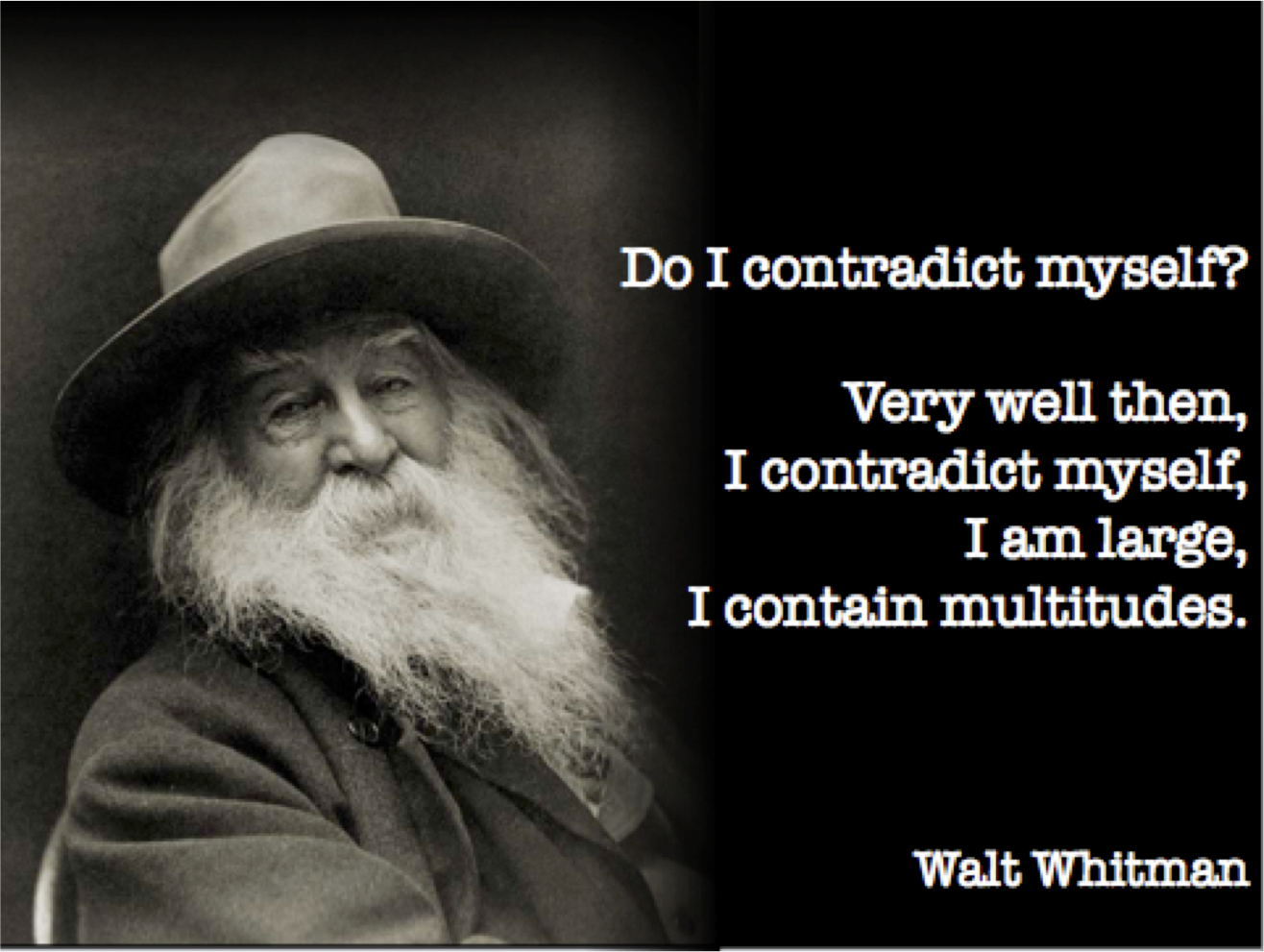
Most of you probably don’t know this, but my undergraduate degree was in English & American Literature, at the University of Manchester. I wrote my honours thesis on the poetry of Walt Whitman, and this quote from Song of Myself has always lingered with me. “I contain multitudes” reflects the multi-faceted nature of our identity, and how all the different aspects of ourselves can sometimes be seen as contradictory. I think it’s a great way of thinking about my place as a researcher — where I stand in relation to the research and my participants.
The insider-outsider researcher
The genesis of my research project is personal. My own experiences of cancer, as well as those of others I regularly talk to as part of my volunteer role at Breast Cancer Now, have directly led to my pivot into academia, and shaped the project of my PhD. Navigating ‘survivorship’ and life after a cancer diagnosis has a huge impact on one’s sense of self, and the key themes of my research are all topics that have come up many times in conversations I’ve had with other survivors. So in a fundamental sense, I’m ‘inside’ this research. I am working with people who’ve also had a breast cancer diagnosis. While we’ve all had different experiences, we have a lot in common, and they know that I ‘get it’ in a way that other researchers may not. Listening to the stories of my participants can remind me of my own experiences, can bring back memories and emotions from my own past. But at the same time I occupy the role of researcher, which places me ‘outside’ the world of my research. I am analysing the stories of my participants through an academic lens. I am reading extensively in the fields of my project and bringing theory to the table. I am taking an analytical approach to what I hear, and at the end of all of this, I will be writing 100,000 words about it, fully aimed at an academic audience. I’ll be giving presentations about my research at academic conferences. And part of doing that is to conform to certain expectations of academia, in the way that I present my findings.
My field is social science. And social science has a history of emulating the natural sciences. That is, adhering to some of the ‘rules’ of science, such as objectivity, and a belief that the researcher should be neutral and detached. Research studies should be ‘scientific’, in that they are devoid of emotional engagement, and they should produce results that could be replicated by any other researcher. This is sometimes called a ‘positivist’ approach to research. It creates biases in the way that research is viewed. Journals favour quantitative studies, where results can be demonstrated numerically and cleanly. Reviewers critique qualitative studies as not being useful, because they can’t lead to generalisable results. They also critique people who have a personal connection with their research as being unable to be objective, therefore not trustworthy or credible. But, unlike the natural sciences, social science is about human beings, and human beings are all uniquely different. You can’t reduce the life of a person to numbers and statistics. And the researcher is also a human being, a human being with a history, with emotions, with biases, with thoughts and feelings that they bring to the research. So the idea of objectivity is essentially a myth.
Feminist standpoint theory
When I started my masters in Gender Studies at the LSE, one of the first things we learnt was about Feminist Standpoint Theory. Put simply, standpoint theorists propose that our understanding of the world is unavoidably influenced by our social position. Factors such as our gender, race, class and religion affect how we view the world. In the same way as a piece of art looks different if you’re standing close to it or far away, so our view of anything alters by our position in relation to it. I can’t ignore my own lived experience while I’m doing my research, but that is also precisely the point: I don’t want to ignore it. Instead, I want to embrace it, and to engage with it. To acknowledge it and explore critically what it means.

‘Insider’ benefits
My position as an ‘insider’ gives me certain benefits and privileges. For example, many of my participants said they were much more comfortable about coming forward to be part of my research knowing that I had lived experience of cancer. I had many many more applicants for my research than some of my colleagues. It brought a greater legitimacy to the research, making it seem less like I just wanted to ‘extract’ their traumatic memories. I also found it easier to develop bonds of trust with my participants, as we could talk knowingly about aspects of our research, and they didn’t feel they had to explain everything to me. There are shortcuts when you have that shared understanding. ‘Insider’ research typically captures a greater depth of data (‘data’ here refers to the stories my participants tell me) because of these bonds of trust and openness. People are prepared to tell me more, to go into greater depth about sensitive topics because of my shared experiences.
‘Insider’ challenges
There is a flip side of course. Being an ‘insider’ can also cause potential problems, and it’s important for me to be aware of these. For example, my participants can assume that I’ve had similar experiences to them, which may lead them to not explain fully what they mean. My perceptions of their stories might be clouded by my own experiences. I might shape the interview using questions that pursue my own interests rather than what they really want to share. And my position might also influence my data analysis, focusing on shared factors rather than what is unique about their stories. It’s really important that I remain aware of these potential challenges, and practice continual reflection, approaching my research with an openness and a curiosity.
Challenging the binary
While the concept of being an ‘insider’ researcher can be useful, it also implies a binary of two extremes, regarding my relationship with my research. In reality, researching from lived experience is much more complex than simply being either ‘inside’ or ‘outside’ the field of research. Black feminist sociologist Patricia Hill Collins coined the term ‘outsider within’ to describe how she felt as a Black academic, grappling with unequal power structures which placed her in marginalised positions due to her race and gender. Other researchers working in the world of their lived experience have talked about the ‘space between’ the positions of insider or outsider. There can be tension caused by not fitting neatly into an ‘insider’ or ‘outsider’ box. Structures like academia and medicine have deeply entrenched notions of who gets to be an ‘insider’, and what counts as ‘knowledge’. By occupying a space in the ‘hyphen’ between, or by being difficult to place into a box, I challenge these notions.
Anthropological orientations
The world of anthropology also provides some useful perspectives. Within ethnographic research, which has traditionally been carried out in cultures different from that of the researcher, there is an understanding that the researcher’s position is fluid, and very context-dependent. Anthropologist Rena Lederman talks about how the researcher makes two distinct movements — they ‘turn away’ from the academy and ‘turn towards’ their research subjects, focussing on their lives and worlds. They will often immerse themselves in a culture or society, and then later, when they are moving towards the analysis phase and writing about their research, they will turn their orientation back ‘towards’ the academy, and ‘away’ from that of their research subjects. As a lived experience researcher, I can see that my orientations shift during different phases of my research. When I’m in the kitchen, having lunch with my participants and chatting generally about our cancer experiences, comparing notes about our oncologists, sharing a joke about something we’ve all experienced, I feel as though my focus is very much ‘turned towards’ the world of cancer survivorship. But when I’m analysing their artistic pieces, or their interview transcripts, I’m starting to ‘turn away’, shifting my attention back towards the academy. Perhaps I could think of a position I could occupy which always remains partially ‘away’ and partially ‘toward’, or to seek to disorient myself instead and not attempt to occupy a single, clear orientation in my work.
Borderlands
There’s an agricultural adage that the most fertile ground is found in the borders between fields of different crops. In the borders, seeds from both varieties fall, and this is where interesting stuff happens, biologically. It’s the same with academic disciplines or different fields of thought. In the intersections between these clearly delineated spaces, ambiguity and novelty play a part in creating a fruitful space, for new thinking, for innovation. In the process of translating between different locations, spaces, realms of understanding, there is power in being the ‘bridge’ between two worlds. I can speak with my participants in their language, I’m in the shitty cancer club with them, whether I like it or not. But I also know the language of academia, and I am overcoming the barriers between the different spaces, helping to translate experience, to convey lived realities, and hopefully, ultimately, to affect change.
An ethics of care
So much of my approach to my position in my research is led by my commitment to an ethics of care, towards my participants, their lives and stories, and towards myself. A positivistic view of the researcher is that of someone who is ‘mining’ for data, digging into people’s lives and stories to uncover some kind of fixed ‘truth’. Instead, I position myself as a ‘data traveller’. I am travelling alongside my research participants, working in collaboration with them to make sense of their experiences, to create a shared understanding, and to convey this to other audiences. This ethos of collective care underpins my choice of research methods, which I’m looking forward to sharing more with you as I complete my data analysis.
But for now, I leave you with my unresolved location as a researcher. There is no fixed ‘insider’ position. We are all human beings, we are large, and contain multitudes, and this complexity is what makes social science so interesting, and, as I’m finding out at the moment, so fun!
Thanks for reading Reclaiming pleasure after cancer! This post is public so feel free to share it.
Some references
Anzaldua, G. (2009). To(o) Queer the Writer—Loca, escritora y chicana. In A. L. Keating (Ed.), The Gloria Anzaldúa Reader (pp. 163–175). Duke University Press. https://doi.org/10.1215/9780822391272-024
Brinkmann, S., & Kvale, S. (2015). InterViews: Learning the craft of qualitative research interviewing (Third edition). Sage.
Collins, P. H. (1999). Reflections on the Outsider Within. Journal of Career Development, 26(1), 85–88. https://doi.org/10.1177/089484539902600107
Harding, S. (1991a). “Strong Objectivity” and Socially Situated Knowledge. In Whose Science? Whose Knowledge?: Thinking from Women’s Lives.
Harding, S. (1991b). What Is Feminist Epistemology? In Whose Science? Whose Knowledge?: Thinking from Women’s Lives.
Lederman, R. (2019). Pretexts for Ethnography: On Reading Fieldnotes. In R. Sanjek (Ed.), Fieldnotes (pp. 71–91). Cornell University Press. https://doi.org/10.7591/9781501711954-005
Lorde, A. (with Clarke, C.). (2012). Sister Outsider: Essays and Speeches. Potter/Ten Speed/Harmony/Rodale.
Comments
Nothing yet. Say the first thing.
Sign in to join the conversation.