
A note on who I am: I’ve spent 25 years inside the systems that shape what kids see on screens. I helped build interactive experiences at Sesame Street, Netflix, and PBS Kids, and I hold a doctorate in instructional technology. Now I explore what happens when AI meets childhood, and what it would take to get it right. Subscribe for free to help support my work.
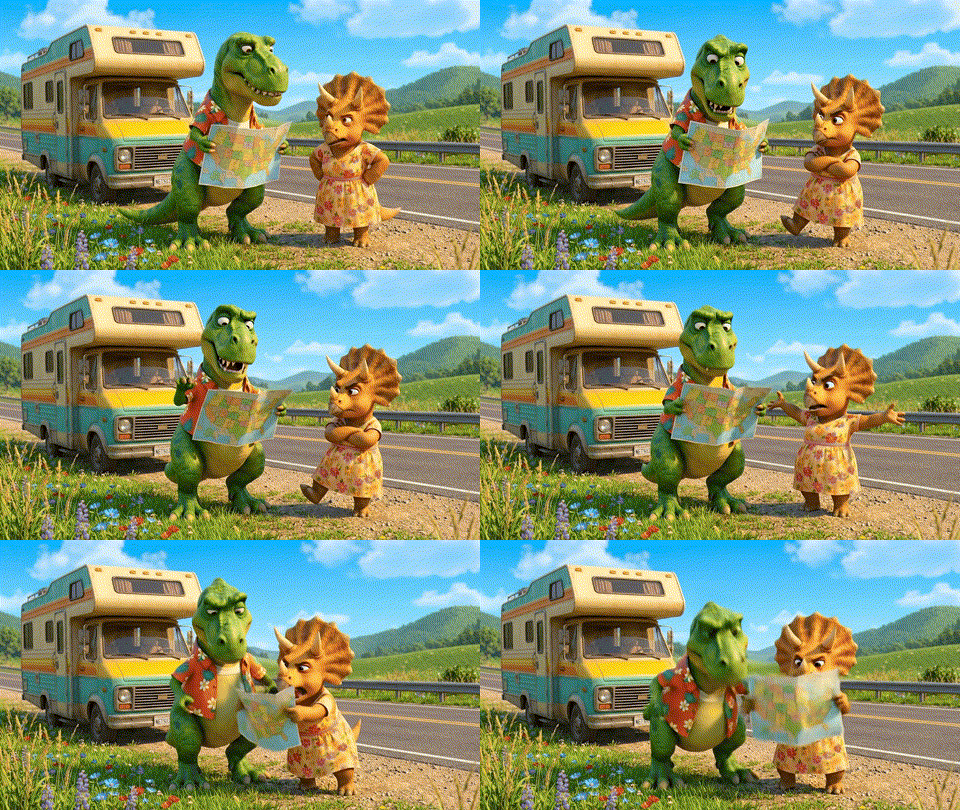
Did you ever sing Fifty Nifty United States in elementary school? Or sing Wakko’s State Capitols song from Animaniacs?
Learning the US states is a rite of passage for most American kids.
Which is why I was horrified, but not shocked, to find slop creators taking this topic on.
For example, from an actual “educational” YouTube video for kids about the 50 states:
“Minnesota winners, Wisconsin No.”
“Indiana bars and Illinois shakes.”
“My shore all together make 50 forever more.”
“Laws land people own.”
The channel (EduBop_School) has more than 2 million views and is a master class in what happens when a human isn’t in the loop. Thankfully, the algorithm seems to have noticed that this particular 50 States video is nothing but slop. It has less than 100 views.
Surely we can do better, right?
Yep, and it takes less time than you think. I spent an hour of back and forth with Claude coupled with my own critical thinking.
For kicks and giggles, I gave Claude (Opus 4.5) my laziest prompt to start.
Me: Write a song about the 50 united states
What I got back in 30 seconds was technically a song. It rhymed. It had all 50 states. It even had a chorus.
It was also pedagogically useless and super lame.
From the Atlantic to the Pacific shore, Fifty states united, each one we adore, Alabama, Alaska, Arizona too, Arkansas and California calling out to you. And on and on it went.
Perhaps my favorite is “South Dakota faces carved with no alarm.”
That caused me alarm!
A lazy creator could generate a song with this and upload it in no time at all. (Which is what I’m guessing that YouTube channel did.)
But it wouldn’t teach a child anything. It’s a random list with a rhyming scheme. The same problem as “Minnesota winners, Wisconsin No.” Just slightly more grammatical.
My response to Claude was to coach it to look at the lyrics with a critical eye.
Me: Does that make sense?? Think about this as an award-winning children’s content creator and a leading education scientist.
Claude immediately saw the problem. No scaffolding. No participation hooks. Arbitrary groupings. It knew this. It just didn’t apply it until I asked, then it was overly verbose in that adorable generative AI way.
Problems with that song as educational content:
1. Cognitive overload. Fifty states in one song is way too much information for young learners. There’s no chunking, no scaffolding, no repetition of key concepts. It’s essentially a list set to music, which is the lowest form of educational content.
2. No meaningful learning hooks. Throwing out “Idaho potatoes” and “Wisconsin cheese” gives kids random associations but no deeper understanding. What does a child actually learn about these places? Nothing sticky or transferable.
3. No participatory elements. Great children’s content invites interaction. Where are the call and response moments? The movement prompts? The places where a child can predict what comes next?
4. Arbitrary groupings. I just alphabetized and rhymed. There’s no pedagogical logic to how states are grouped. No geographic reasoning, no thematic connections.
5. Age appropriateness unclear. Who is this even for? A 3 year old? A 7 year old? The vocabulary and density suggest older kids, but older kids need more substance.
We debated whether all 50 states even needed to be in the song and discussed the merits of the Fifty Nifty United States song.
Then I asked Claude a simple question: Decide what the goal is for this song.
Claude chose geographic and spatial understanding. Its reasoning was sharp: Fifty Nifty already exists and does pure memorization perfectly. Why compete with the gold standard? The gap is helping kids build a mental map of where states actually are.
That one decision shaped everything that followed. No more alphabetical order. No more random rhyming lists. We were building a road trip.
Once we had a goal, I thought we’d be off to the races. We decided on a road trip structure. I imagined a map with lines connecting each state, tracing the road trip.
The song travel through regions, learning where states actually are.
Then Claude wrote:
Start in Maine up in the corner way up high
I pushed back: “’Way up high’ isn’t correct. It should be north.”
Claude was thinking vertically. But maps aren’t about high and low. They’re about cardinal directions. A five-year-old learning this song shouldn’t internalize that Maine is “high.” Maine is north. That’s the whole point of the song.
Then there was this:
North Dakota, South Dakota, Nebraska, Kansas too Twelve more states, we’re halfway through!
I asked: “Are we actually halfway when that lyric is said?”
Claude counted. After the Midwest verse, we’d covered 35 states. That’s 70%, not halfway. The AI confidently wrote “halfway” because it sounded good, not because it was true.
A kid singing this song would learn that 35 is half of 50. That’s not just empty. It’s wrong.
Then there were the rhymes…
Start in Maine up in the corner way up high, New Hampshire, Vermont, and we’re heading forth
“Heading forth?!?!?”
Claude was rhyming for the sake of rhyming. “Forth” meant nothing. It was filler dressed up as lyrics. This is the DNA of slop: words that exist to fill space, not to teach.
The random words tossed into the lyrics became the recurring, maddening theme. Claude (and all generative AI) are trained to complete patterns. When a pattern of rhyme has been established, generative AI MUST FIND THE RHYME AT ALL COSTS.
So you get lyrics like
“Here’s a riddle” (when there was no riddle)
“Do a little jig” (why?)
“Final score” (what score? it’s a road trip)
“Oh what joy” (empty)
“Skies of blue” (generic)
Every single one got cut. My job wasn’t writing. My job was saying “that means nothing” over and over until what remained actually earned its place.
Slop is full of filler. Quality has none.
I obsess over the chorus in songs. It’s a key repetitive structure for kids. It sets the tone, the mood, the beat.
Claude, on the other hand, was a mess of overcomplicated chorus disasters.
We’re on a road trip across the USA, Learning every state along the way, East to west, north to south we roam, Fifty states together make one great big home!
Too many ideas. Too much to remember.
I referenced “Going on a Bear Hunt” and the power of dead-simple repetition.
Then I just wrote one myself.
We’re going on a road trip, Across the USA, Fifty states to visit, We’re on our way!
Four lines. Repeatable. Simple.
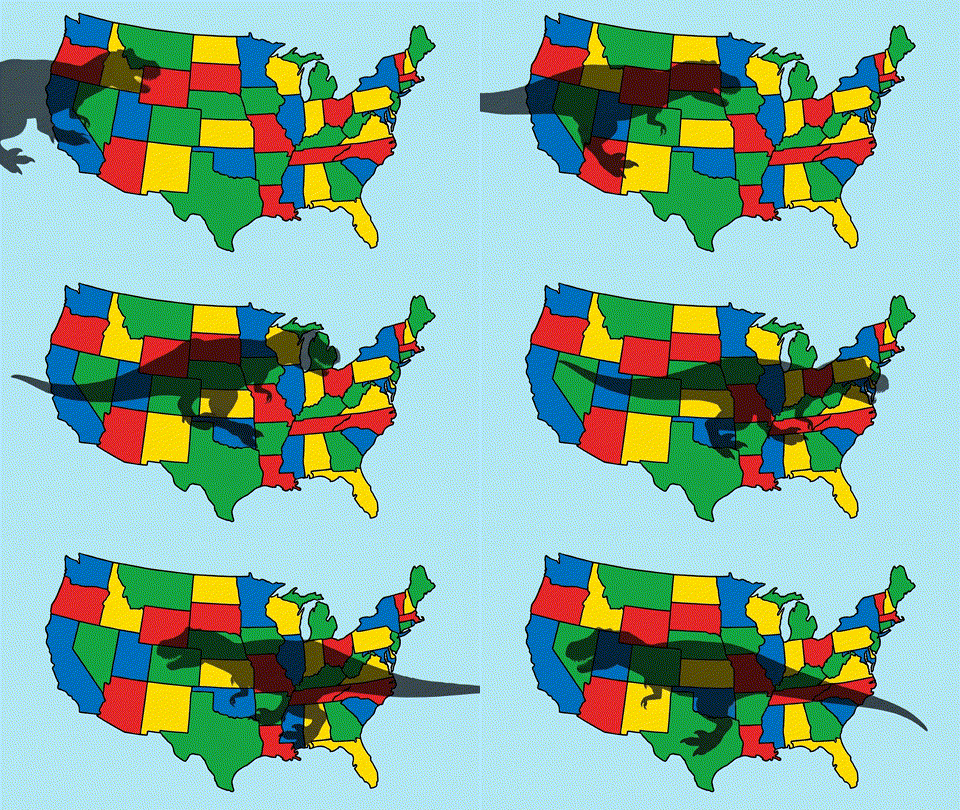
About 20 minutes into our conversation, we finally had a working song that wasn’t complete slop.
I ran the lyrics through Suno to see how it sounded with music.
It wasn't very interesting. Nothing to compel a kid to keep listening, and not much for visuals to grab onto. The educational architecture was solid, but it had no story.
Could we keep the same educational architecture but wrap it in a story?
Enter the dinosaur family road trip.
Me: I’m thinking it’s a little more story driven. So the states are more the chant that happens as they progress. But it’s more about the funny things that happens on a roadtrip for dinosaurs
Same route. Same state groupings. But now there’s a narrative layer: a family of dinosaurs squeezing into an RV, bickering in the backseat, stopping for bathroom breaks, Dad refusing to ask for directions.
"Are we there yet?" No.
"Are we there yet?" No!
"I gotta potty!"
We stopped five minutes ago!
The story layer solved a problem the straight version couldn’t: it gave kids a reason to care about what comes next.
A list of states is something you endure.
A dinosaur family discovering a road side attraction of extinct dinosaurs is something you want to hear again.
And every time you replay it, the states sink in a little deeper. That’s the whole trick of great educational content. The learning is the scaffolding. The story is what makes kids want to climb it.
A year ago, working with AI meant crafting prompts with context, and instructions, and examples to get the output you wanted.
That’s not what this is.
My conversation with Claude was about an hour of back and forth. Dozens of exchanges. I pushed back. Claude revised. I caught errors. Claude fixed them. I made suggestions. Claude integrated them.
(This was also days before Claude Opus 4.6 released, which has even more conversational abilities.)
We’re not just moving toward models that are better at following instructions. They’re better at collaboration. They can hold context across a long conversation. They can receive criticism and actually improve. They can be coached.
So while the slop creators are still relying on one-shot prompts, thinking they can shortcut the whole process and get it right in a single go, the rest of us are learning the conversation is where the work happens.
Especially when you know what good looks like so you can steer toward it.
If you’re using AI to create educational content, here’s my advice on how to put the human in the loop.
Force a goal decision early. If AI serves you a buffet, make a choice.
Fact-check everything. AI will confidently tell you Texas is a desert and that 35 is halfway to 50.
Kill the filler. If a line exists only to rhyme or fill space, cut it.
Ask “what would a child learn from this?” Not “does this sound nice?” but “what would a five-year-old take away?”
Trust your expertise. You know things the AI doesn’t. Your job is to keep asking questions until the AI’s output matches what you know to be true.
Don’t ship the first draft. Ever. The first draft is where slop comes from.
Claude can generate infinite options. But it still misses context. It doesn’t know that “heading forth” sounds ridiculous. It doesn’t notice when “halfway” is mathematically wrong.
The AI is a brilliant first-draft machine with no quality filter. The expert’s job is being the filter and coach.
💡 Want more from Dr. Carla?
Subscribe on YouTube to get all our latest Hippo Polka videos for kids. New in 2026, I’m also posting how-to videos on YouTube.
Follow me here on Substack and on LinkedIn for more articles like this.
Share your thoughts or questions directly with me at carla@hippopolka.com. I’d love to hear what’s working for your family (or what’s not!).
Together, we can make screen time joyful, educational, and so much less stressful.
Comments
Nothing yet. Say the first thing.
Sign in to join the conversation.