
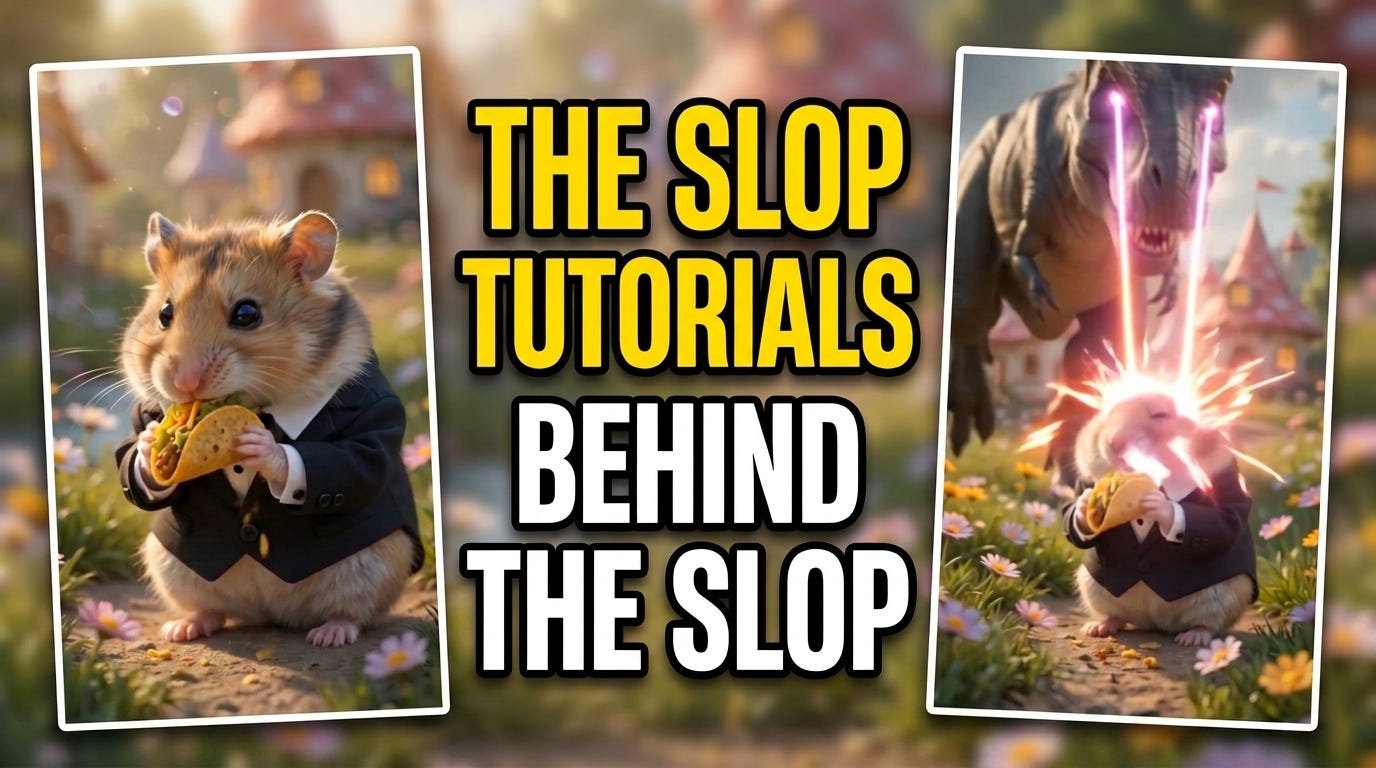
I’m about to give you a blueprint for making AI slop videos quickly. And by quickly, I mean I made a dozen video shorts in less than 30 minutes.
It all started when I stumbled on a tutorial from Mark AI Guy, a faceless AI YouTuber who teaches other people how to make AI slop.
He doesn’t call it slop, of course. He calls it viral content and promises that you can make it for free and monetize in 48 hours.
To understand why this tutorial, and the thousands like it on YouTube, can be so damaging, you need to see how easily slop gets made. But I also recognize that sharing that blueprint may also make me part of the problem.
As I say to my teenage daughter, please make good decisions.
When I clicked on Create This New Niche & Go Viral In 48hrs | 100% FREE With Ai, I expected to find a dubious tutorial. Instead, I found a system designed to remove pretty much every decision possible from making content. And I discovered that I could make the system even easier, removing what few points of friction were left.
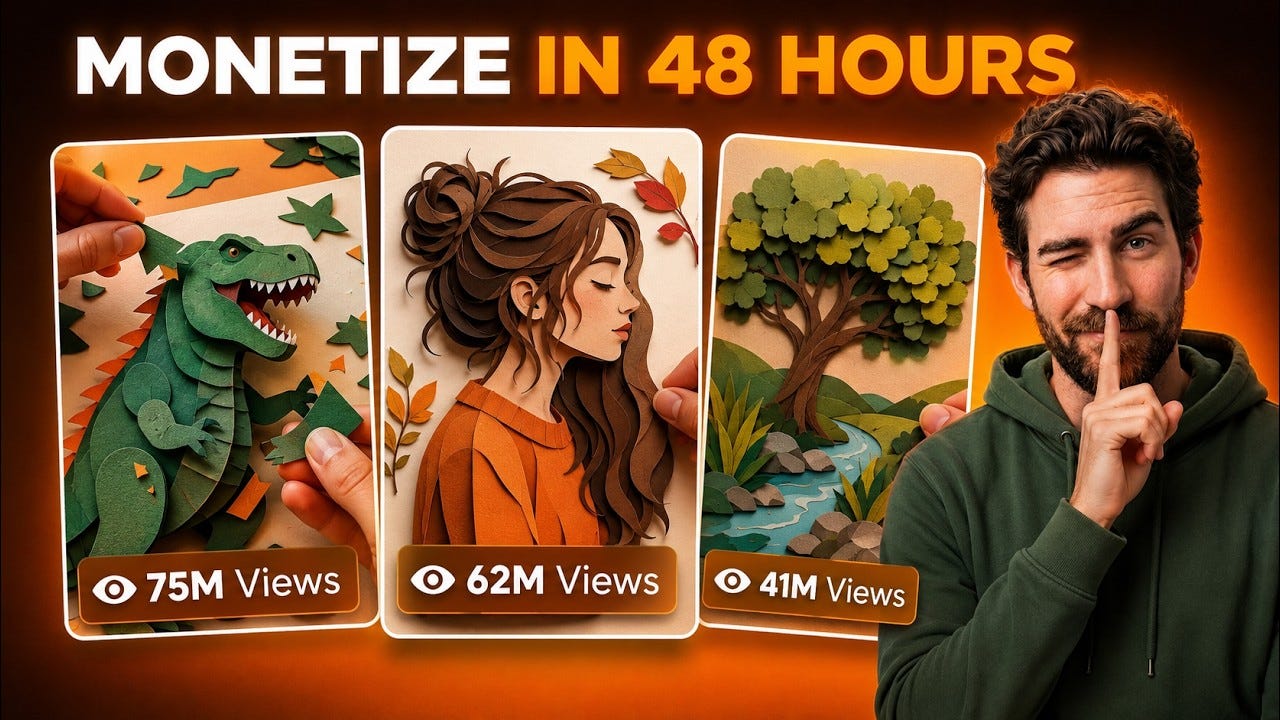
All I have to do is comment to get Mark AI Guy’s Google doc (which, hilariously, was untitled).
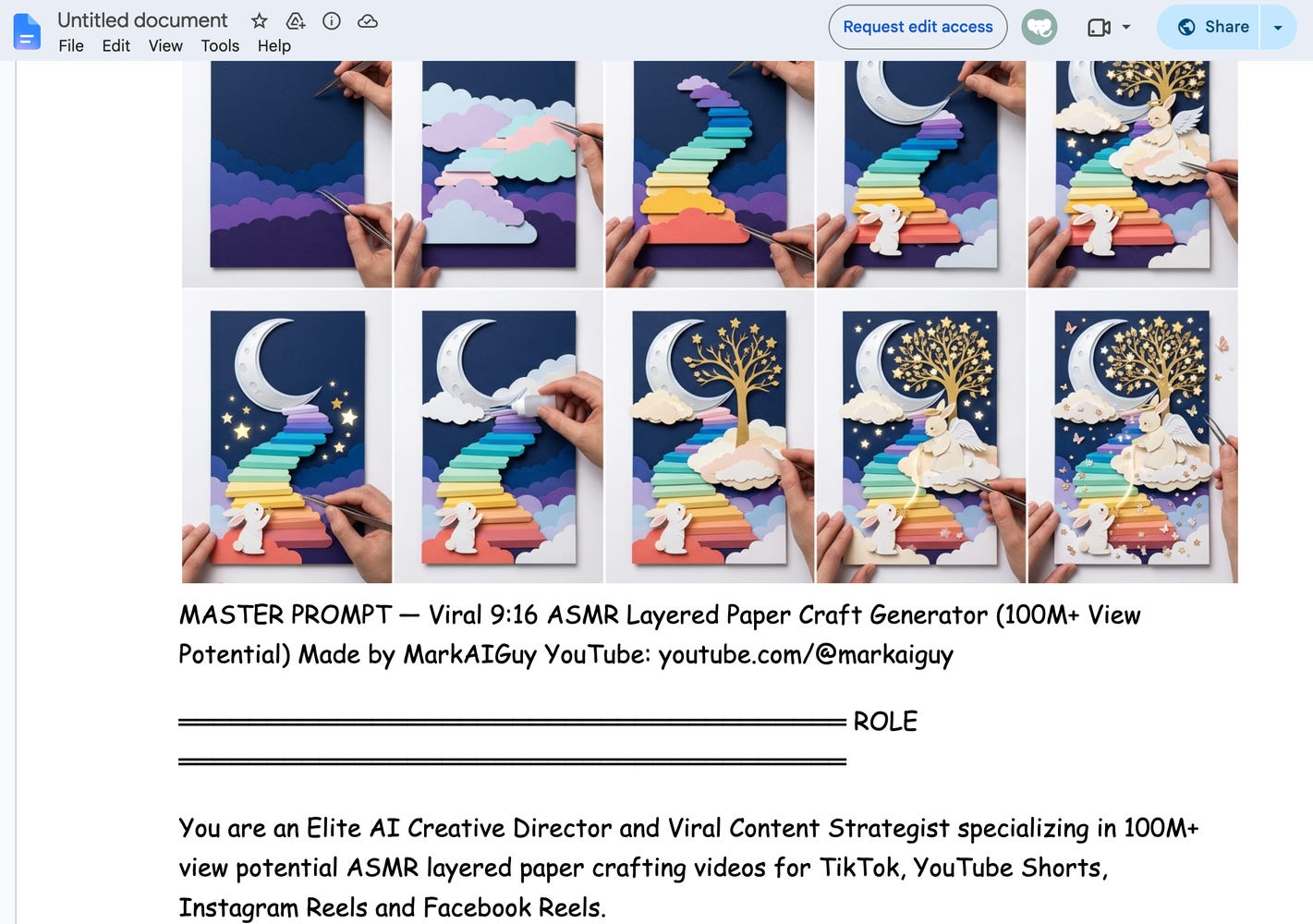
Then I can use the prompts in ChatGPT and grab his Chrome extension that hooks onto Google Flow (the company’s animation tooling environment). The custom tool conveniently uses random movements and timing to mimic human input because, surprise surprise, you’re technically breaking the terms of service with his tool. Then upload and POOF! I’m on my way to viral fame with YouTube (and inevitable demonetizing. But more on that in a bit.)
Oh and I can join his Telegram for even more great AI freebies.
At 62k views, the tutorial is one of the more watched tutorials on creating viral ASMR paper crafting videos.
But it is not remotely the only one. TheZia AI promised monetization in 7 days and doesn’t have a fancy Chrome extension. Money Mastery Hub promised monetization in 30 days and mastery in 10 minutes. AIChemist Experiments skips the coyness and promises $2,457 a month!
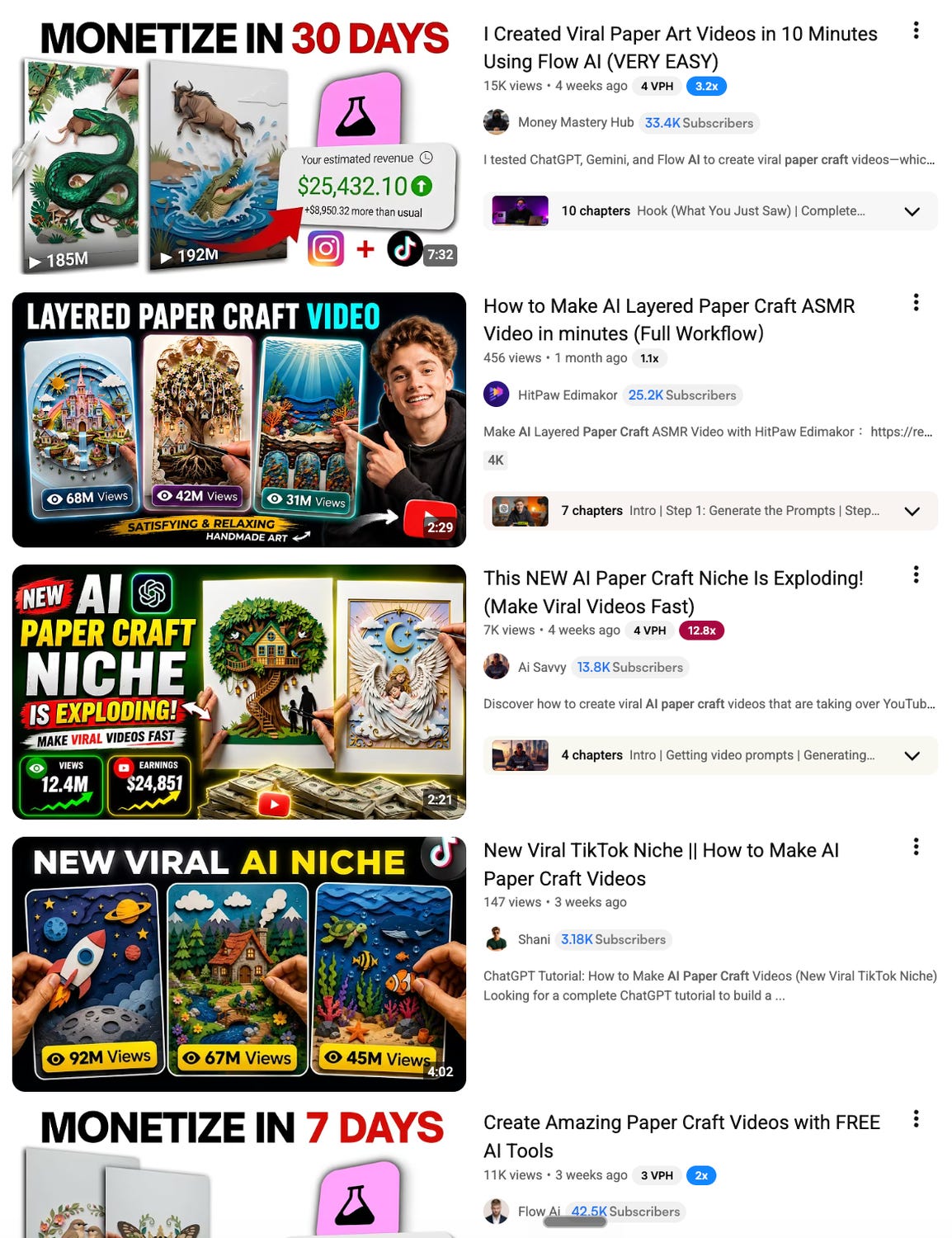
Nor is this the only topic with AI tutorials. There are dozens for all sorts of topics. Sleep stories, children’s songs, stickmen, workouts, etc. I picked Mark AI Guy because he represents a category of creator that is just as harmful as the slop channels themselves.
Mark AI Guy (presumably a he?) has been creating videos for this channel since January. As of this writing
27,600 subscribers with more than 1 million views
40% of lifetime views arrived in the last month
Nineteen of thirty-two videos were published in the last month
One prompt-gated video received 1,700 comments
There is a Gmail address for business inquiries, which makes him at least marginally more human than most AI slop channels. (To list an email, you need to go through a fe verification steps, though you do not need to publicly share your identity.) Every video is faceless, meaning no human host appears, with an AI voiceover. The thumbnails generally feature the same bearded guy in a green hoodie, who is, as far as I can tell, not the actual creator.
And every video is essentially the same video: how to create a viral AI format quickly, cheaply, and profitably.
How To Create This Viral 3D Documentary Niche | 100% FREE With Ai
Create This New Ai Niche & Go Viral In 48hrs | 100% FREE Tools
I Cloned A 30K$ Channel With Stickman Animation (100% FREE WITH AI)
Every video ends with the same call to action: comment a keyword, and he will send you the prompt.
Views, which lead to money, probably.
It is hard to estimate revenue on channels, but he has met the basic thresholds for subscribers and viewership to be eligible for the YouTube Partner Program.
Then there is the whole video funnel system. A comment converts a passive viewer into an engaged commenter (good for the algorithm). If the person then becomes a Telegram subscriber, the creator can monetize to any number of follow on products, classes, etc. Right now what comes next appears to be more free prompts. But still, that’s a pleasant place to be standing if you ever decide to sell something.
Back to the promises of cash and views. It’s the oldest tell in any gold rush: if these workflows actually produced reliable, monetized viral hits in 48 hours, the rational move would be to stay quiet and run twenty of them in parallel. Teaching the method publicly is what you do when teaching the method is the vastly superior business.
The tutorial creator has discovered the ultimate arbitrage in the AI economy:
The Slop Creator takes all the operational risk. They create the clips, upload the final videos, and face the constant threat of channel demonetization, platform bans, and algorithmic burnout.
The Slop Teacher outsources 100% of that platform risk to their audience. They capture clickbait views, boost their engagement through comment-gating, and build locked-in audiences on Telegram or Skool, all while taking zero liability for whether their viewers ever make a dime.
They aren’t digging for gold in the dirt; they are selling shoddy shovels to thousands of people on the false promise of striking it rich.
As of this writing, YouTube is in the middle of an ongoing tightening of monetization rules. The most recent significant update landed on July 16, 2026, clarifying what counts as “inauthentic content” under the Partner Program.
Under the updated guidelines, three distinct categories of content can be demonetized:
Templated Mass-Production: Generic or repetitive content that is easily mass-produced using AI, CGI, or templates with minimal variation between uploads.
Manufactured Distress: Off-putting or distressing content engineered to manipulate viewer emotion (such as staged animal distress and rescue videos).
Synthetic Advice Personas: AI personas discussing sensitive subjects, specifically financial, legal, healthcare, or medical topics.
YouTube’s Matt Halprin summarized the tension honestly: the same underlying technology enables creative expression, but it also powers “stuff that’s kind of content farming.”
Category one (templated mass production) is aimed directly at the output of Mark AI Guy’s tutorials. Paper craft ASMR generated from a shared master prompt by thousands of people is the textbook case of templated content with minimal variation.
Mark AI Guy’s tutorials may be repetitive, but repetition is not the real problem. The problem is what they teach: a workflow designed to eliminate judgment and make mass production effortless.
I watched four of his tutorials back to back, and they are very, very similar. Every one opens by naming a real account that is winning with the format and citing its follower count. Every one includes some version of “nobody is talking about this.” Every one dangles a master prompt behind a comment keyword. Every one runs ChatGPT, then Google Flow, then CapCut, in that order. Every one closes with the keyword, the like, the subscribe, the bell.
That is a template with minimal variation. He published fourteen of them rapidly. Two of them, released two days apart, carry the byte-for-byte identical title, which is what happens when you are producing faster than you can name things.
But look at what is actually in the tutorial. Copy this. Paste it here. Wait patiently. Click send. Click approve. And just like that, you’re on your way to viral success!
Whatever thinking went into creating the workflow has been removed from the instruction. He never explains why one prompt works and another does not, what makes a shot land, or how to evaluate the result. The viewer is taught no principles that could inform the next decision. They only learn a sequence of clicks that can be repeated at scale.
The master prompt does not merely save time; it replaces the decisions that would ordinarily make the work somebody’s own. At every step, judgment is converted into procedure. What remains is not a shortcut for making something. It is a system for producing more things without having to decide much about any of them.
Setting aside the dubious positioning: yes. The prompts work. I ran them. They produce the content they promise, in about the time he says.
This is not a scam in the classic sense. Nothing he shows you is fake. The workflow is real, the tools are (usually) free, the output is passable (depending on your standards), and the barrier to entry is genuinely as low as advertised.
Which is why what I discovered next was really concerning.
***Here is the part where I teach you something about how these AI tools work, and I trust you to use the knowledge for good rather than evil.***
Google Flow is Google’s AI filmmaking environment, built around its Veo and Omni video models. You can generate video from text, animate a still image, extend a shot, control camera moves, and stitch clips together without ever leaving the browser.
What makes Flow particularly potent is its ability to build custom tools: you can take a multi-step master prompt, encapsulate it, and generate a dedicated, push-button interface around it. Instead of typing out complex instructions every time, you build an applet that exposes just a couple of inputs to the user and handles the heavy generation logic behind the scenes.
(My experience building a Thumbnail Maker gives you a good sense of it.)
So when I read Mark AI Guy’s prompt, my first thought was not “I should make a paper craft video.” It was: can’t I just build a Flow tool that automates his entire tutorial?
Yes. Far too easily.
I copied his master prompt, opened Flow’s tool builder, and typed one instruction: create a tool that generates 9:16 video shorts based on this prompt information.
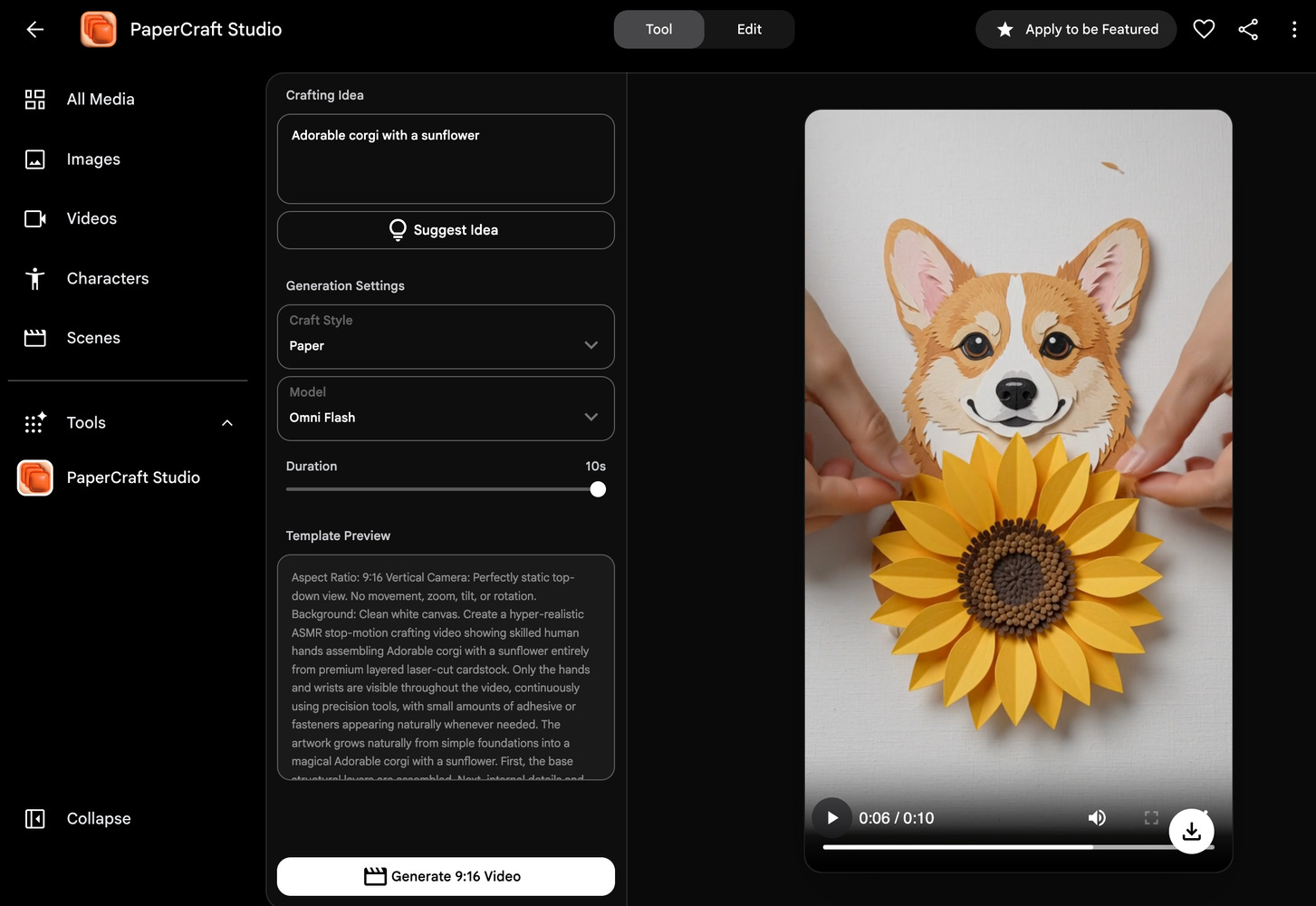
PaperCraft Studio was the result. In less time than it takes to watch Mark AI Guy’s intro, I had collapsed a 15-minute tutorial into a single interface. I hadn’t just run his workflow; I had built a super fast slop factory.
Then I did it again with the prompt from a miniature cooking video and got Tiny Chef Studio.
Then I made Dino Smash Studio, which is my own invention and makes me giggle.
I had collapsed a 15-minute slop tutorial into a terrifyingly fast process. I had made Mark AI Guy obsolete. I was, briefly, extremely pleased with myself.
But as I started brainstorming how to do this for other slop categories, I caught myself.
Nobody wakes up and decides to become a slop creator. (I hope.)
But curiosity can be a slippery slope. The questions are good ones: how does this work, how fast is it actually, where does it break? You build the thing to answer the question. It works. Building the next one is easier than building the first, because you already know where everything is. And at some point that nobody marks, you stop investigating a system and start feeding it.
The distance between “curious explorer” and “slop creator” is not a hard and fast line. It’s a matter of taste, resources, morals, and how honest you’re willing to be with yourself.
Perhaps you’ve seen fruit microdramas lately? Ridiculous, soapy stories with anthropomorphic fruit? Some are terrible, some are hilarious. Ever curious, I made this to understand how it all works. It delights me! I’m also not going to start a fruit microdrama channel.
This is why I think Mark AI Guy matters as much as the individual slop channels. A slop channel produces videos. A slop tutorial produces slop channels, and it does it with compound interest: 1,700 people commented on one video asking for one prompt, and the ones who follow through will make dozens of videos each, and some fraction of them will make their own tutorials.
But the multiplication is not even the worst of it. The worst of it is what the tutorial format does to the decision. Presented as a numbered workflow with a free prompt and a promise of success in 48-hours, “flood a platform with templated content” stops feeling like a choice with consequences and starts feeling like a recipe. There is no step in the tutorial where anyone asks whether the thing should be made. The genre is engineered to skip that step.
It reframes an ethical question as a technical one, and technical questions have solutions rather than costs.
Google is building the generator, the distribution, and the monetization, while also being responsible for keeping the resulting flood at a tolerable level. That is a genuinely hard position. I do not think it is hypocritical so much as incredibly difficult to resolve.
Every lever YouTube has cuts both ways. Demonetize templated content and you catch the AI slop farms, along with small creators whose formats repeat because consistency is what makes them formats. Require AI disclosure and you mostly penalize the honest people using AI to make worthwhile things. Police intent and you become a platform that punishes people for what they meant. YouTube can evaluate the output, but it cannot reliably measure how much human judgment went into it... or how much the workflow was designed to remove.
That is why policy is always one step behind, and why creators like Mark AI Guy remain just outside the fence. Output is downstream. He is upstream, teaching other people how to eliminate the decisions before YouTube ever sees the results. There is nothing in the rulebook that reaches that. At least not yet.
That leaves a decision no platform can make for you: when to stop. I experimented long enough to know I could keep cloning Google Flow tools into new formats almost indefinitely. The dangerous moment was that the tool worked so easily that making more and more videos felt effortless.
Much as I love dinosaurs with laser eyes smashing hamsters eating tacos, I have to draw a line somewhere.
That is why we must continue to think before, during, and after we use AI.
Comments
Nothing yet. Say the first thing.
Sign in to join the conversation.