

Platforms are finally trying to put up guardrails against slop.
YouTube announced changes to its Partner Program to choke off automated view farms by doubling view hour requirements, while Suno announced new download limits intended to make it harder for bad actors to mass-export music to streaming services. Spotify has separately introduced a spam filter targeting mass uploads, duplicates, SEO manipulation, and other tactics increasingly enabled by generative AI. The message seems clear: stop flooding the feed with machine-generated noise.
Meanwhile, I fell down the rabbit hole of slop-creation tutorials on YouTube. And because I can’t help myself, I then built a tool that automates their entire pipeline, generating brain-melting children’s media even faster than the gurus teach you to do it. It’s all in the article.
Despite the platform policy changes, YouTube remains delightfully, terrifyingly full of unchecked AI slop.
The defining feature of AI slop is not that it was made with AI. It is that every creative decision has been subordinated to scale, retention, and search traffic.
It’s been a minute since my last roundup, so we’re bringing back the train-wreck of a series with a fitting new name: AI-AI-Oh-No-No-No.
Nothing says “beginner English listening practice” quite like a birthday party clown kidnapping a little girl into an abandoned warehouse.
At first glance, this video claims to be a “Slow English Listening Story” for early language learners. The actual experience is a 46-minute marathon of AI-generated animated skits that blend Pixar-style visuals, over-articulated dialogue, and melodramatic stranger-danger thrillers into a stream of digital noise.
The plot escalates into a crime drama: a circus clown lures a little girl named Lily away from a party with a giant ice cream cone. Her brother Henry finds melted ice cream on the sidewalk, activates his smartwatch GPS, and leaves a trail of cookie crumbs through the woods while calling his parents in a panic. The parents notify the police, who raid an abandoned warehouse, draw firearms on the clown, and place him under arrest for felony kidnapping.
Once the kidnapping arc resolves with a sofa lecture on stranger danger, the video seamlessly transitions into an endless cycle of short, AI-generated behavioral scenarios:
The Supermarket Rules: The children run wild in a grocery store, ride carts, pop open unpaid boxes of cookies, tear apart action figures, poke raw meat with dirty fingers, and open freezer doors for fun, while the parents repeatedly lecture them on respecting public property and paying for damage.
The Lost in the Mall Trap: The kids run off to the toy aisle, knock over shelves, flee an angry store clerk, get lost in dark corridors, and almost walk away with another shady stranger offering chocolate bars until a security guard intervenes.
The Scout Camp Rules: A talking bear in scout gear teaches Henry about politeness after Henry rejects a handmade cardboard robot gift in favor of a giant toy airplane.
The Financial Literacy Lesson: The kids learn the difference between needs and wants at a farmer’s market before spending a month saving coins in piggy banks to buy a wooden car and a coloring book.
Family Life English routinely publishes 40-to-50-minute compilations of AI animation paired with unnaturally slow voiceovers and titles targeting English-learning searches. By stitching dozens of behavioral skits into a single upload, the channel turns basic vocabulary practice into a watch-time machine. This video alone has attracted more than 830,000 views.
It is a classic example of “educational compliance slop.” It uses the shield of English language learning and moral lessons to pass as benign content, but wraps those lessons in bizarrely intense AI melodramas designed to keep viewers glued to a screen for nearly an hour at a time.
The “educational” premise is the alphabet. The actual lesson is that every problem, from bee stings to imprisonment inside a beehive, can be solved with a sufficiently large hammer.
Pre-literate toddlers may not understand the phonics, but they do not need to. The video grabs their attention with an animal in obvious distress, then delivers a fast, violent resolution: swollen faces, frantic crying, buzzing bees, and finally something getting smashed. It is less an alphabet lesson than an attention-harvesting loop wearing an educational-media name tag.
Then it repeats the same formula for all 26 letters:
The Swollen Victim: An AI-rendered animal appears with grotesquely inflated cheeks, crying as bees swarm around its head.
The Hammer-Wielding Savior: A second animal arrives carrying a wooden sledgehammer roughly the size of a telephone pole. No first aid. No adult supervision. Just blunt-force problem-solving.
The Hive Smash: The rescuer demolishes a giant beehive, releasing the animal inexplicably trapped inside. Why are animals being imprisoned in alphabetically coordinated hives? The curriculum does not elaborate.
The Mixed Message: A cheerful voice sings about “love, kindness, and harmony” while honey and wood splinters explode across the screen.
The commitment to the premise is impressive. A dolphin stands upright on dry land to swing a heavy wooden mallet. By the letter S, a snake, an animal with no arms or hands, somehow grips and operates a sledgehammer.
The video was uploaded 10 months ago and has accumulated 2.9 million views. It is still being watched, although Gon Gon Edu has stopped posting. Happily, this particular lesson appears to be over.
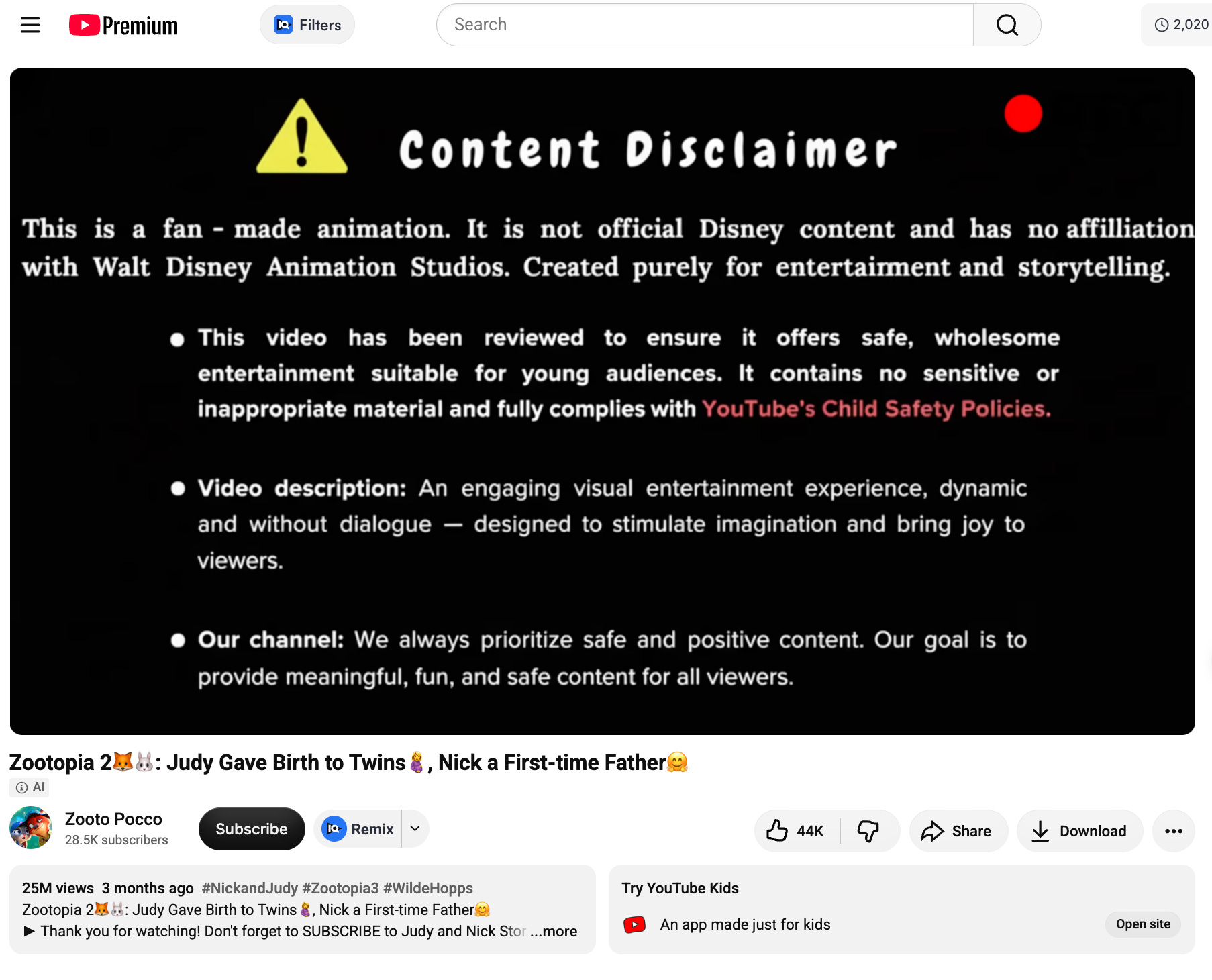
This is a generative AI soap opera built from Disney’s copyrighted characters and disguised as fan entertainment. The actual lesson is that if you put a text-heavy legal disclaimer on screen for a split second, you can spend the next ten minutes feeding Disney characters into a generative image pipeline and printing 25 million views.
Before the video begins, a warning screen appears just long enough to be missed. Pause on it and you will find assurances that the fan-made animation “fully complies with YouTube’s Child Safety Policies” and provides a “safe, wholesome environment suitable for young audiences.”
Then, it immediately launches into a bizarre, hallucinated fever dream:
The Disney IP Hijack: AI-rendered models of Judy Hopps and Nick Wilde from Zootopia appear in a series of rapidly stitched, semi-animated stills. Judy is pregnant with twins. Nick is panicking in a grocery aisle.
The Alien Plot Twist: Midway through the hospital rush, a UFO lands in downtown Zootopia. A glowing blue alien couple emerges. Naturally, the alien mother goes into labor at the exact same time as Judy, leading to a joint delivery room scene where Nick and an alien father bond in the hallway.
The Multiverse Time-Jump: Just when you think the story has settled, the video abruptly resets into caveman Stone Age, followed by a corporate office job interview drama where Nick and Judy apply for corporate roles under Gazelle.
The Audio Mask: Beneath the surreal visual chaos plays an impossibly upbeat, generic AI synth-pop ballad with auto-tuned vocals singing endless refrains about “love, family, and working together hand in hand.”
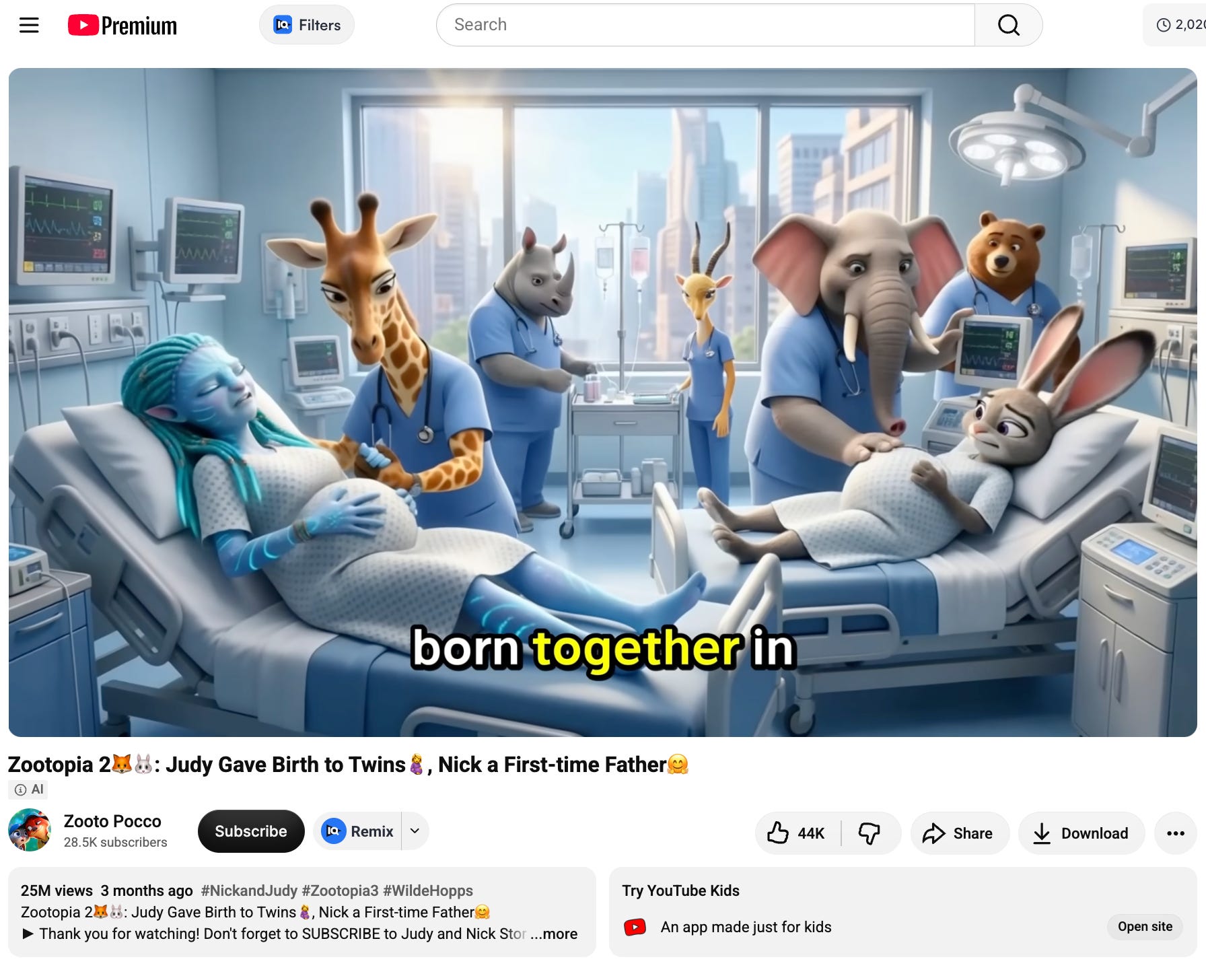
Uploaded four months ago by Zooto Pocco, this single video has racked up a staggering 25 million views. Whatever its intended purpose, the disclaimer functions less like useful guidance for parents than a preemptive shield for a view-farming pipeline built from Disney characters.
This isn’t an isolated upload. The channel is a hyper-focused content farm built on one specific engine: churning out mass-produced Zootopia fan fiction. A quick scan of their library reveals a small handful of long-form videos, all following the exact same prompt template. Nick and Judy getting married, going into labor, adopting alien babies, or traveling through time.
Not all AI slop relies on violence or sensory overload. Some of it arrives in soft light with a lullaby.
In a video from Story Rhymes Kids, a golden retriever walks through a sunlit forest and repeatedly discovers baby animals in mild distress. It nudges a twig or approaches the trapped animal, the problem instantly disappears, and the rescued creature joins an expanding parade. The sequence repeats with a rabbit, duck, fox, panda, koala, and fawn.
Nothing disturbing happens. That is the point. There is no dialogue, vocabulary, meaningful problem-solving, or cause and effect beyond “puppy approaches, problem disappears.” It borrows the visual language of a children’s story while asking nothing of the child watching it. The puppy keeps walking. The animals keep following. The view counter keeps ticking upward.
Welcome to the activewear division of AI slop: automated health and wellness content built around a suspiciously familiar character.
“Little Rumi’s Flexibility Flow” claims to be a fun, full-body yoga routine designed to get young children stretching and moving, especially those fans of KPop Demon Hunters. The actual video is an eight-minute carousel of static, AI-generated images of a CGI girl holding contorted, biologically impossible poses while a 20-second timer counts down.
This isn’t an instructor teaching kids how to move safely. It is an image-generation pipeline masquerading as a fitness routine:
Anatomical Hallucinations: The featured character, “Rumi,” is presented in complex advanced poses that defy basic human physics. In several slides, her hips, spine, and knees twist in directions that would require medical intervention. For the “One-Hand Split Handstand,” her arm rests on the mat while her legs and torso float in a completely detached, gravity-defying plane.
Zero Instructional Guidance: A real kids’ yoga video breaks down how to enter a pose safely, where to place your feet, and how to protect your joints. Here, the video simply cuts from one static, fully-contorted AI render to the next with zero transition or physical explanation.
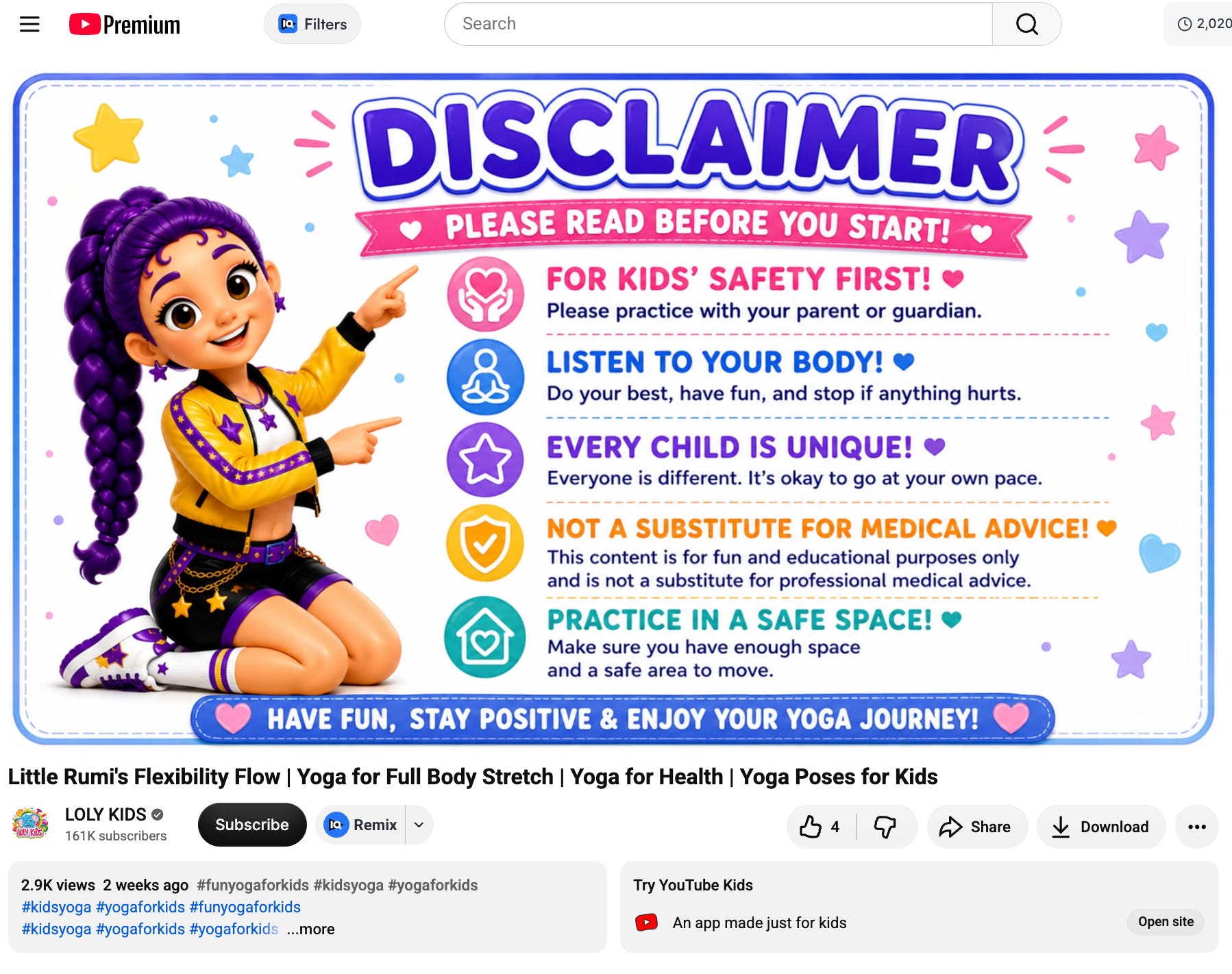
The Medical Disclaimer Shield: Just like our Zootopia specimen, the video opens with a busy text graphic assuring parents that this content is “for fun and educational purposes” and “not a substitute for medical advice.” It urges kids to “listen to your body,” while displaying visuals of a digital puppet doing pretzel acrobatics that no toddler should ever attempt.
The Assembly Line: This is classic “template-recycling.” The creator generated 15-20 static AI poses of a single character model, dropped a stock countdown timer in the top corner of each image, and paired it with a looping AI-generated song.
It carries the “LOLY KIDS” hallmark: zero human instruction, zero developmental grounding, and a complete reliance on bright visuals and health-adjacent keywords to capture algorithmic search traffic from parents searching for “kids yoga.”
Then there is BST Kids Indonesia, where a school bus full of toddlers flees an Indominus rex through a collapsing city to an Indonesian cover of “Wheels on the Bus.” The children fight back with slime grenades and squirt guns while a monkey crashes a motorcycle, a bear is dragged by the dinosaur’s tail, and buildings crumble around them. It is a nursery-rhyme singalong assembled from familiar toddler characters, a high-fidelity dinosaur asset, and maximum urban destruction. The result has attracted more than 500,000 views.
Here’s a clip of Indominus Rex while set to “Wheels on the Bus.” (This channel has blocked embedding.)
It’s not all bad news.
If you are going to let AI content into your household, this is what thoughtful execution actually looks like.
Published by the Japanese channel Mokka Chan, “A Day Working at a Fried Rice Shop” follows Mokka, an adorable AI-rendered kitten wearing a tiny chef’s uniform, as she goes through a complete, cozy workday routine: waking up, washing her paws, commuting through a quiet city, prepping ingredients, cooking omurice, taking an employee lunch break, and washing dishes at closing time.
While it is entirely synthetic, it sits in a completely different category from algorithmic slop. Here is why it works:
Intentional Craft and Consistency: Instead of hallucinating floating limbs or switching character models every three seconds, the creators maintained remarkable character visual consistency. Mokka’s tiny chef outfit, apron, and facial features remain stable across complex motion sequences like whisking eggs, chopping green onions, and flipping an omurice omelet.
Cozy ASMR Pace: The audio design avoids chaotic synth-pop screams or hyperactive sound effects. It relies on soothing ambient sound effects: sizzling woks, running water, gentle chopping, and quiet Japanese subtitles with a mellow background acoustic score.
Relatable Life Routines: The narrative follows a clean, grounded human routine rather than relying on shock triggers like swollen faces, sledgehammers, or alien hospital deliveries. It models gentle habits: washing up before work, taking orders politely, working hard, eating a meal, cleaning up your workspace, and getting a good night’s sleep.
The Palate Cleanser: With over 215,000 views, Mokka Chan represents the “Cozy Slice of Life” tier of AI media. It proves that generative video tools do not have to be used to build brain-melting retention traps. When a creator applies actual artistic intent, narrative pacing, and care to the pipeline, AI can be used to create warm, calming digital storybooks that parents do not have to immediately block.
The video follows Shiromaru-kun, a round, felt-textured blob, as he wakes up, packs a bento box with tamagoyaki, octopus-cut sausages, karaage, and onigiri, puts on a tiny backpack, and strolls through a riverbank lined with blooming cherry blossoms to enjoy a picnic under the falling petals.
Here is why this piece stands out as a genuine palate cleanser:
Textural Fidelity and Tactile Craft: The visual style mimics needle-felted wool and stop-motion animation. You can see individual fibers on the character’s body, subtle felt physics as he rolls omelets with chopsticks, and carefully styled miniature Japanese apartment interiors.
Masterful Foley and ASMR Design: There are no frantic pop tracks or hyperactive sound effects. The audio relies entirely on crisp, comforting ASMR sound design: the crack of an egg, the gentle sizzle of sausages in a pan, the crinkle of plastic wrap, footsteps on wooden floorboards, and gentle acoustic guitar music paired with natural outdoor ambient sounds.
Grounded Cultural Rituals: Rather than relying on absurd shock loops, the story highlights thoughtful daily routines: preparing food with care, wrapping a bento box in a traditional furoshiki cloth, filling a thermos with tea, and quietly resting under cherry blossoms after eating.
The Counter-Metric to Slop: With over 3.1 million views, Shiromaru-kun proves that high retention does not require shock tactics, screaming voiceovers, or aggressive algorithms. When human creators use digital tools to construct warm, high-craft stop-motion stories with intentional pacing, kids stay engaged through genuine wonder rather than dopamine exploitation.
Tightening monetization rules might slow down the absolute lowest-tier spam channels, but as long as algorithms prioritize raw screen time, high-volume noise isn’t going anywhere.
The real takeaway here isn’t that AI tech is inherently bad for kids’ media. It’s that software is secondary to human care. When creators focus on craft and genuine storytelling, generative tech can produce peaceful, cozy art. When they optimize purely for retention, you end up with alien labor rooms and slime grenades.
Have you spotted any wildly bizarre (or surprisingly wonderful) AI creations in your feeds lately? Reply and send them my way for the next edition of AI-AI-Oh No No No.
Comments
Nothing yet. Say the first thing.
Sign in to join the conversation.