
I’ve been trying to get ahead of my writing, but have admittedly been going on many different tangents. I suppose this has always been my way, ever since I started writing about my life online. On my LiveJournal account(s), I’d post multiple times in one day, whenever a new thought or feeling struck me. Perhaps not quite as the short-form format of Twitter used to facilitate, but there would be days where I’d post maybe five times a day and then disappear for a couple of days, even though I was in high school and didn’t really do much outside of class.
In early college, I was on Tumblr, which really began this sort of nature of having a thought, reblogging it, and then discarding it immediately. I would file Tumblr posts under vague tags like #remember this and not-so-vague ones like #my wife (my tag for Kristen Stewart). Anyway, my point is that now this sort of letter is a consolidation of some of my thoughts and feelings throughout an unspecified length of time, and will go on for as long as the trains of thought coalesce into something that feels reasonable. Substantial.
My husband, Mark, and I have a very casual attitude towards film programming, which is surprising because he loves movies. Although, perhaps, what made me feel really safe regarding my decidedly selective tastes (less “auteur” and more “stuff that reminds me of a simpler time in my life”) is because there is never any judgment and also an occasional relenting to watch dystopian young adult adaptations. Sometimes, there’s even mutual enjoyment.
I’ve been trying to find the middle ground between his love for Kathryn Bigelow’s 90s psychosexual thrillers and my love for Torrance Shipman and 90s nostalgia-bait, and one of my picks for movie time was Election. I’ve been begging him to see it with me for ages, but for some reason, he just wouldn’t say yes. Not until I kept “joking” about wanting to watch Twilight again. Long story short, we both enjoyed it, and I was right.
But also, about a week after we had seen it, I asked him who the worst character was. Before I let him answer, I said that it was Matthew Broderick’s Jim McAllister. If you’re unfamiliar with Election, stop reading now and scroll down. If you have seen it and don’t care about spoilers (for a film from 1999), please indulge me.
Spoilers begin now. You have been warned.
Essentially, Election is about one for the student body president of George Washington Carver High School. Reese Witherspoon magnificently plays the quintessential overachieving kiss-ass, Tracy Enid Flick, who begins the film as a shoe-in for president, mainly because, thus far, she had been running unopposed. Jim McAllister, or Mr. M, is a social studies teacher who is simply just irritated by her entire being. You know that trope of a teacher looking derisively at a student who is not only smart and actually does the work, but is keenly participating? Mr. M has that perpetual attitude towards Tracy, because she’s “too” engaged. But, also, we find out that Tracy was involved with one of Jim’s friends, Dave Novotny — a math teacher — who ended up getting fired from his job (which is like, the bare minimum, truly) and then divorced by his postpartum wife, Linda. Dave had to move back in with his parents out of state, and Mr. M has hated Tracy’s guts ever since.
Which, to me, is weird because a) you’re an adult, b) she’s pretty much a child, and c) YOUR FRIEND WAS BANGING HER AND TELLING YOU ABOUT IT.
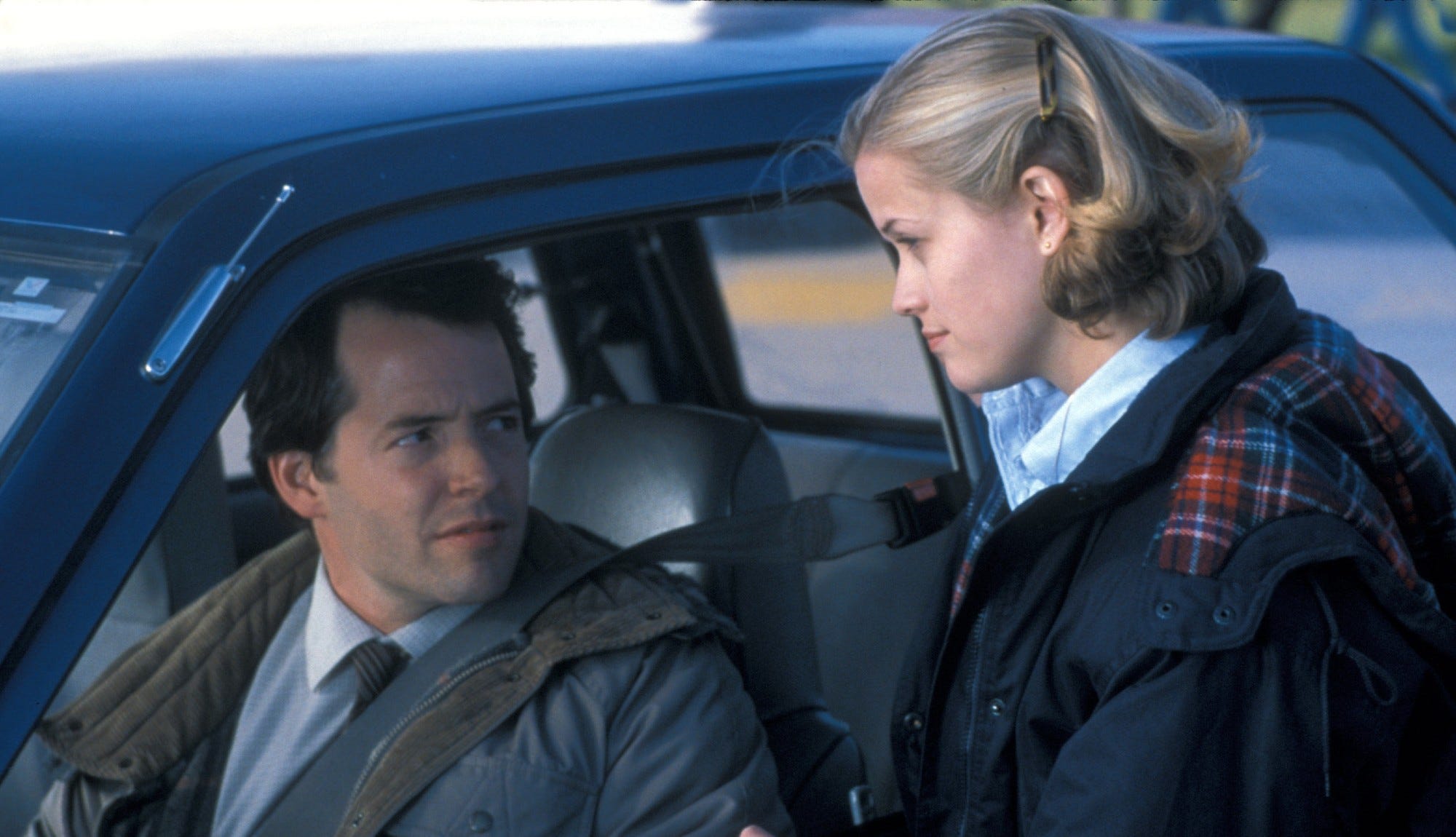
The whole film is about how Mr. M sabotages Tracy’s run for high school president by convincing injured football hero, Paul Metzler (played by, to my mind, a Keanu-esque Chris Klein), to run against Tracy because he’s so sad about his thwarted football plans. Mr. M makes him feel like he student body president is Paul’s new purpose in life. To a high school student, Paul is probably a more palatable candidate. He’s popular, but he’s nice. He’s not too smart, but who cares? He’s fun.
As if that weren’t enough, some internal drama within the Metzler family (a bizarre love triangle if there ever was one) adds another candidate to the presidential slate: Paul’s sister, Tammy (played by Jessica Campbell, RIP), who runs against Paul out of spite for unintentionally stealing her secret girlfriend, Lisa, who then also signs up as Paul’s campaign manager. This turn of events lowers Tracy’s chances for the seat from 100% to 33.33%.
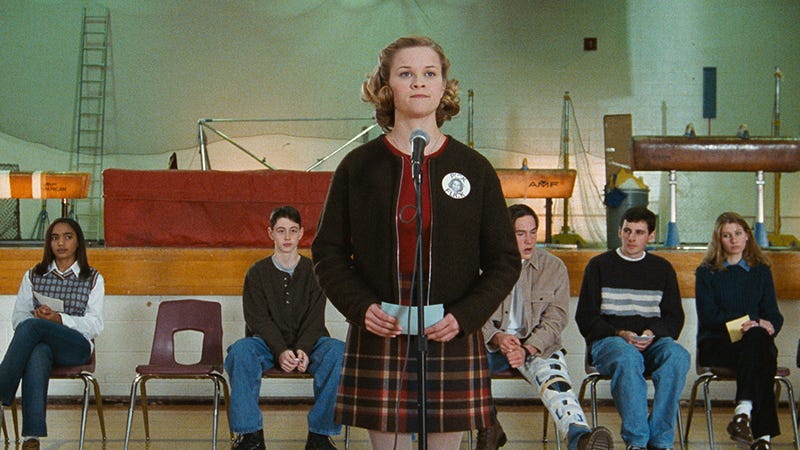
And I remember spending my entire childhood thinking of just how annoying Tracy is and how funny it was that Ferris Bueller is going through such great lengths just to see her lose. However, the 37-year-old me is looking back at Election in absolute horror that a teacher who has lessons on ethics and morals is doing all of this to someone who is just very driven and involved. No one else wanted the job in the first place.
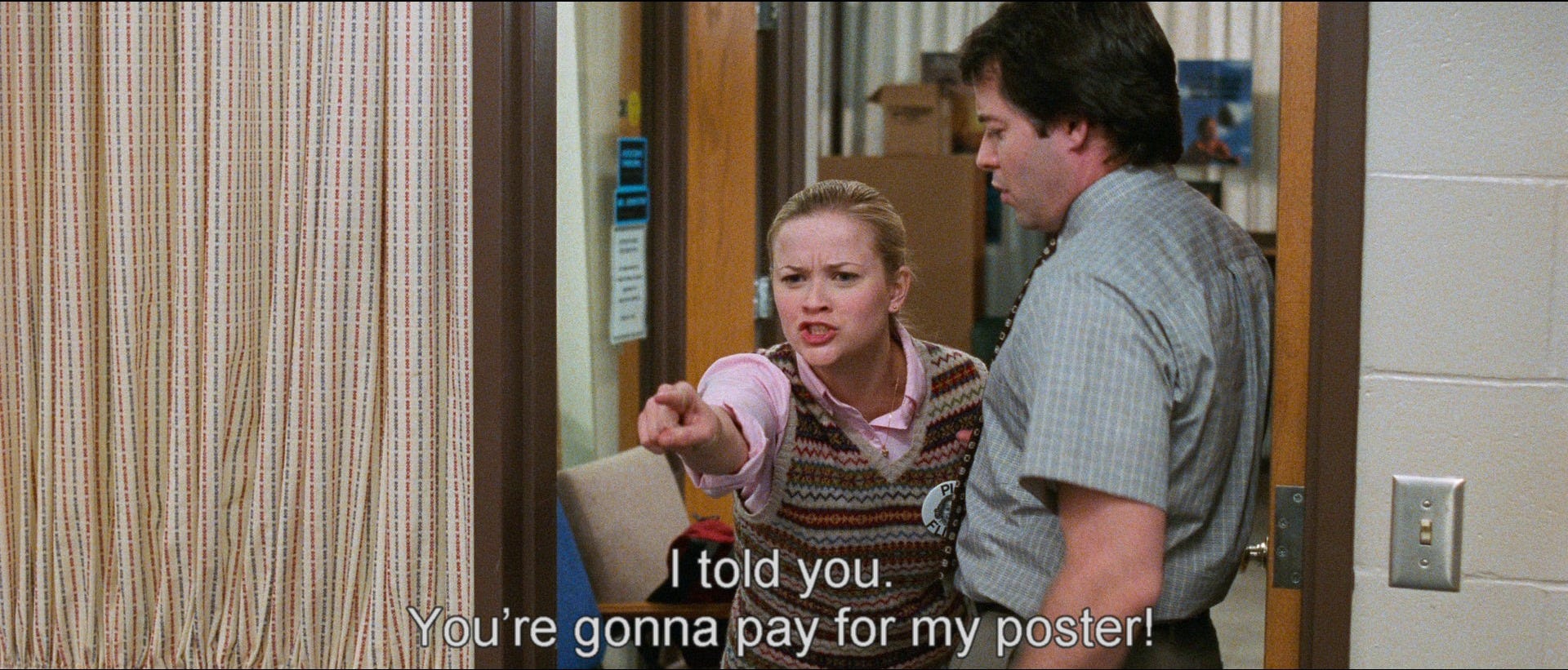
Tracy Flick was painted to be the villain of the story because she’s insufferable and tries too hard and because she’s particular. And, sure, she also did a proto-Mean Girls red herring sabotage move, where she accidentally damages a campaign poster and then proceeds to tear down everyone’s in a fit of rage, including her own, to throw investigators off her scent, of course. Mr. M is suspicious because no one else was at scene of the crime. Tracy was only there late one weekend evening to work on extracurriculars, because of course she was.
But — and I don’t even remember being bothered by this too much when I was watching it as a young person — her math teacher was fooling around with her (making her crouch down in his car on the drive up to his house that he shared with his wife and infant son) and wrote her declarations of love that incriminated himself. She didn’t even press charges, you know? All this time, Mr. M knew about all of it because his gross middle-aged friend would talk about their sexual activity so obscenely, and he didn’t report his friend.
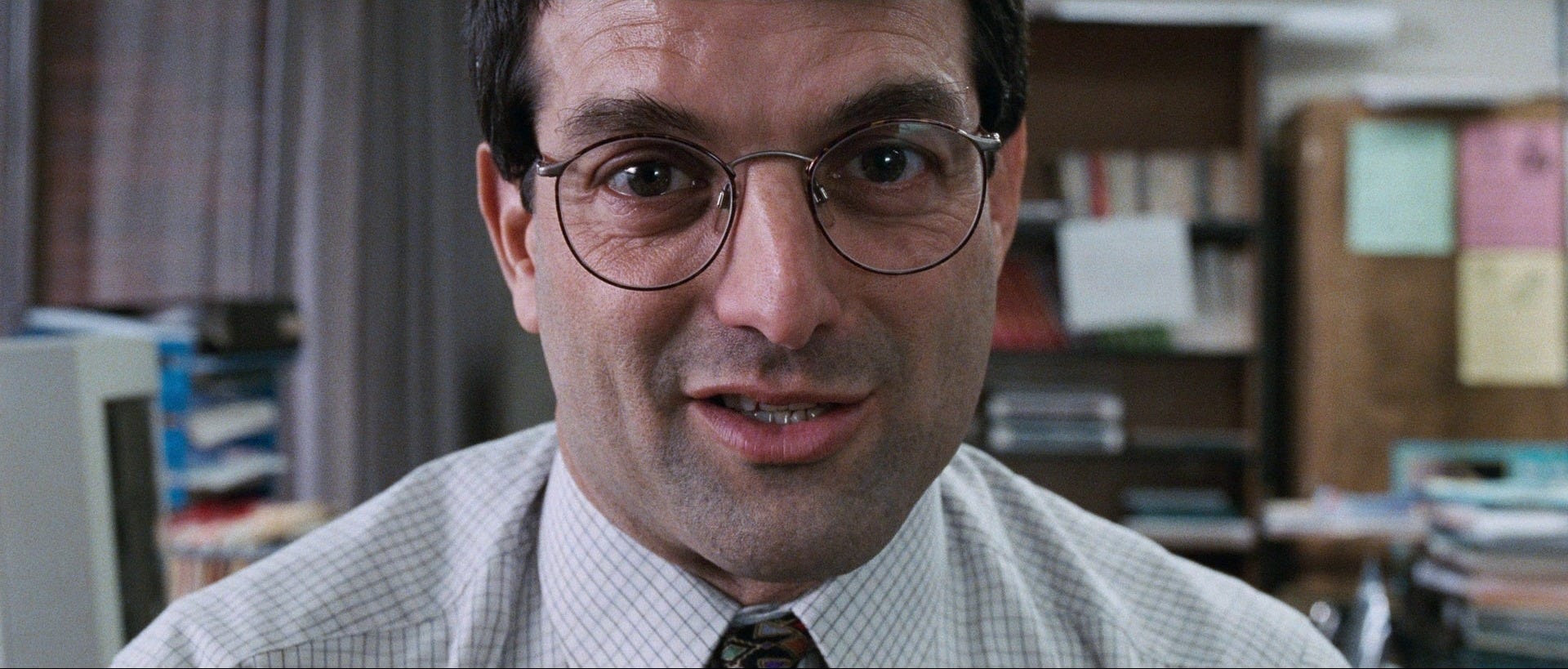
All of this fucked up stuff happened even before the election chicanery, and he didn’t even stop there.
Because despite all of his meddling, Tracy still won. AND HE DUMPED TWO OF HER VOTES SO PAUL WOULD WIN. Like, get a life, Mr. M.
(Granted, Paul voted for Tracy because he didn’t want to vote for himself, but that would have just evened out their votes.)
Mr. M can’t even do a good job of electoral fraud, and the poll workers, who are pretty much future Tracies, did a little sleuthing and exposed the hidden votes tucked in his waste basket (helped by the janitor who Mr. M has also unknowingly slighted). Meanwhile, he still found the time to invite his ex-friend’s wife, Linda, who’s also friends with his own wife, Diane, to a motel in the middle of a school day, even though she’s going through a rough divorce (from, again, his ex-friend!) and navigating single parenthood. Did I mention that he also had visions of both Linda and Tracy while having sex with his wife, with whom he was trying to conceive a child?
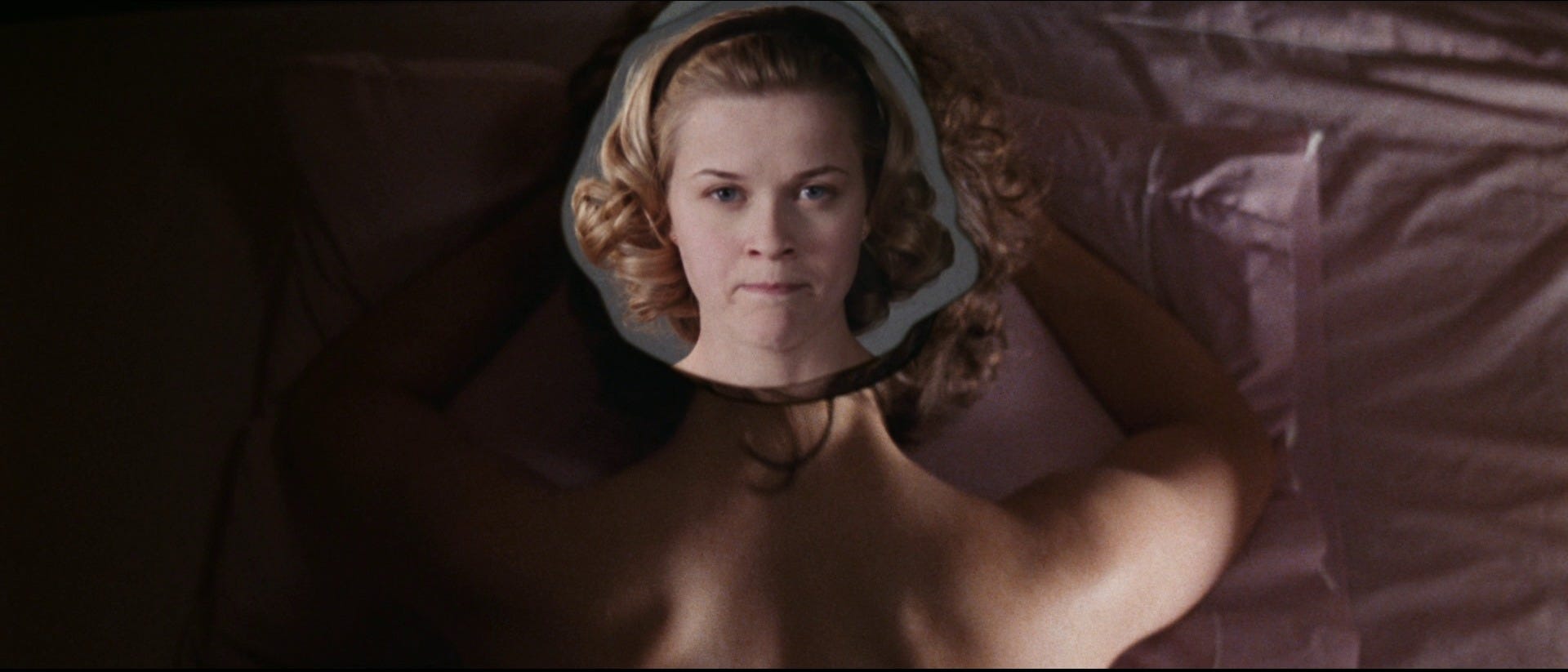
I don’t know if all of this was evident to everyone else who watched it at the same time I did, but I was about 11 when it came out, and all I thought then was that Election was really funny, and that Tracy was annoying, and that her plans of being president deserved to be thwarted by this married, adult man. Did I find it weird that he was meddling this hard for a high school election? Not really. I wasn’t even in high school yet.
All this to say that Tracy Flick was unfairly villainised. It’s possible that that wasn’t the intention of director Alexander Payne and the original novel’s author, Tom Perrotta, but Tracy Flick was (is?) widely considered a villain. I looked through pages and pages of commentary and all I kept seeing were lists where she’s named one, comparisons to actual female politicians (not in a flattering way), and even Reddit threads from a year ago, where a user says, “Can you explain how he’s ‘sad, pathetic, and sexist’? I’m not saying he was a perfect character by any means, but we’re making it sound like he’s the villain.”
Um, he is the villain, my guy.
Apparently, in the 2010s, her character was rethought in the wake of Me Too, pretty much reframing her as… not exactly the victim, but certainly not the villain. (Here’s a link to an NYT article, in case you need more convincing. )
And even if you still thought that she was, her villainy is a hundred percent dwarfed by Jim McAllister’s. And his friend, Dave’s. At most, her crimes were relentless perfectionism and also being a girl in high school. What are these men’s excuses?
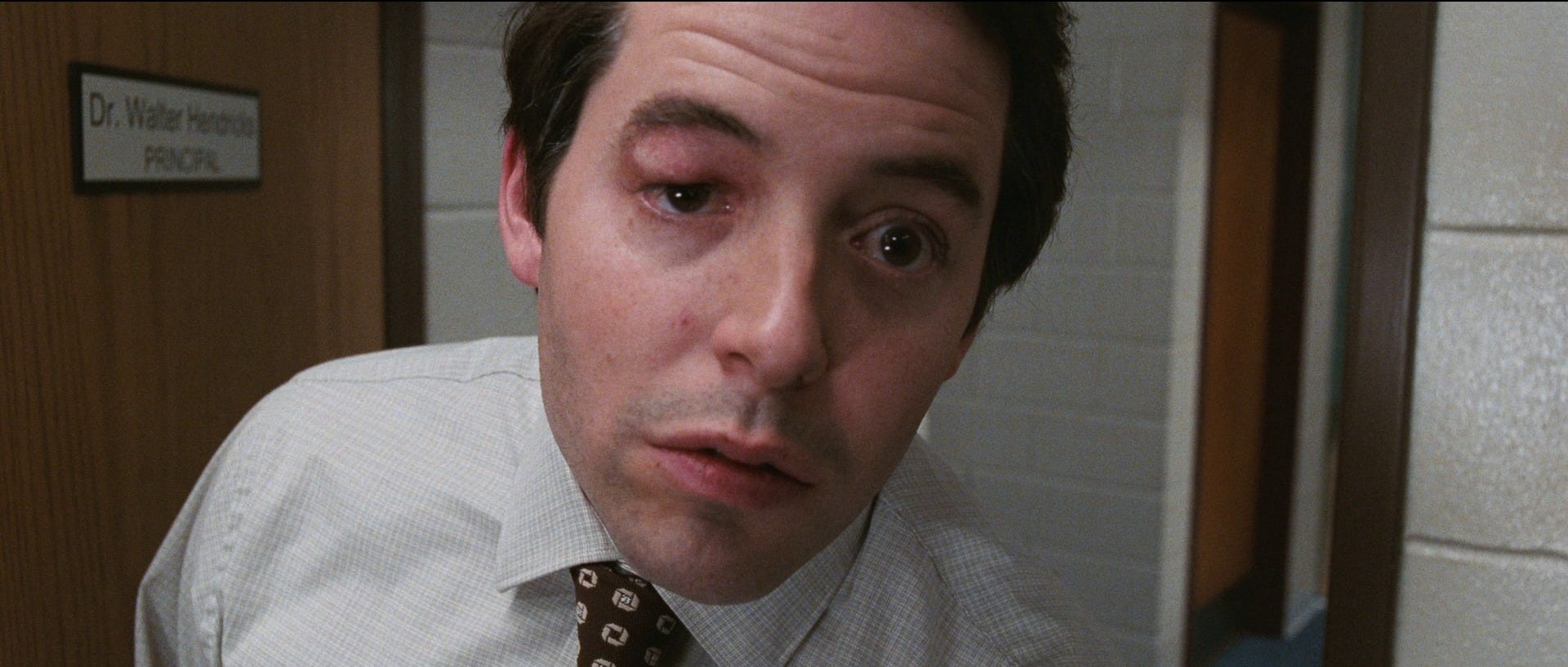
As you can tell, it turns out I had a lot of feelings about this. If you ask me, Mr. M’s bee sting to the eye is but a fraction of what he deserves. I almost can’t believe how much I was stewing in hatred for him until I listed everything down.
But anyway. I was planning on writing about more things I had in mind, but as I mentioned in the beginning of this letter, I will write until it feels long enough. I will, however, give a small update on what the next Arts & Letters edition. It will be on the last novel I read that’s not part of The Wheel of Time world: Jem Calder’s I Want You to Be Happy.
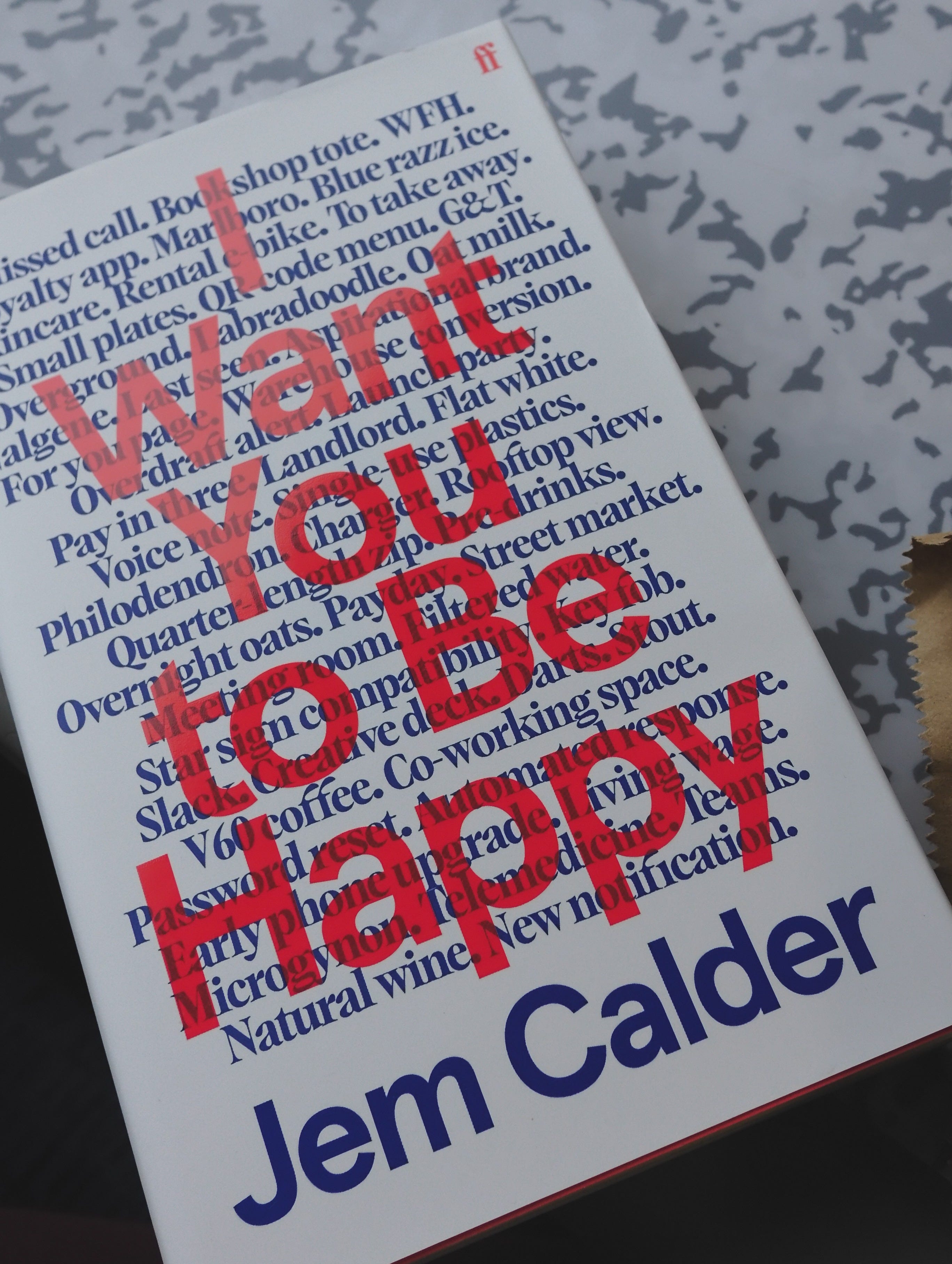
This was a blind buy from a lovely small bookshop in Hastings that turns out to be owned and ran by Jeremy Atherton Lin’s partner, Jamie, who was the bookseller at the time of purchase and who was also very lovely and friendly. The shop is called The Waves and it had loads of other printed matter on sale as well as works of art (I really wanted one of the book-shaped paintings). It also had a free tote with a purchase of Jermey Atherton Lin’s new book, Deep House, which I unfortunately did not buy because I was trying to “save money”. Train tickets are not cheap, especially when you are too old for a rail card.

Anyway. I Want You to Be Happy is not for everyone, and it especially not for you if you need to like your main characters. I did have a soft spot for one of them, but the other one can leave the plane of existence. Not to get ahead of myself, but the book was very easy and quick to read (I finished it in pretty much a day), and although Calder takes care not to be overly specific about locations and such, it still feels so much like the London I know. The blurb that got me to buy it was Leslie Jamison’s (“Its world became more real to me than my own”), which is very high praise.
It did remind me a lot of the shit you pretty much have to eat when navigating the dating world. I can only imagine that it’s worse these days. But anyway, I already have my artist(s?) pairing with it, and I can’t wait to share. I wonder if any of you can guess whose work I’ve been thinking about alongside this book.
No posts
Comments
Nothing yet. Say the first thing.
Sign in to join the conversation.