
In the spirit of sustained writing activity (because I want to write more, and I want to read more, and I want to think more), I’m starting a series called Arts & Letters. Named as such because I am attempting to read more books and think more broadly about how I can relate themes, meanings, and feelings from the books to art that I love.
For me, this project is a matter of finding these threads and really sitting down and processing things. One of the biggest revelations for me throughout my many years of writing, both personally and professionally, is that the main way that I think through things is writing about these ideas. I’ve only recently climbed out of a very severe struggle with public speaking into just a reasonably-sized discomfort, but I’ve always been much better at verbalising my thoughts as written work.
I will say that I have started a lot of series that are numbered or timed, so the embarrassment of releasing only a single “issue” of this series isn’t something I consider at all. I have learned how to live with various humiliations of many degrees, and to be honest, the ability to find humour in these situations (or, even, the ability to ignore the embarrassment after a while) is kind of impressive, even for me.
I will also say, however, that I am truly treating this as a writing and creative exercise. I have the first couple of pairings already lined up, and I believe I’ve selected a cadence of a new instalment every two weeks, which is not overwhelming for me, as a person.1 So, the structure is as follows:
An essay pairing of a book and a work of art or an artist’s body of work.
A collection of images that visualises themes, moods, connecting threads.
An atmospheric experience (lol, more expansion on this later, in a letter between to Arts & Letters posts).
Lately, I’ve been talking on and on and on about how everything is interconnected, and it’s something that is so clear in my head, but something that I want to be able to address more and exemplify. I feel like this is a good way to do that, but I suppose it remains to be seen. Anyway, here is Arts & Letters No. 1: The Hour of the Star by Clarice Lispector + Lygia Clark’s Bichos series.
Clarice Lispector’s The Hour of the Star was a little tricky for me to investigate and inhabit, which surprised me since it mirrors the state of poverty that’s prevalent in Lispector’s Rio and my own Manila. I’ve read some short stories of hers before, from that Penguin edition that republished them in a slim, Tiffany blue volume under the name Daydream and Drunkenness of a Young Lady. Truthfully, I’ve found it really hard to completely comprehend Lispector. When people are celebrated and my encounters with them are less life-altering than I expect them to be, I feel confused and a little dumb. Like I don’t get a joke everyone else finds funny.
And this introduction sort of seems like I didn’t like the book, which isn’t true. What I real difficulty is trying to encapsulate a work succinctly when it so skilfully elides a straightforward summary. Objectively, the novella follows a poor typist, Macabéa, who moved to Rio from the more impoverished Northeastern Brazil, but even Lispector states that the story is not so much about “a girl who was so poor that all she ate was hot dogs.” Rather, The Hour of the Star is a story about “a crushed innocence, about an anonymous misery.”
It was not so upon first read, but when I revisit my notes and my annotations, I can see how much this little book has actually moved me. I liked it a lot, but on my first read-through, I think I was waiting to be really irrevocably changed by it, which is an unfair thing to put on a book.
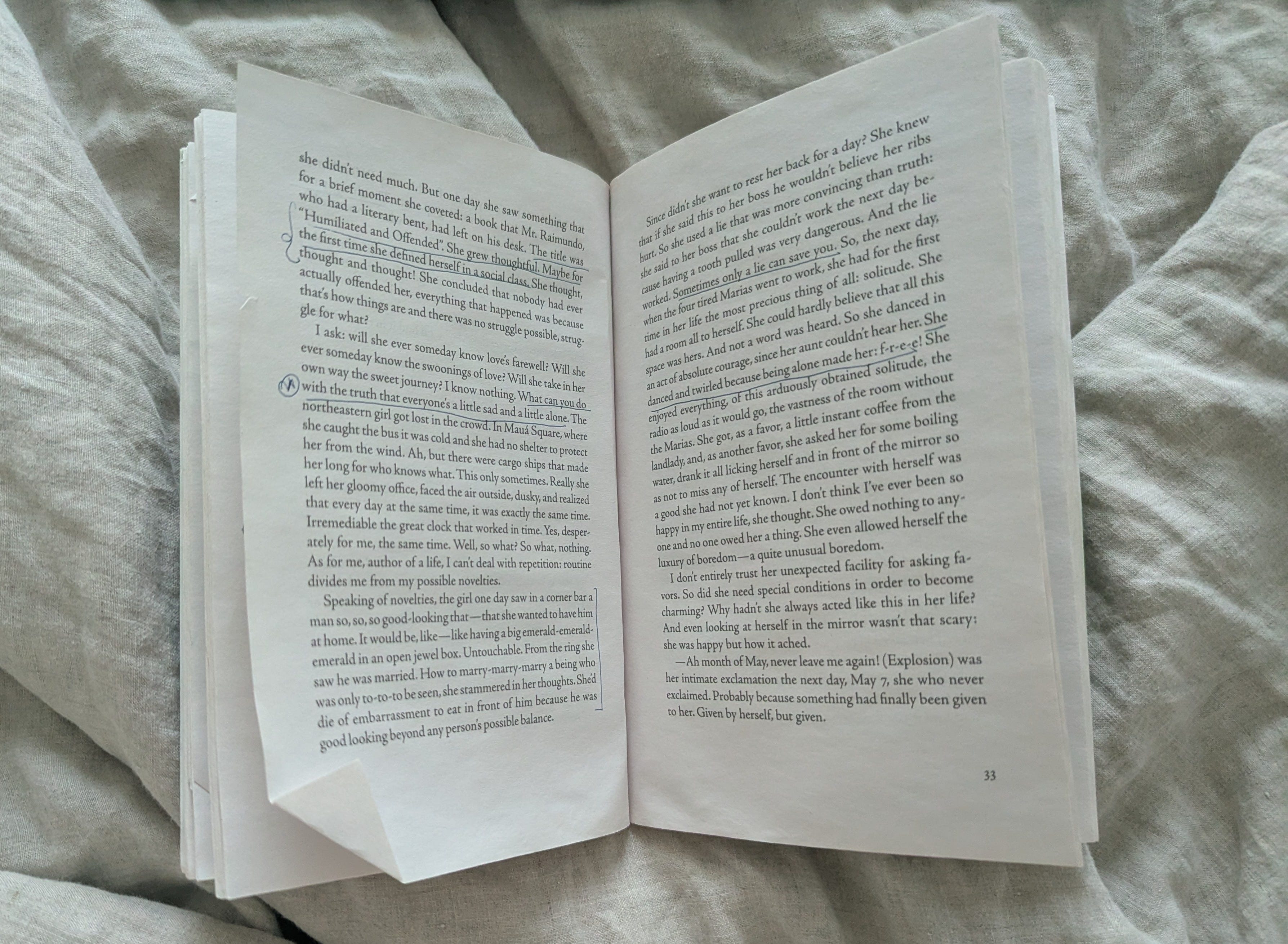
It’s also easy to equate this sort of story with an obvious one-to-one relation of social realist depictions of poverty, but while the novel doesn’t hold (at least, to me) the most dazzling of premises, everything it questions beneath this narrative thread is exquisite. For a volume so slim — 75 pages in my edition — its Rio is fully-formed and easy to visualise, which makes it a little hard to look beyond this environment and find art that resonates without being too on the nose.
The Hour of the Star (which has a total of 13 titles2) follows the narration of Rodrigo S.M., who is described as a writer and is inexplicably privy to Macabéa’s life. All throughout these pages, Rodrigo is both enamoured by Macabéa and feels unsure about the time he spends telling her story. Lispector, through Rodrigo’s interventions, questions who is deserving of our attention.
At the heart of it, the novel is about social invisibility and notions of identity, existing in a world and society that feels perpetually skewed towards a select group of people. Objectively, Macabéa’s life is tragic. She is an incompetent and illiterate typist (although I loved that she has a distaste for consonants existing beside each other) who loves Coca-Cola, and waking up early on Sundays because it gave her more time to do nothing. With an unconventional upbringing and a truly isolated life where she has no one to lean on for support, she is oblivious to her unfortunate circumstances, taking these inconveniences as merely givens in her life.
While looking for art that felt like The Hour of the Star, I came across Lygia Clark’s body of work. Also Brazilian, Clark worked somewhat alongside Lispector, in that both were active in the scene at around the same time, though never really quite intersected in their circles, from what I’ve read. However, researching both brought about some pieces of writing where they are both examined alongside the other:
Breathe with Me, a Breath of Life: Material Mysticism in Clarice Lispector and Lygia Clark by Charles Stankievich for Afterall (paywalled)
The Brilliant Orbit of Clarice Lispector by Meg Weeks for Frieze (exhibition review)
In this review of Lygia Clark’s retrospective at Neue Nationalgalerie, writer Louisa Elderton refers to it as Clark’s “architecture of feeling.” This phrase is particularly resonant for me when I think about The Hour of the Star because of how Macabéa’s interior life and Rodrigo S.M.’s insertion in it are embodied in the city Lispector writes about.
Curiously, Clark’s work — at least her objects and spatial interventions — really feel detached from humanity to me, in a way. Her Bichos series appear cold and geometric objects (she was “a central figure in the Brazilian Neo-Concrete movement”) at first, but once you realise that she meant the objects to be viewed as “living” beings (bichos is Portuguese for “critters” or “animals”) that audiences are invited to interact with, it changes the meaning of this body of work immediately.
In the hands of a participant, this bicho — an unassuming, static form — is transformed. Through the eyes of Rodrigo, Macabéa is made visible, the life of someone ignored and discarded is witnessed.
“As for the girl, she lives in an impersonal limbo, without reaching the worst or the best. She just lives, inhaling and exhaling, inhaling and exhaling. Actually—why should she do anything more?”
So, to subvert my own notion of what this instalment of this series was going to be, I’m rereading my own reading (ha) of The Hour of the Star and Macabéa’s story, and rather than looking for something to propose alongside it, as a mirror, I’m putting with it a companion, what I wish Macabéa had in her life.
Oblivious to something “better” — “Macabéa blanched: it never occurred to her that her life was that bad”, after a visit to a fortuneteller who saw the life she had thus far lived — she was never looking for happiness beyond what she felt, and she had, really, no one to go to for some semblance of those feelings.
Lately, I’ve been thinking about community and real support. Although Rodrigo was a looming presence in how we perceived and receive Macabéa’s story, he had no power as a spectator in how the events of her life unfurl. Similarly, there is a certain helplessness, sometimes, when you are merely viewing a work of art. Some meaning may be generated in your brain, but the embodiment of the piece itself, as far as the artist is concerned, is final. In contrast to this, Clark’s Bichos require the intervention of someone in order for them to take shape beyond the folded up versions.
“The Bichos are fundamentally unstable structures. They question the physical certainty of the user, as they are at all moments at the brink of collapsing. They don’t have an ideal shape. They don't have front and back. They are fully manipulable. And they unfold as potential multiplicities, structurally as well as organically.” — Luis Perez-Oramas, for MoMA.
“What can you do with the truth that everyone’s a little sad and a little alone”, Rodrigo writes, more as a statement of resignation and acceptance, rather than a question to which a solution can be found. Again, I’ve been finding that both showing up for people and asking for community to show up for you have had profound effects on my life, not just for the aspect of social exposure, but for the kind of modern life that unfailingly feels increasingly detached. I’ve yet to look further into Clark’s body of work — an update I hope to supply in between this and the next Arts & Letters letter — but it does go into more participatory work as well as art therapy.
It feels a bit like kismet to have these two works of art by two Brazilian women making and creating in the same sort of time period, shedding light on and addressing notions of social invisibility and community.
———
One last note: I wanted this to be the first book for this series, and it was a pleasant surprise to see art used as a device for description: “I write in bold and severe painter’s strokes’“; “I swear this book is made without words. It is a mute photograph”; “Because all of a sudden the figurative transformed me… I also want the figurative like a painter who only paints in abstract colours but want to to show that he does so”; one of the characters sculpts. Not as a sculptor, but just as someone who makes them because he derives some sort of pleasure from it.
Part of me had notions of what this series was going to look like. Like I would just be writing about topics I was obsessed with and knew a lot about, so it was really so refreshing to be looking into new(-old) things that have existed but I’ve never encountered. It felt like being back in school again, but in a good way.
Here is a colour palette in my head of the book: grit, a middling beige existence, Coca-Cola red and nail polish: her indulgence, rain on pavement, and “that swooning longing and lilac.”

A few prompts for you to end this with:
Find one person or thing in your daily life that you move past without really seeing. Look at them for longer than feels comfortable. Notice what changes.
From the book: “What is the weight of light?”
Thanks for reading The Second Structure of Feeling! This post is public so feel free to share it.
For full transparency, I will be turning on a paywall for this series of posts at some point, just because while it has been fun and beneficial for myself (practising my researching and thinking muscles again), they do actually take a lot of work to pull together. The first two or three I’ll leave up for free. I want you to know the type of work you’ll be supporting, and sort of proof of concept that it’s not arbitrary or random.
I’m still undecided on whether to turn on the paywall immediately or a week or so after the initial publishing (sort of like a paid archive), so any comments or suggestions are welcome. All other content — and future iterations of these — will remain free to read and access.
I have recently thought that I might be living with AuDHD, but I have yet to set a meeting for a diagnosis. I previously went to a neuropsychologist for autism, but my depression and anxiety were both undiagnosed and more visible at the time I went that these were the obvious conditions. I don’t want to self-diagnose or pathologise what may just be quirks, and I also don’t want to invalidate these conditions and lived experiences just because of a lack of an official diagnosis — and it’s another story for another time — but basically the AuDHD profile is sort of what aligns most with my reality, and I am in the process of getting that looked at. For free, if possible.
The titles are: “The Hour of the Star”, “It’s All My Fault”, “Let Her Deal With It”, “The Right to Scream”, “.As for the Future.”, “Singing the Blues”, “She Doesn't Know How to Scream”, “A Sense of Loss”, “Whistling in the Dark Wind”, “I Can’t Do Anything”, “Account of the Preceding Facts”, “Cheap Tearjerker”, and “Discreet Exit Through the Back Door”. All of which shed some sort of light on how Lispector herself was looking at this work.
No posts
Comments
Nothing yet. Say the first thing.
Sign in to join the conversation.