
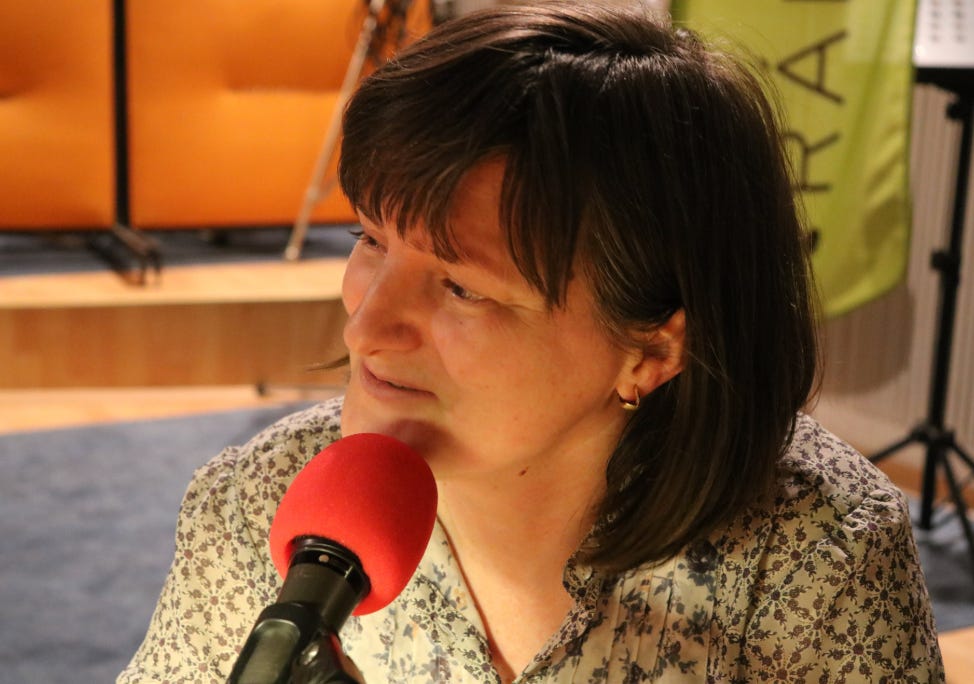
Episode 29 of the Careful Thinking podcast features my conversation with the Slovak philosopher and care theorist Adriana Jesenková.
Adriana is an Associate Professor of Philosophy in the Faculty of Arts at Pavel Jozef Šafárik University in Košice in eastern Slovakia, where her research has explored issues of care, power and justice in education and medical practice from the perspective of feminist care ethics. She is the author of numerous journal articles and book chapters in both Slovak and English, applying a care ethical perspective to subjects such as the education system in Slovakia, sex education, and the challenges posed by a fragmented and polarised society.
Text within this block will maintain its original spacing when published
Adriana Jesenková
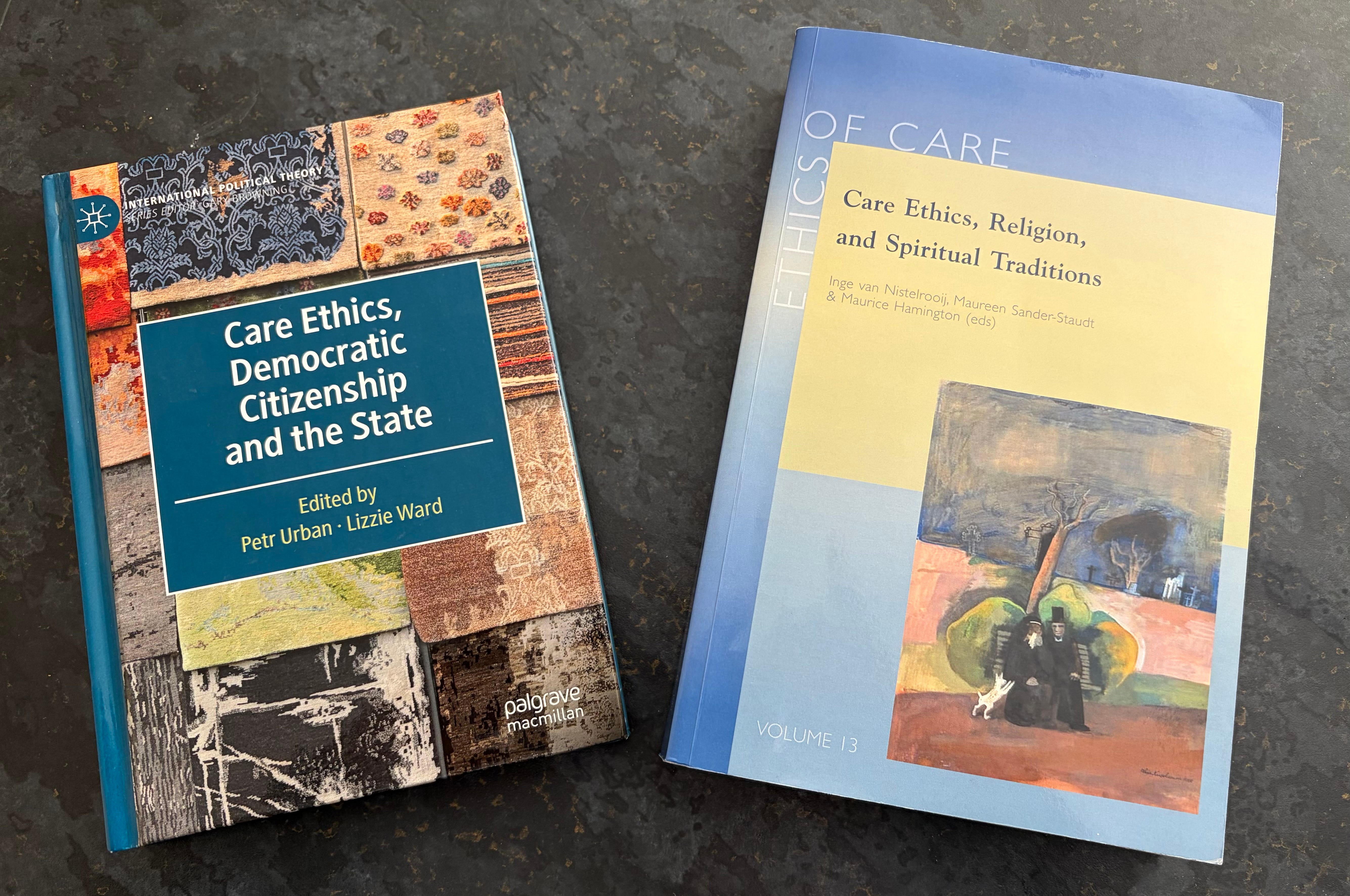
I first came across Adriana’s work when we both contributed to the edited collection on Care Ethics, Religion, and Spiritual Traditions, which was published by Peeters in 2022. I was also interested to see that Adriana had contributed a chapter to the 2020 volume on Care Ethics, Democratic Citizenship and the State, which was co-edited by the Czech scholar Petr Urban, my guest in Episode 4 of the podcast. Since then, I’ve followed Adriana’s publications closely, and I’ve been particularly interested to see how she applies insights from care ethics to the particular circumstances of a post-communist society like Slovakia.
As I mentioned in my last post, interviewing Adriana set me thinking about the relationship between education and care, and reminded me of previous episodes of the podcast, such as Episode 19 with Mia Sosa-Provencio, which also explored the ways in which education can be viewed as a practice of care. Adriana’s work raises intriguing questions about the role of education in nurturing an ethic of care and promoting what Joan Tronto would describe as a ‘caring democracy’.
It was interesting to talk with Adriana about her extensive writing and activism around sex education, and about the boundaries between the public and private realms in relation to this topic, particularly in the light of my post earlier this year on the role of the state in care. Adriana’s criticisms of the role of the Church in this area made quite a contrast with the previous episode, which featured an author whose work is deeply rooted in his Catholic faith. I confess that I went into the interview prepared to be critical of Adriana’s stance on these issues, but I thought she gave beautifully nuanced answers to my questions, balancing a respect for the views of those who see sex and intimate relationships as in some sense sacred and therefore private, and the responsibility of the wider community to ensure the wellbeing of the vulnerable and prevent abuse.
I learnt a lot from talking with Adriana, not least about the culture and history of Slovakia, a country about which I confess I knew very little beforehand. Coincidentally, I’ve just finished reading Luka Ivan Jukic’s book Central Europe: The Death of a Civilisation and the Life of an Idea, which was published last year, and which I’d recommend to anyone wanting to get a sense of the complex history of that part of the world.
Text within this block will maintain its original spacing when published
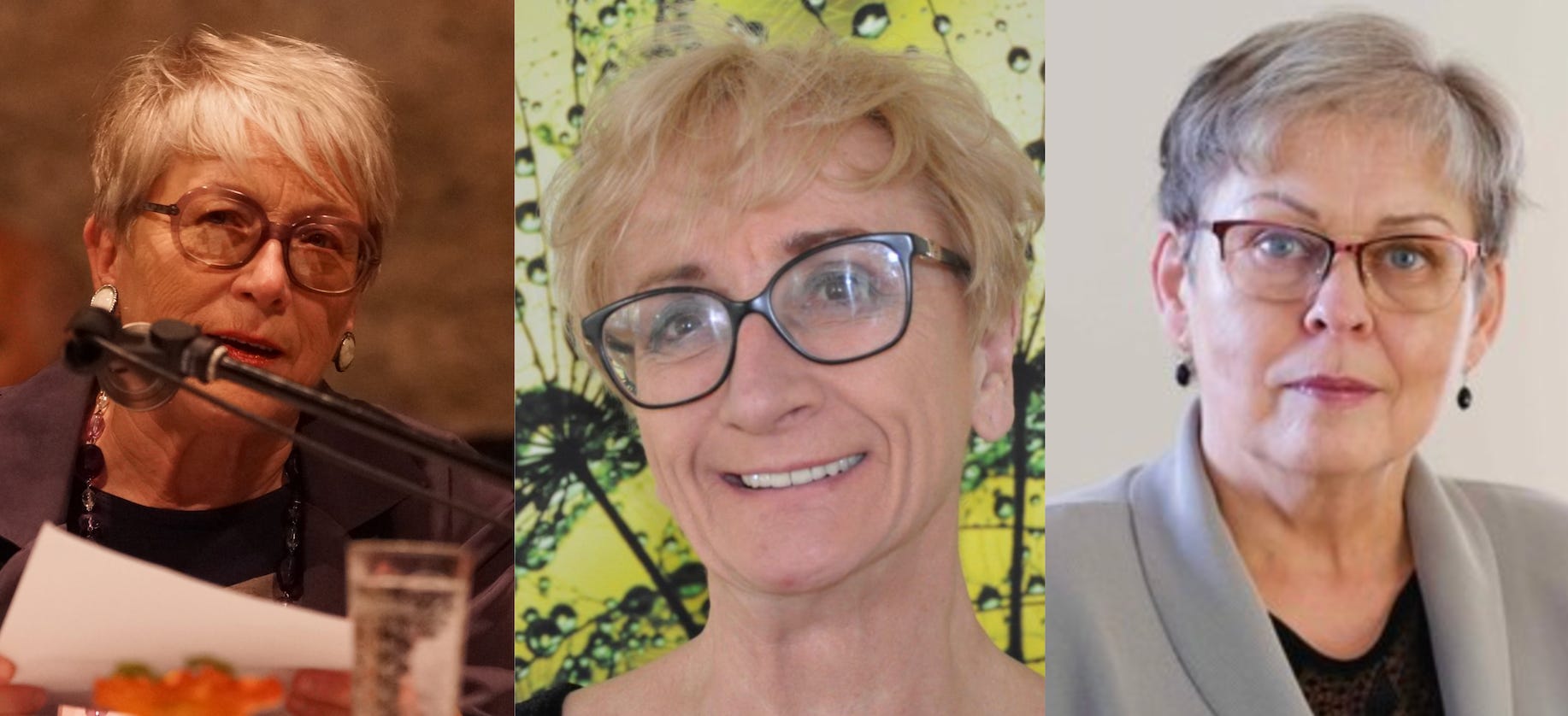
L to R: Etela Farkašová, Zuzana Kiczková, and Mariana Szapuová We began our conversation on the podcast by discussing Adriana’s upbringing and education against the background of the transition to democracy country following the Velvet Revolution in what was then Czechoslovakia. Adriana spoke about her university studies in philosophy and especially about the important influence of her supervisor and mentor, Etela Farkašová, as well as other Slovak feminist philosophers such as Zuzana Kiczková and Mariana Szapuová. We discussed Adriana’s introduction to feminist care ethics, which came primarily through discovering the work of Joan Tronto, who has clearly been a major influence on her work.
Moving on to Adriana’s own writing, we discussed the reasons for her focus on education and what she has described as a ‘deficit of care’ in the education system of her home country, and how feminist care ethics can contribute to understanding and addressing these issues. We then discussed Adriana’s work on sex education, before turning finally to a recent article in which she describes the experience of using a novel by Etela Farkašová in her philosophy teaching, as a way of addressing what she sees as the fragmentation of contemporary Slovak society and as a way of ‘caring’ for intergenerational relations. Towards the end of our conversation, Adriana talked about her plans to write a book which will interpret some of the key elements of care ethics for a Slovak audience.
Here are some quotes by Adriana from our conversation:
My supervisor for my thesis was Etela Farkašová, a prominent Slovak philosopher and writer, who is one of the three Slovak philosophers, women philosophers working at the Department of History of Philosophy at the Faculty of Arts of Comenius University in Bratislava. And she brought feminist philosophy to the Slovak and Czech environment in the ‘90s. And for me, and for my colleagues from this time, it was a very important and formative period in our lives. We are talking...about this time of a very exciting period in our life, because we had the opportunity the first time to know something new about Western philosophy, about feminist philosophy. And Etela Farkašová, my supervisor and mentor, together with Zuzana Kiczková and Mariana Szapuová…started university-wide interdisciplinary courses in gender theory and feminist philosophy and founded the Centre for Gender Studies, which operates at Comenius University to this day.
...
I am interested in mainly practically-oriented philosophy...relationships, mutual relations between women and men, justice, inequalities, love, power, suffering, the good life....and this practically-oriented philosophy was for me feminist philosophy, pragmatism and moral philosophy especially, but also social and political philosophy. But very early I understood that it is also about epistemology and ontological questions, how I think the world...functions and about its structure...what determines our understanding of our obligations, duties and needs and ideals and values. So during my studies, these practical questions about...personal life, family life, social life, professional life, it was very important for me to find out and to look for the concepts and theories that could answer...these important questions for me.
...
Around 2012...I started working as a university teacher, and I joined the first teachers’ strike in Slovakia. And the marginalisation of care in the teaching profession...became a completely obvious question and problem for me. And I also can say that I learned about Joan Tronto’s book Caring Democracy in that time...and everything suddenly began to take on different shapes, meaning and logic. And I understood that my feelings, my intuitions about this deficit of care and...injustices and inequalities...in different social areas of life and professions could be understandable through the conceptions of Joan Tronto and care ethics. Feminist care ethics...is a conceptual tool for me. It allows me to grasp clearly what I often perceive…only intuitively.
...
It is important to say that before the Velvet Revolution...Slovaks and Czechs lived in a common state together in Czechoslovakia, and Czechoslovakia was a totalitarian state with real socialist economics, politics and culture. And I was seventeen and in the third class of gymnasium when the Velvet or ‘gentle’ revolution, as we are saying in Slovakia, started. And after the totalitarian system...collapsed we started democratisation...and Slovaks and Czech started to live in independent states in 1993. And we had clearer periods and also darker periods in the three decades from the Velvet Revolution in our country...We started to democratise the educational system through different reforms...We are still working on the improvement of the educational system in Slovakia. But the most important challenge, about inclusive education and about desegregation of marginalised pupils...is still very important and still unrealised.
...
If Nell Noddings and Virginia Held argue that the main purpose of education should be to form, develop, cultivate and strengthen human capacity to care for human relations and through them, for ourselves and others, we can ask our schools, our institutions and our politicians if we are preparing our children to be able for such caring practices. And some of the last research studies said about the level of distrust...in Slovak society...so this high level of distrust is a very strong factor of fragmentation of Slovak society. And where society is so fragmented, it is not possible to join together and to collectively act. And also it is very complicated...in such a fragmented society to feel mutual and common responsibility for others...What is very inspirational from care ethics is its appeal to us that we need our institutions and also our individuals to educate for the ability to care more responsibly and non-hegemonically.
...
I am not only a university teacher and a teacher who is philosopher, I am also an activist, I’m also working in an NGO, and we are focusing on gender sensitive education and supporting human rights, culture and civic society and civic participation. And we started to focus on the problematic of gender sensitive education together with education for reproductive health and also healthy intimate relationship and sexuality...We were witnessing discrimination practices and inequalities as a consequence of marginalisation and segregation processes of social injustices. And we perceived the necessity to...have more information about the attitudes of young people about sexuality and sexual rights. And it was in the time when I started to read Joan Tronto and her Caring Democracy and Moral Boundaries and we drew inspiration from care ethics for designing our research project.
...
I agree...that when it is possible, the state should not interfere in the private sphere. But about 90% of sexual violence...is...in close and intimate relations. So how to ignore...this... terrible amount of violence, and argue that this is the private sphere and we the others, it is not only the state, but we, neighbours, friends, citizens, the members of the same society, the same community, that we should ignore this violence...? I think that care ethics is able to say us that caring is necessary. Why? Because all we are vulnerable, and...we all are able to hurt others. And we are responsible for using our power... we all have power and we also are able to use this power...maybe not intentionally, but we are able to hurt others, to act so they will be suffering and they will feel pain and they will be traumatised....If it is important for us, so it is necessary to not think in such rigid differentiations and classifications...We are interfering through legislation, through visible and invisible practices of power and misusing of power…And when we are ignoring these practices of mutual interference, we are ignoring the misusing of power and we are empowering vulnerabilities of the most vulnerable people.
...
Our society, together with Hungarian and Polish societies...are the most fragmented and polarised societies in Europe. And I really experienced it on my own skin...and it touched me, this experience...and the sharing of this experience was for me very important, very healing, very caring...It was very important for me. And it showed me that it is not only my experience, that it is something that needs to be reflected. And what is the way out from this, what to do? For me, it was something, what is very important, what to do. And that is why I am doing philosophy, because for me, it is the way how to solve not only my problems, but problems of my community, my society, my environment...And now these problems of fragmented relations are important, because when we are fragmented, we are vulnerable. We are vulnerable not only as individuals, but also as a collective, as a community...And it is important to look for ways how to empower caring relations, because through caring relations we can renew our energy.
You can listen to the whole episode here, or wherever you get your podcasts.
You can download a transcript of the episode here:
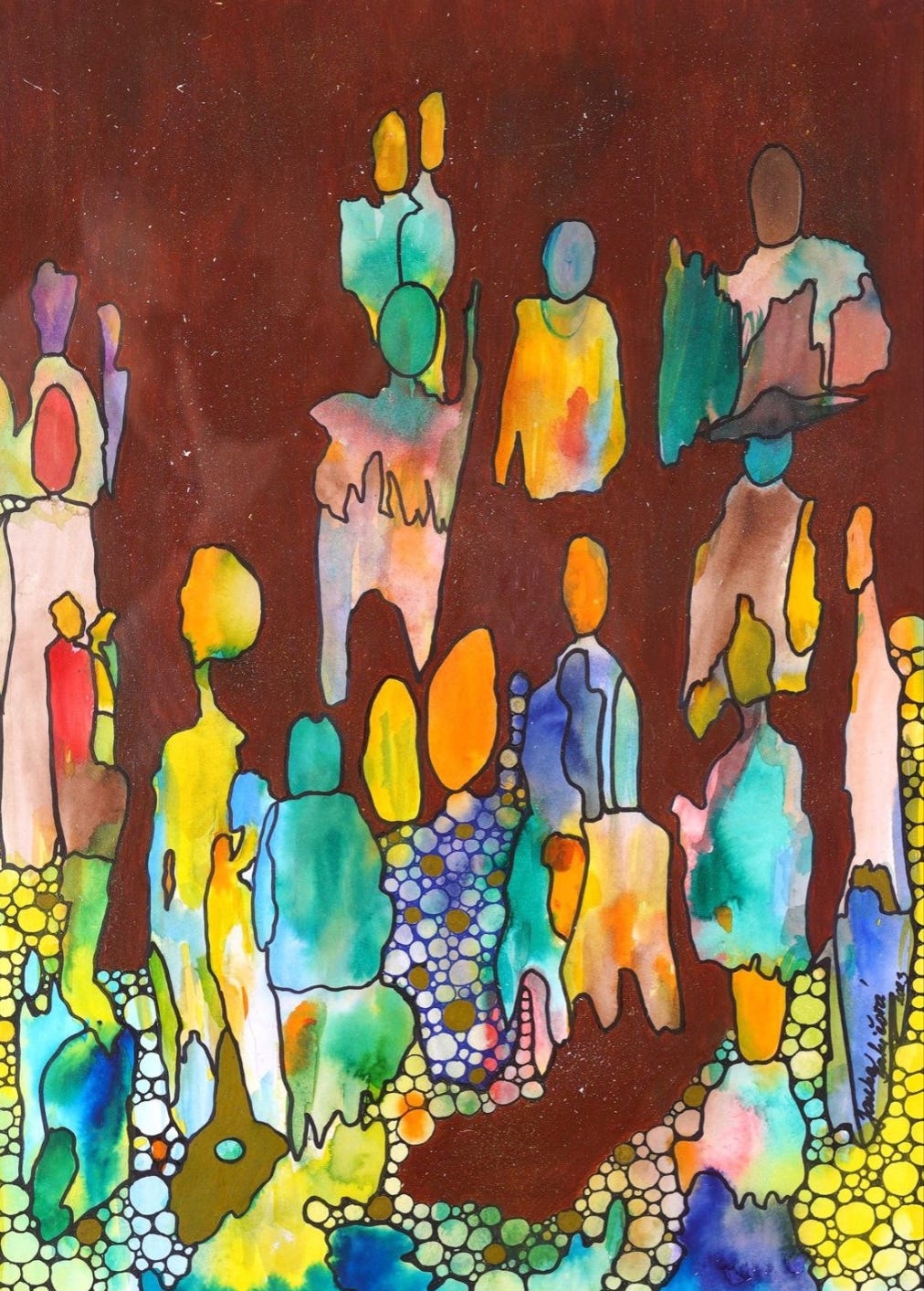
The header image for this post is the painting ‘Behind The People’ by contemporary Slovak artist Jana Bakičová who often exhibits her work in Košice (permission requested).
No posts
Comments
Nothing yet. Say the first thing.
Sign in to join the conversation.