
‘I and the public know
What all schoolchildren learn,
Those to whom evil is done
Do evil in return.’
W. H. Auden, ‘September 1, 1939’
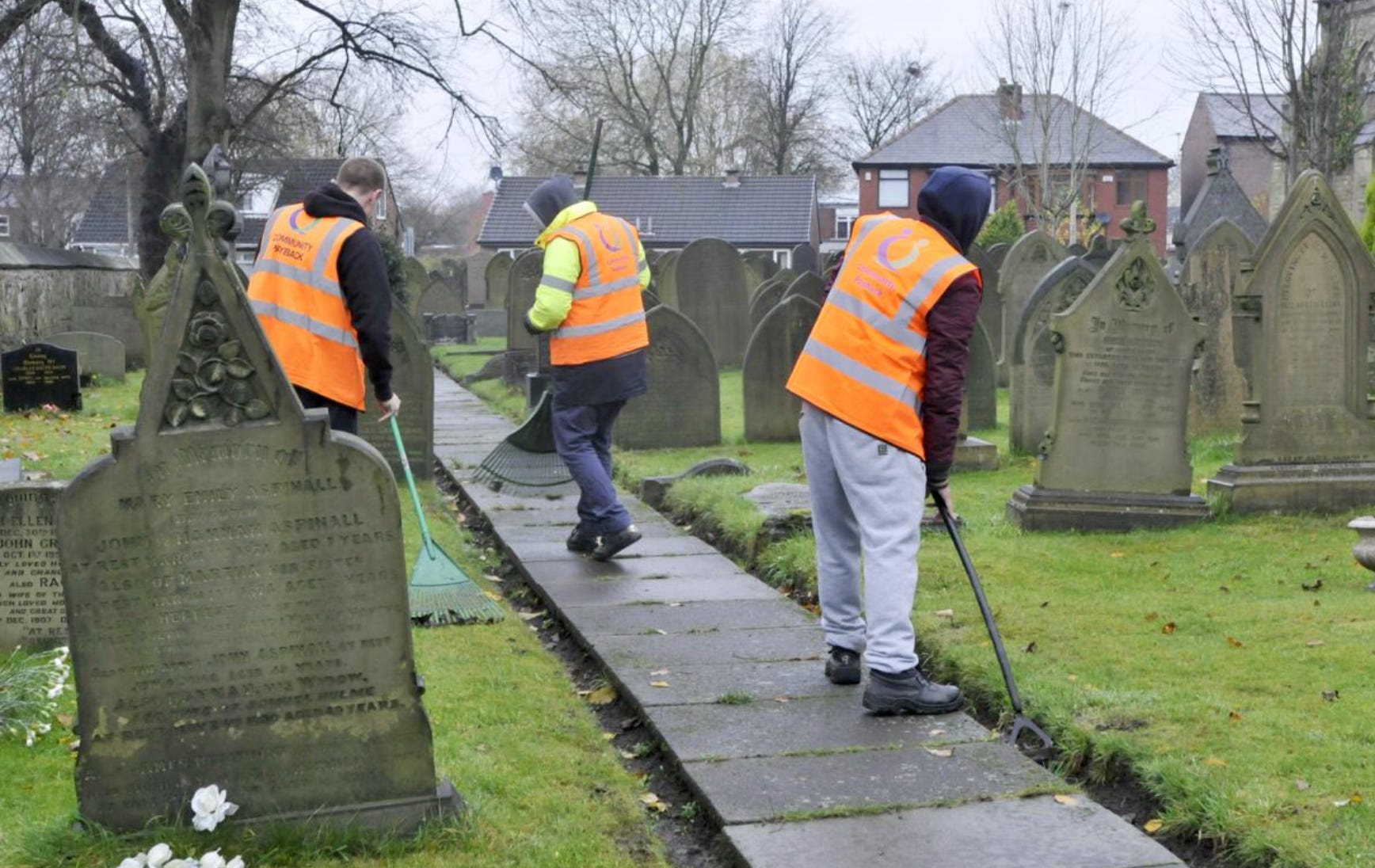
Visiting my wife’s parents’ grave recently, we noticed a group of men working in the churchyard, cutting the grass and sweeping paths. The logo on their high-vis jackets and on the van parked nearby indicated that they were part of a Community Payback scheme. In other words, these were offenders carrying out what used to be known as community service orders, a court-mandated alternative to prison. Watching them at work made me wonder whether this could be described as a ‘care-ful’ response to crime.
It also reminded me that I’ve been meaning to write something about crime, justice and care, ever since I read a post over at Mélina Magdelénat’s Substack, on ‘Care in uncaring places’, in which she interviewed Claire Favre, a clinical psychologist with experience of working in the French prison system. And the process of writing my recent post about ‘Education as a practice of care’, in which I described my earlier career organising educational programmes for ex-offenders, has brought back memories of those times and set me thinking about what a care ethical approach to crime might look like.
Text within this block will maintain its original spacing when published
          Community Payback team working in a churchyard in Bolton, Lancashire
                              (image via https://www.theboltonnews.co.uk)
As I mentioned in that earlier post, between finishing my first degree and starting my doctoral research, I spent a year working as a full-time volunteer in a hostel for ex-prisoners with mental health challenges. Then, as a postgraduate student in Manchester, I volunteered at an education project in the city run by NACRO, the National Association for the Care and Resettlement of Offenders. Those experiences helped me secure my first full-time job, managing a new NACRO education project in Basildon, Essex, which in turn led to my appointment as an education officer at NACRO’s North London Education Project, an initiative offering accommodation and support to ex-prisoners seeking to continue their studies on release.
One of my responsibilities in the latter role was visiting prisons to interview prospective applicants to the project. The interviews usually took place in the education wing, where applicants had been studying during their time inside. In her interview with Mélina, Claire Favre talks about the paradox of offering care, which in her case meant therapeutic treatment, in ‘uncaring’ places such as prisons. In my experience, education wings also represented spaces of care, oases of more humane and ‘care-ful’ relationships, within the generally ‘care-less’ environment of the prison.
The two prisons with which our project had the closest ties were Pentonville, a typical Victorian men’s prison, and Holloway, a women’s prison, at the other end of Caledonian Road, which has since closed. Holloway offered perhaps the starkest example of an attempt to create a haven of care in an uncaring environment, in the form of its controversial ‘mother and baby’ unit, which allowed women to keep their young children with them while serving their sentences. There was a vigorous debate at the time about whether this was really a ‘caring’ initiative, or whether there was something inherently uncaring about confining innocent children in prison. Recalling those debates now, I’m reminded of my interview for the Careful Thinking podcast with political scientist Lorraine Krall McCrary, in which she talked about her research on the work of midwives in Auschwitz, whose care for pregnant women she interprets, drawing on Hannah Arendt’s concept of natality, as ‘bearing witness to natality’ - to life, hope and care - in an institution whose raison d'être was the very opposite of care.
While some of the women in Holloway had been convicted of serious crimes, many were petty criminals and were themselves victims of violent or abusive relationships. At the north London project, we formed close links with the advocacy organisation Women in Prison, which was set up by former prisoners to support women caught up in the criminal justice system. One of the offshoots of their work was the women’s theatre company Clean Break which uses drama to shine a light on the uncaring conditions experienced by many women prisoners and to campaign for change. Shortly after joining The Open University in the early 1990s, I wrote and presented a radio programme, as part of the BBC/OU ArtWorks series, which focused on the work of Clean Break and included an interview with Anna Reynolds, a young woman who had been convicted but later acquitted of killing her mother, while suffering from extreme hormone imbalance, and who has since gone on to become a successful dramatist, screenwriter and novelist. (There’s an interesting chapter by Caoimhe McAvinchey on the work of Clean Break, which makes connections with Joan Tronto’s work in care ethics, in the volume on Performing Care co-edited by James Thompson, my guest in Episode 11 of the podcast).
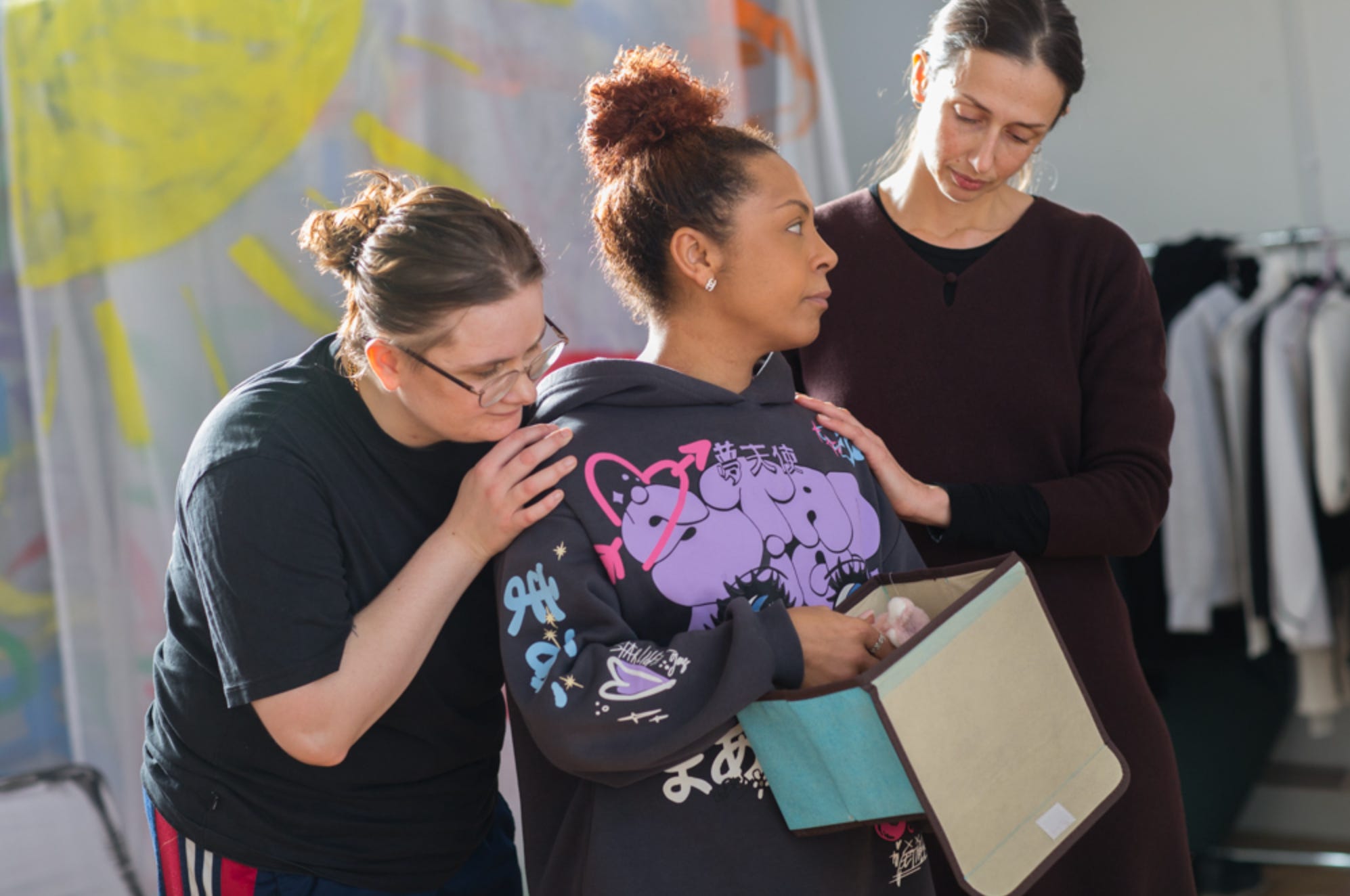
A scene from the recent Clean Break production of ‘Scenes from Lost Mothers’ by Gurpreet Kaur Bhatti (via cleanbreak.org.uk)
While Clean Break works mainly with ex-prisoners, others attempt, often against heavy odds, to carry out creative, arts-based work inside prisons. I recently came across the Locked Up Living podcast, in which forensic psychologists Naomi Murphy and David Jones interview people doing innovative work in closed institutions. I was particularly intrigued by their conversation in a recent episode with Jean Trounstine, who has pioneered productions of Shakespeare with women prisoners in the United States, motivated by a belief that literature and drama can help to transform lives damaged by the criminal justice system. Arts-based initiatives in prisons can be seen as another manifestation of care in uncaring places.
Reflecting on the contradictions involved in offering care in contexts of what we might call ‘un-care’, or even ‘anti-care’, also brought to mind the work of my Open University colleague Rod Earle, who himself spent some time in prison as a young man. I’m thinking particularly of his research with teenage fathers in young offender institutions, in which he explored the paradox of requiring prisoners to attend parenting classes, learning how to care in an institution inherently hostile to care. Rod has been an active supporter of The Open University’s longstanding educational work in prisons and recently co-edited a volume celebrating 50 years of that vital provision. He has also been one of the pioneers of ‘convict criminology’, scholarship on criminal justice by those with first-hand experience of the system.
It’s well known that the experience of imprisonment damages as much as it rehabilitates, tending to perpetuate a vicious cycle of ‘carelessness’. It’s also a truism that many who end up in prison are as much sinned against as sinning, having often been victims of neglect or abuse themselves. To paraphrase Auden’s poem at the head of this post, we might say that those who have experienced a lack of care tend to become uncaring in their turn. A striking instance of this is captured in the doctoral research undertaken by Rod Earle’s student Jade Levell, which examined the experiences of young men who had witnessed domestic violence in their childhood and later became caught up in gang culture: an example, we might say, of an experience of ‘un-care’ engendering ‘care-less’ behaviour.

Ironically, it is those with experience of the so-called ‘care system’ who are statistically most likely to end up in prison. Justin Rogers, another of my Open University colleagues, co-wrote a chapter for our recent book on Men and Loss, examining the high incidence of suicide and deaths in prison among ‘care experienced’ men. Justin’s co-author Ian Thomas writes from personal experience of both the care system and imprisonment. When I worked at the NACRO project in Basildon, our ex-offender volunteers included David Akinsanya, who had been ‘in care’ as a child and later spent time in young offender institutions, then known as ‘borstals’. As David wrote in an article for the Guardian some years later:
To be honest, it was no surprise to go straight from care into custody. I’d grown up being told I’d make nothing of my life and borstal was, and still is, part of the expected journey – many of the boys I knew left care for jail, while the girls left with babies. I was 18 when I was locked up, and hadn’t had anyone looking after me officially for three years. I had just been given a flat and left to get on with it.
However, for David, it was a caring intervention by a social worker that helped to turn his life around:
Unlike many in care, I had someone who continued to watch out for me in an official capacity as my ‘social aunt’ – Jenni Randall, who had been my social worker from the age of eight until I was 14…She visited, wrote to me, and made me feel like someone cared…When I came out of borstal, she was there. She fed me, did my washing and encouraged me to follow the path I did.
David would go on to become a leading activist on behalf of young people in care, as well as a highly-regarded journalist and film maker. His experience offers an illustration of how an experience of authentic care can help to repair a life damaged by a lack of care.

Text within this block will maintain its original spacing when published
L to R: Rod Earle, Jade Levell, Justin Rogers, Ian Thomas, David Akinsanya
Some years ago, I led an Open University/Action for Children research study which involved interviewing young men in contact with social care services across the UK. At ‘Moving On’, a project for young offenders in an economically depressed area in the west of Scotland, participants spoke about growing up in an environment characterised by poverty, addiction, violence, and crime. Staff at the project, who were often from similar backgrounds, sought to break that cycle by providing a space of care for those they worked with. The young men we interviewed described feeling genuinely cared for, often for the first time in their lives. The project can be said to have created an alternative, virtuous circle of care. As one of the project workers said: ‘When we ask the guys what they want to do with their lives, they say, “I want to do what you do”’. In other words, an experience of being cared for engendered a desire to care for others. When I worked at the north London project, it was a standing joke that our ex-prisoner students all wanted to become social workers. To turn that quote from Auden on its head, we might say that those to whom good is done will be motivated to do good in return.

Some of the participants in that research study were young fathers, and they would often claim that becoming a dad had played a vital role in rescuing them from a life of crime. Teenage fathers tend to be portrayed in the media as feckless and irresponsible, but these young men, despite their often traumatic upbringing, were determined to do things differently and to be actively involved in the care of their children. In these cases, we could say that it was an experience of caregiving that interrupted the vicious circle of ‘carelessness’. On the same theme: some years ago, I supervised Jane Reeves’ doctoral research, in which she explored the lives of young fathers in contact with social services, examining the ways in which parenthood offered her participants a path from ‘recklessness’ to ‘responsibility’.
One of the strongest arguments for the kind of ‘community payback’ schemes with which I began this post, and for restorative justice more broadly, is that they require those who have committed crimes - have acted in ‘uncaring’ ways - to engage in acts of care, whether directly for the person they have offended or indirectly for the wider community, for example by caring for a graveyard, park or community building. In his classic work on Embodied Care, Maurice Hamington (my guest in Episode 6 of the Careful Thinking podcast) writes about the ways in which our bodies know ‘habitual activities of care’, arguing that ‘these are not instinctual activities but learned (and learning) behaviours that exhibit care’. The hope has to be that, for these offenders, participation in activities requiring care, whether for people or places, will inculcate habits of care that replace patterns of ‘care-less’ behaviour. Of course, some might question whether care that is compelled - in this case, by the justice system - can be described as ‘real’ care. At the same time, in cases of restorative justice, in which offenders are required to confront the victims of their crimes, the victim must always have the right of refusal: one cannot be compelled to ‘receive’ care.
None of this is to suggest that care should be the only or the whole response to crime. Readers who have been victims of crime, or who live in high crime neighbourhoods, may justifiably argue that the first priority of criminal justice policy should be to deter crime, and that deterrence needs to include the threat of meaningful punishment. Criminal behaviour, whether it’s theft or an act of violence, can be viewed as an offence against care, breaking the bonds of care and interdependence which are at the heart of any community, and the community has a right to ensure that such actions will have serious consequences. And of course there’s a powerful argument that it’s the victims of crime who should be the primary recipients of ‘care’ from the wider community.
However, unless we want to return to an earlier and less forgiving era, in which those who committed even minor crimes were simply written off by society - either executed, transported, or locked away out of sight and forgotten - it’s surely in all our interests to find ways of reintegrating offenders into society and enabling them to become responsible - and caring - members of the community. I would suggest that the kinds of ‘care-ful’ interventions - whether community service, education, or creative arts - that I’ve described in this post should be seen as acts of care not only for offenders, but for the whole community.
…
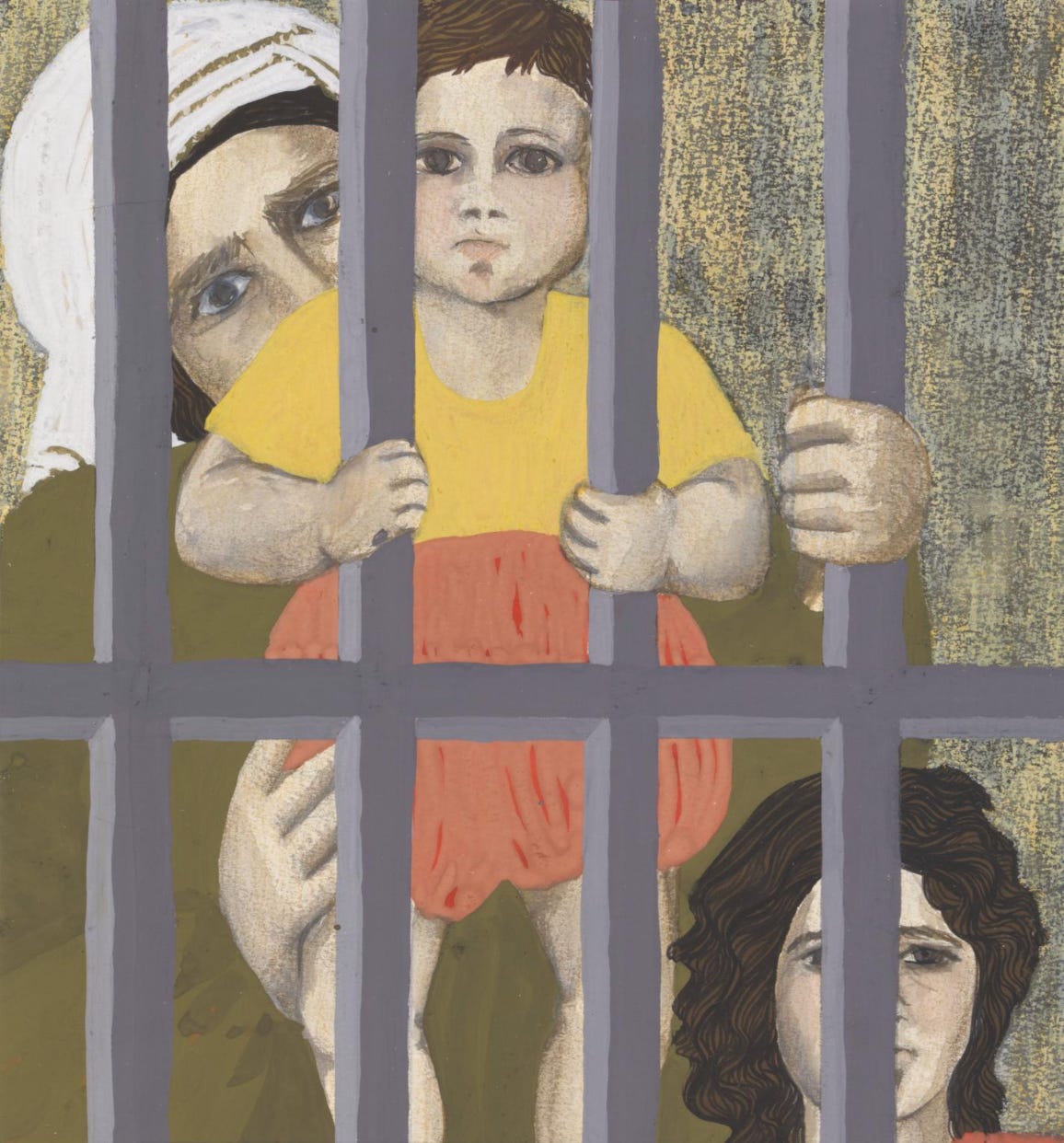
The header image for this post is ‘Prison Paintings 16’, one of a series created between 1972 and 1978 by the Turkish artist Gülsün Karamustafa (via tate.org.uk). According to the Tate website: ‘Following the military coup of 1971 Karamustafa, who was a member of the 1968 generation and a politically active student during her university years in Istanbul, was arrested and sentenced to six months in prison for aiding and abetting political activists. The Prison Paintings were painted from memory, after the artist had been released from an institution intended for female prisoners serving life sentences.’
No posts
Comments
Nothing yet. Say the first thing.
Sign in to join the conversation.