

Traveling business class in a plane 25 years ago used to be a bit like travelling in the back of a luxury car. You had loads of leg room, a deeply padded seat that electrically reclined, and an arm-rest and fold-down table. But business class airliner accommodation has changed a lot since then. Today when you fly long-haul, and you’re fortunate enough to not be in economy, you don’t so much as have your own seat as your own private suite. And luxury cars look set to follow.
In 2000 British Airways launched the Club World seat (designed by Tangerine under Matt Round and Martin Derbyshire, and overseen by Neal Stone under Mike Crump at BA) that could lie flat, a pioneering feature enabled by passengers alternately facing each other so that when they reclined they were head-to-toe.
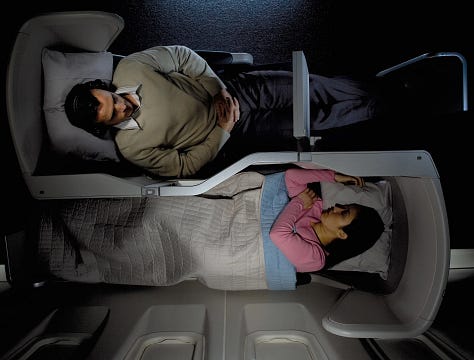
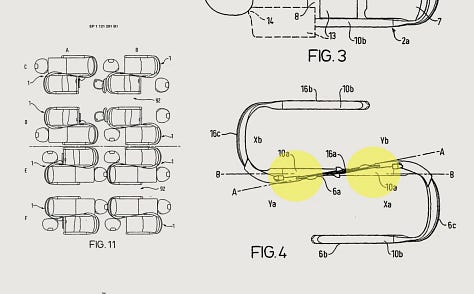
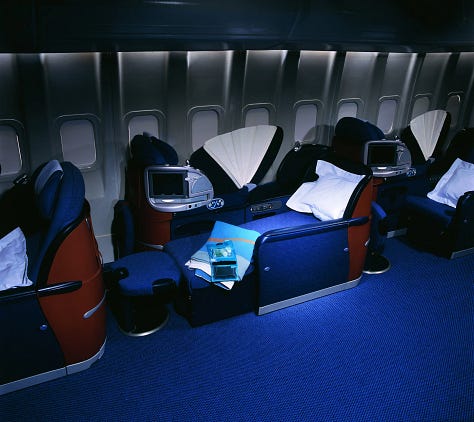
This yin-yang seating arrangement fragmented the cabin master plan into a herringbone pattern instead of straight rows of forward facing seats. And instead of the passengers having their head and torso close to their neighbours, they sat with plenty space between them and, when their privacy blind was unfolded, within their own little secluded booth-like space. The Club World seat, proved a huge hit, and so most other airlines followed with business-class seats that lay flat in increasingly separated suite spaces.
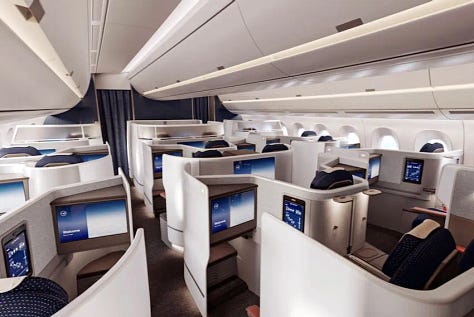
Today business and first class airliner seating is dominated by high walled suites that feature privacy doors, lots of personal accoutrement storage, screen and device connectivity, an ottoman ‘buddy seat’, and an off-set seating / lying position that maximises space utilisation by vertically overlapping the recumbent leg-room of one passenger with the storage space of another.
The 2025 Cathay Pacific Aria Suit (designed by JPA Design — as image top — is a leading exemplar, and the Vantage Nova from Thompson Aero (the work of Tangerine again) soon to be in China Southern planes, the Recaro R7 (as used by Latam, Iberia, Nippon and LOT and others) and the Lufthansa Allegris business class (designed by Pearson Lloyd) follows much the same design pattern. Today premium travel in the air is all about the suite.
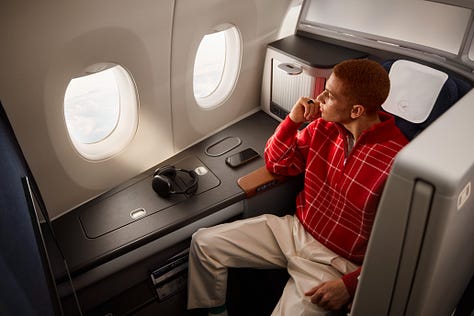

And now we are beginning to see this airline business-class suite make inroads into luxury car design.
Last summer Bentley unveiled the EXP15 concept with two individual rear seat-pods, each shrouding its occupant with wrap around sides and with seat-belts and small storage space set within its suite-like space too.
Also last summer, the GM design studio in China presented the Buick Electra Orbit concept that featured ensconcing rear seats divided from each other by a translucent screen that arced from floor to ceiling.
And at the Japan Mobility Show last autumn, Toyota presented the Century concept with a single rear seat with adjacent ottoman and innovative multi-string partition screening the driver.
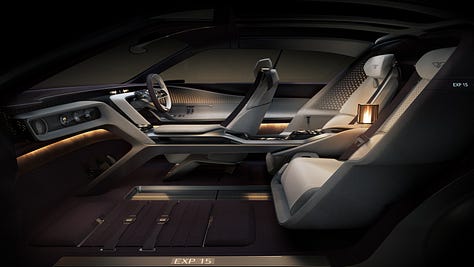
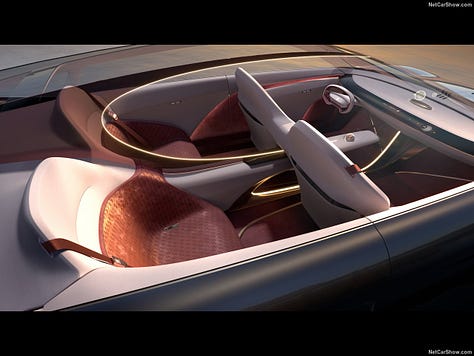
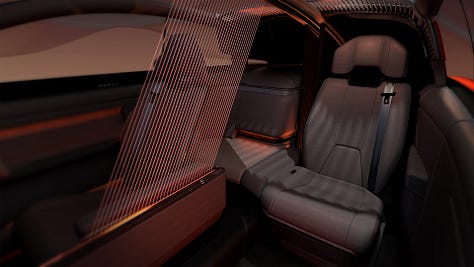
Designers at these brands have recognised that most of their customers frequently travel by first and business class in the air and so have come to know and value the individually secluded experience of the suite. These new car designs have some privacy screening and dedicated furniture within their suite-like space for their personal accoutrements. But no car brand, even in concept form, has yet challenged the forward facing side-by-side seating hegemony in car design with one that alternately orientates passengers at different angles and vertically overlaps leg space of one passenger with screen and storage space of another. Perhaps because car design has crash legislation that precludes sitting at much of an angle to the direction of travel, and cabins that tend not to be shared with strangers, and because cars have less space that can be dedicated to the individual too. But there is clear opportunity in three different ways for learning to be taken from these airline suites into car design:
1. With the emergence of truly luxurious large MPVs — such as the new Mercedes Benz VLE — there is now the space to embrace both seating angles that slightly deviate from the straight-ahead or rearwards, and to have vertical overlap of passenger’s spaces.
2. The idea of privacy and individual seclusion, and to variably affect this with moving screens or doors, has marked potential for rear-seat accommodation in large luxury cars, and arguably for all classes of car in some optional form.
3. Regardless of car type, airline suites shows the high value for passengers to store or rest or charge or warm or cool personal accoutrements and food items, and also to have personal (slave) screens.
So car design can take direct learning from airline cabin design — recognise both that they share customers who have expectations formed as they travel in the air that they take to their travel on the ground, and recognise the value of the best airliner suite design solutions too.
It is not a one-way street from design in the air to the ground though. There are many ways that automotive interior design and wider in-car UX design has and is advancing in ways beyond that of airliner cabin design. Broadly there is scope to see wins from greater cross-pollination between airline and car cabin design. And specifically, if today’s premium travel in the air is all about the suite, tomorrow’s premium travel on the ground will also be all about the suite.
#cardesign
#cardesignresearch
#AIX2026
No posts
Comments
Nothing yet. Say the first thing.
Sign in to join the conversation.