
If you only read one post in this series, this is probably the one. Shale changed everything about US and global energy in the last fifteen years, and the climate community’s intuitions about oil and gas were largely formed before the change had fully landed. Most of what’s confusing about US energy policy in 2026, the LNG export debate, the methane regulation fights, and the question of whether US gas prices are about to spike trace back to the technical and economic features of unconventional production.
The shale revolution
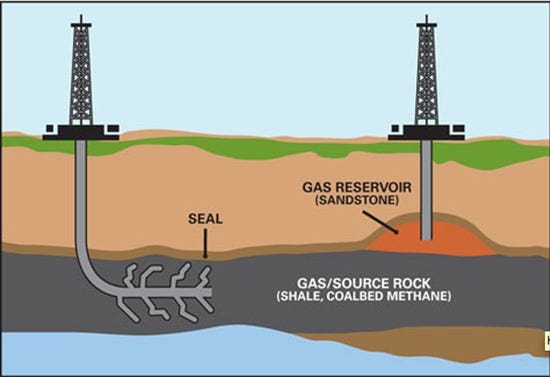
For most of the 20th century, shale was a source and seal rock, never a reservoir. Geologists knew shale held enormous quantities of hydrocarbons. It was just uneconomic to get them out. The permeability is too low. Even with a long horizontal wellbore exposing thousands of feet of rock, the hydrocarbons don’t flow.
The trick was to combine two technologies that had each existed independently for decades: horizontal drilling and hydraulic fracturing. Horizontal drilling matured in the 1980s. Hydraulic fracturing, pumping fluid into a wellbore at high pressure to crack the rock, was first applied commercially in 1949 in Stephens County, Oklahoma, and became routine for stimulating conventional wells over the following decades. The breakthrough was combining them at scale, with the right fluid chemistry and proppant technology, in shale formations specifically. This breakthrough came in the private sector, but was built on decades of public sector funding of research and development.
Mitchell Energy is generally credited with cracking the commercial puzzle in the Barnett Shale of north Texas in the late 1990s, after roughly two decades of trial and error. Once Mitchell proved it worked, the technique spread fast: Fayetteville, Haynesville, Marcellus, Eagle Ford, Bakken, and finally the Permian, which is now the most productive oil basin in the world.
Why did it work in the US, and not anywhere else? Shale formations exist on every continent. The reasons it scaled in the United States and basically nowhere else are:
Decades of public funding The United States government is one of the largest funders of research and development on cutting-edge energy technologies. They had been derisking the early development of horizontal drilling and hydraulic fracturing decades before it was commercialized.
Private mineral rights In the US, landowners typically own the hydrocarbons under their property and can lease them directly to operators. Everywhere else in the world, the state owns subsurface minerals. That single legal difference made it economically possible for tens of thousands of independent landowners to sign leases with hundreds of independent operators, generating the rapid trial-and-error that the technique needed.
A mature service ecosystem Halliburton, SLB, Baker Hughes, and a long tail of regional pressure-pumping companies meant the technical capability to drill and complete a horizontal well at $7M existed off the shelf.
Capital markets are willing to fund it US public and private debt markets funded the shale boom through years of negative free cash flow on the bet that productivity would eventually catch up. It mostly did, eventually. Few other countries have capital markets willing to take that bet.
Pipeline infrastructure to move the product A new shale well in the Marcellus or Permian connects to existing gas and oil takeaway capacity within months. In most of the world, getting a product to market is a separate multi-year project.
The result was a near-doubling of US oil production from 2010 to 2024, from around 5.5 million barrels per day to 13.4 Mbpd, and a roughly equivalent surge in gas production. The US went from a net oil and gas importer to a net exporter of both. Global oil markets, which had spent the 2000s anticipating a peak in non-OPEC supply, were instead flooded with new American molecules. The geopolitics of energy got rewritten in about a decade.
Hydraulic fracturing
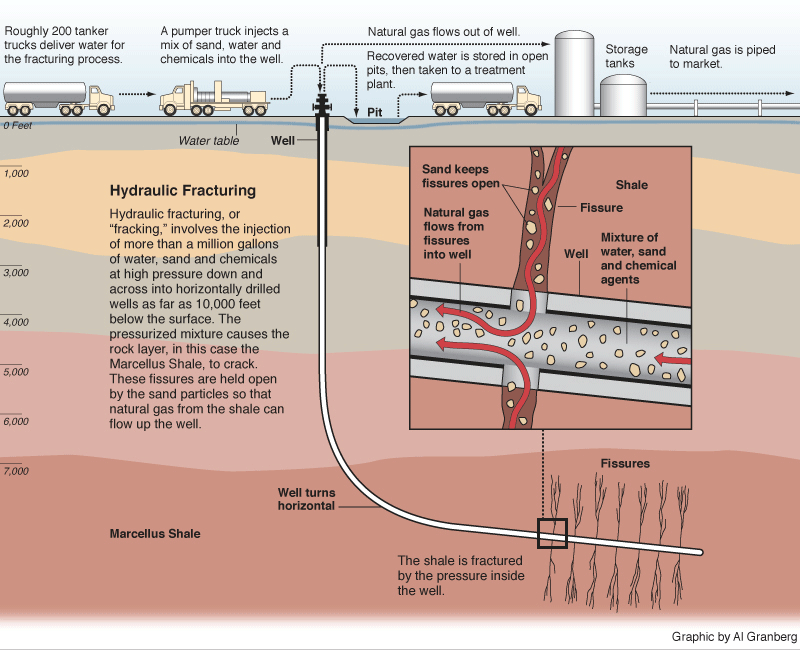
After a horizontal section is drilled and cased, you pump fluid down the well at pressures high enough to crack the surrounding rock. The fluid is roughly 90% water, 9% sand or ceramic proppant, and 1% chemical additives: friction reducers, biocides, scale inhibitors, and surfactants. The cracks (called fractures) propagate outward from the wellbore for tens to hundreds of feet. The proppant lodges in the fractures and holds them open after pressure is released, creating a network of high-permeability pathways that connect the otherwise impermeable shale to the wellbore.
A modern Permian well is fracked in stages. They start typically 30 to 60 of them along a 10,000-foot lateral, with each stage stimulated separately. Total water use per well runs several million gallons, and the whole operation takes a few weeks.
A quick aside on fluids, since I underplayed this in the last post. The drilling muds I described earlier come in three flavors: water-based, oil-based, and synthetic-based. The choice involves real tradeoffs in performance, cost, and environmental impact. Oil-based muds give you better lubricity, better shale stability, and superior performance in deep or hot wells, but they’re expensive, and most jurisdictions ban discharging the cuttings to the environment. Water-based muds are cheaper and easier to dispose of, but underperform in challenging formations. Synthetic-based muds emerged in the 1990s as a compromise: the performance of oil-based muds with much lower toxicity, and offshore disposal regulations have evolved to accommodate them. The North Sea outright bans discharging oil-based mud or contaminated cuttings; the Gulf of Mexico has a more permissive regime that’s evolved over time. Frack fluid chemistry has its own version of the same tradeoff. Slickwater versus gel versus hybrid systems, each optimized for a different rock type.
The politics of it all
This is the technique that became politically synonymous with everything controversial about US oil and gas. Worth being honest about which controversies are about the frack job itself and which are not.
Methane emissions are the most climate-relevant impact of US shale by a wide margin. Methane leaks from wellheads, valves, separators, gathering lines, processing plants, and abandoned wells. Aerial and satellite measurements consistently find that actual emissions exceed inventory estimates. A 2024 Science paper using aircraft data found methane emissions roughly three times higher than the EPA inventory across major US basins. Policy on this has been a pendulum: EPA finalized methane rules and a Waste Emissions Charge in 2024, Congress repealed the implementing rule in March 2025, and EPA enforcement priorities subsequently shifted away from methane. The underlying statutory charge remains on the books without an implementing rule, and the EU methane import standard still creates trade-side pressure on US producers selling into Europe. The technical truth (methane leaks are real and cheap to fix) and the policy truth (US federal pressure is currently soft) are both worth holding in mind.
Water is two issues. First, freshwater consumption, several million gallons per well, in arid basins like the Permian, is non-trivial though small relative to agriculture. Second, the produced water that comes back up the well is hyper-saline brine, often radioactive, and has to be disposed of. Most of it gets injected into deep disposal wells, regulated as Class II under EPA’s Underground Injection Control program.
Induced seismicity is mostly not about the frack itself. It’s about the wastewater disposal that follows. Oklahoma went from an average of 24 magnitude-3+ earthquakes per year before 2008 to 688 in 2014, driven primarily by high-volume injection of produced water into deep formations near the basement rock. The state regulator imposed depth and volume limits starting in 2015, and the seismicity rate dropped sharply. Hydraulic fracturing itself can also induce earthquakes, but these are typically smaller and rarer than the wastewater-driven swarms. The policy implication is that “ban fracking” is roughly the wrong instrument for the seismicity problem; “regulate injection wells” is the right one.
One bonus point worth flagging, courtesy of a reader of this Substack: acid gas injection is the oil industry name for what other industries call carbon sequestration. Sour gas processing facilities have been injecting CO2 (along with H2S) underground for decades to handle hydrocarbon streams that contain too much sulfur and CO2 to sell. Regulated as Class II wells under UIC, same category as oilfield wastewater disposal, rather than as Class VI dedicated CO2 sequestration. Same physical activity, same molecule going underground, but a different regulatory pathway and a different economic accounting. Recent academic work has explored whether 45Q tax credits could make AGI wells economically viable as dedicated CCS infrastructure, which would essentially recategorize an existing oilfield practice as a climate solution. This is the kind of overlap that runs throughout the upstream-to-CCS interface.
It’s tough to wade through the physical realities of shale versus the politics of shale. But my view is that shale has both lowered US emissions (by displacing coal in power generation) and contributed substantially to global emissions (by being burned). Methane is a local-to-global climate concern. Water and seismicity are mostly solvable with good regulation. Surface impacts are real but localized.
Decline curves: Shale Lives Like it was Dying
A conventional well declines slowly. After an initial flush of production, it settles into something like 8–10% annual decline, which it sustains for decades. A field operator can confidently project that a well drilled in 2026 will still be producing in 2046 at maybe 15% of its initial rate.
A shale well does not behave like that. The first-year decline rate on a typical Permian or Bakken well is 50–70%. The second-year decline is another 30%. After three years, a shale well is producing maybe 10–15% of its initial rate. After five years, the late-life decline rate is still 17–23% — much higher than the conventional 8–10%. This precipitous rate of decline and need to continue drilling is often called the Red Queen Syndrome (thank you Dr. Aidan Preston for the correction on the terminology).
To grow shale production, you have to drill new wells fast enough to overcome the legacy decline of all your existing wells. The industry calls this the treadmill, and it speeds up every year as the production base grows. Recent analysis finds that shale decline curves are getting steeper as wells get drilled closer together (because closer-spaced wells interfere with each other), which means the treadmill is getting faster.
To stand still, to keep the Permian flat at its current production, operators have to drill thousands of new wells per year just to replace what their existing wells lose. To grow, they have to drill even faster. The moment drilling stops, production starts collapsing within months.
This is the structural feature that makes shale fundamentally different from conventional production. And it’s why short-cycle is a meaningful descriptor. Shale really is a quarter-to-quarter business in a way that conventional oil and gas simply is not.
The associated gas challenge
A meaningful share of US natural gas is not produced from gas wells. It’s produced as a byproduct of oil wells. When a well is drilled into an oil reservoir, gas dissolved in the oil comes out alongside the oil at the surface. The industry calls this associated or produced gas.
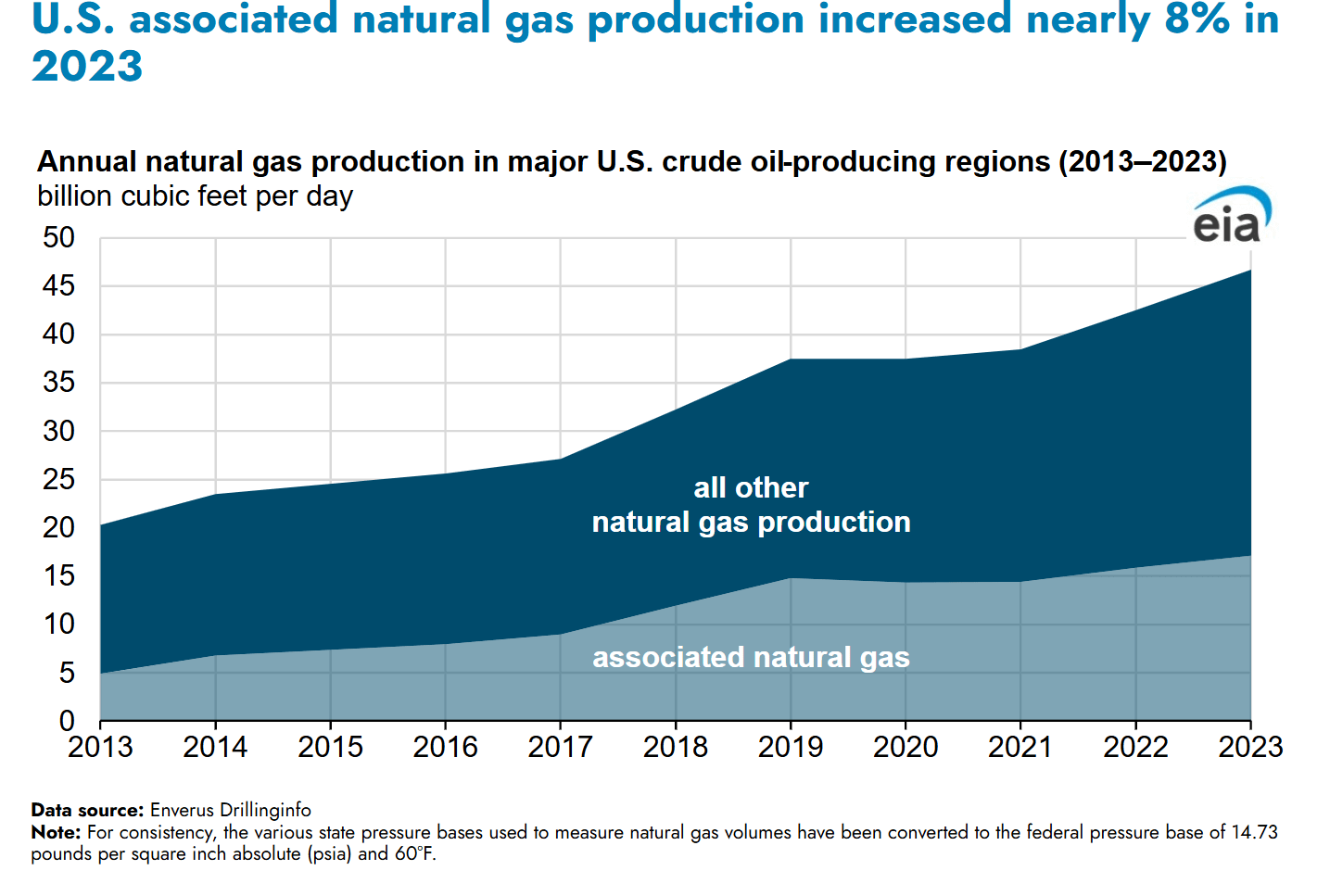
In 2024, US associated gas production from the five major oil-producing regions averaged 18.5 Bcf/d, about 14% of total US gas production. In the Permian specifically, 40% of total production by energy content is now gas, not oil, and the gas-to-oil ratio is rising as the basin matures. The Bakken’s associated gas share is 67%. Eagle Ford is similarly heavy.
The decision to drill those wells is an oil decision. When WTI is at $80, Permian operators drill aggressively, and a flood of associated gas comes out alongside the oil, whether anyone wanted it or not, which is part of why Henry Hub prices have been suppressed for years and why WAHA is currently negative in natural gas prices. When WTI drops to $50 and oil drilling slows down, associated gas falls with it, regardless of what gas demand is doing.
The implication is that a non-trivial share of US gas supply is yoked to the oil price, not the gas price. That coupling complicates a few common climate frames. The “natural gas as a transition fuel” argument depends on a stable, low-cost gas supply. If a meaningful share of that supply is coming as a byproduct of declining shale oil wells, then in a scenario where oil demand peaks and shale oil drilling slows down, gas supply is going to fall whether we want it to or not. That tightening pushes gas prices up, makes coal more competitive, and makes the transition harder, not easier.
This is also where decline curves come back to bite. As the existing shale oil base ages and declines at 50–70% in year one and 30% in year two, the associated gas base declines with it. To keep US gas production flat in a low-oil-price scenario, you’d have to drill a much higher share of dedicated gas wells (in the Marcellus, Haynesville, Utica) to replace the falling associated gas or do more enhanced oil recovery to keep the oil and gas flowing. That requires a price signal, a higher Henry Hub, to make those projects economic. This means a real risk of structurally higher US gas prices in the late 2020s and early 2030s if oil drilling slows down.
It’s a coupled-supply issue that has real implications for LNG export economics, US power sector emissions, and the cost of decarbonizing residential heating, and it gets discussed surprisingly little in climate writing.
Climate implications
The five things from this post most likely to matter for climate work:
Shale and conventional are different businesses, not different versions of the same business Shale is short-cycle (months from decision to first production), capital-light per well (~$8M), and brutally decline-driven. Conventional is long-cycle and produces for decades. A climate strategy that treats them identically will fail on at least one of them.
Methane, not CO2, is the lowest hanging fruit in upstream climate intervention Methane leak reduction is technically cheap and operationally well-understood, with remote sensing increasingly making it enforceable. The marginal climate return on a dollar spent on US upstream methane reduction is much higher than the same dollar spent on most other oil and gas climate interventions
A meaningful share of US gas is yoked to oil If oil drilling slows for any reason, peak demand, capital discipline, policy, or associated gas falls with it. That coupling means the “abundant cheap gas as transition fuel” thesis is more fragile than it looks, and structural gas price increases are a real risk in scenarios where oil demand peaks or unconventional shale oil supply peaks.
Induced seismicity is a wastewater problem, not a fracking problem The political framing that bundles them together leads to the wrong policy instruments. Regulating injection-well depth and volume reduces seismicity. Banning hydraulic fracturing does almost nothing for it.
Acid gas injection is carbon sequestration by another name AGI wells under Class II have been injecting CO2 underground for decades, but they don’t count toward most climate accounting frameworks because they’re permitted as oilfield disposal rather than dedicated CCS. Whether to recategorize this existing infrastructure (under 45Q or otherwise) is one of the more interesting open policy questions at the upstream-CCS interface.
What’s next
Next post moves above ground. Pipelines, tankers, LNG, storage. The boring middle of the value chain that quietly determines who can sell what to whom and at what price. The geopolitics of the Strait of Hormuz, Henry Hub vs TTF, why LNG export terminals take a decade to build, and why “the gas grid” is more like several mostly-disconnected regional markets than a global commodity.
Glossary
New terms introduced in this post (post 2 and 3 glossaries still apply):
Acronyms
AGI — Acid Gas Injection. The oil industry practice of injecting CO2 and H2S underground from sour gas processing facilities, regulated as UIC Class II in the US. Functionally similar to dedicated carbon sequestration but classified differently.
Bcf/d — Billion cubic feet per day. Standard unit for natural gas production at country or basin scale.
bpd — Barrels per day.
CCS — Carbon Capture and Storage. The dedicated practice of capturing CO2 from industrial or atmospheric sources and storing it underground. Regulated as UIC Class VI in the US.
EPA — Environmental Protection Agency. US federal regulator with jurisdiction over air emissions, water, and underground injection.
EUR — Estimated Ultimate Recovery. The total volume of oil or gas a well is expected to produce over its lifetime.
GOR — Gas-to-Oil Ratio. The volume of gas produced per barrel of oil from a given well, usually expressed in thousand cubic feet per barrel (Mcf/b).
Henry Hub — The pricing point in Erath, Louisiana that anchors the US natural gas futures market.
Mbpd — Million barrels per day.
OBM / WBM / SBM — Oil-based mud, water-based mud, synthetic-based mud. The three main families of drilling fluid, each with different performance characteristics, costs, and environmental tradeoffs.
TTF — Title Transfer Facility. The pricing point that anchors the European natural gas market, located in the Netherlands.
WEC — Waste Emissions Charge. The methane fee established by the Inflation Reduction Act of 2022. EPA’s implementing rule was repealed by Congress in March 2025; the underlying statutory charge remains technically on the books but is not actively enforced.
WTI — West Texas Intermediate. The benchmark crude oil grade priced at Cushing, Oklahoma; one of the two main global oil price benchmarks (the other being Brent).
Terms
Associated gas — Natural gas produced as a byproduct of an oil well, dissolved in the oil at reservoir pressure and released at the surface.
Class II / Class VI wells — EPA Underground Injection Control well classifications. Class II covers oil and gas-related injection (wastewater disposal, EOR, AGI). Class VI is the dedicated CO2 sequestration class established in 2010, with stricter monitoring, reporting, and verification requirements.
Hydraulic fracturing (fracking) — Pumping fluid into a well at high pressure to crack the surrounding rock and create flow pathways. Combined with horizontal drilling, the basis of the shale revolution.
Induced seismicity — Earthquakes caused by human activity, in this context primarily by deep wastewater injection.
Lateral — The horizontal section of a horizontal well. Modern Permian laterals run 10,000 to 20,000 feet.
Mineral rights — Legal ownership of subsurface hydrocarbons. In the US, typically held by the surface landowner; in most other countries, by the state.
Pad / multi-well pad — A single surface location from which multiple wells are drilled in different directions, reducing surface footprint and cost.
Permeability — A rock’s ability to let fluids flow through it. Conventional reservoirs are highly permeable; shale is roughly a million times less so.
Produced water — The hyper-saline, often radioactive water that comes back up the well alongside oil and gas. Has to be disposed of, usually via deep injection.
Proppant — Sand or ceramic particles pumped into a fracked well to hold the fractures open after pressure is released.
Shale revolution — The combination of horizontal drilling and hydraulic fracturing that, starting in the early 2000s, made shale formations commercially producible and roughly doubled US oil and gas production over fifteen years.
Slickwater — A type of frack fluid with friction reducers added to allow high pumping rates. The dominant fluid for unconventional shale completions.
Sour gas — Natural gas containing significant H2S and/or CO2. Must be processed before sale, generating an acid gas stream that is typically injected underground (AGI).
Stage — A single segment of a horizontal well that is fracked separately. A modern Permian well has 30–60 stages.
Stripper well — A late-life well producing very small volumes (typically <15 boe/day). Roughly 80% of US wells are strippers, but they account for only ~6% of production.
Tight oil / tight gas — Oil or gas produced from low-permeability formations, requiring stimulation to flow. Often used interchangeably with “shale,” though tight formations can also include sandstones and carbonates.
Treadmill (the shale treadmill) — Industry shorthand for the constant drilling required to overcome decline of existing shale wells. The treadmill speeds up as the production base grows.
Wastewater disposal well — A well used to inject produced water into deep formations for permanent disposal. Distinct from EOR injection wells, which inject into producing reservoirs.
No posts
Comments
Nothing yet. Say the first thing.
Sign in to join the conversation.