
The first four posts of this series have been about getting hydrocarbons out of the ground. This one is about getting them somewhere they can be sold. It is the world’s most impressive logistics problem.
We are currently in the midst of two incredibly consequential energy events: Russia’s invasion of Ukraine and the ongoing fight over the Strait of Hormuz. Both have implications in the midstream of the oil and gas industry. Both show the challenges in moving the molecules from point A to point B. And that’s midstream.
The Messy Middle
The value of any cubic foot of gas or barrel of oil is contingent upon where it can go. A barrel of crude trapped in landlocked Alberta is worth less than the same barrel sitting at a Gulf Coast export terminal, because the latter has options. A cubic foot of Russian gas was worth one thing when it could flow through Nord Stream to Germany and a very different thing when it couldn’t.
The price of oil and especially gas is heavily location-dependent, and the location dependence is determined by the midstream infrastructure (or lack of it) that connects buyers to sellers. Pipelines, tankers, LNG terminals, and storage are the assets that determine which markets can compete with which others.
Midstream assets have long been a target of the climate community. The Keystone XL, Mountain Valley, and Atlantic Coast Pipelines, as well as the LNG export pause, all had extensive pushback. There’s even a book called “How to Blow up a Pipeline” for the curious. These fights are not likely to subside, as the concerns about stranded assets grow stronger.
FERC It
Pipelines are the workhorse of onshore oil and gas movement. Crude oil pipelines, refined product pipelines, and natural gas pipelines all use roughly the same physical setup. They are buried steel pipes, with compressor or pump stations every 50–100 miles to maintain pressure.
The North American grid is enormous. The US has roughly 3 million miles of natural gas pipelines and 230,000 miles of liquid petroleum pipelines, regulated primarily by the Federal Energy Regulatory Commission (FERC) for interstate gas pipelines and a patchwork of federal and state agencies for oil. The big midstream operators, Enbridge, Energy Transfer, Kinder Morgan, TC Energy, Williams, are utility-like businesses earning regulated returns on tariffs that pipeline shippers pay per barrel or per Mcf moved. This return is set by FERC. The economics look more like an electric utility than like an oil producer. These companies deal in long-lived assets, predictable cash flows, modest growth, and leveraged balance sheets.
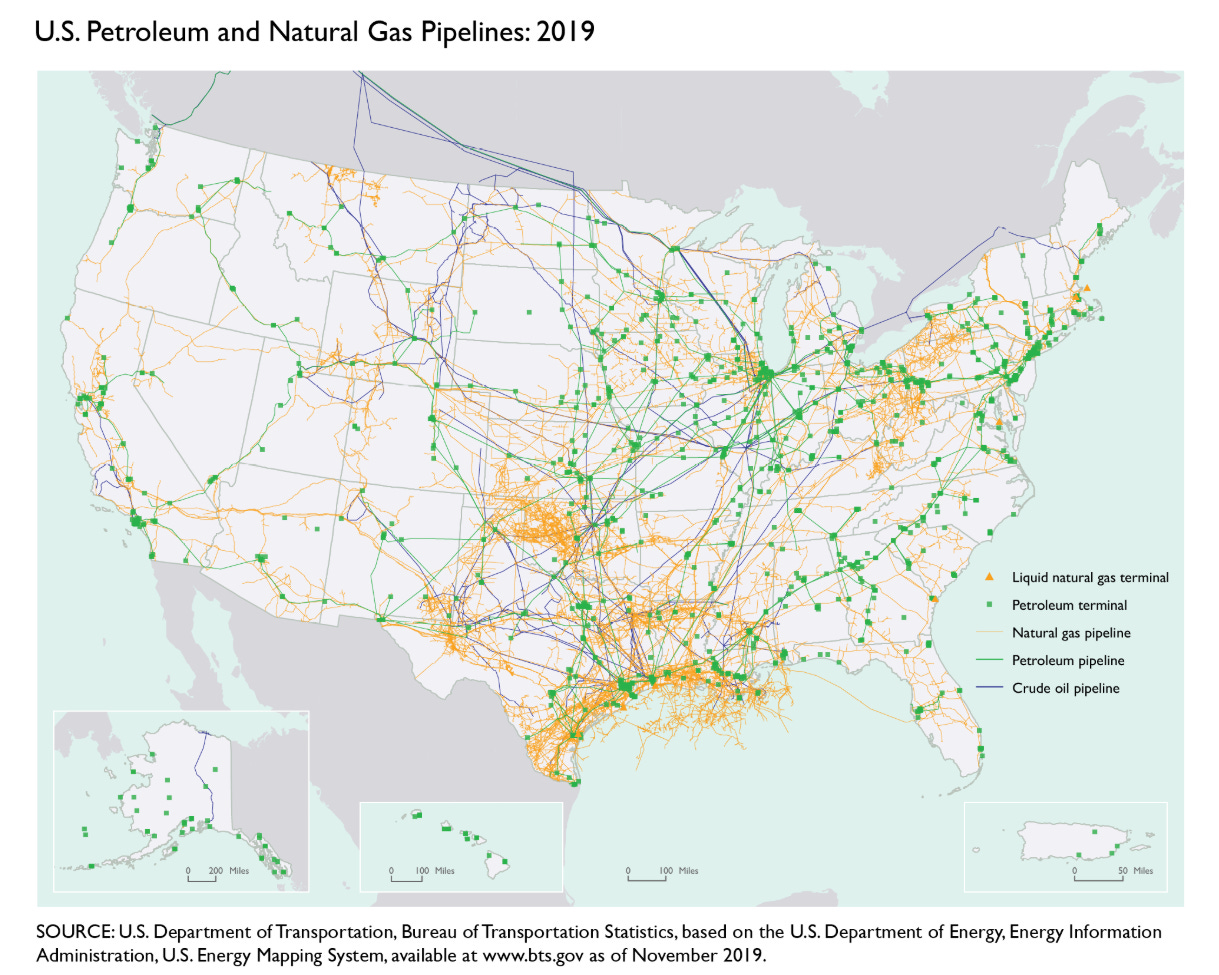
The political topic de jour and the name of the game in the midstream is permitting. Building a new interstate pipeline requires authorizations from FERC, the Army Corps of Engineers, the Fish and Wildlife Service, sometimes the Forest Service or BLM, and state water-quality certifications under the Clean Water Act.
How pipelines work
Oil pipelines are deceptively simple-looking infrastructure that hides many engineering decisions. The pipe itself is steel or carbon steel for crude lines, with diameters ranging from 6 inches for gathering lines that collect oil from individual wells up to 48 inches for major trunk lines like Keystone or the Trans-Alaska Pipeline. Wall thickness scales with operating pressure. Pipe sections come in 40-foot or 80-foot joints that get welded together in the field, with each weld X-rayed or ultrasonically inspected to verify integrity. The completed pipeline is then coated externally and protected by cathodic systems, running a low-voltage current through the pipe to prevent corrosion in contact with the soil. Buried depth is typically three to four feet, deeper at road and river crossings.
Pump stations move crude oil spaced every 50 to 100 miles, depending on terrain. Each station has multiple centrifugal pumps in series or parallel, typically electric-driven, and the pumps re-pressurize the line to push the crude over the next segment. Operators sometimes inject drag-reducing agents like long-chain polymers that smooth turbulent flow at the pipe wall to increase throughput by 20-40% without adding pumps. Heated lines exist for moving heavy or waxy crudes, but most pipelines operate at ambient temperature.
A single pipeline rarely carries just one crude. Most major lines run “batches”. These are sequential slugs of different crude grades, each typically 20,000 to 100,000 barrels, separated by interfaces where some intermixing inevitably occurs. The interface volume gets diverted to a tank for reprocessing or sold at a discount. Refined product pipelines run more grades and require even tighter scheduling and interface management. Pipeline operators run computerized scheduling systems that look more like air traffic control than logistics, coordinating which shippers’ barrels enter where and exit where, with custody transfer measured at each point to fractional-percent accuracy because the dollar values are large enough that a 0.1% measurement error becomes real money.
Monitoring is the unglamorous part that determines whether a line operates safely. SCADA systems (Supervisory Control and Data Acquisition) read pressure, flow, and temperature sensors every few seconds along the line and feed them to a central control room. Leak detection algorithms compare the expected mass balance) what went in vs. what came out vs. what the line should be holding) against measured values, and flag anomalies. Smart pigs, instrumented inspection robots that travel inside the line themselves, are wild devices. They crawl through the pipe at flow speed using magnetic flux leakage or ultrasonic sensors to map wall thickness, find dents, and identify corrosion or cracking before it becomes a rupture. A major pipeline gets pigged every 3-5 years. The data goes into integrity management programs that drive repair and replacement decisions. None of this prevents every spill, but it’s the difference between modern pipelines spilling at rates of fractions of a barrel per million barrels moved versus the order-of-magnitude-worse rates of fifty years ago.
Rip it and ship it in big ass tankers
Crude oil is a genuinely global commodity. A barrel produced in Saudi Arabia, Brazil, Norway, or the Permian can, in principle, be sold to a refiner in any of dozens of countries, because tankers can go almost anywhere.
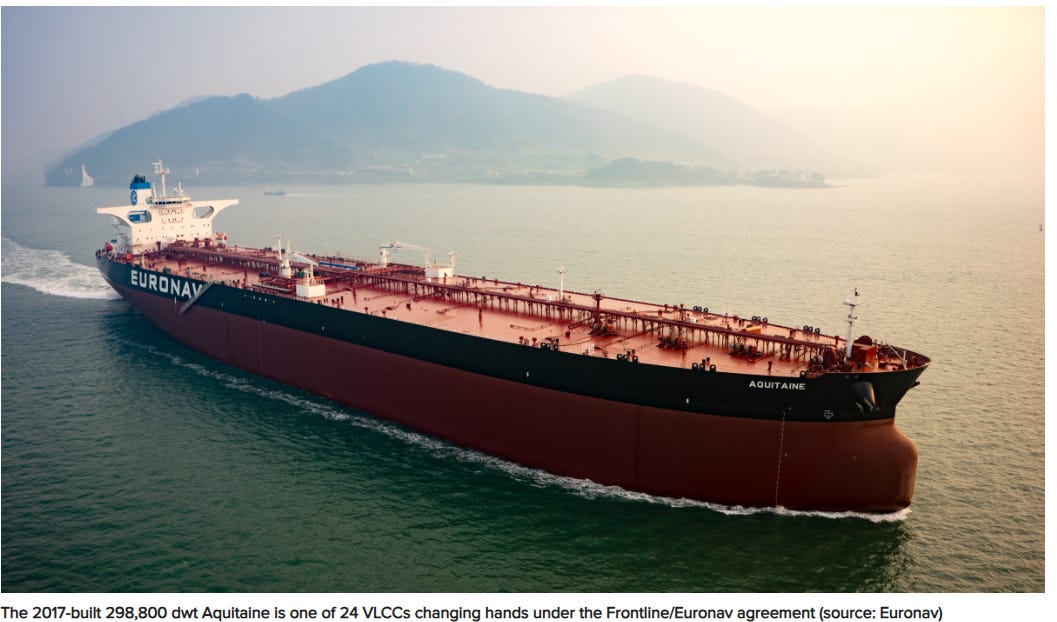
The shipping fleet sorts by size. VLCCs (Very Large Crude Carriers) carry 2 million barrels each and dominate Persian Gulf-to-Asia routes. VLCCs are one of the best naming conventions in oil and gas, just straight to the point of what it is. Suezmaxes and Aframaxes carry 1 million and 700,000 barrels, respectively, and serve regional routes (Atlantic basin, Mediterranean, intra-Asia). Day rates fluctuate wildly with geopolitical risk and seasonal demand, but the ships themselves are commodified. There are something like 800 VLCCs in the global fleet, owned by hundreds of operators.
Hormuz
A little case study. The Strait of Hormuz is a narrow passage between Iran and Oman that connects the Persian Gulf to the Arabian Sea. At its narrowest, it’s about 21 nautical miles wide, with shipping lanes only a few miles across. Saudi Arabia, Kuwait, Iraq, the UAE, Qatar, Bahrain, and Iran all export oil through it. In 2024, it carried roughly 20 million barrels per day, about 20% of global petroleum liquids consumption and more than a quarter of global seaborne oil trade. It also carried about 20% of global LNG trade, primarily Qatari cargoes.
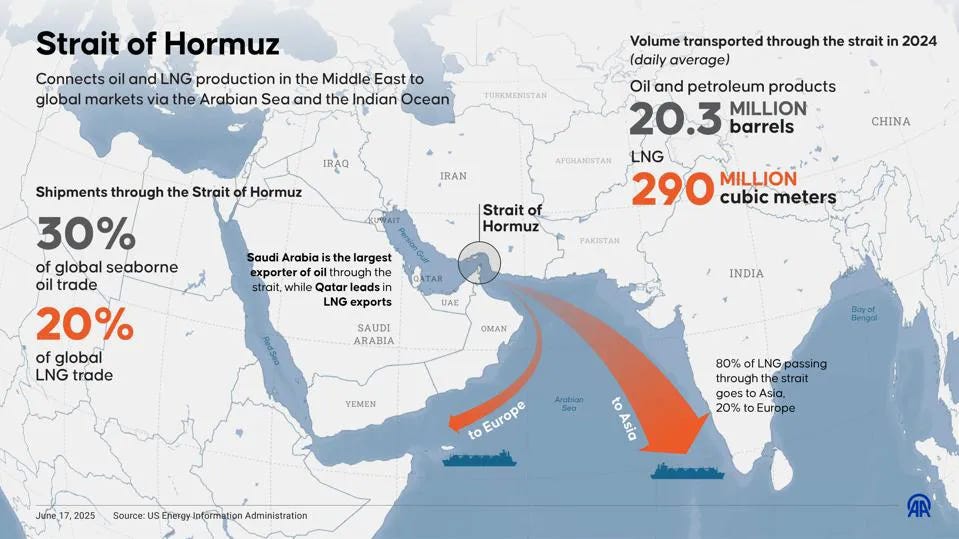
There is no good substitute. Saudi Arabia and the UAE have pipelines that bypass the strait — Saudi Aramco’s East-West pipeline (5 million b/d, expandable to 7) and the UAE’s Habshan-Fujairah pipeline (1.5 million b/d) — but together they can divert maybe 3.5 million b/d if pushed hard. The other producing countries (Iran, Iraq, Kuwait, Qatar, Bahrain) have effectively zero alternatives. Asian buyers, China, India, Japan, and South Korea, depend on Hormuz for the substantial majority of their crude. Pakistan and Bangladesh depend on it for most of their LNG.
In non-war times, this is a reliable supply corridor. Iran has periodically threatened to close it, most seriously during the 2018-2019 sanctions standoff and again in March 2026, when Iranian forces attacked over a dozen vessels in and around the strait following US and Israeli strikes on Iranian targets.
The Strait of Hormuz has been effectively closed since early March 2026, following the February 28 US-Israeli strikes on Iran and the assassination of Supreme Leader Ali Khamenei. Iran imposed a blockade, attacked vessels attempting transit, and laid sea mines in the strait; the US imposed a counter-blockade on Iranian ports beginning April 13. The closure has now lasted over two months, with roughly 2,000 commercial vessels stranded and 22,500 mariners trapped on more than 1,550 ships per the Joint Chiefs. The IEA has called it the largest oil supply disruption in the history of the global market. The bypass pipelines from Saudi Arabia and the UAE are running near maximum, but they cover only a fraction of normal Hormuz throughput, leaving a net shortfall of 14-16 million barrels per day. Even after a ceasefire is reached, US officials estimate it will take six months to clear the mines, and shipping companies, including Hapag-Lloyd, say transits will not resume until insurers underwrite war risk again. Industry analysts expect it to be a gradual, months-to-years process rather than an immediate return to pre-war flows. The economic shock has been severe. Oil, refined products, and LNG prices have spiked. Pakistan and other Asian importers have scrambled for alternative supply routes. Iraq has shut down operations at the Rumaila oil field due to a lack of storage (tankers can’t leave to deliver crude).
Natural gas is regional, not global
Natural gas is fundamentally a regional commodity, not a global one. Pipelines carry it across continents but not across oceans. As a result, there are three mostly-disconnected gas markets in the world: North America (anchored on Henry Hub in Louisiana), Europe (anchored on the Title Transfer Facility, or TTF, in the Netherlands), and Asia (anchored on the Japan-Korea Marker, or JKM, plus various national benchmarks). In late 2024 and 2025, Henry Hub traded around $3-4 per million BTU while TTF traded $13-15 and JKM traded $12-15.
LNG Case Study: Russian Accelerationism
LNG is natural gas chilled to about -162°C, at which point it becomes liquid and shrinks to roughly 1/600th of its gaseous volume. That liquid can be loaded onto specialized cryogenic tankers and shipped anywhere. At the destination, it gets warmed back into gas and fed into a pipeline grid. Liquefaction, shipping, and regasification are the three pieces of infrastructure that together turn regional gas into something approximating a global commodity.
The economics are punishing. A liquefaction terminal costs roughly $10-20 billion to build and takes 5-7 years from FID to first cargo. Almost all liquefaction projects require 20-year offtake contracts to secure financing. Regasification terminals (or floating storage and regasification units, FSRUs) are smaller and faster but still measured in billions and years. The LNG carrier fleet itself is highly specialized and growing; there are around 700 ships globally, with new ones costing $250M+ each.
Before the invasion, Russia supplied the EU with about 155 billion cubic meters of gas in 2021, roughly 45% of EU gas imports, almost all via pipeline. Nord Stream, Yamal, the Ukrainian transit corridor, and TurkStream. The European gas system was built around that supply. By 2025, Russian gas imports had fallen to about 36 bcm, pipeline transit through Ukraine ended on January 1, 2025, with the contract expiry, Nord Stream was sabotaged in September 2022, and most other flows had been cut by sanctions or sender-side decisions. LNG imports filled most of the gap. EU LNG imports rose to 140 bcm in 2025, with the US becoming the largest single supplier at roughly 58% of EU LNG (~76 bcm), up from about 19 bcm in 2021. Norway’s pipeline exports also rose modestly.
Building three years’ worth of LNG import capacity in eighteen months was the largest peacetime infrastructure mobilization in modern European history. It worked, in the sense that European homes were heated and European industry kept operating, but the cost was enormous: TTF spiked to over $90/MMBtu at one point in 2022 (vs typical $5-10), German industrial demand contracted significantly, and global LNG markets were squeezed for two years as Europe outbid Asia for cargoes. Coal generation actually rose in Europe in 2022 as gas-to-coal switching took place under emergency conditions.
The climate-relevant takeaway is twofold. First, gas markets are tightly coupled in stress conditions, even when they’re loosely coupled in normal times. Second, the buildout of LNG infrastructure that Russia’s invasion accelerated is now a long-lived asset base that will shape European gas demand for decades. Those regasification terminals and 20-year supply contracts have effectively locked Europe into substantial gas consumption through the 2040s, on a timeline that is hard to reconcile with European decarbonization targets.
Storage
For oil, storage exists primarily for pricing and contract delivery. Cushing, Oklahoma, is the WTI delivery point and holds roughly 75 million barrels of capacity. The US Strategic Petroleum Reserve holds about 350 million barrels (down from a 2020 peak of 695 million after sales during the 2022 price spike). Commercial inventories at refineries and terminals are larger still.
For gas, storage is an operational necessity. The US has about 4 trillion cubic feet of underground gas storage capacity in depleted gas reservoirs, salt caverns, and aquifers. Gas storage absorbs summer-winter demand seasonality and acts as a buffer against supply shocks. Europe’s massive draw on storage during the 2022-2023 winter kept the lights on.
Storage matters more in a transition scenario. The more variable the supply, the more buffer capacity the system needs.
Climate implications
The five things from this post most likely to matter for climate work:
Midstream determines what’s possible upstream Stranded gas is gas that has no pipeline to a market. This is part of why pipeline fights have been politically popular.
Hormuz is one of the largest single energy security risk on Earth A sustained closure would force a coal-back-on, but will also create demand destruction and a new wave of energy security policies
Gas is regional unless you have LNG infrastructure, and LNG infrastructure is a multi-decade asset The European LNG buildout post-2022 has effectively locked in substantial European gas demand through the 2040s.
The transition will create more midstream stress, not less When demand shifts faster than infrastructure can build or rebuild, you get price spikes, fuel-switching, and emergency political compromises..
What’s next
Next post moves into the refinery.
Glossary
New terms introduced in this post
Acronyms
Bcm — Billion cubic meters. The standard unit for natural gas at country scale in European data; one Bcm ≈ 35.3 Bcf.
FERC — Federal Energy Regulatory Commission. The US federal regulator with jurisdiction over interstate natural gas pipelines, electricity transmission, and LNG export terminal siting.
FSRU — Floating Storage and Regasification Unit. A ship-based regasification facility that allows faster deployment of LNG import capacity than onshore terminals.
FTA — Free Trade Agreement. US LNG exports to FTA countries are presumptively in the public interest; non-FTA countries require DOE public interest determination.
JKM — Japan-Korea Marker. The spot price benchmark for LNG delivered to Northeast Asia.
MMBtu — Million British thermal units. Standard unit for natural gas pricing.
MVP — Mountain Valley Pipeline. A 303-mile natural gas pipeline from West Virginia to Virginia, completed June 2024 after a decade of permitting fights.
PHMSA — Pipeline and Hazardous Materials Safety Administration. The US federal regulator for pipeline safety.
SPR — Strategic Petroleum Reserve. The US government emergency oil stockpile, held in salt caverns along the Gulf Coast.
VLCC — Very Large Crude Carrier. A class of oil tanker carrying about 2 million barrels.
Terms
Aframax / Suezmax — Smaller crude tanker classes, carrying roughly 700,000 and 1 million barrels respectively. Aframaxes are the workhorse for regional Atlantic and Mediterranean trade.
Cushing — A town in Oklahoma that serves as the delivery point for WTI futures contracts. Cushing crude inventories are a closely-watched market signal.
Henry Hub — A natural gas pipeline interchange in Erath, Louisiana, used as the delivery point for US natural gas futures. The benchmark for North American gas.
Liquefaction — The process of cooling natural gas to about -162°C to convert it to LNG for shipping. Energy-intensive and capital-intensive.
LNG — Liquefied Natural Gas. Gas chilled to liquid form for transport in cryogenic tankers.
Nord Stream — A pair of natural gas pipelines built to transport Russian gas to Germany under the Baltic Sea. Sabotaged in September 2022.
Offtake contract — A long-term agreement to purchase a specified volume of a commodity, typically required to finance large midstream projects like LNG terminals. Usually 15–25 years in duration.
Regasification — The process of warming LNG back to gas at a destination terminal so it can be fed into a pipeline grid.
Strait of Hormuz — A narrow passage between Iran and Oman, the world’s most important oil and LNG chokepoint. Roughly 20% of global oil and 20% of global LNG transit it.
Tariff — In pipeline economics, the per-unit fee shippers pay to move oil or gas through the line. Pipeline tariffs are typically regulated, producing utility-like returns.
TTF — Title Transfer Facility. The Dutch virtual trading hub that anchors European natural gas pricing.
Underground storage — Natural gas stored in depleted reservoirs, salt caverns, or aquifers to balance seasonal demand. The US has about 4 trillion cubic feet of working capacity.
Comments
Nothing yet. Say the first thing.
Sign in to join the conversation.