
One of the most important things to understand about an oil or gas well is that it is dying from the moment it starts producing. Another is that some die slowly and some die fast, and the difference between those two patterns explains roughly twenty years of energy market history.
This post and the next are about how we get hydrocarbons out of the ground. I’m splitting them because conventional production and shale are very different businesses with different timescales, different climate implications, and different politics. This one covers the basics. How you drill a well, what casing actually is, how a conventional field gets produced from primary through tertiary recovery, and why a Saudi field can produce for seventy years. Next post is shale: the revolution, the politics of fracking, the red queen syndrome, and the important role of produced gas.
Get On a Rig
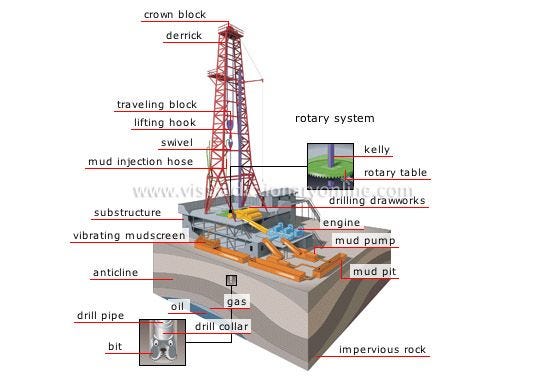
A drilling rig is a tower (called the derrick) that supports a long string of steel pipe with a rotating bit at the bottom. The bit chews through rock. As it goes deeper, you add more pipe, typically 27 to 30-foot sections called “joints” (API Range 2, the industry standard), to extend the string. The whole assembly rotates, the bit cuts, and the rock fragments (called cuttings) get carried back to the surface by drilling mud, a carefully engineered fluid pumped down the inside of the drill string and back up the annulus around it.
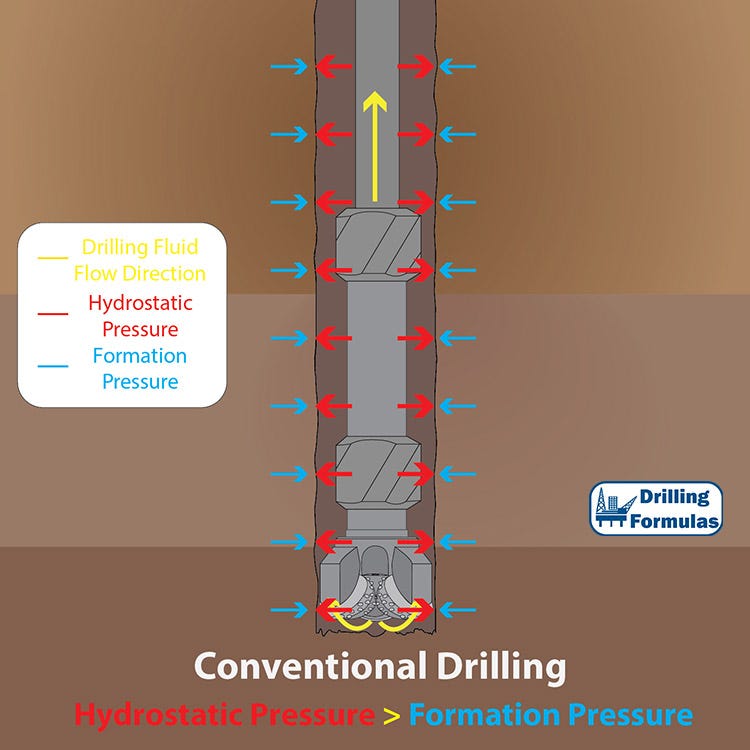
Drilling mud does several jobs at once: it cools and lubricates the bit, it carries cuttings up to the surface, it stabilizes the wellbore (preventing the rock walls from collapsing), it forms a thin filter cake on the borehole wall to prevent fluid loss into porous formations. Most importantly, it provides hydrostatic pressure to hold back any oil, gas, or water that might want to flow into the well uninvited. The pressure of the mud column has to be greater than the pressure of the formation fluids, or you get a kick, formation fluids enter the wellbore, which, if not controlled, becomes a blowout. Deepwater Horizon was a blowout caused by a failed well integrity test and a chain of bad decisions about mud pressure.
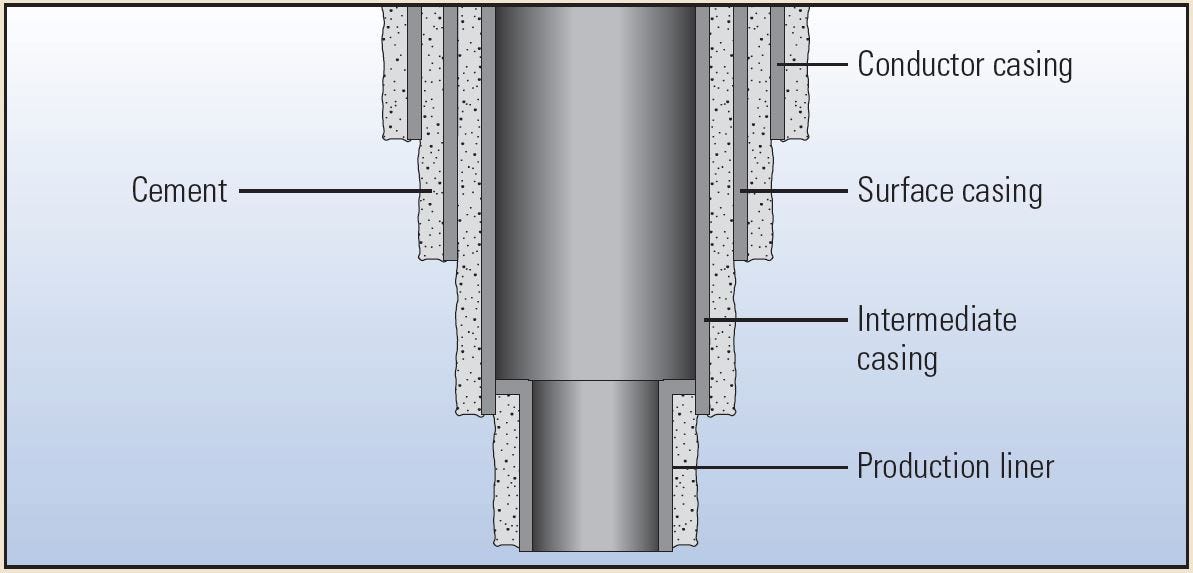
As you drill deeper, you periodically stop to install casing. Casing is concentric strings of steel pipe that get cemented into the wellbore to seal it off from the surrounding rock. A typical well has multiple casing strings, each smaller than the last, like a telescope. The outermost (called surface casing) protects shallow groundwater (technically, “underground sources of drinking water,” or USDWs, in EPA language). The intermediate strings isolate the wellbore from troublesome zones like overpressured shales, water-bearing formations, and lost-circulation zones where the mud disappears into porous rock. The innermost string (called production casing) lines the section that will eventually produce hydrocarbons.
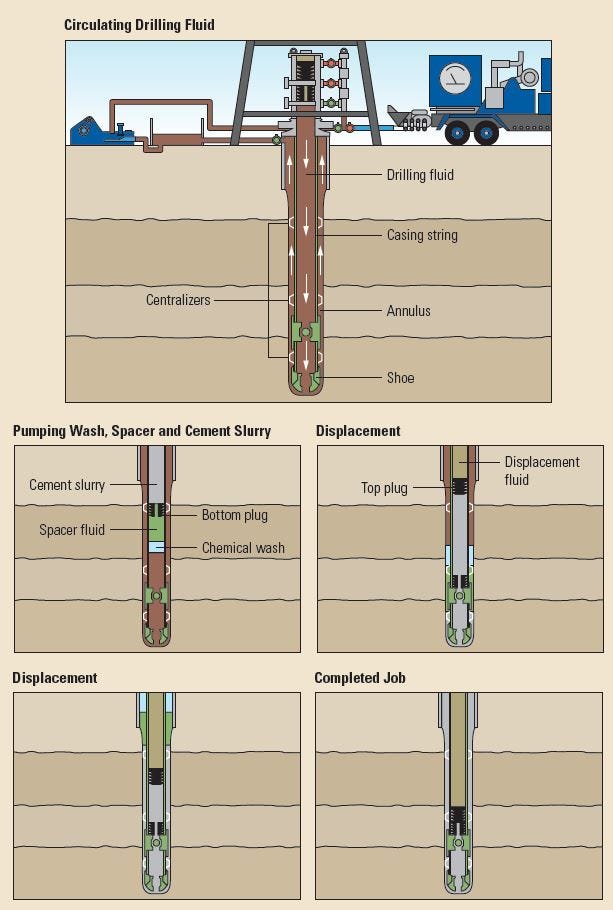
Cementing is what makes the casing actually do its job. Cement is pumped down the inside of the casing and up the annulus between casing and rock, where it sets. A good cement job is the difference between a well that produces cleanly for thirty years and a well that leaks methane into an aquifer. Cementing failures are one of the most common causes of well integrity problems. Federal regulations require periodic mechanical integrity tests precisely because the cement seal is invisible from the surface, which is part of why methane leakage from the upstream sector is hard to monitor.
Once the well reaches its target depth, you complete it. Completion changes a hole in the ground to a producing asset. You perforate (make holes in) the casing across the reservoir interval (using shaped explosive charges to blast holes through the steel and cement), running production tubing, installing valves and a wellhead at the surface, and hooking up to the surface gathering system.
Upways, downways, sideways, and any other ways you can think of going
For a century, almost all wells were vertical, straight down.
In the 1980s and 1990s, directional drilling matured. Using specialized motors mounted just above the bit (called mud motors) and steerable bottomhole assemblies, you could deflect the wellbore at controlled angles. A deviated well goes down at an angle. A horizontal well goes down vertically and then turns 90 degrees, running parallel to the surface through the target reservoir for thousands of feet.
This was a massive advancement in drilling and extraction because you can drill multiple wells from a single surface location, which matters when surface real estate is expensive. Also, a horizontal well exposes far more reservoir rock to the wellbore. A vertical well in a 100-foot-thick reservoir contacts 100 feet of rock. A horizontal well in the same interval can contact thousands of feet. For conventional reservoirs, this is a productivity boost. For shale, it’s the only thing that makes production possible at all! But that’s the next post.
Conventional production: primary, secondary, tertiary
A conventional oil or gas field typically produces in three phases.
Primary recovery: the natural pressure of the reservoir pushes hydrocarbons to the surface. Drill the well, open the valve, oil flows. This recovers maybe 10–20% of the oil in place before pressure drops too low to flow naturally. For gas, primary recovery is more efficient; gas expands as pressure drops, so you can typically recover 60–80% of a conventional gas reservoir on primary alone.
Secondary recovery: When pressure drops, you inject something to push more oil out. Usually, water (waterflood) is injected through dedicated injection wells while production continues from producer wells. A waterflood typically adds another 15–25% recovery on top of primary.
Tertiary recovery, also called enhanced oil recovery (EOR): when waterflood plays out, you inject something more aggressive. Steam (for heavy oil that’s too viscous to flow), chemicals (surfactants and polymers to mobilize trapped oil), or CO2 (which dissolves into the oil, reduces its viscosity, and sweeps it toward producers). EOR can add another 10–20% recovery on top of primary plus secondary.
The decline curves are gentle. Saudi Arabia’s Ghawar, the largest conventional oil field ever discovered, started producing in 1951 and is still going. North Sea fields developed in the 1970s and 80s are still producing in 2026, though most are in late life. Conventional production declines at roughly 8–10% per year absent further investment, which means a single well or field can be a thirty-year asset. That long, slow tail is what makes conventional oil and gas a fundamentally different business from unconventional.
In praise of CO2-EOR for the climate
CO2-EOR deserves a paragraph because it’s the technical and political bridge between this industry and the carbon storage world.
Inject CO2 into a depleted oil reservoir at the right temperature and pressure, and it becomes miscible with the residual oil. This means the two fluids mix rather than just push past each other. The CO2 swells the oil, drops its viscosity, and sweeps additional barrels toward the producing wells. It’s been done commercially in the Permian Basin since January 1972, starting at the SACROC field in West Texas. Today, CO2-EOR produces around 300,000 barrels per day in the US, about 2% of current US oil production (a much smaller share than during the pre-shale era, when it accounted for 5–6%), almost all of it in the Permian.
The climate-relevant complications are layered. First, most of the CO2 historically used for EOR has come from natural underground accumulations (Mississippi’s Jackson Dome being the biggest source), which complicates the net atmospheric CO2 equation that depends on the counterfactual (would this oil be produced anyway in a new well, what are the process emissions, etc.). Second, when industrial or DAC-sourced CO2 is used instead, EOR does sequester CO2 underground at a meaningful scale; around 600 million tonnes have been retained in Permian reservoirs to date, more than thirty years’ worth of emissions from a small fleet of coal plants. Third, the resulting oil still gets burned, so the lifecycle accounting depends entirely on how much CO2 stays underground per barrel of oil produced and consumed.
This is why CO2-EOR is treated very differently in different parts of the climate community. To some it’s the most mature CO2 storage technology we have, with existing infrastructure (roughly 2,400 miles of CO2 pipelines in the Permian alone, and over 5,000 miles across the US) that could be repurposed for dedicated saline aquifer storage. To others, it’s “greenwashing”, using carbon storage to produce more oil. The honest answer is that it depends on the CO2 source, the storage accounting, and the counterfactual. I’ll come back to this in later posts.
Offshore: conventional production at extreme engineering scale
Offshore is where the conventional model still operates at a large scale, and where the climate story is mostly about capital lock-in.
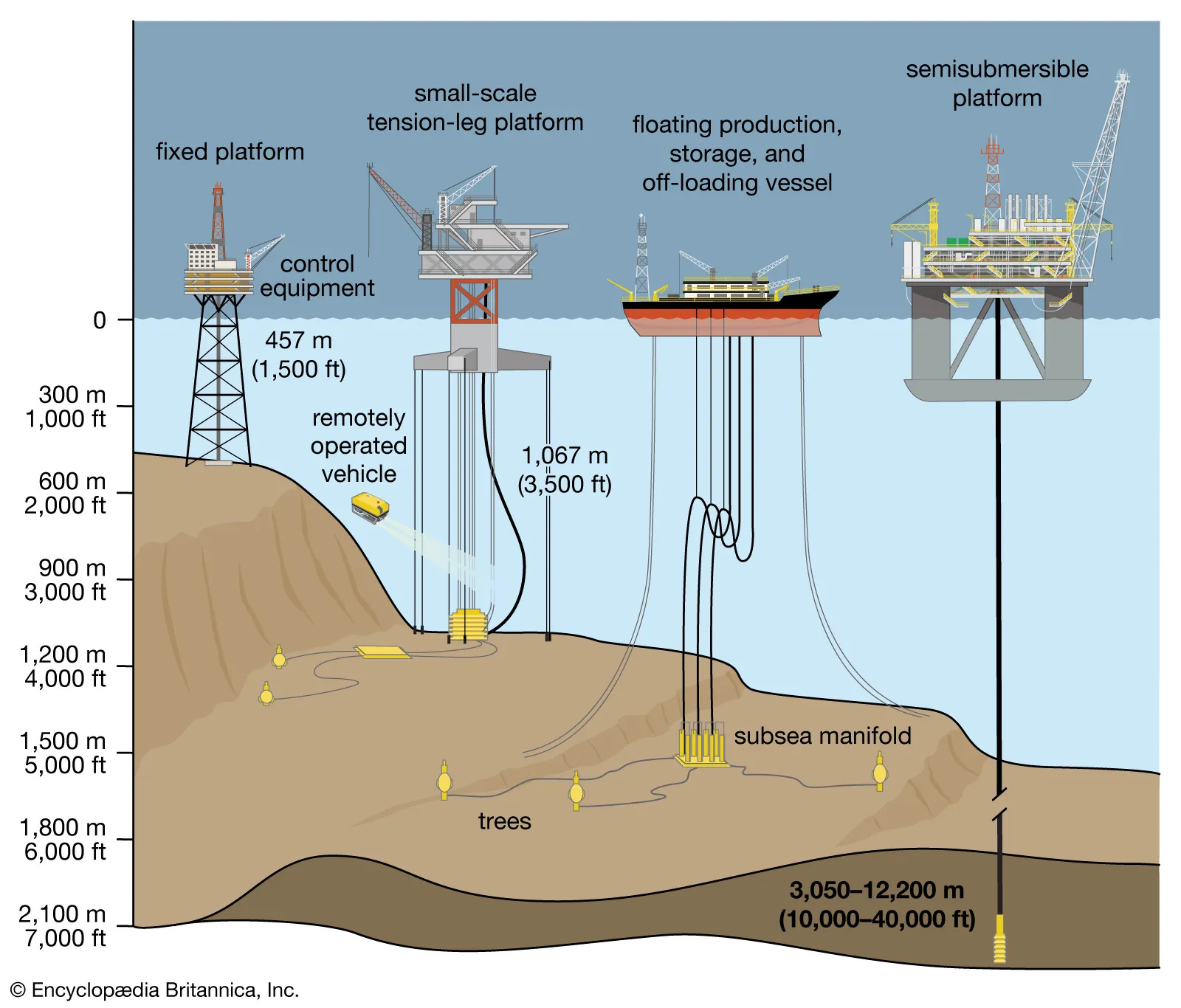
The geography is divided into shallow water (less than ~500 feet, where you can install a fixed platform on legs that touch the seabed), deepwater (500 to 5,000 feet, requiring floating production systems), and ultra-deepwater (beyond 5,000 feet, requiring the most expensive engineering in the upstream business). The North Sea is mostly shallow. The Gulf of Mexico, Brazil pre-salt, West Africa, and parts of the eastern Mediterranean are deep to ultra-deep.
A modern deepwater field is produced through an FPSO, a floating production, storage, and offloading vessel, typically a converted or purpose-built tanker that processes oil and gas from subsea wells, stores oil, and offloads to shuttle tankers. Recent deepwater FPSOs cost between roughly $340 million and $4.6 billion to build and deploy, depending on capacity, water depth, and gas-handling complexity. They typically take 4–7 years from sanctioning to first oil and produce for 25–40 years.
That long timeline is the climate-relevant feature. Once a project is sanctioned, the operator has committed billions of dollars and is going to produce for decades, almost regardless of what happens to oil prices or climate policy. A 2026 sanctioning decision in Brazil or Guyana is a 2055 production decision. This is the capital lock-in problem in its purest form.
Climate implications
The four things from this post most likely to matter for climate work:
Conventional fields are thirty-year assets. A well drilled in 2026 may still be producing in 2056 at meaningful volumes. That long tail means decisions made today lock in emissions for decades, a much longer commitment than people without industry context typically appreciate.
Cement and casing are the unsung heroes of climate infrastructure. Methane leakage from improperly sealed wells (active and abandoned) is one of the most leverageable upstream emissions sources. Better cement jobs, stricter mechanical integrity testing, and remote sensing for leak detection would do more for upstream emissions than most policy debates address.
Capital lock-in for offshore is the purest form of the long-cycle problem. A deepwater project sanctioned in 2026 is producing in 2030 and amortizing through 2055.
CO2-EOR is the most mature CO2 storage technology in the world. Multi-hundred-thousand-barrel-per-day scale, fifty years of operating history, hundreds of millions of tonnes stored underground in the Permian alone. Whether it’s a stepping stone or remains an underutilized climate tool depends on the incentives to produce with EOR, the CO2 source, and the counterfactual, which requires actual case-by-case analysis.
What’s next
The next post is the unconventional half of upstream. The shale revolution and what made it possible. Hydraulic fracturing, mechanically and politically. Why every shale well is dying the day it’s drilled and what that means for production. The underappreciated way the US natural gas supply got yoked to US oil drilling. And honest treatment of the controversies: methane, water, induced seismicity, and local impacts. I’ll be separating those that are about fracking itself and those that are not.
Glossary
New terms introduced in this post (post 2’s glossary still applies):
Acronyms
DAC — Direct Air Capture. Technology that removes CO2 directly from ambient air.
EOR — Enhanced Oil Recovery. Tertiary recovery techniques used to extract oil that primary and secondary recovery leave behind.
FID — Final Investment Decision. The point at which a company commits capital to develop a discovered field. Also called sanctioning.
UIC — Underground Injection Control. EPA program established under the Safe Drinking Water Act regulating any well used to inject fluids into the subsurface; includes six well classes covering hazardous waste, oil and gas operations, mining, shallow disposal, geothermal, and CO2 sequestration.
USDW — Underground Source of Drinking Water. Regulatory term for groundwater that must be protected from contamination by injection activities.
Terms
Annulus — The space between the outside of one tubular (drill pipe, casing, tubing) and the next surrounding one, or the rock wall.
Blowout — Uncontrolled flow of formation fluids (oil, gas, water) from a wellbore. Usually catastrophic.
Casing — Steel pipe cemented into the wellbore to seal it off from surrounding rock and protect the integrity of the well.
Cement / cementing — Slurry pumped between casing and rock that sets into a solid seal. The primary defense against zone-to-zone fluid migration.
Completion — Everything done to a well after drilling to make it productive: perforating, tubing, wellhead.
Decline curve — The predictable pattern by which a well’s production rate falls over time.
Derrick — The tower structure on a drilling rig that supports the drill string.
Directional / deviated drilling — Techniques for drilling at controlled angles rather than straight down.
Drilling mud — The engineered fluid pumped down the drill string and back up the annulus during drilling. Cools the bit, carries cuttings, stabilizes the wellbore, forms filter cake, and controls formation pressure.
Filter cake — A thin layer of solids deposited on the borehole wall by drilling mud, which prevents excessive fluid loss into porous formations.
FPSO — Floating Production, Storage and Offloading vessel. A floating production facility used in offshore oil fields, especially in deepwater.
Hydrostatic pressure — Pressure exerted by the column of drilling mud, used to balance formation pressures and prevent kicks.
Joint — A single section of drill pipe; the standard length (API Range 2) is 27–30 feet.
Kick — Influx of formation fluid into the wellbore during drilling. A precursor to a blowout if not controlled.
Mechanical integrity test (MIT) — A federally required test demonstrating a well’s ability to contain fluids and prevent migration to underground sources of drinking water.
Mud motor — A downhole motor powered by drilling mud flow, used to rotate the bit independently of the drill string. Enables directional drilling.
Perforation — Holes blasted through casing and cement using shaped explosive charges, allowing reservoir fluids to enter the wellbore.
Primary / secondary / tertiary recovery — The three sequential stages of conventional oil production. Primary uses natural reservoir pressure; secondary injects water or gas to maintain pressure; tertiary (EOR) uses CO2, steam, or chemicals.
Sanctioning / FID — The decision point at which a company commits capital to develop a field. The before-and-after distinction matters for climate analysis because pre-FID projects can still be canceled; post-FID projects almost never are.
Wellbore — The drilled hole itself, before or after casing is installed.
Wellhead — The surface equipment at the top of a well that controls flow.
No posts
Comments
Nothing yet. Say the first thing.
Sign in to join the conversation.