
This post is one in a series on the oil and gas industry, tilted towards those interested in climate change, policy, and regulation. See the first post here, and read through the life of a hydrocarbon from extraction to end use.
A barrel of oil can become many things. While gasoline is the largest single product from the barrel, most of it is used for other stuff: fuels like diesel, jet fuel, and marine bunker that move people and things around the world, around the clock; material building blocks of modern infrastructure, like asphalt; and petrochemical feedstocks that become, among other things, plastics, clothing, packaging, electronics, and medical devices.
That fact is underappreciated and has important implications for climate and the future of oil.
First, an evergreen disclaimer: I have no inherent fondness for oil and gas, and see large-scale deployment of renewables as an inevitability. But regardless of how you feel about the oil and gas industry, you should be semi-fluent in how it works, especially if you’re going to criticize it or write policy that would affect it.
This post is about how a hot, viscous mixture of thousands of chemicals gets separated into the products that run the modern economy. It’s part of a series on the oil and gas value chain, from how oil and gas are found, extracted, processed, distributed, and used.
I want to flag upfront that the technical content here owes a real debt to Brian Potter’s excellent piece on how an oil refinery works in Construction Physics. If you want a deeper dive on the mechanics, read this.
Crude at the start
As I describe in my rocks post, when we talk about oil, we’re talking about dead things buried deep in the earth that have carbon-to-hydrogen bonds (hence the term hydrocarbons). The stuff that comes out of the ground is called “crude.” Not all crude is created equal. It varies in density (light vs. heavy), sulfur content (sweet vs. sour), and trace contaminants, and those differences determine which refineries can process which crudes and at what cost. The two main axes are density, measured by API gravity, and sulfur content, measured by percentage.
West Texas Intermediate is around 40° API, “light”
Canadian dilbit is around 20° API, “heavy”
Crude below 0.5% sulfur is “sweet”
Crude above 0.5% is “sour”
Light and sweet is easiest to refine into high-value products like gasoline and jet fuel. Light-sweet trades at a premium. Heavy-sour (Canadian oil sands, Maya from Mexico, much of the Middle East barrel) are cheaper to buy because they’re difficult to refine and strip out the sulfur. Refiners that can run heavy-sour crude profitably tend to be large, well-funded operations. They have structural cost advantages over simpler refineries that are limited to light-sweet feedstock. The cost spread between those grades is one of the most important variables in downstream economics.
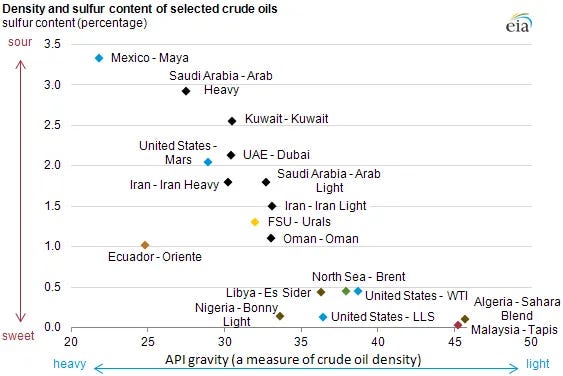
The economics, configuration, and survival of a refinery all come back to the grades of crude it can run, and which products it can make. Countries rarely have the capacity (largely driven by economics and geology) to produce and refine all types of crude. For example, the US refines heavy, sour crude in the Gulf Coast, much of which is imported from Canada.
Crude distillation: a quite refined process
Crude oil is quite complex, a mixture of thousands of different hydrocarbon molecules ranging from very simple (propane, butane, three or four carbon atoms each) to very complex (asphaltenes containing thousands of atoms). A refinery first separates that mixture into useful fractions. Later, it chemically transforms the less useful fractions into more useful ones.
The first step is distillation, which leverages the simple fact that different molecules boil at different temperatures. Heat crude oil to 650-750°F and most of it vaporizes; lighter molecules vaporize at lower temperatures, heavier ones at higher. Feed that vapor into a tall column with horizontal trays at different heights, each holding a pool of liquid. As the vapor rises through the column, it cools. Toward the bottom, the heavy molecules condense back to liquid, in the middle the medium molecules condense (the precursor to kerosene, jet fuel, diesel), and at the top you get light molecules as vapor(propane, butane, naphtha). The heaviest molecules never vaporize at all, and drop straight to the bottom as residue.
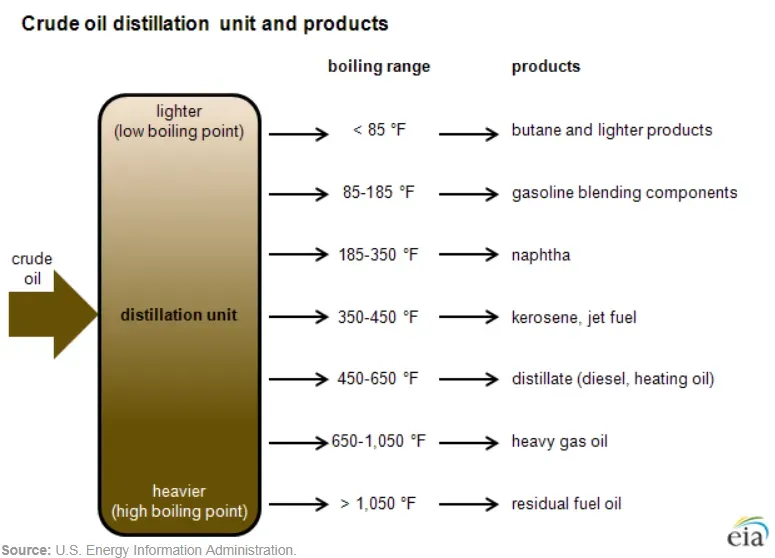
Every refinery in the world starts in this column, called the atmospheric distillation unit (because it operates at roughly atmospheric pressure). Next step: gasoline? Ah, if it were only so easy. What comes next separates a simple refinery from a complex one.
Cracking: turning heavy into light
A typical light crude run through atmospheric distillation produces something like 50% heavy distillates, 25% middle, and 20% light. Actual US demand is much more weighted toward gasoline and middle distillates, together about 85% of refinery output. So, to meet demand, refineries have to chemically transform the heavy stuff into lighter, more valuable products. That transformation is called cracking.
Cracking literally cracks long hydrocarbon molecules into shorter ones using some combination of heat, pressure, and a catalyst. Modern refineries use several variants.
Fluid catalytic cracking (FCC): heavy gas oil gets mixed with a sand-like catalyst at high temperature, speeding chemical reactions that break long molecules into shorter ones.
Hydrocracking combines cracking with hydrogen addition, producing cleaner, higher-quality products. Requires more complex equipment.
Coking is a thermal process for the very heaviest fractions that catalysts can’t handle. It produces lighter liquids plus petroleum coke, a solid carbon residue that gets burned as fuel or used in aluminum smelting.
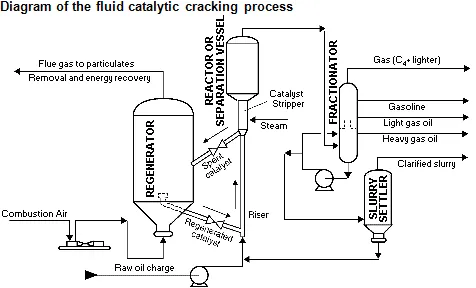
Around the cracking processes, refineries layer additional units that further upgrade specific streams.
Catalytic reforming takes the naphtha fraction (one of those pesky light distillates) and rearranges its molecular structure to produce a high-octane component of gasoline called reformate.
Isomerization rearranges light molecules like pentane and hexane into isomers, made of the same atoms but arranged differently, that blend into gasoline with far higher octane.
Hydrotreating reacts fractions with hydrogen to strip out sulfur (essential for meeting modern fuel standards. Sulfur oxide is real bad for humans and causes acid rain.
Alkylation combines small molecules useful for premium gasoline.
You can think of a refinery as an insanely expensive chemical Lego set: atmospheric distillation is the base, and each additional unit (FCC, coker, hydrocracker, etc.) is an optional add-on that costs hundreds of millions to billions of dollars, and enables beaucoup profit.
Simple vs complex refineries
The industry measures this sophistication with the Nelson Complexity Index, which assigns each processing unit a complexity factor and weights it by the unit’s capacity relative to the refinery’s atmospheric distillation capacity. A refinery that does nothing but atmospheric distillation has a complexity of 1. The average US refinery is around 8.7. Chevron’s Richmond, California, refinery is 14. Reliance’s Jamnagar refinery in India, the world’s largest at 1.4 million barrels per day, is 21.
Why does this matter? Because crude grade and refinery complexity have to match. A simple refinery limited to light sweet crude pays the premium for that crude but extracts gasoline and middle distillates easily. A complex refinery can buy cheap heavy sour crude at a discount, run it through cokers and hydrocrackers, and end up with the same high-value product slate as the simple refinery but with a much wider crude grade margin. In a market where light sweet crudes (WTI, Brent) trade $5-15/bbl above heavy sour crudes (Maya, Western Canadian Select), complex refineries have a structural cost advantage that compounds with scale.
This is why the Gulf Coast refining cluster is what it is. US Gulf Coast refineries spent the 1990s and 2000s investing heavily in coking and hydrocracking capacity to run cheap heavy sour Mexican and Venezuelan crude. When the shale revolution made light sweet US crude abundant in the 2010s, those same refineries had to figure out how to run a different feedstock through complex equipment designed for the opposite. The story of US refining over the last fifteen years is largely a story of these mismatches and the adaptation around them.
Crack spreads: how refiners actually make money
Refining is not the oil business. Refiners don’t get richer when oil prices go up; they get richer when the gap between crude prices and product prices widens. That gap is called the crack spread.
The simplest version is the 3:2:1 spread: assume 3 barrels of crude in, 2 barrels of gasoline out, and 1 barrel of distillate (diesel/heating oil) out, and calculate the dollar margin. Dallas Fed publishes weekly 3:2:1 spreads for various crude grades as a quick proxy for refining profitability. In 2022, post-Russia-Ukraine, spreads spiked to historic highs as global product markets tightened. Gulf Coast 3:2:1 against WTI averaged over $40/bbl, multiples of the typical $10-15 range. By 2024 they had fallen 25-29% year-over-year as new global refining capacity came online and product demand softened.
Crack spreads vary by region, crude grade, and product. A US Gulf Coast refiner running heavy sour Maya into a Coker FCC configuration faces a different margin than a California refiner running light sweet ANS into a hydrocracker. Operators chase the highest-margin product slate they can produce given their configuration, which is why US refineries shifted yields toward jet fuel in 2024, record-high jet fuel share, lowest gasoline share since 2015. Jet fuel margins were better. The refinery configurations couldn’t shift fully. You can’t suddenly turn a gasoline refinery into a jet fuel plant, but at the margin, every refiner pushed the slate toward where the money was.
This responsiveness to spreads is also why predicting product prices is so hard. A diesel shortage in Europe pulls Gulf Coast yields toward diesel. A gasoline shortage pulls them back. The system has more elasticity than people realize, but the elasticity is bounded by physical configuration, and the configuration is bounded by what you can change in a five-year capex cycle.
The players
US refining is concentrated. The country has 132 operable refineries with a combined capacity of over 18 million barrels per day, more than half of it clustered along the Gulf Coast of Texas and Louisiana. The major operators split into a few categories.
Integrated supermajors: ExxonMobil, Chevron, Shell (which sold most of its US refining but retains a global footprint), BP. These run refineries as part of integrated value chains where crude comes from their own upstream operations and products feed their own marketing networks. The integrated model has been on the back foot for a decade as pure-play refiners often outperform on capital efficiency.
Pure-play US refiners: Marathon Petroleum, Valero Energy, Phillips 66, HF Sinclair, PBF Energy. These companies do nothing but refining, midstream, and marketing with no upstream production. Marathon alone runs about 3 million barrels per day across 13 refineries. They tend to be lean, focused, and aggressive about capital returns to shareholders. The pure-play refiners are also where most of the recent US capacity has been lost: the country shed about 850,000 barrels per day of refining capacity in 2020 after the pandemic demand collapse, with several smaller and older refineries closing permanently.
International giants: Saudi Aramco (which owns Motiva, the largest single US refinery at Port Arthur, Texas), Reliance Industries (Jamnagar), Sinopec and PetroChina (the largest refining systems in the world by aggregate capacity), Rosneft, and the rest of the global NOC and IOC field.
Petrochemical-integrated complexes: increasingly important and somewhat distinct from traditional refineries. These are integrated refining-and-petchem complexes optimized for chemical feedstock production rather than transport fuels. Jamnagar is the iconic example. The Saudi-China joint venture refineries (Yanbu, Fujian) are the model going forward.
Petrochemicals: where the growth actually is
For most of the 20th century, refining was a fuel-production business with petrochemicals as a sideline. The slate was 85-90% transport fuels and heating oil, plus some lubes and asphalt, with a few percent going to petrochemical feedstocks. That ratio is shifting fast.
Petrochemicals already account for about 12% of global oil demand, but they’re the part of the demand picture that’s growing fastest. The IEA estimates that from 2019 to 2024, more than 95% of net global oil demand growth came from petrochemicals, not from cars or planes. Petrochemical demand is projected to account for more than a third of global oil demand growth to 2030 and nearly half to 2050, with the feedstock share of oil demand rising to roughly 17% by 2030. This is the structural transformation of the downstream that’s quietly reshaping the industry.
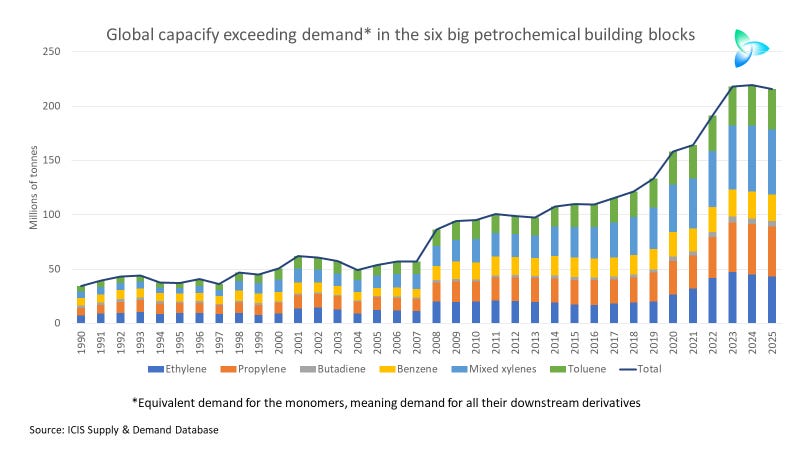
Three reasons we see this shift happening.
First, plastic. Global plastic demand has roughly doubled since 2000 and continues to grow at 3-4% annually, driven by packaging, construction, automotive, and consumer goods. Recycling is real-ish, but isn’t keeping up. Recycled polymer remains a small share of total polymer demand, and the rest gets met by virgin petrochemical feedstock.
Second, no substitute. EVs displace gasoline. Heat pumps displace heating oil. Sustainable aviation fuel can theoretically displace jet fuel. But there’s no equivalent demand-side substitute for ethylene, propylene, benzene, and the rest of the high-value chemicals that get turned into plastics, fertilizers, solvents, and synthetic fibers. The bio-based alternatives exist, but at a higher cost and on a limited scale.
Third, China and feedstock-rich regions are building aggressively. Between 2019 and 2024, China alone added ethylene and propylene capacity equal to all of Europe, Japan, and Korea combined. The US, with cheap shale ethane, has built around 40% of global ethane-based petchem capacity and has become a major exporter of ethylene derivatives. The Middle East is the lowest-cost producer of basic chemicals due to dirt-cheap NGL feedstock and is expanding aggressively. The fight for global petchem market share is now the central strategic question for downstream players, and traditional fuel refineries are losing it to integrated refining-petchem complexes.
A climate strategy that achieves significant decarbonization of road transport (EVs), heating (heat pumps), and even aviation (SAF) still leaves a hard core of oil demand for petrochemicals that doesn’t have a near-term substitute. The IEA’s net-zero scenarios assume aggressive recycling, bio-feedstock substitution, and outright reduction in plastic intensity, but even with all of that, petrochemical oil demand declines slowly compared to fuel demand. Understanding what your climate model assumes about petrochemicals is often the difference between a scenario where oil demand peaks in the 2020s and one where it plateaus into the 2040s.
The death of the coastal refinery, partially exaggerated
Refining is a peak-fear industry right now. The narrative goes: oil demand will peak in the 2020s or 2030s, refining capacity is being added in Asia and the Middle East while the West retires capacity, and Western refineries are sitting on multi-billion-dollar capital bases that may not earn out their useful lives.
Is this accurate? Well, sort of. The EIA’s outlook projects US refining capacity declining to about 17.9 million b/cd over the next decade as marginal refineries close. Several large US refineries have closed since 2020 (Phillips 66 Rodeo and Wilmington, LyondellBasell Houston, several others) or converted to renewable diesel production. European closures have been even sharper. The simple refineries with limited complexity and high cost structures are genuinely under pressure.
But the larger and more complex refineries, Gulf Coast deep-conversion configurations, Reliance’s Jamnagar, the new Saudi and Chinese mega-complexes, are not in any imminent danger. They have the cost structure to outlast the smaller competition, the petrochemical integration to ride the growing demand wave, and the geographic positioning to export products globally. Marathon, Valero, and Phillips 66 are still earning meaningful margins. Saudi Aramco’s downstream strategy is built around expanding refining-petchem capacity at home and acquiring strategic positions abroad (Motiva, Chinese JVs). The death of the refinery looks more like a Darwinian thinning of the herd than an extinction event.
The capital lock-in question is the real question, but cuts the other direction from what you might expect. A modern refinery is a 50-year asset. Capital invested today amortizes through 2075. The complex refineries getting built right now in China, India, Saudi Arabia, and the UAE are betting on long-tail oil demand from petrochemicals lasting deep into the climate transition. If they’re right, those assets earn out fine. If they’re wrong, if global petchem demand peaks earlier than the consensus expects, or if recycling scales faster than projected, those become some of the world’s largest stranded assets.
Climate implications
The five things from this post most likely to matter for climate work:
Gasoline is less than half the barrel EVs eat gasoline but barely touch jet fuel, diesel, marine bunker, or petrochemical feedstocks. A climate strategy built around “displace gasoline” addresses one slice of demand. The harder slices are where the long-tail emissions live.
Petrochemicals are the structural growth story for downstream 95%+ of net global oil demand growth in recent years has come from petchem, and the share is rising. Climate scenarios that ignore petrochemicals or assume aggressive feedstock substitution often hide the assumption rather than defend it.
Refinery configuration determines what’s economic to run A complex refinery running heavy sour crude has structural advantages a simple light-sweet refinery doesn’t. As crude grades and demand patterns shift through the transition, the configuration mismatch will create stranded capacity well before total demand declines significantly.
The next generation of refineries is integrated petchem complexes, not fuel plants Jamnagar, Yanbu, the Chinese mega-complexes, these are betting that petrochemicals are the durable downstream demand and fuels are the declining sideline. If the bet is right, that infrastructure earns out for fifty years. If wrong, it becomes the largest single category of stranded assets in the energy transition.
Refining is more flexible than its critics suggest Crack spread responsiveness means refiners can shift yields significantly between gasoline, diesel, and jet fuel within their configuration constraints. This elasticity makes “transport fuel demand will collapse” predictions more complicated than they look. Substitution in one slice creates room for the refinery to optimize toward the other slices, partially offsetting net demand decline.
What’s next
The next post is the other half of every emissions equation: demand and end use. Where the molecules actually get burned (or made into stuff that doesn’t). Transport, industry, heating, plastics, aviation, and marine. Why are some sectors easy to substitute, and some are very hard? Peak oil demand framing, and why the IEA, OPEC, and the major oil companies all disagree about timing and shape in ways that are doing real work in current investment decisions.
Glossary
New terms introduced in this post (post 2-5 glossaries still apply):
Acronyms
API gravity — A scale used by the American Petroleum Institute to measure crude density. Higher numbers mean lighter crude. WTI ~40°, Saudi Arab Light ~33°, Canadian dilbit ~20°.
BTX — Benzene, Toluene, Xylene. The three primary aromatic petrochemicals, used as feedstocks for plastics, solvents, and synthetic fibers.
FCC — Fluid Catalytic Cracker. The most common type of catalytic cracking unit, using a fluidized sand-like catalyst to break heavy gas oil into lighter products.
HVCs — High-Value Chemicals. Industry shorthand for light olefins (ethylene, propylene) and aromatics (BTX) that serve as the building blocks for most petrochemical derivatives.
NCI / Nelson Complexity Index — A measure of refinery sophistication that weights each processing unit by its complexity factor and capacity. Simple refineries are around 1-3, US average is ~8.7, the most complex global refineries are ~20+.
NGL — Natural Gas Liquids. Hydrocarbons heavier than methane but still gaseous or liquid at moderate pressure (ethane, propane, butane). Major petrochemical feedstocks.
PADD — Petroleum Administration for Defense District. The five regional designations EIA uses for US petroleum statistics. PADD 3 is the Gulf Coast and contains over half of US refining capacity.
SAF — Sustainable Aviation Fuel. Jet fuel produced from bio-based or synthetic feedstocks intended to reduce lifecycle emissions vs conventional kerosene.
Terms
Alkylation — A refinery process that combines small molecules (typically isobutane and light olefins) into larger branched-chain hydrocarbons used as high-octane gasoline blendstock.
Aromatics — A class of hydrocarbon molecules with ring structures (benzene, toluene, xylene). Used as gasoline blending components and as petrochemical feedstocks.
Atmospheric distillation — The first and most fundamental refining step. Crude is heated to ~650-750°F and separated by boiling point in a tall column at atmospheric pressure.
Catalytic reforming — A process that rearranges naphtha molecules to produce reformate, a high-octane gasoline blending component, plus hydrogen as a byproduct.
Coke / Coker — Coke is a solid carbon residue produced from cracking the heaviest fractions of crude. A coker is the thermal cracking unit that produces it; coke is used as fuel or as a feedstock in aluminum electrode manufacturing.
Crack spread — The dollar margin between crude oil input cost and refined product output value. The 3:2:1 spread (3 barrels crude → 2 gasoline + 1 distillate) is the standard quick proxy for refining profitability.
Cracking — The chemical process of breaking long hydrocarbon molecules into shorter, more valuable ones. Subtypes include fluid catalytic cracking (FCC), hydrocracking, and thermal cracking (coking and visbreaking).
Distillate — In refining, a general term for middle-fraction products including diesel, heating oil, and kerosene. “Distillate fuel oil” in EIA statistics is primarily diesel.
Distillation curve — A graph showing what fraction of a crude oil has boiled off at each temperature. Different crudes have characteristically different curves and produce different natural product slates.
Ethylene / Propylene — The two most important light olefins, produced primarily by steam cracking ethane, propane, or naphtha. The fundamental building blocks of polyethylene and polypropylene, the world’s most common plastics.
Hydrocracking — A high-pressure cracking process that uses hydrogen to break heavy fractions into clean, low-sulfur middle distillates (jet fuel, diesel).
Hydrotreating — A hydrogen-based process that removes sulfur, nitrogen, and other impurities from refinery streams. Essential for meeting modern fuel sulfur standards.
Integrated refining-petchem complex — A facility designed to maximize chemical feedstock output rather than transport fuel output. Increasingly the dominant new-build configuration globally; Jamnagar is the iconic example.
Isomerization — A refinery process that rearranges the molecular structure of light alkanes (typically pentanes and hexanes) to produce higher-octane isomers used in gasoline blending.
Light olefins — Reactive short-chain unsaturated hydrocarbons, primarily ethylene and propylene. The most important petrochemical building blocks.
Merchant refiner — A refiner that has no upstream production and buys crude on the open market. Contrasted with integrated refiners that source crude from their own upstream operations.
Naphtha — A light refinery fraction (boiling range ~120-400°F) used as gasoline blendstock and as a primary petrochemical feedstock outside of North America.
Petroleum coke (petcoke) — A solid carbon residue from coking units, used as a fuel (typically in cement kilns and power plants) or as a feedstock for graphite electrodes.
Reformate — The high-octane gasoline blending product from catalytic reforming.
Residual fuel oil — The heaviest liquid output from a refinery, used as bunker fuel for ships and as feedstock for further cracking.
Steam cracker — A petrochemical (not refinery) unit that uses high-temperature steam to crack ethane, propane, butane, or naphtha into light olefins (ethylene and propylene) and other chemicals.
Sweet / sour crude — A classification based on sulfur content. Sweet crude has <0.5% sulfur and is easier to refine into low-sulfur products. Sour crude requires more hydrotreating and is typically discounted.
Tank farm — The storage area at a refinery, typically housing millions of gallons of crude, intermediate streams, and finished products in dozens or hundreds of individual tanks.
Vacuum distillation — A second distillation step performed at near-vacuum pressure, which lowers boiling points and allows separation of heavy fractions without cracking them.
Visbreaking — A mild thermal cracking process used to reduce the viscosity of heavy residue, producing lower-viscosity products and some lighter distillates.
No posts
Comments
Nothing yet. Say the first thing.
Sign in to join the conversation.