
“In the middle of a difficulty lies opportunity.”
– Albert Einstein
Exactly two years ago I was detained in Nuuk, Greenland by a special unit of Danish police officers that had been flown in from Copenhagen specifically to arrest me.
I remember that morning quite vividly.
The harbor was eerily quiet as we slipped in. A handful of fishing boats puttered out to sea, their engines fading into the mist. Two Danish warships were moored on the far side of the docks. Our course took us past them, toward the fishing boat pier where the fueling station waited.
Once the ship was secured alongside the dock, I scanned the quay. The stillness was unsettling. No visible threats, yet. But in my experience, trouble rarely announces itself.
When the John Paul DeJoria docked in Nuuk, Greenland, in the early hours of July 21, 2024, I knew there was a chance border control might flag me.
As the ship secured alongside the fuel dock, I scanned the quay. No signs of trouble, yet.
But it didn’t take long.
Two unmarked white vans rolled up to the dock, and I wasn’t even surprised when a squad of Danish police officers stepped out. This was no routine inspection.
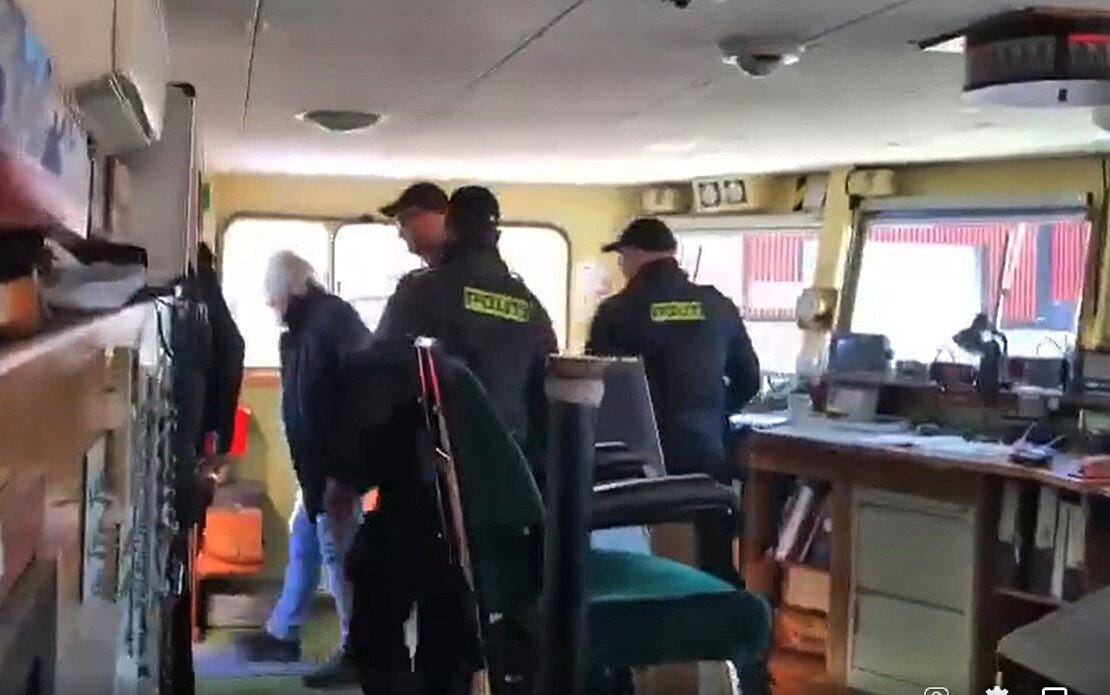
I settled into the captain’s chair on the bridge, watching as fourteen officers, all bristling with purpose, marched up the gangway toward the wheelhouse. There was only one reason for this kind of show of force.
The moment they crowded inside, the air turned electric. Fourteen pairs of eyes locked onto me, unblinking, like I was the most wanted man in the Arctic. The biggest of them, a towering, broad-shouldered Dane with the kind of Nordic features that made him look carved from ice, stepped forward, his hand resting on the grip of his sidearm.
“Are you Paul Watson?” His voice was low, dangerous.
“Yes.”
Before I could react, he seized my shirt in both fists and yanked me out of the chair with enough force to nearly knock me off balance.
“I assume I’m under arrest,” I said, allowing myself the faintest smirk.
His face twisted like I’d spat in it. Mistaking my amusement for defiance, he drove his thumbs into my chest, hard. “Yes.”
“On what charge?”
“You’ll find out.” He wrenched my arms behind my back, ratcheting the cuffs so tight they bit into my wrists. Then he shoved me toward the door, steering me onto the port bridge wing.
I glanced back at the overkill of officers. “You sure you brought enough?” I asked dryly.
They marched me down the gangway and hurled me into a van. The drive to the station was short. The cell was an unpleasant surprise, a concrete box with a thin plastic mattress on the floor, cold seeping through my clothes. But in my jacket pocket, a small book of Lord Byron’s poems. Enough to pass the time.
A few hours later, the same dozen officers who’d arrested me returned to haul me from the holding cell, this time in handcuffs. A two-block ride to the courthouse hardly warranted such a show of force, but I understood the theatrics. Japan had painted me as a dangerous terrorist, and now I was public enemy number one in their eyes.
The procession marched me into the Sermersooq Circuit Court in Nuuk, where I came face-to-face with my prosecutor for the first time: Mariam Khalilm. Her hostility wasn’t just apparent, it was deliberate, a performance of disdain so pointed it bordered on personal.
A lawyer had been appointed, who arrived swiftly. He’d represented me at the first hearing. The best part? Denmark covers legal fees.
The judge was a stoic and reserved Inuk woman, her expression unreadable as the prosecutor launched into her performance. Prosecutor Khalilm spared no dramatics, painting me as a raving, violent terrorist, a clear and present danger to society who needed to be locked away for the good of the community although she did not specify which community. With theatrical flair, she described me as an armed and dangerous international fugitive.
I had to hand it to her, she was good. Almost convincing enough to make me believe it myself. Frankly, I was a little flattered. Not everyone gets to be the villain in such a vivid production.
My court appointed lawyer argued for my release—no incarceration, just a promise to appear. Mariam shut him down instantly. “Unacceptable. He’s a flight risk.” Then, with infuriating confidence, she declared my extradition to Japan a fait accompli. “The case is simple. The outcome is certain. I’m just waiting on the file from Tokyo.”
My first thought: How the hell is this a certainty when you haven’t even seen the damn file?
But perhaps she just checked the balance of her bank account. Japan was notorious for tossing out bribes.
The judge, meek and wide-eyed, looked like she’d rather be anywhere else, nodded along. No questions. No hesitation. Just a quiet, “Detained until August 14th.”
The twelve dutiful Danish officers handed me off to the Greenlandic police who, to my surprise, were far nicer. Despite strict orders not to, they let me call my wife Yana and my two sons. I pressed the phone to my ear as the squad car wound through a desolate expanse of jagged gray rock, the bleakness broken only by the surreal beauty of the sea: a vast, icy blue dotted with miniature icebergs.
Then, around a bend, it appeared, a hulking slab of gray concrete, grim and utilitarian. A Greenlandic Gulag?
And just like that, this grey prison became my new home for the next five months.
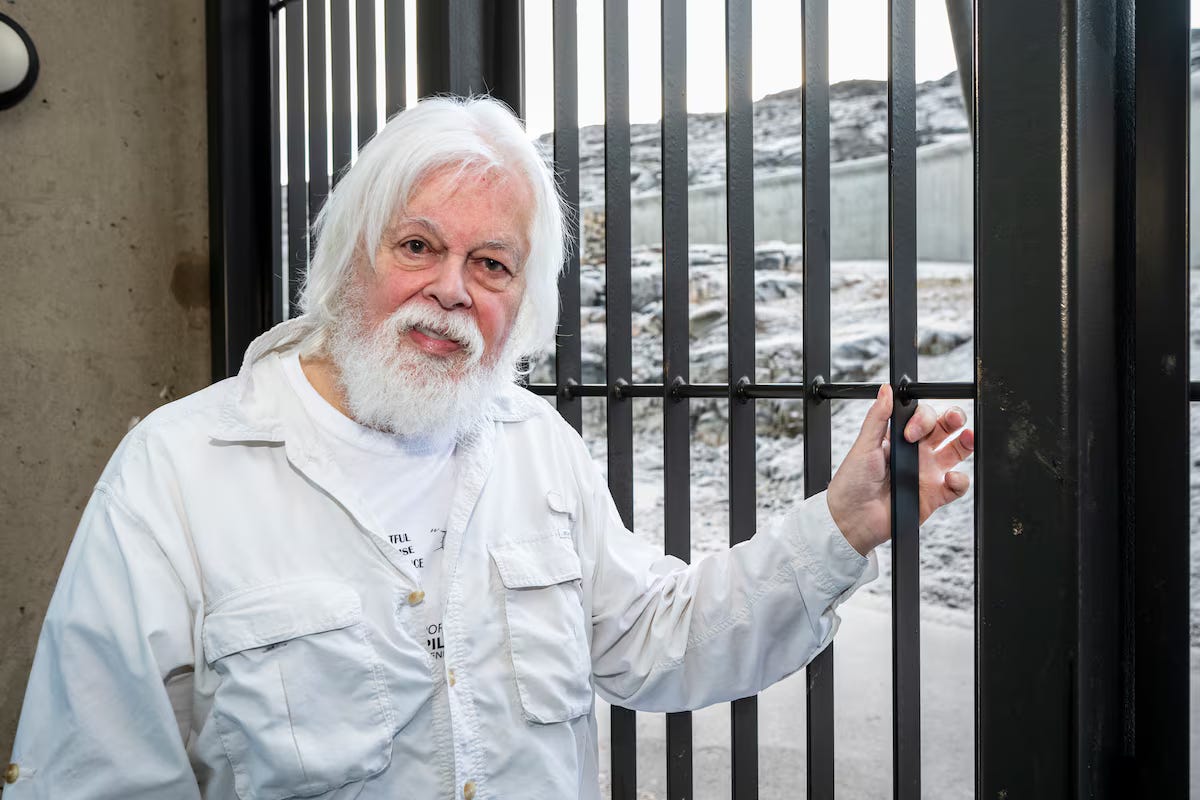
The guards were friendly, but I had to strip, surrender my phone, my money and anything they considered unnecessary. After that they walked me down several hallways down two flights of stairs to Cell block A which contained 10 separate cells.
By prison standards anywhere, Nuuk’s facility was downright luxurious. The inmates, mostly Inuit and even some of the guards were warm, easygoing. My cell was more spacious than my ship’s cabin, complete with a mini fridge, a desk, a TV, a comfortable bunk, and a private bathroom with a sink, toilet, and shower.
But the real luxury was the window.
Unbarred, floor-to-ceiling, it framed a breathtaking panorama of the fjord: icebergs drifting like scattered diamonds, jagged mountains rising in the distance. And then, on my first morning, the showstopper, a humpback whale breaching just offshore, her massive tail slapping the water before vanishing beneath the surface. Beside her, a calf surfaced in a playful arc, as if putting on a private performance.
The outer wall facing me was a mural of Arctic life, whales, walruses, fish, a polar bear, musk oxen, caribou, narwhals. Even the local wildlife got in on the act: enormous ravens perched on the ledge, and once, a silver arctic fox darting past.
Some people would pay a fortune for a view like this, I thought.
Strangely, it felt like I’d come full circle, the view brought me back to the Southern Ocean, where this whole ordeal had begun years ago.
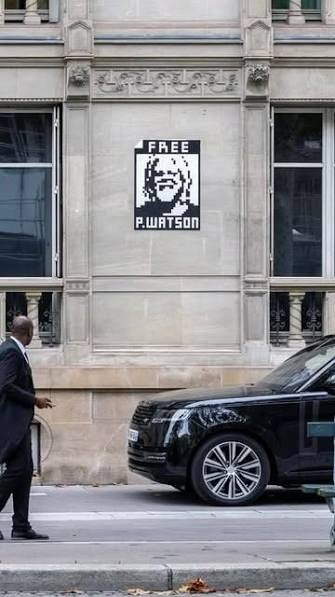
The initial assessment of my situation was grim but not unexpected. After twelve years of evasion, Japan had finally persuaded a nation to detain me. No surprise it was Denmark: one of only two countries on Earth that still indulge in the annual, barbaric slaughter of defenseless dolphins (the other being Japan).
What I did not anticipate was a blessing. The dolphin killers of the Faroe Islands tipped Denmark off about our refueling stop in Nuuk. A miscalculation on their part. A gift to us.
Neither Japan nor the Faroese expected my arrest to backfire so spectacularly. What they saw as a victory, my detention became, in fact, a global megaphone. While they celebrated in Taji, Tokyo, and Tórshavn, we secured the perfect stage to expose their shared atrocities to the world.
The inmates were all Inuit Greenlanders, save for one affable Faroese man named Peter, married to a local woman. He was the only fluent English speaker; the others spoke Greenlandic, knew a few words of English, but all spoke Danish.
What surprised me was how many recognized me. Whale Wars had been a hit in Greenland, and by day one, several inmates were asking for autographs. I even played a few chess matches with them. They were no trouble at all.
The guards mirrored the mix: about 70% Inuit, the rest Danish, with a near-even split between men and women. And just like the prisoners, they were unfailingly friendly.
On the morning of Wednesday, July 24th, a guard summoned me to the common room. There, two more guards sat at a table, handing out envelopes. Each prisoner had to sign for theirs; each contained 1,350 Danish krone (€180).
Turns out, this was standard. Every Wednesday, inmates received funds to shop at the prison market that same day and again on Mondays. The kitchen was fully equipped: freezer, stove, sink, dishwasher, coffee maker, kettle. Prisoners could buy whatever was available, cook their own meals, or pool resources for group dinners.
The prison market was a revelation. Shelves brimmed with canned goods, dry staples, and frozen foods, but fresh produce was scarce. I learned to rely on frozen vegetables and the passable potatoes, onions, apples, lemons, limes, and oranges. The avocados, tomatoes, and carrots? Usually on the verge of rot but overall it was sufficient and I was free to choose.
The real surprises were the spices: a steady supply of turmeric, ginger, and garlic.
The centerpiece was a long, open-topped freezer – unappetizing in fact quite disgusting at first glance. Inside: pork, mutton, beef, musk ox, seal, narwhal, beluga, fish, shrimp, and scallops. My fellow inmates avoided the narwhal and beluga, favoring pork, musk ox, and beef. Being vegetarian was easy enough. And if I needed something special like olive oil or tofu, I could order it for the next delivery.
The communal kitchen had just three knives, a butcher knife, a bread knife, and a paring knife, all wired to the countertop. No one could walk off with them, and any dispute would’ve been confined to a tiny space. Not that it mattered: in all my time there, I never once saw anyone lose their temper.
I prepared my own meals and ate in my cell, but I did join the coffee pool. Each prisoner chipped in 35 kroner to cover the week’s supply, and the first one up in the morning, usually myself, handled the brewing.
This rrison offered the illusion of absolute security—food, clothing, medical care, showers, even entertainment and a kind of peace. Some might call these comforts. But one thing it can never provide is freedom.
Yet freedom isn’t just a place. It’s a state of mind. If a prison can’t break your spirit, you’re still free. When the specter of years in a Japanese prison loomed, I refused to let it take root. Instead, I focused on how to turn captivity into a platform for the cause. And in those moments, my thoughts turned to the orcas and dolphins, magnificent, socially intricate, deeply intelligent beings forced to endure the slow torture of confinement, the ache of solitude, the brutal severing from the sea they call home.
This wasn’t my first time behind bars. In 1997, Germany arrested me on Norway’s extradition request, held me a couple of days, then released me—only for the Dutch to pick me up days later for the same charge. That stint lasted 120 days in Lelystad Prison before the court set me free. Norway never got their hands on me.
Back in 1993, Newfoundland police arrested me for chasing Spanish drag trawlers off the Grand Banks. The charges? Three counts of mischief, two of endangering life, and one of property damage—despite no injuries and no actual damage. The St. John’s Telegram noted that everyone in the courtroom seemed tense except the defendant, who appeared to be enjoying himself. The jury acquitted me.
So, here’s the tally: arrested more times than I can count, over a year in prison total—and not a single felony conviction to my name.
During my stay in Nuuk, I received some 7,000 letters from around the world and a few thousand drawing of whales from children. Every single letter was supportive including some 35 letters from Japan. I received two letters from Dr, Jane Goodall and support from the President and Prime Minister of France, the President of Brazil, the President of French Polynesia and Pope Francis.
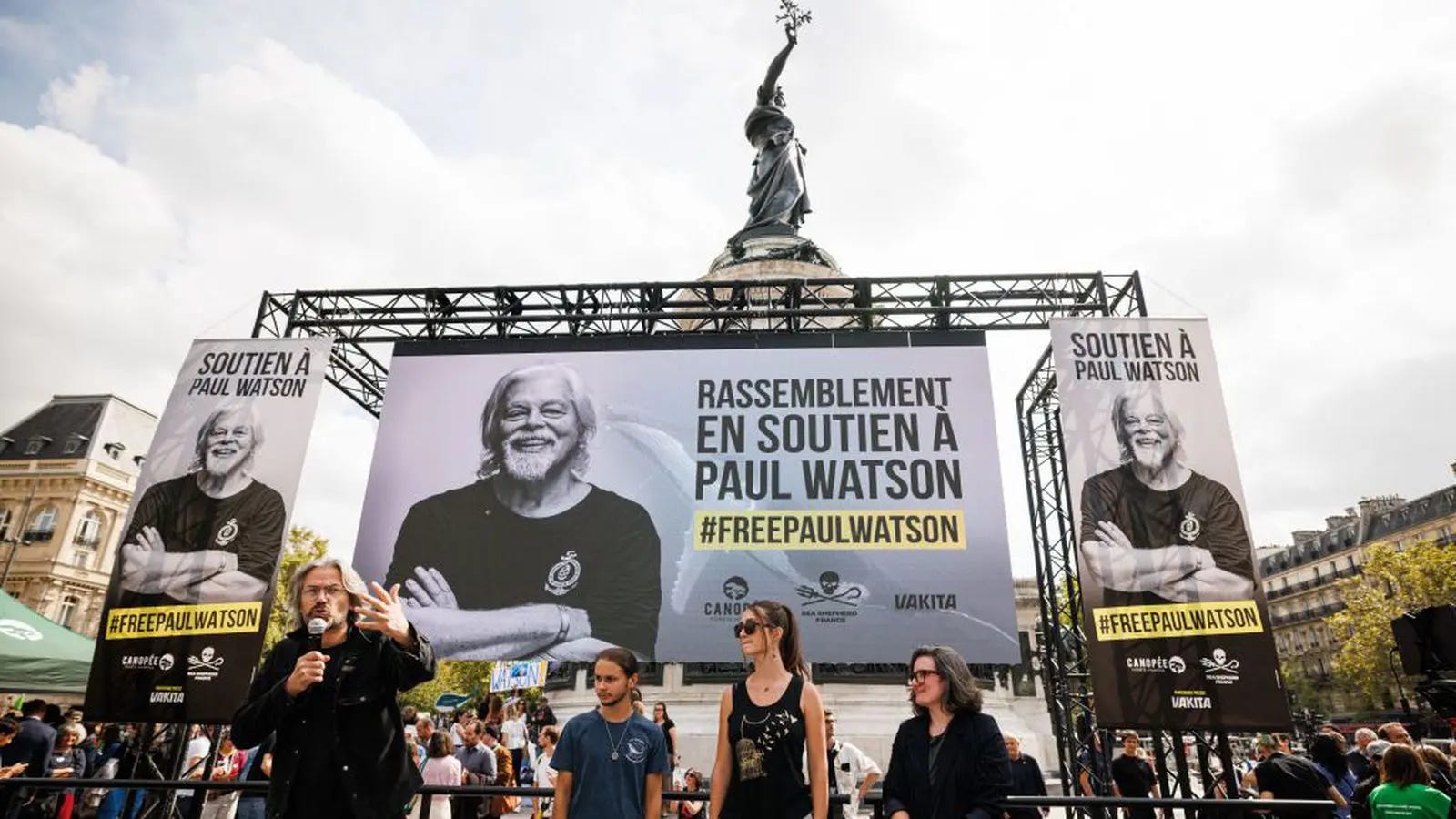
Most importantly I was given an opportunity to denounce and expose the continued illegal whaling operations by Japan with the added bonus of focusing internation attention on the cruel slaughter of pilot whales and dolphins in the Danish Faroe Islands. I was allowed to meet with media teams from around the world and it was clear that once again that every situation can be an opportunity and my five months in Nuuk prison was an opportunity to speak in opposition to the criminality and cruelty of whaling and dolphin killing.
After five months and only a few days before Christmas I was released thanks to my incredible legal team of Danish Attorney’s Julie Stage, Jonas Christoffersen and Greenlandic attorney Finn Meinel, and French Attorneys] Jean Tamelet, Emmanuel Jez and François Zimeray.
And most importantly thanks to the awesome efforts by Lamya Essemlali, the President of Sea Shepherd France, Natalie Gil, the President of Sea Shepherd Brazil, Clementine Pallanca, the Executive Director of the Captain Paul Watson Foundation, Cyrill Gutsch of Parley for the Ocean and Hugo Clement of Vaquita.
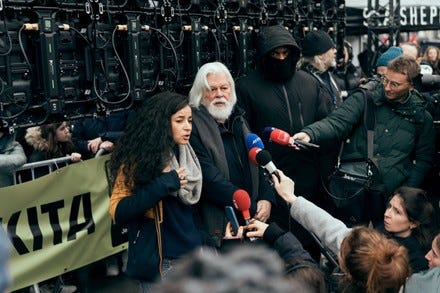
The victory against Japan’s outrageous politically motivated persecution came from these people so passionately loyal to the cause of defending whales. Their support over five months provided me with immense support, hope and encouragement for which I will always feel appreciation and love.
Upon my return to France I was given an honorary citizenship to the City of Paris and the Medal of the National Assembly of France.
In short it was a very successful campaign, a quite pleasant stay in the comfort of the Nuuk prison and the final victory, the removal six months later of the Interpol Red Notice on the grounds that it was politically motivated by Japan.
The fight continues. We are opposing Icelandic whaling right now in Icelandic waters and we will return to the Southern Ocean once again if Japan decides to ignore international law by killing whales in the Southern Ocean Whale Sanctuary.

No posts
Comments
Nothing yet. Say the first thing.
Sign in to join the conversation.