
Sweden is a high-trust society. In the Integrated Values Surveys (which combines the European Value Study and the World Value Survey), about 63 percent of respondents in Sweden say that “most people can be trusted.” That is an unusually high number in international comparison and an increase since the first survey wave, in 1982.
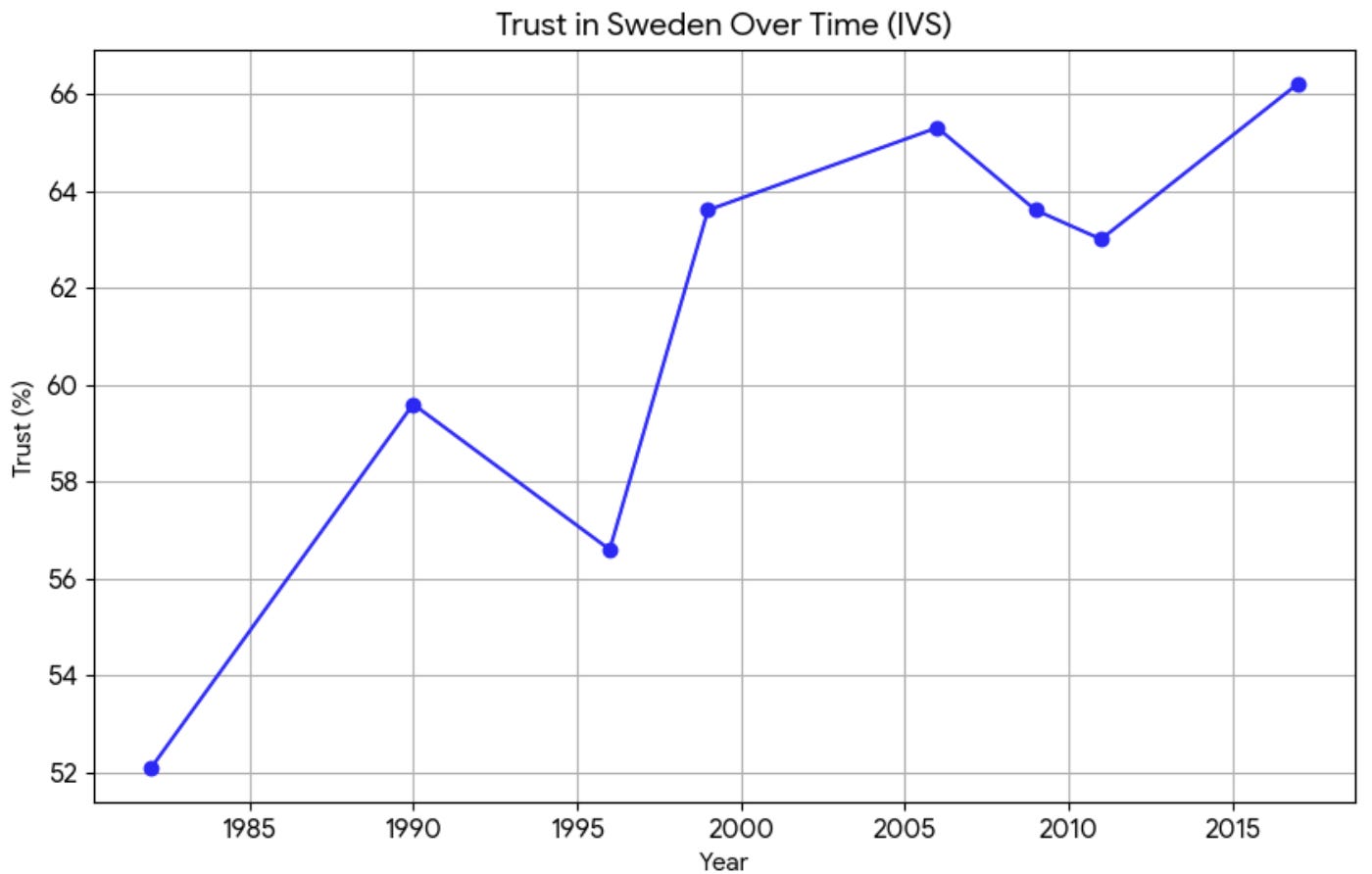
But there is a natural question: Do these surveys accurately capture social trust among immigrants? The share of immigrants has increased substantially: In 2024, about 20.8 percent of Sweden’s population was foreign-born. Many immigrants come from low-trust countries. And still, social trust is increasing. Is there perhaps a bias here?
Immigrants are included in the surveys. In the most recent wave (around 2018), 84.4% of respondents were born in Sweden, and 15.2% were first-generation immigrants. But the sample is small:
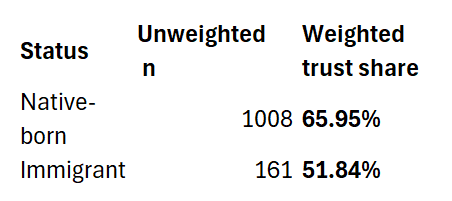
If we trust (!) the survey, immigration is accounted for. But looking more closely at the data, the largest immigrant groups are 20 respondents from Finland, 11 from Denmark (both highly trusting), 10 from Poland, and 9 from Norway (and then even fewer from the remaining countries).
It may well be the case that the immigrants who answer the survey are self-selected, creating a bias that cannot be corrected using survey weights.
So let’s try a different method to obtain an upper bound on the impact of immigration on social trust in Sweden.
Using official Swedish population data, the three largest foreign-born groups in Sweden are people born in Syria, Iraq, and Finland. In most cases, social trust in the country of origin is substantially lower trust than in Sweden, according to the IVS:
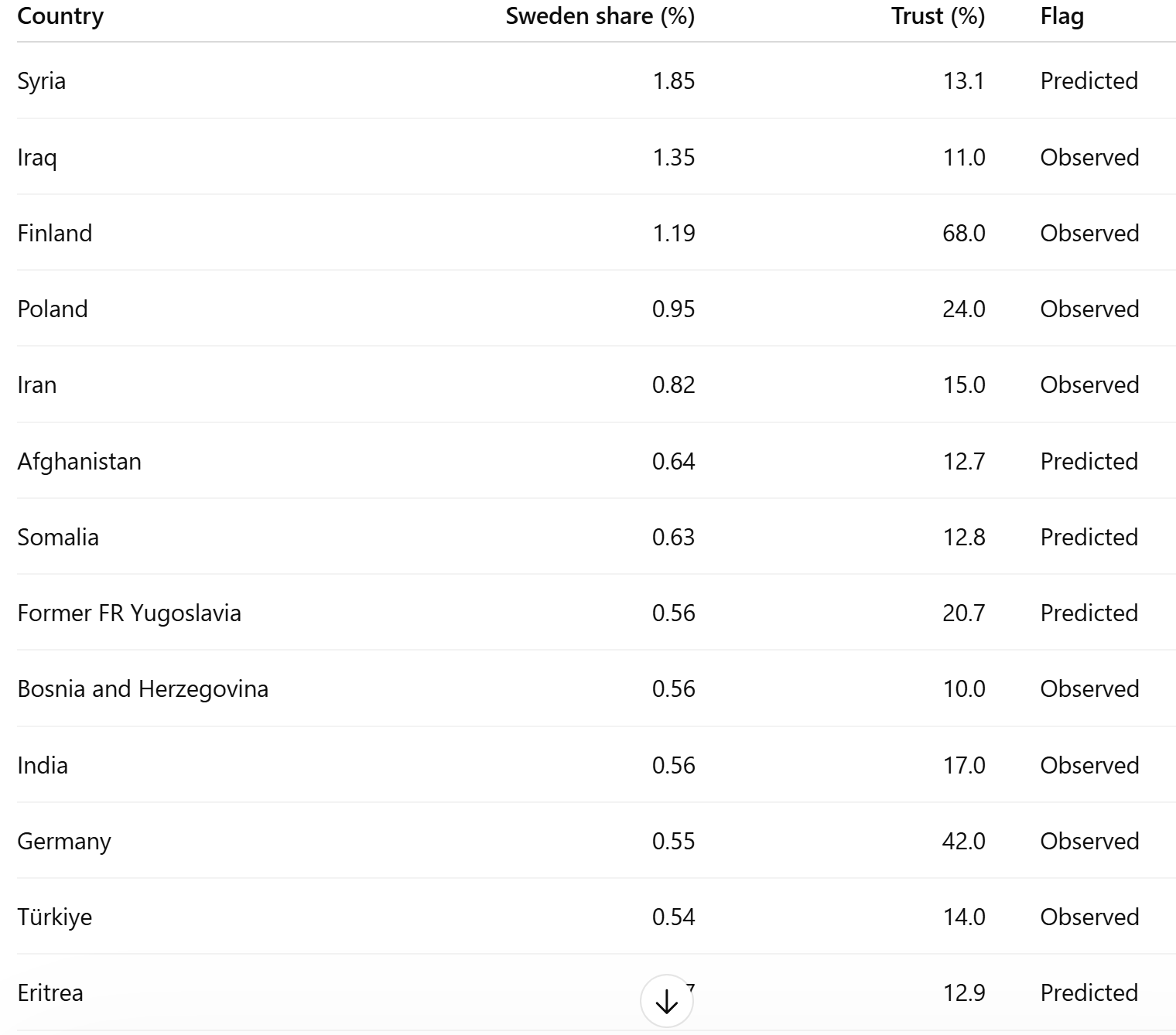
For some countries, there are no trust data. For these, I predicted social trust from GDP per capita using a simple cross-country regression (R2=0,56).

When I weigh trust levels by the size of each immigrant group in Sweden, I estimate an average immigrant trust level of 25.1 percent.
That is far below Sweden’s overall 63 percent, and it is also well below the trust among immigrants in the WVS survey (which was 52).
We can now estimate the bias. Let’s start with two extreme assumptions to get an upper limit: Suppose that the Swedish trust survey somehow captures only the non-immigrant population and misses immigrants entirely. Suppose also that immigrants have the same level of trust as in their country of origin.
To correct the bias, ee have
Actual social trust in Sweden = (1 − s) × 63 + s × Tᵢ
where:
s = share of the population omitted by IVS
Tᵢ = average trust of the omitted immigrant group
The foreign-born make up 20.8 percent of Sweden’s population, and their average trust as calculated above is 25.1 percent; the actual national trust level would be:
0.792 × 63 + 0.208 × 25.1 = 55.1
Even under these extreme assumptions, social trust has increased somewhat since the first survey wave in 1982.
As shown by Nannestad et al (2014), migrants from low-trust countries to high-trust countries are typically more trusting than those who remain in the country of origin:
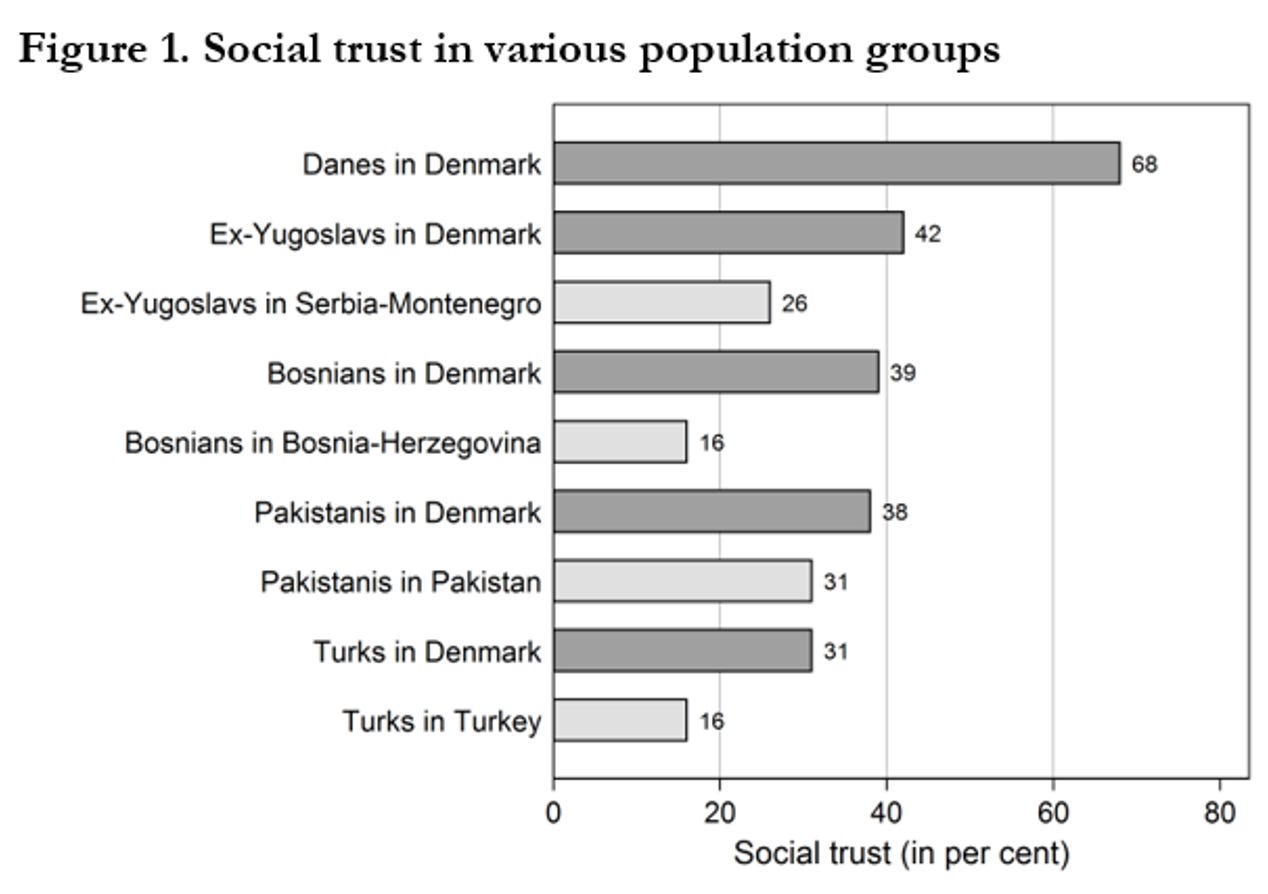
Nannestad et al attributes the difference to institutions, but (imho) it could also be a selection effect (emigrants being more trusting than those who stay).
In the present case, it doesn’t matter why: For some reason, migrants from a country tend to have higher (and in some cases more than twice as high) social trust than those who remain in the country of origin
For a perhaps more plausible scenario, assume that only half of the immigrant population is missed by the surveys, and assume immigrants have 50 percent higher trust than their country of origin. That implies that actual trust in Sweden would be
(1−0.104) × 63 + 0.104 × 37.1 = 60.3
The mechanical effect of immigration on social trust is likely to be underestimated by WVS/EVS. But even under extreme assumptions about the size of the bias, trust is higher in the most recent wave than in the first.
References:
Nannestad, Peter, Gert Tinggaard Svendsen, Peter Thisted Dinesen, och Kim Mannemar Sønderskov. ”Do Institutions or Culture Determine the Level of Social Trust? The Natural Experiment of Migration from Non-western to Western Countries”. Journal of Ethnic and Migration Studies 40(4): 544–65.
No posts
Comments
Nothing yet. Say the first thing.
Sign in to join the conversation.