
In December 2025, this NBER working paper sparked some debate:
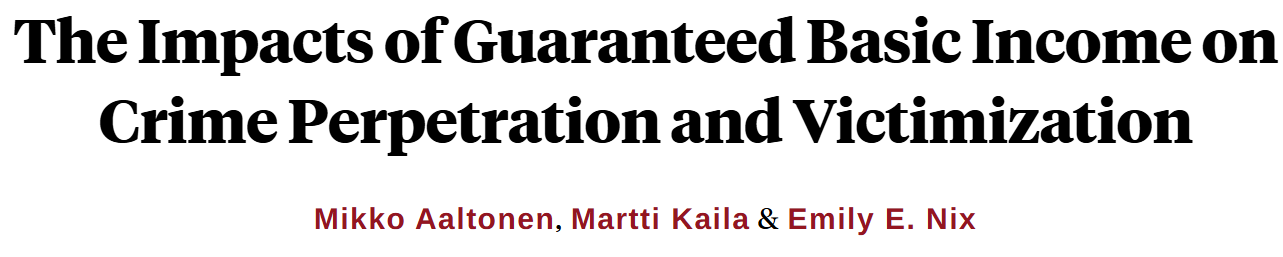
The key result: A randomized controlled trial of Basic Income (BI) in Finland found no effect on crime.
On social media, it was in some cases interpreted as showing that poverty does not cause crime. If it did, introducing a BI should lower crime in the treatment group. Right?
Well… not necessarily. If poverty causes crime, the introduction of BI should lead to a reduction in crime in situations with a lot of poverty. But in Finland, the control group remained in the regular social safety net. Thus, the paper is not informative about the poverty-crime link. Even framing it as saying anything about the causal effects of BI on crime stretches it, because those effects depend on the context in which BI is introduced.
In that sense, the NBER-working paper is a sad example of over-selling a local average treatment effect. (The first sentence of the abstract: “This paper provides the first experimental evidence on the impact of providing a guaranteed basic income on criminal perpetration and victimization.”)
The paper tests some highly specific changes in the way Finland supports the unemployed. Putting too much trust in single papers with a “perfect” identification strategy is a common disease in economics these days (as I’ve tried to illustrate here).
Sadly, there’s more. The randomized experiment in Finland did not have a perfect identification strategy, far from it. During the experiment, Finland suddenly introduced activation policies, disrupting the control/treatment comparison. And the next year, those policies were abandoned.
Here is Karl Widerquist on the topic:
Introducing the activation model in 2018 was a major policy reform during the experiment, and it affected the target group asymmetrically by increasing the conditionality of the unemployment benefits. This is not in accordance with the standard principles of field experiments. In addition, the activation model sparked a major public debate on conditionality and working while receiving an unemployment benefit. Basic income and conditional unemployment benefits are, to some extent, opposite social security models, although they both aimed to increase employment, particularly in the Finnish context. The activation model was abolished at the end of 2019.
Simply put, it was not a basic income experiment. It was an attempt at experimental welfare state design. That is not necessarily a problem. But what can be learned?
Here is my take. In a country with generous social safety nets, it is crucial that work incentives remain in place. There are different strategies to achieve that.
One is through conditionality, which means that generous benefits must come with strings attached: recipients must be actively seeking jobs, prove they have applied for positions, and, if they turn down job offers, benefits will be reduced or lost. The marginal effective tax rate will be (close to) 100 percent.
Another strategy is through incentives and individual freedom. Benefits may be lower, but less conditional, and some may even be combined with work income. In this case, the marginal effective tax rate is well below 100%, creating strong economic incentives to work.
What Finland tried was to lower the conditionality for the treatment group. It seems to have had some positive effects on the welfare of those treated, with little effect on employment. Survey answers suggest that the respondents in the treatment group answered more positively on questions concerning
life satisfaction, overall health, mental health, social life, cognitive capabilities, trust in institutions, self-confidence and confidence in their own future, and financial security.1
Source: Lassander and Jauhiainen 2021, Kangas et al. 2021, Simanainen and Tuulio-Henriksson 2021 (all chapters in Kangas et al 2021)
Sounds pretty good, right? The problem is that treated could still claim regular benefits on top of the basic income, and a majority did so.
In my opinion, the Finnish experiment was a lost opportunity to test experimentally the idea that countries with generous benefits and high conditionality can gain by lowering both benefits and the degree of conditionality, thereby saving tax money and improving the well-being of the unemployed.
While nothing in the Finnish experience points against that mechanism, the evidence is not nearly as strong as it might have been.
Literature
Kangas, O. et al (2021) Experimenting with Unconditional Basic Income. Lessons from the Finnish BI Experiment 2017-2018. Link.
Widerquist, K. (2018), A Critical Analysis of Basic Income Experiments for Researchers, Policymakers, and Citizens, London: Palgrave Macmillan. Link.
The results regarding employment are a bit hard to interpret. The basic income was introduced into the existing social benefit system in a way that created variation in work incentives between family types due to differences in eligibility for different social benefits. Couples with children responded to basic income with higher employment. Employment responses among other family types remained negligible. This is odd because the experiment provided larger improvements in monetary work incentives for childless households than for those with children.
No posts
Comments
Nothing yet. Say the first thing.
Sign in to join the conversation.