
I recently participated in a discussion on inequality and billionaires at Stockholm University. Gabriel Zucman and Daniel Waldenström presented research and statistics, while Elinor Odeberg and I offered commentary. The discussion largely revolved around Zucman’s proposal for a billionaire tax. What should one make of such a proposal?

The super-rich are superb at minimizing their taxes through global tax planning. This was evident from the statistics Zucman presented - but here is an older graph conveying the same message:
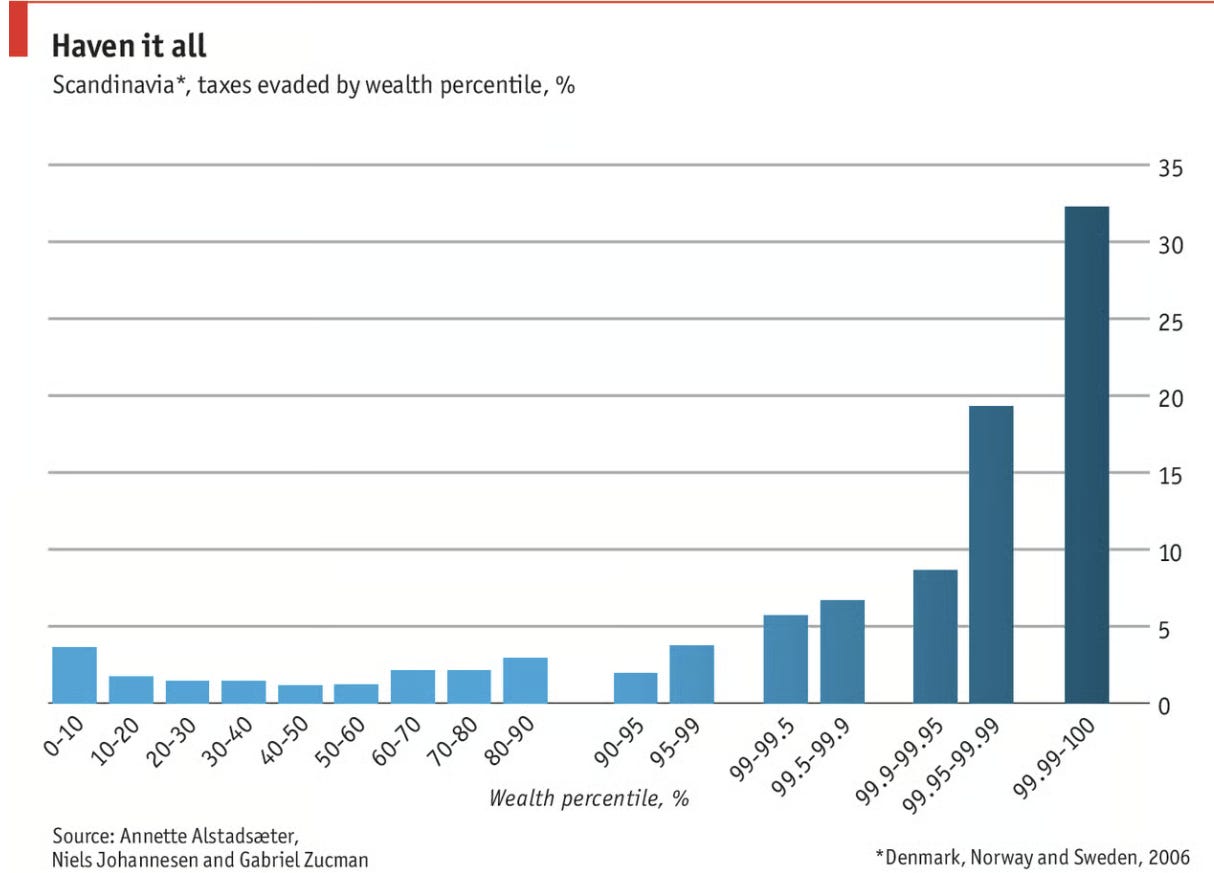
If we assume that will continue to be the case in the future, it means that even Zucman’s billionaire tax would be circumvented by most of them.
That, in turn, means it would likely not harm entrepreneurship and growth to any significant degree — and that it wouldn’t solve the problems created by inequality. In other words, the Zucman tax is mostly a symbolic suggestion.
Both Zucman and Waldenström presented fascinating time series on the development of income distribution. But these data don’t show how the wealth was created. And according to the view of distributive justice that most people actually hold, that matters enormously.
Simply put, people can become rich in three different ways:
Theft and corruption
Inheritance
Value creation that others voluntarily pay for
It would be interesting if economic historians tried to distinguish between these three in their data. Even without such data, I believe the priority should be to create institutions that make it harder to get rich the first way and easier to get rich the third way.
Even if wealth is created solely through fair processes, there can still be large gaps between the super-rich and everyone else. Both Elinor Odeberg and Gabriel Zucman rightly noted that problematic power imbalances can arise when inequality in a society becomes too great. However, those imbalances will persist even if a billionaire tax were introduced and successfully implemented.
Moreover, as society grows wealthier, the number of billionaires is likely to keep increasing — even with such a tax in place.
I therefore lean toward the view that the problems associated with more super-rich people are better handled through social norms and regulations rather than taxation. In other words, we need to discuss what the super-rich do with their money, what we want them to do, and what they should perhaps be prevented from doing.
One problem frequently raised in this discussion is that the super-rich can influence politics by donating money to certain parties or candidates. When this happens in secret, it’s easy to see the democratic problems it creates.
A first step in addressing such problems would be greater transparency around such contributions. I believe this is important even in Sweden, where we sometimes tend to be a bit naive about corruption in the grey zone between the private and public sectors.
At the same time, there can be benefits to having many super-rich people in a society — especially compared to a situation where economic power is concentrated in the hands of the state, the church, and a few dynasties.
More wealthy people can mean better access to venture capital, research funding, cultural funding, and much more.
Put differently: Even after paying his billionaire tax, Elon Musk will still be super-rich. More important than introducing such a tax is therefore making democracy and society at large robust against wealthy rent-seekers who want to use state power to further enrich themselves.
No posts
Comments
Nothing yet. Say the first thing.
Sign in to join the conversation.