
Here’s what you’re getting in this post: A rubric. Three categories of agents with examples, so you know what belongs where. Then a table. The table is the thing you bookmark. It maps use cases against your options: build it yourself, build it on a platform, buy it. Green, amber, red. It comes from thousands of hours and dozens of engagements where we’ve been inside RevTech stacks, watching what works, what breaks, and what never was going to work.
Let’s be honest about something before we go any further. This is an exciting time to work in go-to-market. It’s also one of the hardest. Every week, there’s a new post telling you to go learn Claude Code or build your own agent swarm or automate your entire pipeline by Friday. Most of that advice is written by people who don’t have your job. You’re trying to hit a number, keep a team together, and make sense of a landscape that changes every week. We’ve had your job. We know. And we’re pissed about how much noise is being thrown at you right now. This post is the opposite of that noise.
This Substack is reader-supported. To receive new posts and support my work, consider becoming a free or paid subscriber.
Now here’s why you need it.
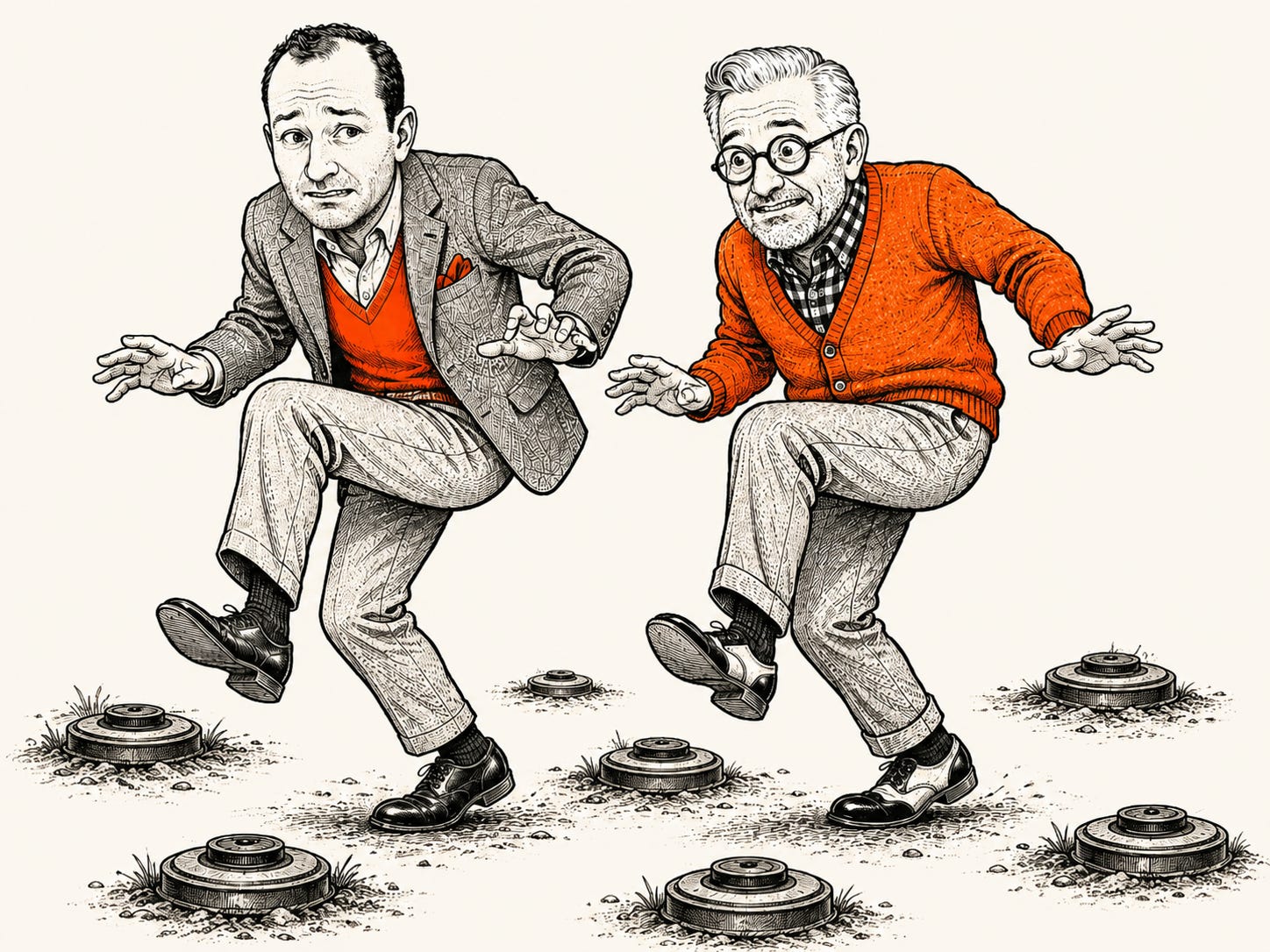
The RevTech stack is a house of cards on fire, and someone is pointing a high-powered fan at it while your revenue team screams.
You’ve got 45 tools. A CRM that was supposed to be the source of truth but became a junk drawer. A marketing automation platform nobody fully owns. A sequencing tool. An enrichment vendor. If you’re lucky, your intent signals live on the same platform. Maybe HubSpot is holding it together. If you’re unlucky, you’re running the Frankenstein monster that is Sales and Marketing Cloud from Salesforce, and half your team has stopped logging in.
You’re looking at this through the lens of your stack. Wrong lens.
We don’t see many organizations thinking about this correctly. Arrogance alert. Sorry, but it’s what’s happening. If we could wave a magic wand, here’s what we’d be seeing: data layer first. A single source of truth that feeds a go-to-market orchestration layer. The CRM becomes an input, not the center. An orchestration layer acts on the data, not alongside 40+ applications that don’t agree on what constitutes a qualified lead. We’ll cover the GTM orchestration layer in a future post. It will be chock-a-block full of recommendations. That’s not this post.
That’s the future: GTM Orchestration. Full stop. And it’s also a massive lift. Organizational alignment. Political capital. Budget. The kind of change that gets people fired when it goes sideways. If you’ve spent any time in a company north of $25M ARR, you know how much entropy lives between a good architecture slide and an actual implementation.
Most growth leaders don’t have the runway for that play. Not right now. We’re busy hearing about how Peter Thiel-backed Monaco just farted out $10M in ARR in three months. And we hate to say it, but it’s sorta the proof point of where things are headed.
But there’s another path. Faster. Cheaper. You can start this week. Many of you already have.
Agents.
Not the garbage AI SDR that’s going to run your pipeline autonomously. It doesn’t. Adoption of those platforms has gotten growth leaders fired. You can’t throw AI on top of a shit ICP and pray that personalization makes the difference. Something simpler. Task agents that do the work you don’t have time for. Interpretation agents that help you make better decisions with the data you already have. Autonomous agents: approach carefully, and only after you’ve earned the right to trust their outputs.
Three categories. We’re going to walk you through each one. Where to start. Where to stay away.
With your permission, Tyson Parody and Doug Bell. We’re your guides. Tyson is a Revenue Systems Architect who has been inside more broken stacks than either of us wants to count. He sees where agents break. Doug sees where the methodology breaks. Together, that’s the whole picture.
Think of this as a punk rock set list. Three chords. No filler. Just enough to play the song.
The Rubric
People hear “agent” and don’t know if they’re talking about a script that pulls data or a system that sends emails on its own. Those are not the same thing.
We know there are dozens of rubrics out there now. We don’t need you to like this one. It’s how we’re navigating, what we’re building, and why. Scott Brinker has a baller rubric you should check out. We aren’t Scott. Our knuckles drag a little too close to the ground.
Three chords:
Do This For Me. A task agent. You give it a job, and it does the job. Research a competitor. Collect public data on a set of companies. Summarize a document. A very fast intern with perfect memory and no opinions. Low risk. High value. Start here.
Help Me Decide. An interpretation agent. It takes what the task agent collected and surfaces patterns, comparisons, and rankings you wouldn’t have spotted. But you make the call. The agent does the heavy lifting. You bring the judgment.
Just Handle It. An autonomous agent. Runs without you. Sends emails. Books meetings. Decides who to contact and when. This is where AI SDRs live. This is where most deployments fail. Not because the technology can’t do it. Because nobody tested the outputs before they shipped.
The rubric isn’t about sophistication. It’s about knowing which category each use case belongs to before you build anything. The agent gives you an answer. The answer is only as good as the human who evaluates it.
One thing before the table: P0
There’s a move that comes before everything in this table. Call it P0. Before you build a single agent or buy a single tool, you teach the machine who you are. Connect your drives. Connect your email if you’re senior enough for it to matter. Feed it your transcripts, your wins, your losses, your ICP, your positioning. Then let it spend real time reading it all and telling you where your own story contradicts itself. You’re building a single source of truth the model can work from.
Here’s why this matters. You cannot orchestrate what you cannot read. Bad input equals bad output. That used to be forgivable because the models were weak. The models aren’t weak anymore. They’re sharp. Which means they’ll take your disorganized, contradictory, half-true data and confidently build on top of it, faster than ever. Garbage in, garbage out, at machine speed.
Most organizations skip this. The data layer is the sacred cow nobody wants to touch. It’s not sexy, it’s expensive, it’s boring, and it has no owner. So everyone builds on a foundation that was never poured.
If you’re just starting, this is good news. You pour the foundation before the mess accumulates. Congratulations. You’re ahead of companies ten times your size.
We’re not going to fully unpack P0 here. That’s a future post, with Tyson walking through the architecture in depth. For now, know this: every use case in the table below works better when P0 is in place. Some barely work without it.
The Tables
Before you look at the tables, a quick note on the columns. ‘Build It Yourself’ means you and Claude Code (or Cursor, or whatever you’re using - or having a team member who can do this - whatevs) in a terminal, building the thing from scratch. No vendor. No platform. Just you and the model. ‘Build It on a Platform’ means you’re using an orchestration layer like LangChain, Relevance, or one of the dozen others that let you assemble agents with less raw code but more dependencies. ‘Buy It’ means you’re paying a vendor for a finished product that promises to do the job out of the box. Each column carries different tradeoffs in cost, control, and risk. The tables maps those tradeoffs against the rubric so you can see where each option makes sense and where it doesn’t.
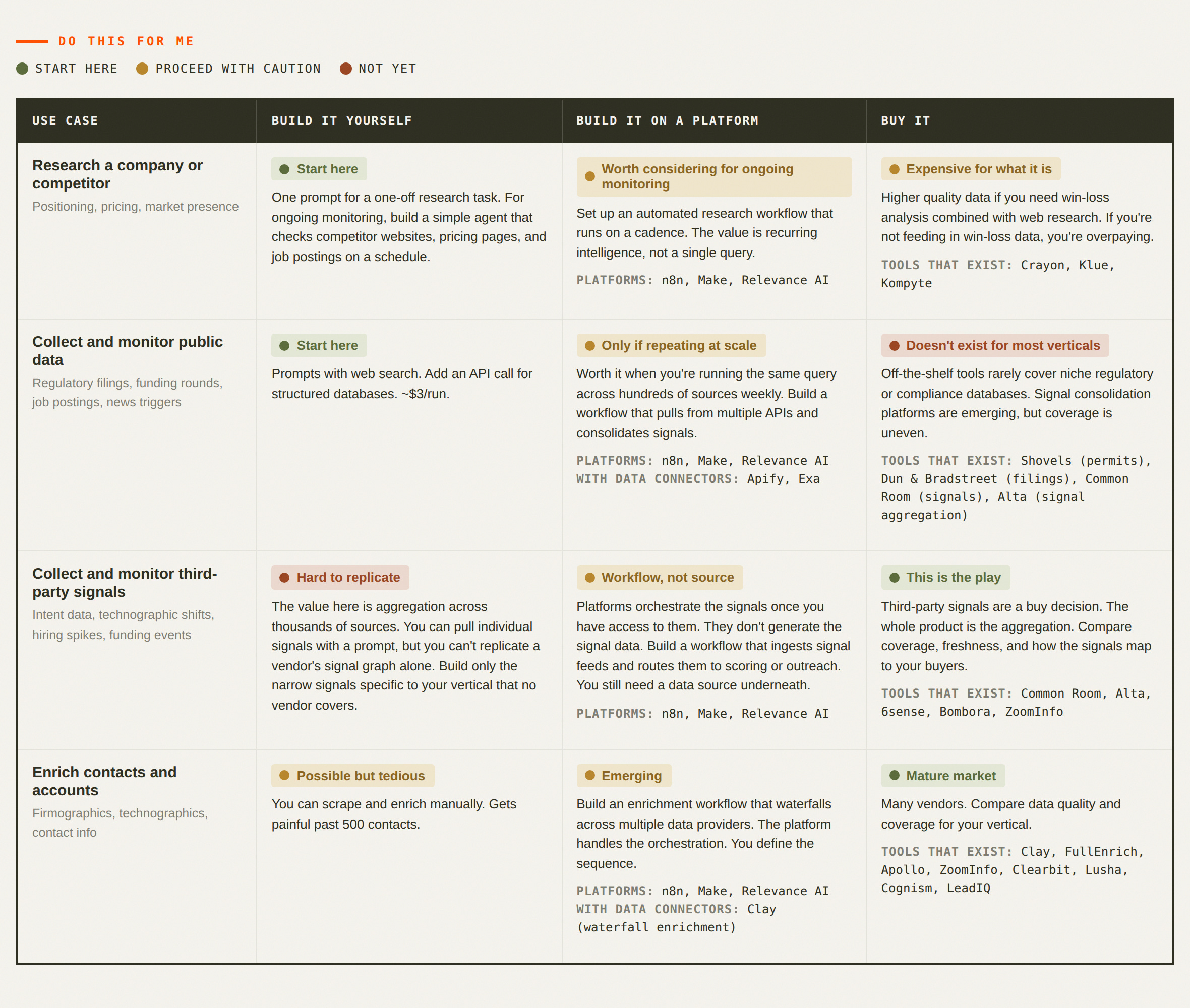
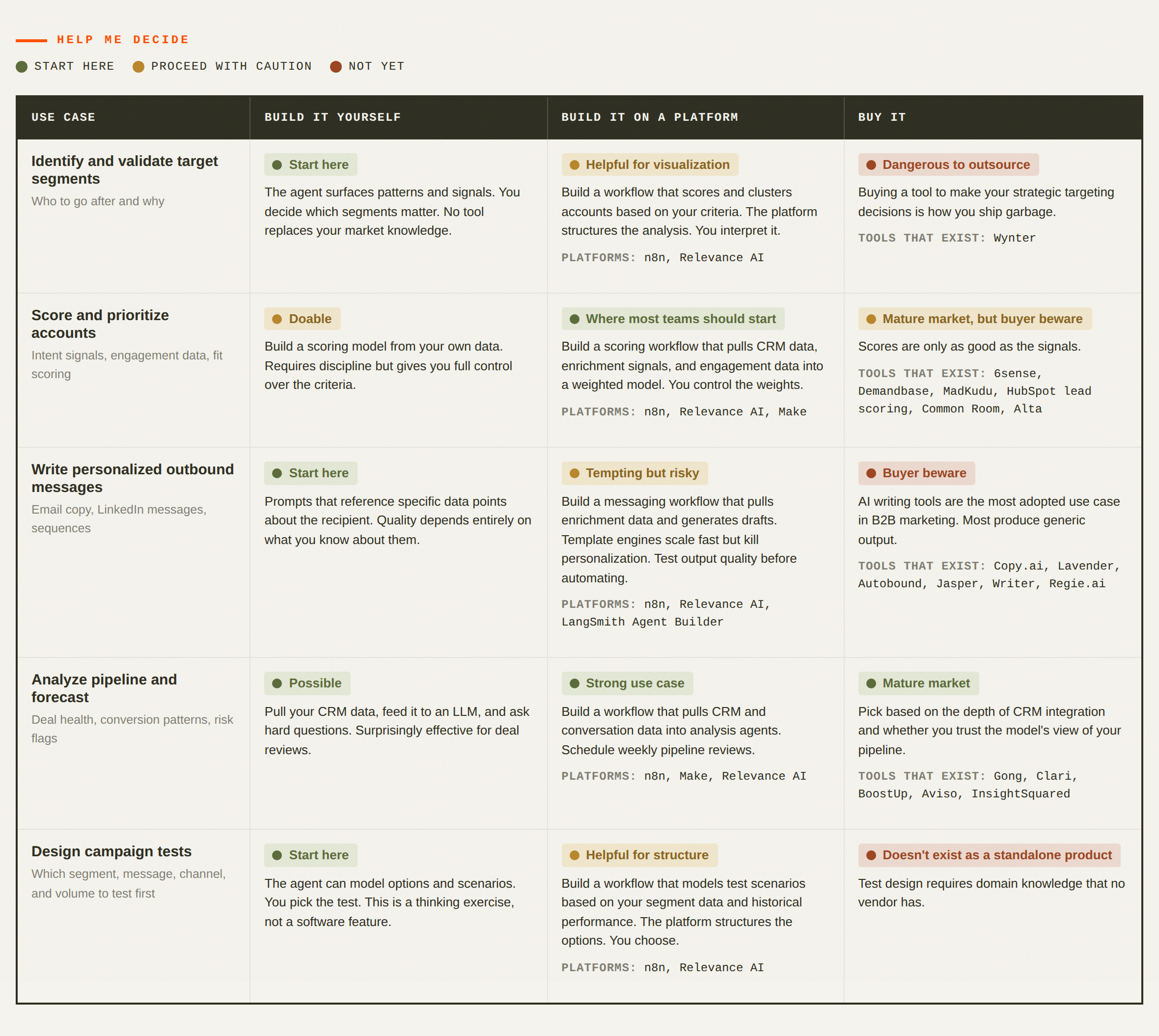
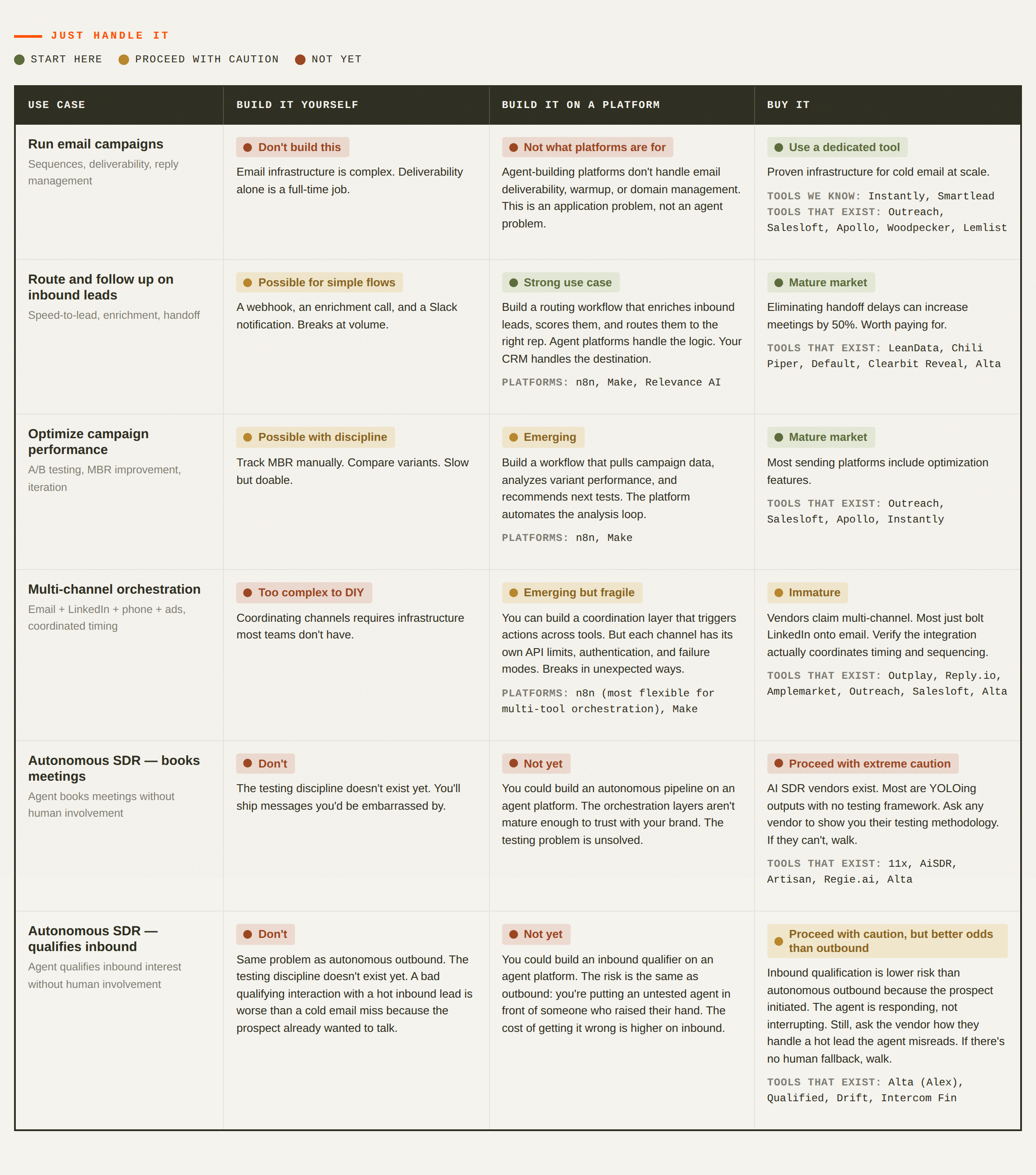
Reading this table: Green means go — this approach works today for this use case. Yellow means it works, but you need to know what you’re getting into. Red means stop — either it doesn’t exist, it’s too complex, or the risks outweigh the benefits right now. This landscape is changing fast. What’s red today may be green in six months.
You’ll be seeing this table quite a bit in the future. As we see the market evolve, our recommendations will shift. The rubric, not so much.
What Comes Next
Agents are more capable than most growth leaders realize. Most agent deployments fail because no one checked the output before it shipped. Both true.
The teams winning right now are not sprinting to Just Handle It. They know which category each use case belongs in. Do This For Me is cheap, fast, and real. Help Me Decide is where the value lives. Just Handle It is where the risk lives.
Post one of three. Next question: where do these agents actually live? Build versus buy. Platform versus DIY. That’s where decisions get expensive.
We pulled two cross-references out of the tables to keep it clean. Both are worth your time if the cells above raised a question.
On why personalization keeps failing: most teams treat personalization as the fix when it’s actually the symptom. The differentiator was never the tool. Read: Why Personalization is DOA.
On testing before you scale: the single most skipped step in outbound, and the one that separates teams who learn from teams who burn budget. Read: The Cannonball GTM 2-Week Test Protocol.
This Substack is reader-supported. To receive new posts and support my work, consider becoming a free or paid subscriber.
Comments
Nothing yet. Say the first thing.
Sign in to join the conversation.