
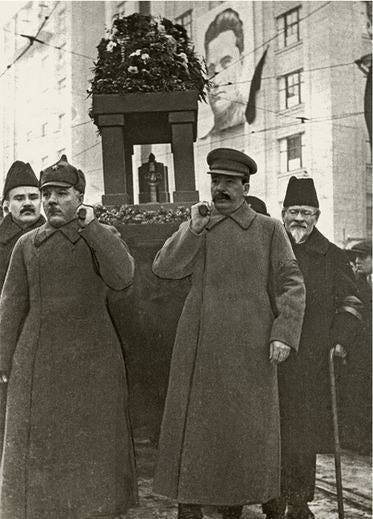
There is a small gallery of images that the twentieth century left us as inheritance, and no caption manages to tame them. Among these, few are as eloquent as the frozen photograph from December 1934, in which Josef Stalin appears in a dark overcoat, his shoulder steady beneath the wood, carrying Sergei Mironovich Kirov's coffin through Red Square. The composition is flawless, the grief convincing, the sorrow seemingly authentic. What escapes the hasty observer, dear reader, is the far from remote possibility that the man weeping is the very one who ordered the silence.
I say possibility because intellectual honesty demands it. Serious historians such as Oleg Khlevniuk and Alla Kirilina, having pored over the Soviet archives opened after the Cold War, maintain that no document exists tying the General Secretary to the trigger, and that Kirov, far from conspiring, supported the overwhelming majority of the boss's policies. Alexander Orlov, a high-ranking Soviet intelligence officer who defected to the West, told a different story with considerable detail, and Nikita Khrushchev, in 1956, hinted at the same before the Twentieth Congress. Amy Knight, for her part, offers the most elegant formulation of the problem, since Kirov's threat never needed to be deliberate in order to be real. It was enough that he existed.
And he existed in a particularly unbearable way.
The man who walked alone
Born Sergei Mironovich Kostrikov, an orphan raised in provincial asylums, enrolled in the Bolshevik faction in 1904, Kirov had become over the course of the early thirties the most popular leader in Leningrad and one of the few Politburo figures capable of drawing applause that was not strictly protocol. He spoke well, improvised better, and possessed that public-square magnetism which bureaucracy always mistakes for insubordination. While Stalin cultivated his own aura in the isolation of the Kremlin, surrounded by security arrangements worthy of a neurotic pharaoh, Kirov walked to his office on foot, crossed the city streets alone, and played with children in the courtyard of the building where he lived. Within a system designed for absolute subservience, that kind of ease functions as provocation.
Forced collectivization turned the discomfort into political risk. The humanitarian disasters of the early part of the decade, including the famine that devastated Ukraine, had grown too large to hide beneath the carpet of official optimism, so that the old guard began whispering reservations in the corridors. Kirov shared some of these in private, which was already enough for the discontented to start pronouncing his name whenever they meant to say alternative. Machiavelli, who understood these matters with a coldness moralists still hold against him, observed that the prince who rises by crushing reality lives in permanent vigilance, given that any shadow of succession looks to him like a dagger.
The Congress of Victors and the ballots that vanished
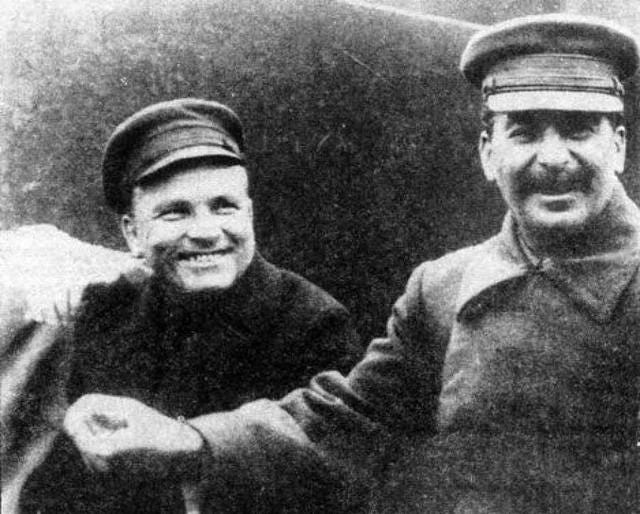
The catalyst arrived in early 1934, during the Seventeenth Party Congress, christened by official propaganda the Congress of Victors and rechristened by history, with that grim humor only facts possess, the Congress of the Condemned. The success of the First Five-Year Plan, generously inflated, was being celebrated, along with the unshakeable solidarity gathered around the great helmsman. Yet when it came time to elect the Central Committee by secret ballot, the staging cracked. Of the one thousand two hundred and twenty-five voting delegates, Kirov was approved with near unanimity, whereas Stalin accumulated a volume of rejections that sources estimate at anywhere between dozens and hundreds of votes, a number nobody has managed to fix precisely to this day, because the solution found was physical. Under the supervision of loyal acolytes, Lazar Kaganovich chief among them, the negative ballots simply ceased to exist before the count.
The message, nonetheless, got through. Still in 1934, Stalin ordered Kirov's permanent transfer to Moscow, an elementary maneuver from any manual of court politics, inasmuch as a leader far from his base is a leader disarmed. Kirov refused. And it was that refusal, more than any manifesto, that sealed the man's fate.
The useful idiot and the police that looked away
Leonid Nikolaev was the sort of human material that police regimes produce in series and later recycle to advantage. A disillusioned party member, expelled and reinstated more than once, resentful of communism's failure to improve the condition of the very worker he claimed to represent, he nursed fantasies of heroic grandeur alongside a personal grudge against the Leningrad apparatus that eventually crystallized into a fixation on Kirov. The ideal tool, then, for a piece of dirty work that could carry no signature.
What elevates the episode from a mere attack to suspected state conspiracy is the conduct of the NKVD. Weeks before the crime, Nikolaev was intercepted loitering around the Smolny Institute, and a search of his bag turned up a loaded Nagant revolver, a diary containing unmistakable notes, and a rough map detailing Kirov's usual routes. In any minimally functional country, a man caught under these circumstances would vanish into a basement for a week. In the Soviet Union of 1934, where an ordinary peasant was shot for hiding flour, Nikolaev was released on the direct orders of senior NKVD officials in Leningrad, Vania Zaporozhets among them, under the command of Filipp Medved, and had his belongings, the firearm included, promptly returned to him.
On the afternoon of December first, under the flagrantly implausible pretext of routine training drills, security along the Smolny's corridors was thinned out. Kirov arrived around four thirty, climbed the grand central staircase to the third floor, and made his way toward his office without immediate escort, since his personal bodyguard, Mikhail Borisov, a devoted and experienced man, was trailing inexplicably some twenty to forty paces behind. Nikolaev emerged from a recess in the corridor, followed him for a few seconds, and fired a single shot into the back of his neck at point-blank range. Death came almost instantly. Moments later, in a nervous collapse well documented in police literature, the shooter fainted beside the body, and it was precisely at that moment that the building's security reappeared with admirable punctuality.
The truck that killed only the witness
If the facilitation raises suspicion, it is the cover-up that produces the chill. The dangerous figure for the conspirators was never Nikolaev, whose muddled motives could be shaped under torture with artisanal ease. The problem was named Borisov, the one man capable of explaining who had pulled him from his úpost and on whose orders.
The following morning, the leadership landed in Leningrad to take personal charge of the investigation, Stalin at the front, flanked by Voroshilov, Molotov, Zhdanov, and NKVD chief Genrikh Yagoda. Borisov was summoned to testify. During the drive in a truck, flanked by NKVD officers, something occurred that the official reports called an accident. An agent seated beside the driver seized the wheel and threw the vehicle sideways into the wall of a building. The officers walked away unharmed. The driver did not so much as scrape himself. The single body pulled from the wreckage belonged to Mikhail Borisov, whose skull, according to later testimony and post-mortem examination, had been crushed with iron bars by his own escorts. A selective accident, in other words, aimed with a surgeon's precision.
Orlov reports that Stalin, standing face to face with the gunman, asked why he had killed such a likeable man, to which Nikolaev, with the boldness of one who already knows himself condemned, pointed toward the NKVD agents present in the room and suggested the question be redirected to them. Weeks later, under an emergency decree that suspended lawyers, witnesses, and appeals, Nikolaev and his alleged accomplices were tried behind closed doors by Vasili Ulrikh and shot within less than thirty days. The file, in effect, was closed by biological means.
Rutkovsky, or the art of washing one's hands with oil paint
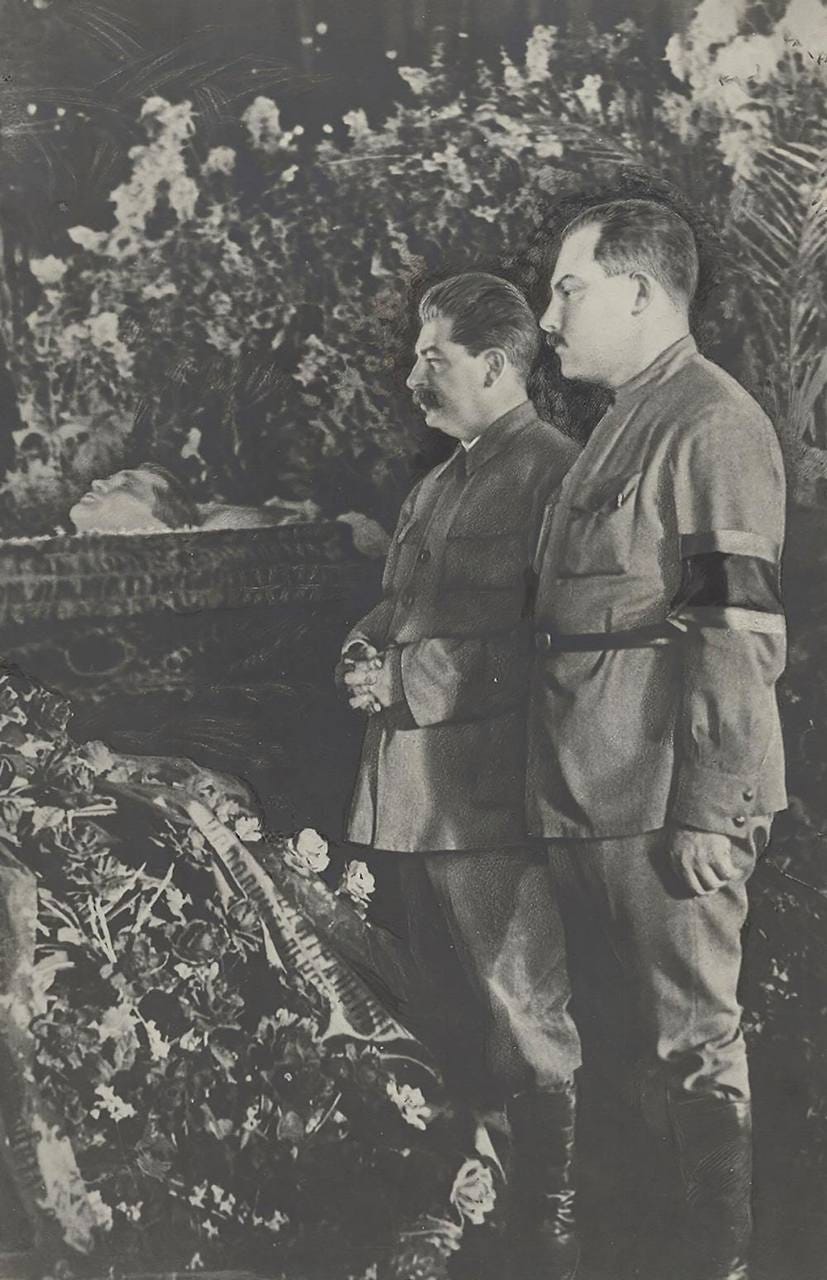
With the rival dead and the trail brutally erased, what remained was converting the corpse into a political asset. Here enters the Soviet propaganda machine, which was never content merely to govern reality when it could rewrite it. Kirov's funeral in Moscow, held on December sixth, was a spectacle of choreographed grief, the coffin crossing Red Square in procession and the ashes deposited with pomp in the Kremlin Wall Necropolis, Stalin cast in the role of the inconsolable widow of the fatherland.
The state promptly commissioned Nikolai Rutkovsky to paint *Joseph Stalin at Sergei Kirov's Coffin*, a canvas nearly three meters tall, dominated by a vivid red set against the cadaverous pallor of the dead man and the somber black of the mourning leaders. The work reflects nothing of the actual politics of those days, and that is precisely why it works. Rutkovsky did not paint a painting. He painted a decree. The canvas came to occupy the walls of offices, museums, and bureaus across the entire Soviet territory, teaching millions of citizens that grief was conclusive proof of innocence. After all, who would imagine that the man capable of such funereal devotion could have signed the death warrant?
Order 00447 and the industrialization of slaughter
Nikolaev's shot proved, according to Kremlin rhetoric, that saboteurs, fascist spies, and traitors had infiltrated the party's own ranks. On that same first of December, Stalin approved an emergency decree annulling legal safeguards for anyone accused of terrorism, authorizing mass arrests, summary convictions, and executions within twenty-four hours. It was the prologue to the Moscow Trials, where Zinoviev, Kamenev, Bukharin, Rykov, and Tomsky would confess, under physical and psychological torture, to plots that never existed, including the murder of Kirov himself.
The true scale of the horror, however, only becomes visible once the machine descends from the party elite to the ordinary population. On July thirtieth, 1937, NKVD Operational Order No. 00447, kept secret until the Soviet collapse, turned extermination into an industrial process. The document targeted former kulaks, clergy, intellectuals, members of non-Bolshevik organizations, and essentially anyone the state classified as socially dangerous, a category elastic enough to accommodate the whole of humanity. Trials fell to regional troikas made up of the local secret police chief, a prosecutor, and a party official, who dispatched sentences by the hundreds without defense or appeal, splitting the condemned between immediate execution and eight to ten years of forced labor in the GULAG.
The most diabolical detail of the decree, moreover, was the setting of quotas. Moscow informed each province how many thousands should be arrested and how many should be killed, and regional chiefs, eager to demonstrate zeal, wired back requesting permission to exceed their targets. The NKVD chief in Omsk reported with pride that his men had fulfilled the plan ahead of schedule and begged permission to execute several thousand more, a request granted personally by the General Secretary. When the desperation for numbers grew acute, agents took to combing telephone directories in search of names and to prioritizing the arrest of married men with children, since institutional sadism had discovered that fathers confessed fastest, clinging to the vain hope of sparing their families.
Between 1937 and 1938, the Soviet state arrested somewhere between one and a half and one point seven million citizens, of whom seven hundred to eight hundred thousand were shot and buried in mass graves such as those at Bykivnia and Sandarmokh, while the archipelago of camps would go on to swallow roughly twenty million human beings over the course of the reign. Call it thanatocracy, a government whose productivity is measured in corpses per quarter. And the entire paperwork of that funereal accounting rests, in the final analysis, on a single body that fell in the third-floor corridor of the Smolny Institute.
The cage one learns to love
We arrive, dear reader, at the point where history stops being the past and begins staring back at us.
I have spent years insisting on a phenomenon I have named mental favelization, describing the process by which a suffocated society, whether strangled by the brutality of drug trafficking or by a parasitic state that corrodes every horizon of prosperity through regulation and inflation, ends up internalizing the logic of its own captivity. The Great Terror was the continental, fully realized version of that pathology. By pulverizing every alternative rallying point, and Kirov was exactly that, Stalin atomized the social body and transferred to the jailer's grip the monopoly over subsistence and protection. The neighbor became a suspect, the brother became a risk, denunciation replaced honor as the technique of survival, and civil society imploded from within without a single tank needing to roll through the streets.
From this follows the enormous Stockholm syndrome that haunts every regime of this kind. Stripped of any avenue toward economic, intellectual, or legal emancipation, the population learns to love whoever holds it captive, given that the very apparatus issuing execution quotas in the morning was revered by afternoon as a benevolent shield against the imperialist threat. A captive people defends its own cage for the most prosaic reason imaginable, since the jailer holds, all at once, the chains, the keys, and the rations.
We need no pre-dawn executions to recognize the grammar. The contemporary script is cleaner, more procedural, and infinitely more polite, though it obeys the same syntax. An impending abyss gets manufactured, whether the threat to democracy, the danger of disinformation, or the chaos of crises that follow one another without pause, and in the name of containing the abyss the state apparatus extends its tentacles. Supreme courts issue censorship by single-judge ruling and tear through due process with the same ease with which the Stalinist state suspended the law in December 1934. Media corporations abandon journalism for the far more lucrative trade of reputation laundering, performing a function identical to Rutkovsky's brush. And the opposition, where one exists, reveals itself an aggregate of vanities lacking any general staff, any doctrine, or any patience for the long work ahead.
The docility with which all this gets accepted, always wrapped in the gift paper of defending the institutions, attests that mental favelization continues operating at full steam. Where intellectual, financial, and legal independence is absent, submission becomes the only language the population still speaks fluently.
The blood spilled at the Smolny nearly a century ago remains, technically, an open enigma, and perhaps it will remain so forever. The lesson, however, does not depend on a confession that will never come. Tyrannies do not sustain themselves through raw savagery, but through the icy efficiency of bureaucracy, through quotas typed out in triplicate, through tribunals of exception, and through the hermetic control of the narrative. Whenever we accept that individual freedoms be suspended during bouts of hysteria to protect us from threats only the state claims to see, we voluntarily assume the position of pallbearers of our own political coffin, exactly as Stalin marched through Red Square carrying on his shoulders the most ingenious of all his inventions.
The past refuses to remain in the perfect tense. It is up to us to decide whether we will break the civic Stockholm syndrome or whether we will keep waiting, with that exemplary patience of the obedient condemned, for the commissar on duty to sign off on the year's quota of our freedom.
Comments
Nothing yet. Say the first thing.
Sign in to join the conversation.