
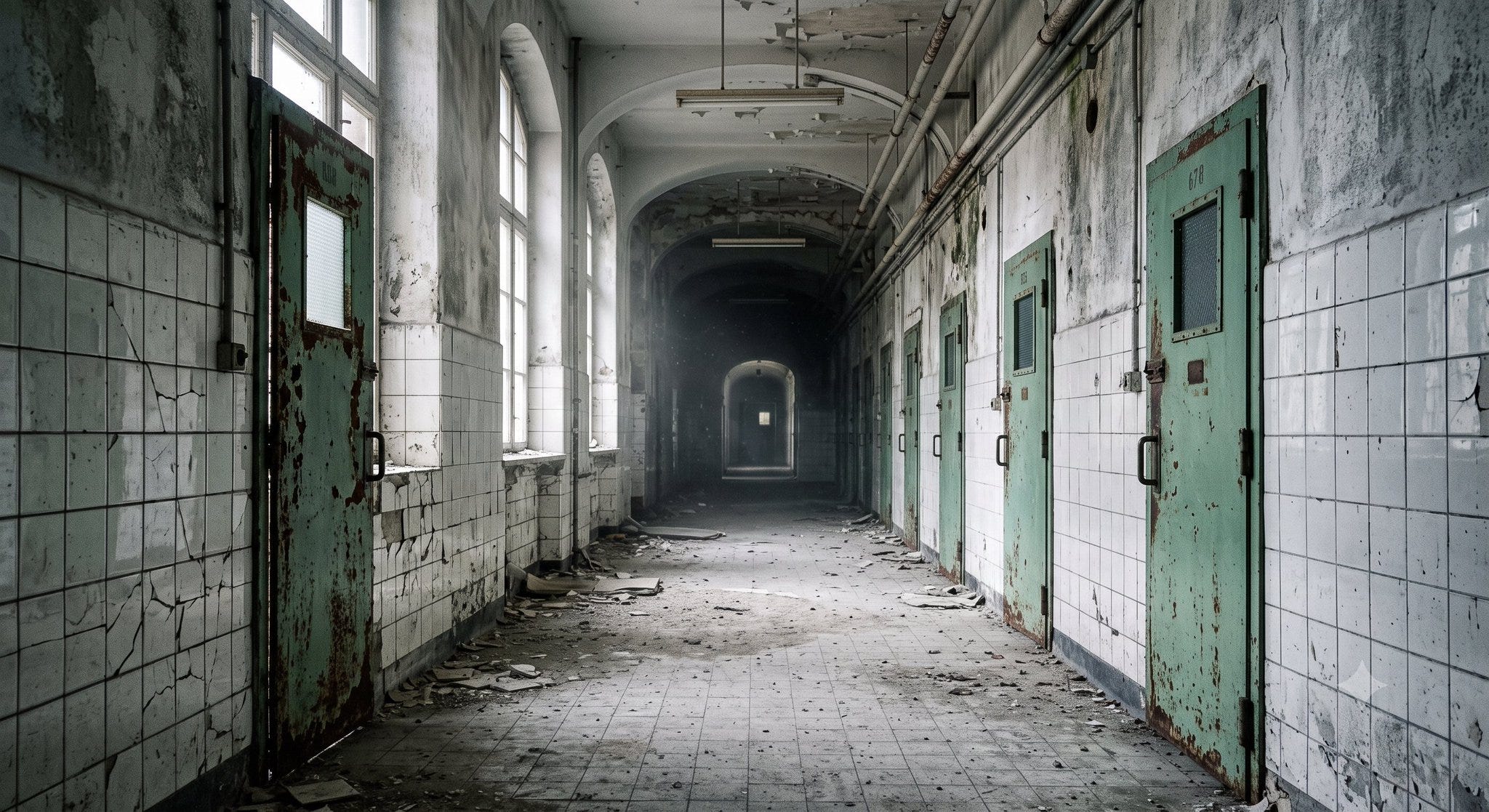
The twentieth century discovered, with considerable delay and a cost in corpses that we have not yet finished counting, that shooting dissidents is a rudimentary method. It leaves a body, leaves a widow, leaves a martyr, and forces the regime to explain itself, explanation being precisely what no power grants willingly. That is why, at some point in the long bureaucratic digestion that separates Stalin from Brezhnev, Soviet psychiatry offered the State a solution of almost geometric elegance. Instead of killing the inconvenient person, it was enough to diagnose him.
The technical name of the thing was sluggish schizophrenia, a category forged by Andrei Snezhnevsky and his school at the Serbsky Institute. The perverse genius of the concept lay in its elasticity, inasmuch as it dispensed with visible symptoms. The patient could reason clearly, work, raise children, pay his taxes, and still suffer from a latent illness whose only clinical sign consisted, roughly speaking, in disagreeing with the Party. Obsessive reformism. Delusion of claiming rights. Pathological perseverance in the defense of what the subject insisted on calling the truth. Vladimir Bukovsky smuggled to the West, in 1971, some hundred and fifty pages documenting the procedure, and the World Psychiatric Association would still take six years to formally condemn it, in Honolulu. The Soviet Union withdrew from the organization in 1983, sparing itself the embarrassment of expulsion. No one was convicted. Everyone was treated.
Now, it would be enormously comforting to suppose that such a contrivance flourishes only in the damp soil of real socialism, and for that very reason it is well to recall Yuri Nosenko. A KGB officer, he defected to the United States in 1964 bringing information about Lee Harvey Oswald, and James Angleton, head of CIA counterintelligence, convinced himself that it was a plant. Nosenko then spent something on the order of three years in confinement, a good part of it in a concrete cell, subjected to sensory deprivation and hostile interrogation, without formal charges, without defense, and without any court having been informed of his existence. Later he was cleared and hired as a consultant by the same agency that had buried him. The republic most jealous of its habeas corpus on the planet simply did not know he was there.
And here, dear reader, we arrive at the irony that structures the entire century. The man who described this machinery with the precision of a watchmaker was Michel Foucault. In 1961 he showed, in the history of madness, that insanity is not a fact of nature but an administrative category, an envelope into which society dumps what it does not know how to process. In 1975, while dissecting Bentham’s panopticon, he formulated the thesis that perfect surveillance does not need to watch, it being enough that the watched ignore when he is being observed, so that he begins to police himself alone and with diligence. The jailer can go home. The prisoner takes the night shift.
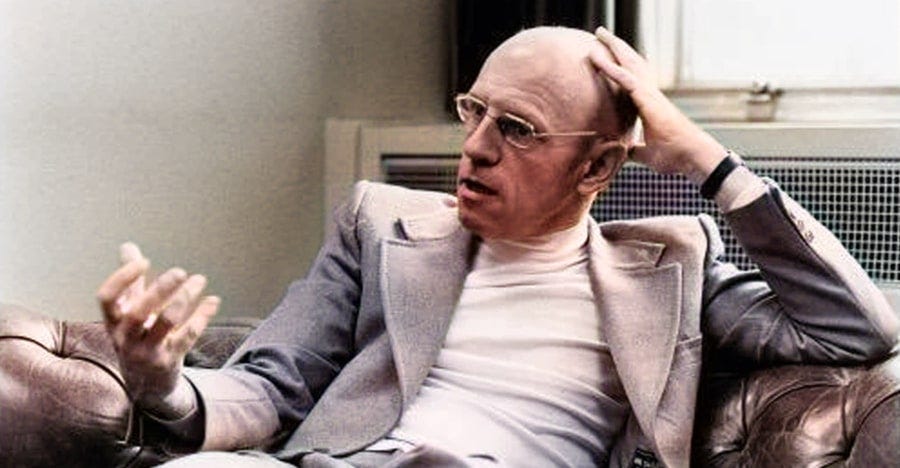
It so happens that the same Foucault signed, in 1977, alongside Sartre, Beauvoir, Derrida, Barthes, Deleuze, Guattari and several dozen other ornaments of French thought, a petition to parliament calling for the decriminalization of sexual relations between adults and minors under fifteen. This is not rumor, it is a public document, and remains available for anyone with the stomach for it. The later accusations about the philosopher’s personal conduct in Tunisia, those indeed remain uncorroborated and should stay where they are, in the realm of allegation. Yet the petition is enough, since it reveals the kinship that matters. Whoever understands that madness is an administrative category also understands that innocence is one.
Brazil need not import this grammar, given that it practiced it on an industrial scale. In Barbacena, the Colônia Hospital received for decades people whose only pathology was being inconvenient. Epileptics, alcoholics, single mothers, homosexuals, indigents, unwanted wives, opponents of some inland political boss. Estimates run to around sixty thousand dead. No judge signed that. A medical report was enough, and the report dispenses with adversarial process because one does not argue with science, one argues with a lawyer, and there was no lawyer there. I call this labelocracy, government by the label, the regime in which authority does not pronounce a sentence but a prescription, and the prescription has the incomparable advantage of admitting no appeal.
The contemporary mechanism has abandoned electroshock for reasons of cost and image, yet conserves the three-story architecture. The administrative floor works by extraction, and the American example is didactic, since the settlement of the Volkswagen diesel-engine scandal generated a billion-dollar environmental mitigation fund whose destination came to be disputed by networks of organizations that no one elects, that no one audits and that present themselves to the public with the candor of those who defend little birds. No one was expropriated. Everyone was fined. The judicial floor operates by selectivity, and in it the prosecutor decides not what is a crime, but who will be prosecuted, so that the law remains intact on paper while becoming optional in practice. The medical floor, finally, is the most elegant of the three, inasmuch as it turns the adversary into a patient, and a patient is not refuted, he is treated.
As for the Epstein file, it is well to be honest about what is known and what is supposed. Documents released by the Department of Justice contain statements from a confidential source according to which the financier had ties to intelligence services, and the records themselves note that such statements were not independently corroborated. There exists, on the other hand, an internal FBI cable dated 2008 indicating that Epstein was providing information to the bureau pursuant to an agreement, which is something quite different and quite more concrete. Moreover, Alexander Acosta is said to have stated that he was told the individual belonged to intelligence and that he should leave him alone, a report that he himself later relativized. In effect, what can be affirmed without exaggeration is that a man prosecuted for sex trafficking of minors obtained, in 2007, a non-prosecution agreement so obscene that no innocent explanation has ever been offered. Perhaps intelligence. Perhaps merely money. Maybe the distinction is less important than we would like.
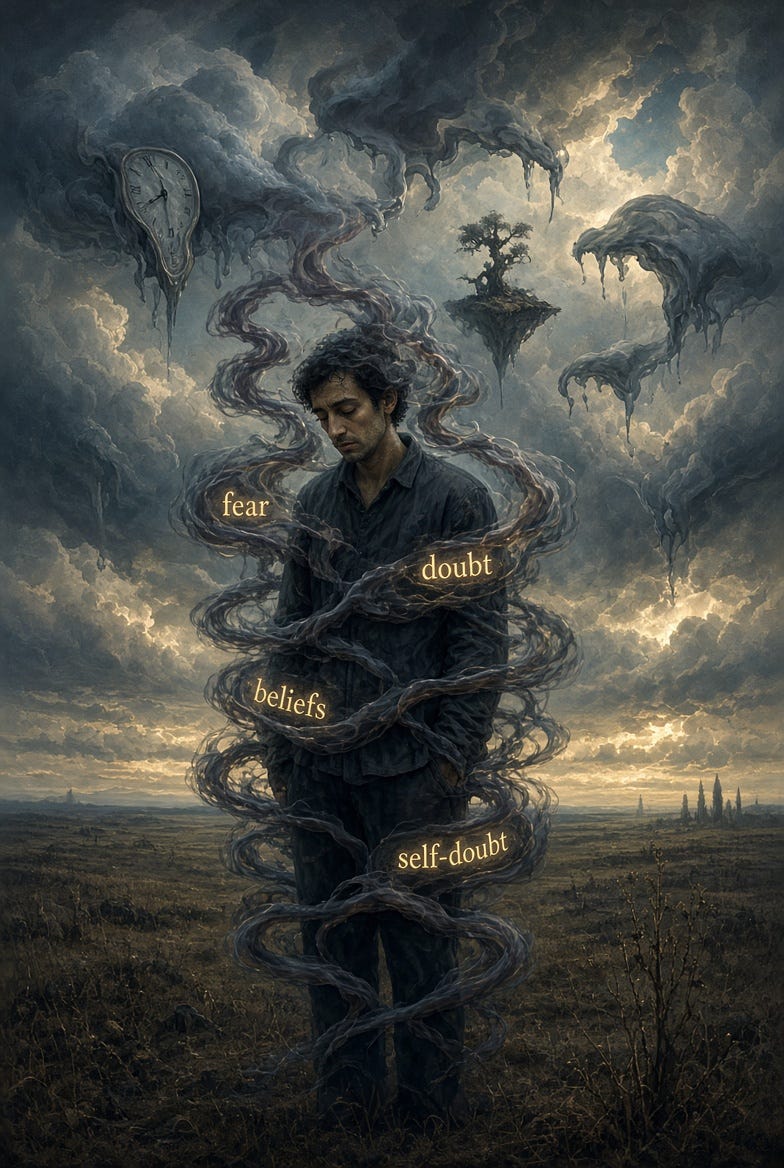
Therefore the pertinent question is not who built the invisible prison, a question that feeds the conspiracy industry and produces nothing beyond a sequel for the next video. The question is why it works so well in formally free regimes, with a press, with elections, with a written constitution and a supreme court. And the unpleasant answer is that it works precisely because of that, inasmuch as democratic legitimacy is the best solvent ever invented for popular distrust. The Soviet subject knew he was a subject. The contemporary citizen holds a ballot every two years and concludes, with bovine placidity, that he is therefore free.
In the end, what Foucault did not foresee, or foresaw and found amusing, is that his description of the prison would become an instruction manual in the exact hands of those he thought he was denouncing. Although the panopticon was conceived as an accusation, it was read as an architectural project. And the prisoner continues convinced that the cell is his home, that the label is his medicine and that the watchman is his doctor, and perhaps he is right, inasmuch as the watchman indeed is.
Comments
Nothing yet. Say the first thing.
Sign in to join the conversation.