
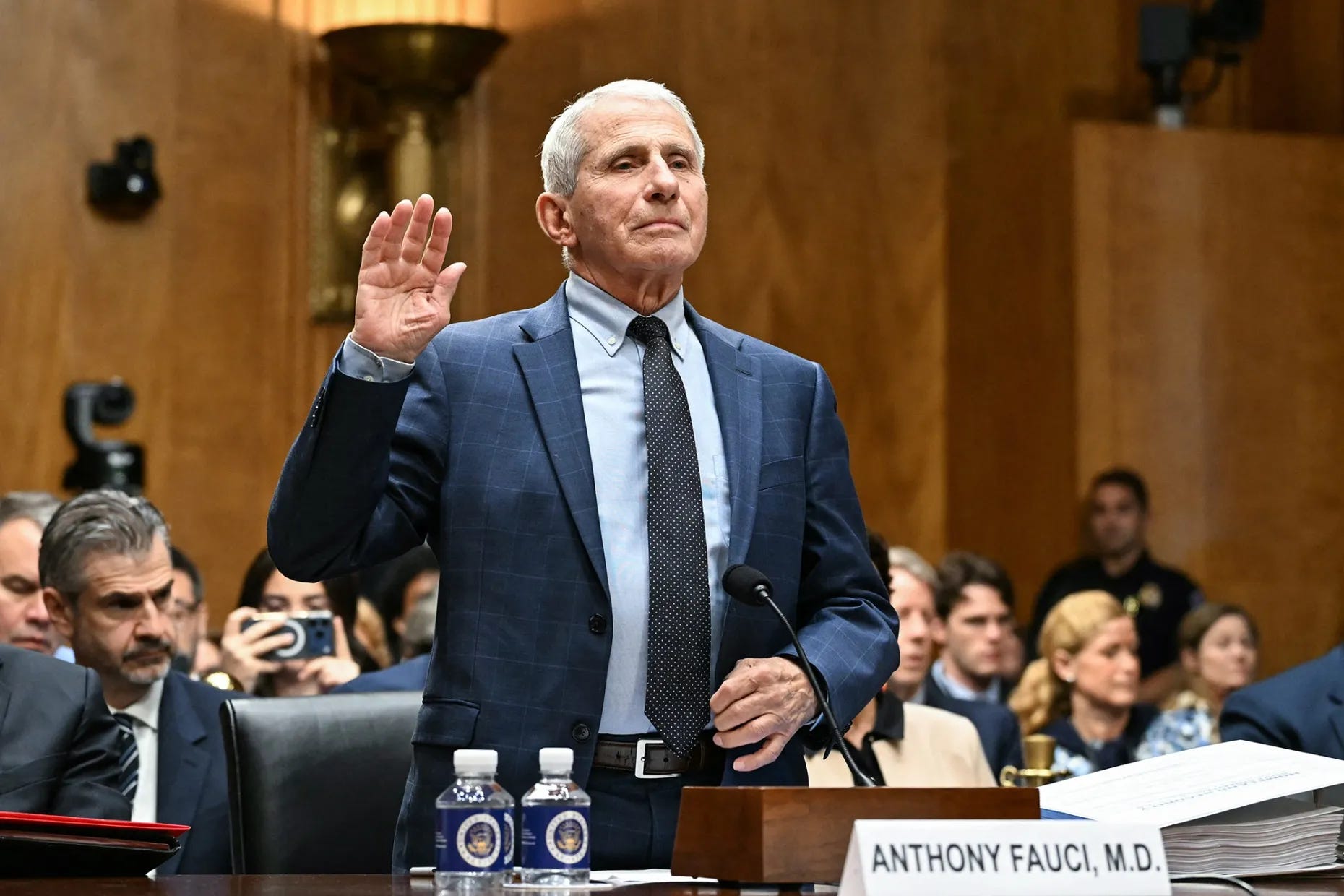
In two years of work, the House Select Subcommittee heard 38 sworn statements and held 25 hearings before concluding, in December 2024, that COVID-19 most likely escaped from a laboratory and that many of the major restrictions imposed on the public lacked scientific support.
When Anthony Fauci sat before the House Select Subcommittee on the Coronavirus Pandemic on the morning of June 3, 2024, he already knew which line he would have to defend. Five months earlier, in testimony transcribed behind closed doors, the former director of the National Institute of Allergy and Infectious Diseases had been asked about the origin of the rule that required Americans to keep two meters apart for more than two years, and he replied that he did not recall any discussion about choosing five, six, or ten feet, because the requirement kind of simply appeared. The line leaked, circulated, and made headlines. In front of the cameras, Fauci tried to reduce it to a technical point, claiming what was missing was a clinical trial comparing distances, and shifted responsibility to the Centers for Disease Control and Prevention, which had drafted the guidance. A representative then asked whether he had publicly challenged the rule at any time, to which Fauci answered that it would not be appropriate to publicly challenge a sister organization.
The exchange appears on page 201 of the final report the subcommittee delivered on December 4, 2024, and may be the most economical summary of the entire document. There are 520 pages of main text, preceded by a prefatory section that lists names, institutions, hearings, and testimonies, bringing the total to more than 550 pages in the published file. According to the opening letter signed by the subcommittee chair, Republican Representative Brad Wenstrup of Ohio, the work consumed more than a hundred investigative subpoenas, 38 transcribed interviews or sworn statements, 25 hearings and meetings, and the review of more than one million pages obtained from dozens of custodians. The text concludes that SARS-CoV-2 likely emerged from a laboratory accident or lab-related research, that U.S. emergency programs lost hundreds of billions of dollars to fraudsters, and that much of the containment measures were adopted without the evidence claimed to exist.
-The witnesses on day one
The process began on February 28, 2023, at a hearing titled "Learning from the Past to Prepare for the Future," and the panel that day now reads like prophecy. Jay Bhattacharya, a Stanford professor; Martin Kulldorff, then at Harvard; and Marty Makary, a Johns Hopkins surgeon—three of the most visible critics of lockdowns—were called, the first two being coauthors of the Great Barrington Declaration. A little over two years later, on March 25, 2025, the Senate confirmed Bhattacharya as director of the National Institutes of Health and Makary as commissioner of the Food and Drug Administration in the same session. Since February 2026 Bhattacharya also held the interim directorship of the CDC, while Makary left the FDA in May of this year. The witnesses summoned to criticize the agencies ended up charged with running them.
Ten days after that first session, on March 8, 2023, Robert Redfield, former CDC director, testified before the subcommittee that from the early days of the pandemic he believed the infection was more likely to have resulted from an accidental leak than from a natural spillover, and he grounded the assessment in the virus's biology and the unusual episodes recorded in Wuhan in the fall of 2019. On April 18, it was John Ratcliffe's turn, former Director of National Intelligence, who stated that if the evidence favoring a leak were placed next to the evidence for a natural origin, the first column would be long and almost overwhelming, while the second would remain empty and thin.
-The paper that changed the debate
The report’s most delicate chapter deals with the article "The Proximal Origin of SARS-CoV-2," published in Nature Medicine on March 17, 2020, after circulating on the Virological platform on February 16. The paper asserted two categorical conclusions: that the virus was not a laboratory construct nor a deliberately manipulated organism, and that no laboratory-origin scenario appeared plausible. The subcommittee concludes that the paper was prompted by Fauci with the declared purpose of discrediting the leak hypothesis, and supports the charge with a reconstruction of January and February 2020 based on emails, Jeremy Farrar’s memoir (then director of the Wellcome Trust), and above all the testimonies of the authors themselves.
Kristian Andersen, a professor at Scripps Research, gave transcribed testimony on June 16, 2023, when he explained that his initial concerns focused on the furin cleavage site, the receptor-binding domain, and the BamH1 restriction site. Asked what he meant by writing that the genome was inconsistent with expectations from evolutionary theory, he replied that it was an elegant way of telling colleagues he thought the virus might have been engineered. Andersen also reported that January 31, 2020, was the first time he spoke personally with Fauci outside of conferences, and that it was during that call that the idea of writing a paper about a possible leak first arose. The next day, a teleconference brought together Fauci, Farrar, Andersen, Robert Garry, Christian Drosten, Ron Fouchier, Edward Holmes, Marion Koopmans, Andrew Rambaut, and Patrick Vallance, among others.
When the subcommittee summoned the authors for a public hearing on July 11, 2023, titled "Investigating the Proximal Origin of a Cover-Up," only Andersen and Garry appeared. Ian Lipkin justified his absence, while Rambaut and Holmes refused to attend. A similar pattern repeated on April 16, 2024, when the subcommittee invited the editors-in-chief of the world’s three leading scientific journals to discuss peer review and public funding. Holden Thorp of Science attended. Richard Horton of The Lancet and Magdalena Skipper of Nature declined.
-Two weeks between a version and its refutation
The May 2024 sequence contained the harshest episodes. On May 1, Peter Daszak, president of EcoHealth Alliance, the organization that brokered U.S. federal funds to the Wuhan Institute of Virology, was interrogated about a fifth-year report for NIH funding delivered nearly two years late. Daszak claimed the organization had uploaded the document into the system, but that the system had blocked it, and added that when the NIH finally requested submission two years later, it took eleven days to unlock access, so any contrary assertion would be demonstrably false.
Fifteen days later, on May 16, Lawrence Tabak, the NIH's principal deputy director, sat in the same chair and was asked whether that was true. He answered that there was no evidence of it. Michael Lauer, head of NIH extramural research, had already stated in transcribed testimony in November 2023 that a forensic audit of the agency’s systems had been unable to confirm Daszak’s account. Confronted at another point with the testimony of Emily Erbelding, director of a NIAID division, which contradicted his claim of transparency regarding access to samples, Daszak wondered whether his colleague had not been present for the discussion or had confused samples with genetic sequences.
On May 22, it was David Morens’s turn, senior scientific advisor to the NIAID leadership and a federal employee for more than two decades. Asked if he had ever deleted official records, Morens replied that he had not, at least as far as he knew, although he noted that he deletes many emails every day because he considered them trivial and unrelated to government business. He also claimed ignorance of what constitutes a federal record and said that no one had ever defined email as such for him, which contradicted his earlier transcribed testimony in which he said he understood emails to be federal records. The subcommittee assembled messages in which Morens explained to colleagues the exact steps he took to insulate himself from problems, instructed interlocutors to use only his personal Gmail and to delete any other address from their contacts, and recorded in writing, in January 2022, that he had twice already deleted everything involving people from EcoHealth from his institutional inbox. The report frames the conduct under Section 2071 of Title 18 of the United States Code, which criminalizes the destruction of federal records.
-The school and the union
On April 26, 2023, Randi Weingarten, president of the American Federation of Teachers, testified at a hearing devoted exclusively to her organization. Asked how the CDC consultation regarding school reopening had occurred, she replied that contact had come from Joe Biden’s transition team even before the inauguration. Although the union had contested in writing, days earlier, the claim of lacking scientific competence, Weingarten admitted in her testimony that the organization did not employ epidemiologists or immunologists. Kelly Nedrow, director of health issues at the AFT, was more direct when heard on June 23, 2023, calling the organization a labor union.
The report documents that Rochelle Walensky, then CDC director and heard in public hearing on June 13, 2023, requested explicit language from the AFT for the operational reopening strategy during a meeting on January 29, 2021, and that line-by-line edits offered by external groups were effectively incorporated into the final text. Gretta Massetti, a CDC technical official, confirmed in testimony that external groups sometimes supplied wording, even though the agency was not obliged to accept it.
The effects are quantified in the report. Nine-year-old children’s performance in math and reading fell to levels not seen in two decades, the composite ACT score dropped below twenty for the first time since 1991, and students who stayed out of in-person schooling lost roughly half of expected math learning, compared with one-fifth among those whose classes were less interrupted. About 230,000 students simply disappeared from American public schools. Economist Eric Hanushek of the Hoover Institution estimates a $70,000 lifetime earnings loss for each affected student. Because schools in poor urban areas remained closed longer, losses were concentrated among Black, Latino, and low-income children.
-The governor and the text message
The Andrew Cuomo case occupies more than fifty pages and produced the most concrete legal consequence of the entire effort. The March 25, 2020 directive, which prevented New York nursing homes from refusing patients diagnosed with COVID-19, is qualified by the subcommittee as contrary to the science known at the time and incompatible with federal guidance. The July 6, 2020 New York State Department of Health document, presented as independent and peer-reviewed, attributed the excess deaths to the behavior of nursing home staff rather than to the directive.
Through testimonies and drafts provided to the subcommittee by a whistleblower, it was established that Cuomo revised the text, edited it to make its conclusions more causal, participated in the choice of external reviewers, and that the decision to omit residents’ deaths that occurred outside facilities was made in a June 27, 2020 call. Initial drafts accounted for roughly ten thousand deaths. The published version omitted the portion that died outside the institutions.
There was also a side episode the subcommittee treated as an attempted interference. James Malatras, a former Cuomo aide, was the first senior state executive official to confirm the governor’s involvement in drafting the report. When heard on May 20, 2024, he said he had not spoken to Cuomo since early 2021, but that he had received a text message from him on February 18 of that year, merely to say he hoped he was well. The subcommittee obtained the message and verified it had been sent within 48 hours of the public announcement of the invitation for Malatras to testify. Questioned about this on June 11, 2024, Cuomo replied that it was just a friendly note, that he did not know about the invitation, and that he did not intend to influence any testimony. He appeared at the public hearing on September 10. On October 30, 2024, the subcommittee referred him to the Department of Justice for false statements to Congress, and that same day Cuomo’s lawyers referred the subcommittee to the Department of Justice without pointing to a specific legal violation.
-What the report credits
It would be incorrect to read the document as uniformly accusatory. The subcommittee attributes extraordinary success to Operation Warp Speed, noting that the fastest vaccine development before 2020 had taken four years, and cites Fauci himself describing the initiative as a great success. It recognizes that travel restrictions imposed early in the pandemic delayed the virus’s spread and saved lives, and it records that public–private partnerships were more effective in producing and distributing tests than federal bureaucracy, whose first kits reached the market with a high failure rate and inadequate disclosure. The text makes a point of stating that discussing compensation for vaccine injury does not equate to anti-vaccination sentiment.
The fraud figures were determined by oversight bodies. The Paycheck Protection Program lost at least $64 billion, expanded unemployment insurance recorded more than $191 billion in fraudulent payments, and at least 17% of the $1.2 trillion disbursed by the Small Business Administration went to potentially fraudulent actors, about $200 billion. It is worth noting that the report’s summary records that last finding as $200 million, while the main text gives $200 billion, one of several inconsistencies in a volume closed in haste before the legislative turnover.
The agencies’ resistance to the subcommittee’s work is documented in the closing sections. Over 22 months, with custodians and search terms specified by the investigators themselves, the Department of Health and Human Services produced 14,799 pages on pandemic origins and gain-of-function research, much of it already public or censored. A single Freedom of Information Act search limited to Morens’s official account yielded more than 30,000 pages. Kathy Hochul’s government, for its part, did not provide a single draft of the July 2020 New York report, citing deliberative privilege, so drafts reached the subcommittee by informal channels.
-After the report
The developments followed quickly. On January 6, 2025, EcoHealth Alliance terminated Daszak’s employment, and on January 17 the Department of Health formally suspended the organization and its former president for five years, expressly citing the evidence raised by the subcommittee. On January 20, hours before leaving office, Joe Biden granted Fauci a full and unconditional preemptive pardon covering federal conduct up to that date. On January 25, the CIA released an assessment commissioned under the previous administration and declassified by order of Ratcliffe, then director of the agency, concluding with low confidence that a research-related origin was more likely than a natural one, absent new intelligence and keeping both scenarios plausible. In April 2025, the chairman of the Oversight Committee re-sent the criminal referral of Cuomo to Attorney General Pam Bondi, and the following month the U.S. press reported the opening of a criminal investigation.
It remains to say what the document is. It is a majority report, produced by a Republican subcommittee during one of the most polarized periods of recent American life, and designed to assign responsibility. Its strongest findings are administrative and documentary because they rely on sworn testimony, authenticated emails, and oversight audits. Its weakest findings are those that depend on contested scientific judgment, since the text selects literature favorable to its thesis and mentions contrary literature, including studies published in Science and Cell that support a zoonotic origin, only to file it away without technical refutation.
Still, surviving the dispute over the virus’s origin is a finding that runs through every chapter and is independent of it, because it is institutional. Public agencies treated oversight itself as a threat, officials managed the state archive as if it were private property, and the public health authority responded to the loss of trust by suppressing those who questioned it. In his opening letter, Wenstrup writes that trust is earned. It is the least original sentence in the volume and the hardest to contest.
Comments
Nothing yet. Say the first thing.
Sign in to join the conversation.