
Such is the case this week in the course of compiling background data trains 46 and 47 through Gravenhurst. The 12-section Pullmans, the magnificent Temiskaming & Northern Ontario 4-8-4s that fronted these trains beyond North Bay, will have to wait for a couple of days. First, a tale for the ages with CNR Pacific 5108.
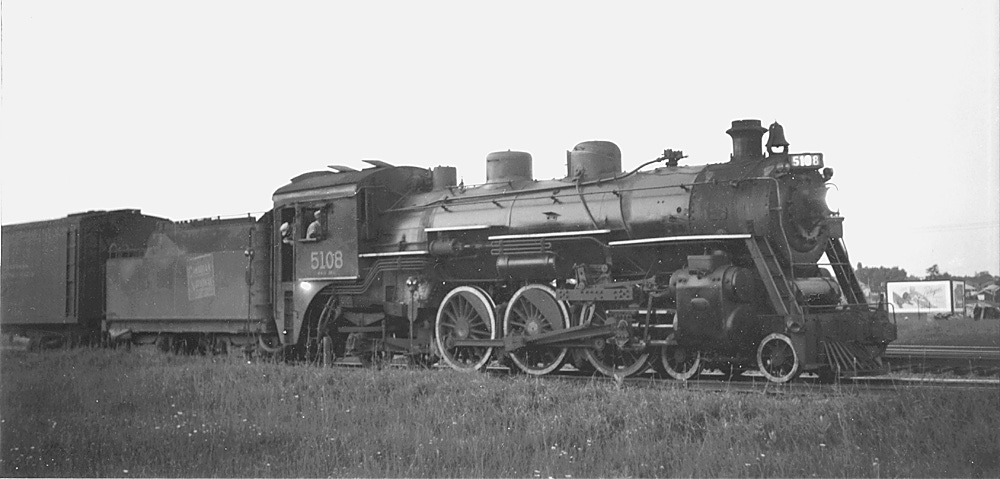
This particular incident I will describe happened in February 1936. I don’t have a lot of data on number 5108 that far before the 1950s, but I know she was a Capreol engine in the late 1940s or sooner. In the early 1950s, she spent time on the Northern Ontario District at Port Arthur, on local trains between there and Longlac. Below is my late friend Bill Cole’s view of her in that capacity at Longlac.
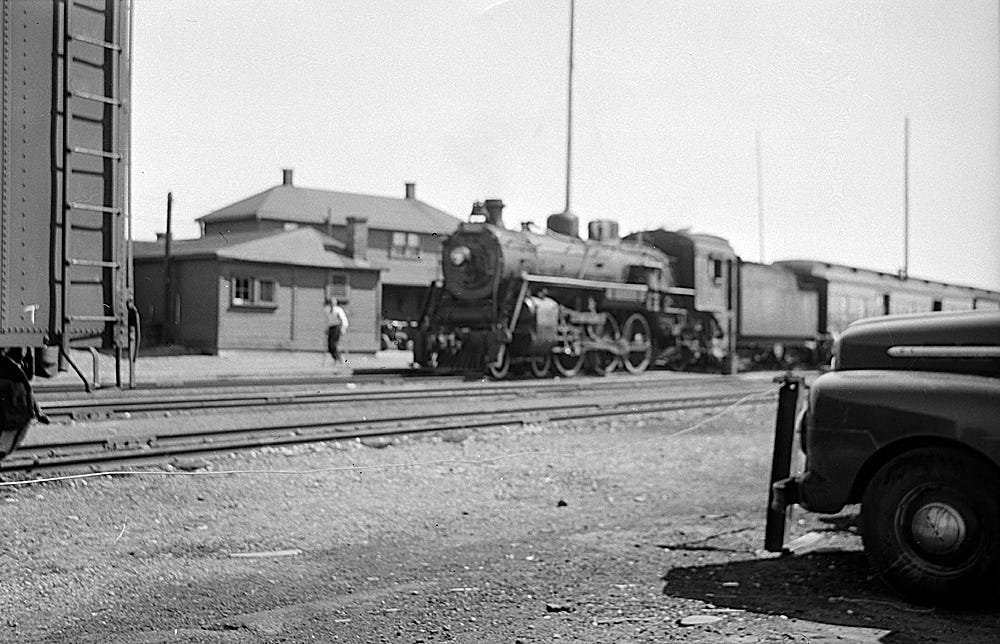
Still later in the 1950s, she ended up on the Southern Ontario District. The late Ray Corley framed her at Peterboro on June 3, 1957 (below).
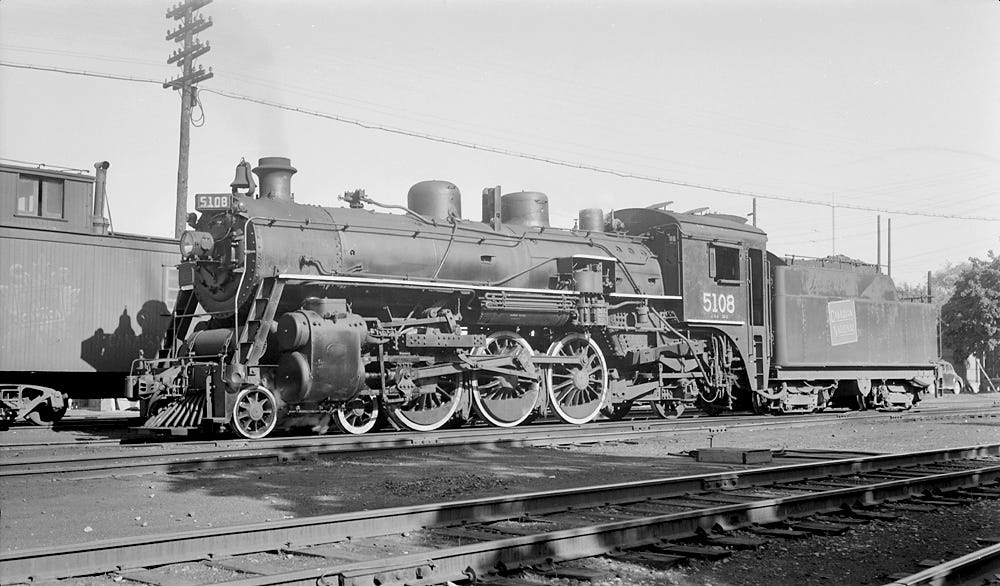
Number 5108 was in work train service at Allandale circa October 1937, not long after our incident. And given the crew change notes at Gravenhurst to follow, it’s safe to say she was an Allandale Division locomotive in February 1936.
Seventeen-year-old Bob Gallagher is doing what I, and millions of other 17-year-old Canadian boys across the ages have done on a mid-winter Sunday afternoon: playing pickup hockey with his chums on an outdoor rink. It’s wired into us!
After playing hockey with his fourth form (Grade 12) friends, it’s time for Bob to leave the ice and head home. In the course of stepping off the south end of the rink, he stumbles. The butt end of his hockey stick lodges on the ground, immovable. He falls on the blade end of his stick. The blade lodges in his left eye.
Bob calmly says to his friends, ‘I think I’ve knocked my eye in.’ He walks to the hospital unaided, practically next door.
The three emergency room doctors immediately recognize the severity of Bob’s injury, as do the specialists who examine him soon after.
There are two serious concerns the physicians share among themselves. The injured left eye cannot be saved; it will have to be removed. Worse still, infection could spread to the uninjured right eye and render the boy totally blind. At whatever cost, they must save the second eye.
The doctors conclude that only a high-risk, delicate operation—performed by expert surgeons at St. Michael’s Hospital in Toronto—can safely remove the injured eye and preserve sight in the remaining eye.
How to get young Bob to expert hands in the Toronto hospital?
It’s 350 miles from Timmins to Toronto as the crow flies. Chartering an aircraft is the first thought on everyone’s mind. But nothing is available that Sunday afternoon. An aircraft is available the next morning, Monday, but weather conditions then preclude the risk of flying out of Timmins, even in an emergency.
It’s 259 miles by rail from Timmins to North Bay, then another 228 miles from North Bay to Toronto. That’s 487 miles altogether. It takes day train 46 out of Timmins (which is then an overnight sleeper from North Bay to Toronto) 17 hours and 45 minutes to make that trip. And that’s the fast way by train in February 1935.
But there are no other options. Bob Gallagher must be conveyed by rail out of Timmins, for whatever distance, then to Toronto as quickly as possible.
Lang directs the T&NO dispatchers at Timmins to charter a special train to take young Gallagher down to Porquis Junction (some 33 miles south of Timmins) or the shortest distance beyond—the object being to charter an aircraft from the nearest point for the remainder of the journey as soon as a ship is available and weather conditions permit. Worst case, an aircraft will be available at North Bay.
A special two-car passenger train (both are coaches), headed by a T&NO Pacific, leaves Timmins at 6:25 a.m. on Monday, February 24, 1935. Lang himself is aboard. Doctor McLaren, Bob’s twin sister, and other family members accompany the boy aboard the train. The lad’s eyes are heavily bandaged, and he is seated in a wheelchair. Gallagher’s anxious father is standing by in Toronto, where he has been on business.
The special arrives in North Bay at 3:40 p.m. That’s after 9 hours and 15 minutes on the road, about the same time as number 46 takes (nine hours even).
Flying anywhere out of North Bay is out of the question. The only option is to continue to Toronto by rail.
She’s probably been dispatched from Allandale or Gravenhurst, on standby. Whatever the case, she’s hot and ready to go, with an engineer and fireman, at the North Bay CNR station.
Passenger Extra 5108 South leaves North Bay at 4:10 p.m. on Monday, February 24, 1936. That’s half an hour after the T&NO crew had arrived with the special.
What trains are opposing our special late afternoon, early evening, on its way to Gravenhurst?
A northbound way freight will have pulled into South River before we get there. Fast freights First and Second 453 (referring to manifests, not schedules) will have been handed over to the T&NO at its North Bay yard hours ago. There’s not much else to worry about (that we know of, ninety years after the fact).
Opposing trains or no opposing trains, every one of the dozen station order boards between North Bay and Gravenhurst is showing green for Passenger Extra 5108 South. Aside for coal and water, there will be no stops.
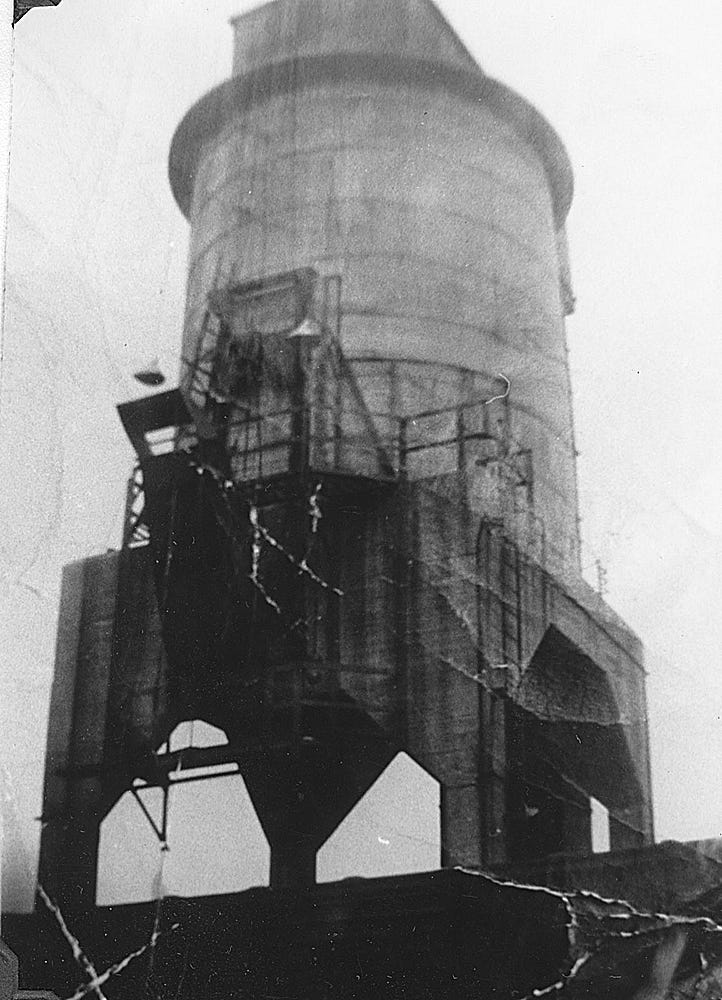
Under the care of Engineer Webb and Fireman Woods, the locomotive will need to take coal on the mainline at South River. She’ll probably take water there too, then again at Huntsville.
The roadbed all the way is heaving with frost action. It could be fatal to test that foundation with the pounding of 69-inch drivers. Nonetheless, the men in the cab maintain the 50 m.p.h. subdivision speed limit (which is meant for ideal conditions) all the way, and sometimes nose the throttle open until number 5108 is doing 60 m.p.h.
With the aforementioned coal and water stops, the Extra pulls into Gravenhurst at 6:44 p.m., having made 116 miles in 2 hours and 34 minutes (the fastest pace ever set on the subdivision, with number 46 normally taking 5 hours and 7 minutes).
Now in the cab it’s Engineer Legear and Fireman Riddell (on the scoop; no stoker as yet on engine 5108). In all likelihood, they are Allandale spareboard men on hand at Gravenhurst for extra assignments (freight and passenger). They’ve taken over at Muskoka Junction, eight-tenths of a mile south of Gravenhurst station.
Six minutes after engine 5108 has come to a stop at Muskoka Junction, she’s underway again with her new crew at 6:50 p.m.
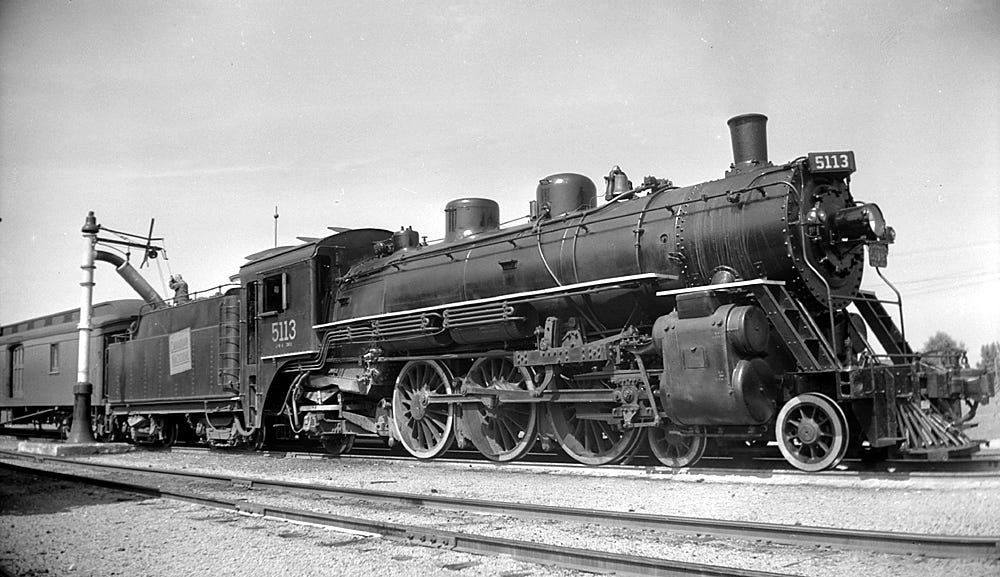
As with every through train, our Passenger Extra 5108 South will take coal at Washago—and water too (as per sister 5113 here, four years later).
It’s about 89 miles from Washago to Toronto via the Bala Subdivision, ten miles shorter than via the Newmarket Subdivision. With the complication of needing to meet number 45 somewhere on the latter subdivision, and no scheduled first-class trains on the Bala, it’s a easy decision how to route the special south from Washago.
My guess is the head-end crew elects to take water at Zephyr, roughly halfway to Toronto.
Engine 5108, heading her two-car passenger extra, enters Track 11 at Toronto’s Union Station on the dot of 9:00 p.m. (twenty minutes ahead of the anticipated arrival). With at least one water stop, she’s made roughly 90 miles in two hours and ten minutes.
Bob Gallagher’s father is waiting for his son on the station platform. Scarcely after the train has stopped moving, the boy is wheeled off the train toward a freight elevator. From there, he is lowered to the baggage room, where an automobile is waiting.
Doctor McLaren, who has accompanied the injured boy from Timmins, helps the lad into the car and offers, “He had a good trip, and we hope to save his right eye.”
Displaying great fortitude in spite of his pain and distress, young Gallagher is then whisked away to St. Michael’s Hospital, where a pair of eye surgeons are on hand, ready to perform the emergency operation.
The engineer and fireman aboard locomotive 5108, grimy with cinders and coal dust, acknowledge their quick run to waiting reporters. “We kept her at a good average of fifty miles an hour,” Engineer Legear comments. “Sometimes we hit sixty, but the frost is coming out of the roadbed, and it wouldn’t do to crowd her over that speed.”
Steam is hissing from engine 5108 on Track 11 as Engineer Legear watches the automobile draw away from Union Station with Bob Gallagher aboard. “I hope they save the young fellow’s eye.” His fireman, Riddell, mops his forehead after more than two hours of nonstop shovelling.
At an early hour the next morning (Tuesday, February 25), doctor’s at St. Michael’s Hospital report the surgery has been a success: the lad’s sight has been saved.
A week after Gallagher arrived at the Toronto hospital, his twin sister returned to Timmins. She reported that her brother was feeling physically fit and had not complained once of his ordeal. He would be at St. Michael’s for at least another week—possibly until Easter—but he was up and walking around, and reading all the letters from his classmates unaided.
The doctor’s opine that, at age seventeen and physically fit, Gallagher’s right eye will likely develop even more strength than normal, given the loss of his left.
That autumn, Bob Gallagher enrolls at St. Michael’s College in Toronto.
Back with our regular programming, as they say, we’ll dive into the fascinating background of Toronto–Timmins trains 46 and 47.
As usual, please spread this email far and wide by forwarding it to a friend or two who share your interest in Canadian National Railways steam operations in Ontario.
Comments
Nothing yet. Say the first thing.
Sign in to join the conversation.