
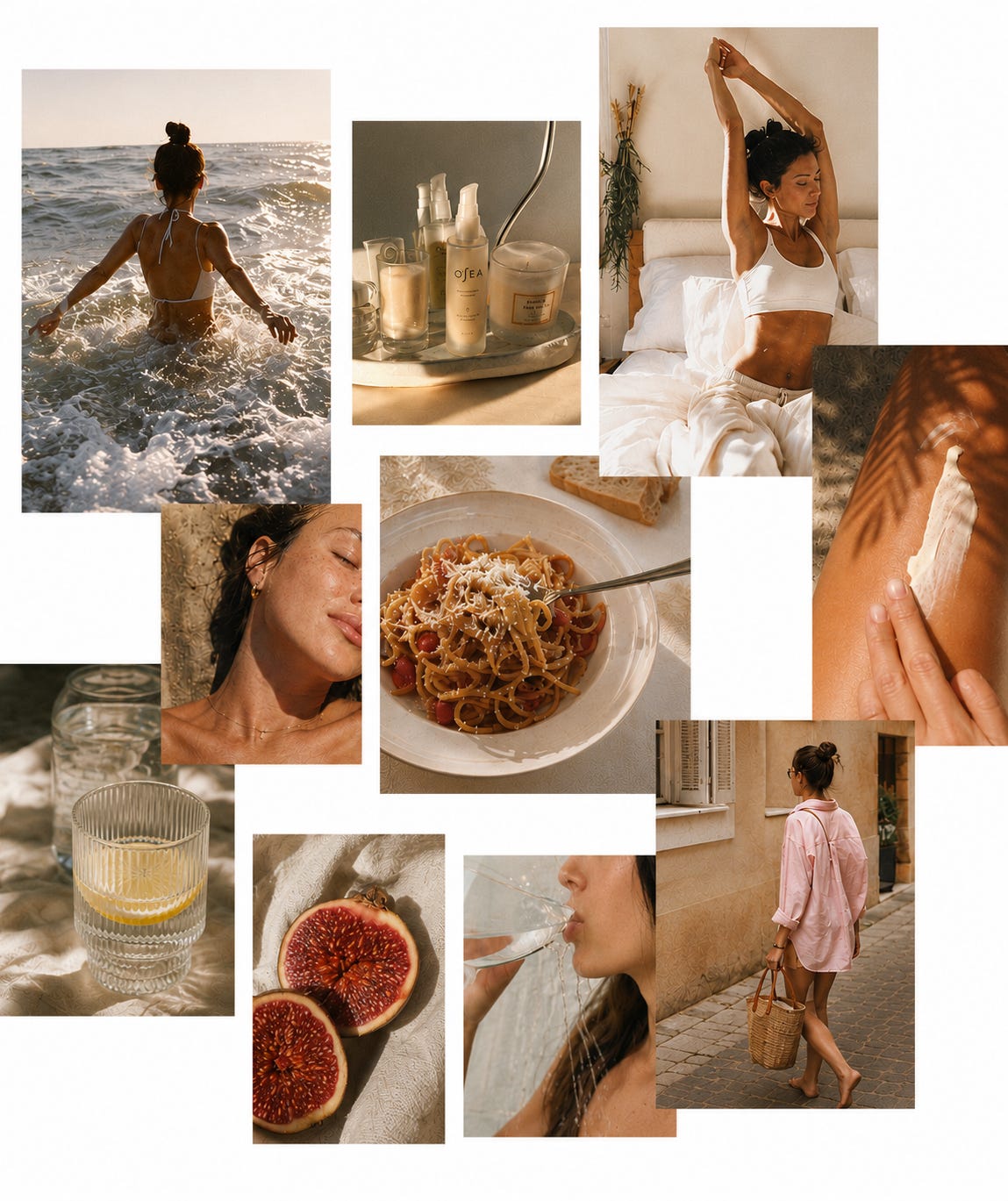
For two years, the first thing I did every morning was check my Oura ring stats. I’d lie in the dark reading my sleep stages like scripture. My HRV and Readiness scores told me how I should be feeling—if the numbers were good, it was permission to feel good. And if they weren’t, I’d spiral into additional stress because (according to my ring) I was apparently already stressed.
I’d do my multi-step skincare routine, work out according to my cycle, white-knuckle my way through the first part of the morning without coffee because Andrew Huberman said it spikes your cortisol. By all standards, my wellness routine was locked in. And I felt... fine (though frequently tired).
But here’s what I didn’t feel: Free. Alive. At home in my body.
And if I’m being fully honest, I’d also been quietly fighting my own cravings for years. Restricting what I ate in the name of health. (Let’s be real: also in the name of fitting into a certain size of jeans.) The reason I skipped the bread basket wasn’t because I didn’t want it. It was because I thought I shouldn’t have it. There’s a difference, and somewhere along the way, I’d lost the plot.
I was devouring self-help books and wellness podcasts because I knew deep down that something needed to change. I just didn’t know yet what that was.
Last summer, we were at our favorite beach in Malibu on a day that was overcast and a little chilly—the kind of day where you negotiate with yourself about whether it really counts as a beach day if you don’t get in the water. Adam and the kids were already wading in, while I settled onto my towel in a sweatshirt with my book, perfectly content to stay there.
“Mom, come in!!”
I kept reading, but my mind was half-distracted with that nagging sense that I was missing the moment. So finally, I stripped off my sweatshirt, goosebumps already forming, and ran straight into the waves before I could think twice. The cold shocked me to the core. I dove straight under a wave, then spent the next twenty minutes jumping, diving, and shivering right along with my family.
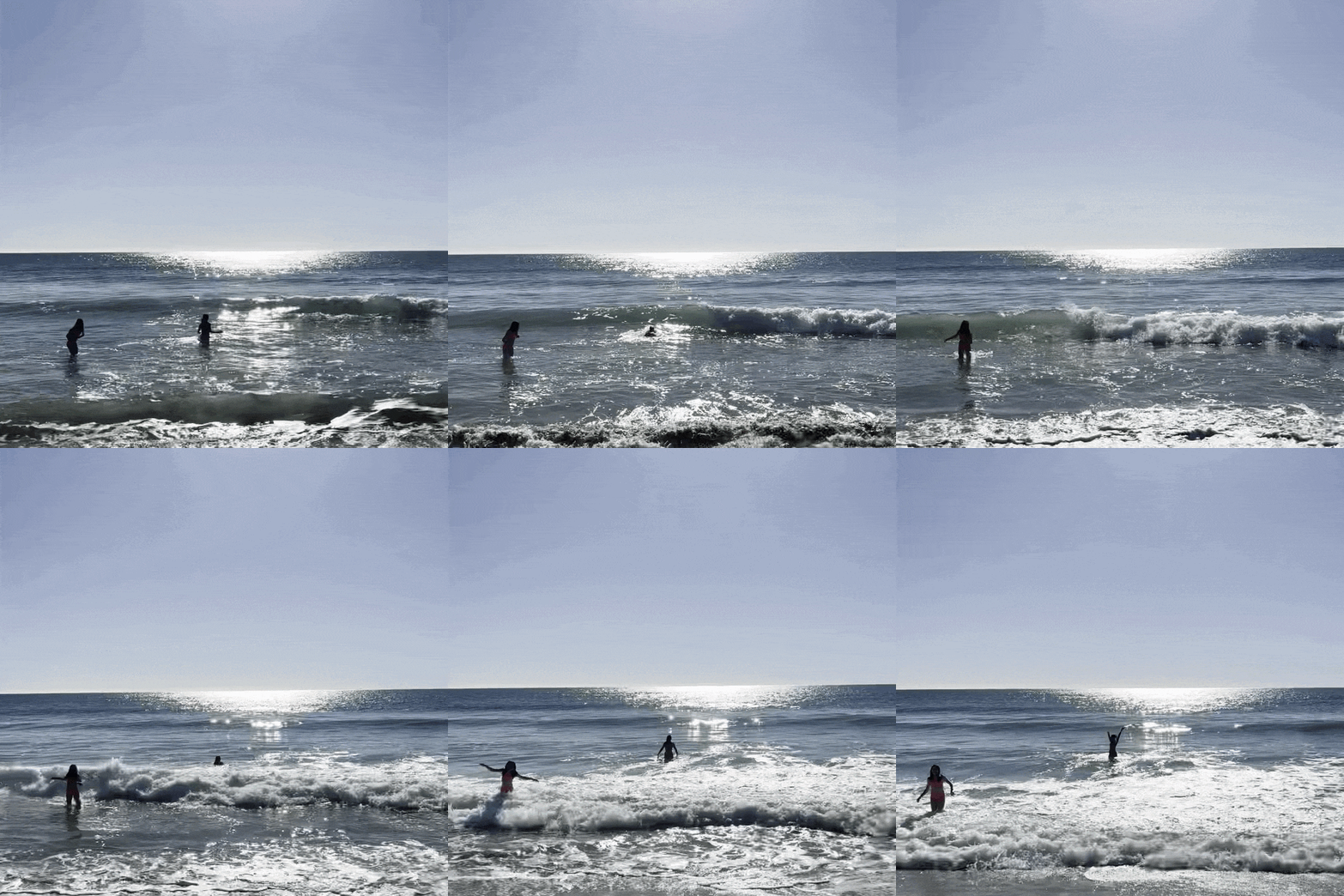
When we couldn’t take it anymore, we ran back up the sand and wrapped ourselves in towels. I felt exhilarated and absolutely ravenous. Not in a depleted way, but in a fully alive, metabolism-stoked, my-body-just-did-something-hard way. It was a high that lasted all afternoon, and I flagged it so I’d remember: I need more of this in my life.
That moment started something. I began to realize that what I’d been calling wellness was actually a system for controlling my body—tracking it to fit inside a framework, rather than fully living in it and trusting it. Our bodies weren’t created as problems to be optimized, but holy temples with a deep inner wisdom.
So I started learning to trust my body instead of managing it. I stopped dragging myself to early workouts if it meant sacrificing sleep. I stopped skipping the bread basket when the bread was really good. I stopped tracking all my health metrics. And slowly, over this past year, something came back online. My hunger signals got clearer: I knew if I was craving avocado and salmon, or needed a big glass of water, or a bowl of ice cream. Then I ate the thing and moved on.
It’s that feeling of aliveness. Waking up excited to get out of bed, feeling fully present with the people in front of me. Jumping into the ocean because I want to, not because it’s in the protocol. It’s the feeling of your interior world and your actual life finally running on the same frequency.
Below, I’m sharing exactly what that looks like in practice for me this summer.
For years, my skincare shelf looked like a small apothecary. A rotating cast of products—some sent by brands, some I’d bought after being fully convinced by an Instagram ad that this would be the serum that finally changed everything. I was spending more time on my skin than ever, and the results weren’t exactly transformative.
This year, my goal became fewer products, better ingredients, everything does more than one job. I wanted a routine I’d stay really consistent with, which for me only happens when it’s somewhat simple. I stick to a small handful of brands whose formulations I trust, and my skin is the best it’s been in years.
MORNING
I start with this gorgeous cleanser, then the Resurfacing Compound, followed by the Super Hydrator—together, these check the boxes on retinol and antioxidants without requiring a ten-step process. Some days I’ll mix in a few tanning drops before moisturizer (I always wear less makeup when I have a glow.) Then my ride-or-die eye cream, which I started taking seriously after my derm told me that deeply hydrating the area makes a lot of fine lines magically disappear.
NIGHT
I do a double cleanse with this luscious cleansing balm to melt off the day—the scent alone makes this feel like a ritual rather than a task. Then back to the Osea cleanser to fully detox pores. From there, the Resurfacing Compound followed by the Super Hydrator, just like morning. I finish by slathering this luxurious balm all the way down my neck and chest—a step I never skip. I genuinely wake up with fewer fine lines when I’ve sealed in all that moisture.
BODY
In summer especially, I like to give a little extra TLC to my body, and I really slow down and enjoy the process. I swear by this body brush to quickly exfoliate and get the lymph moving—it’s the perfect size and covers a lot of ground fast. Then slather on this body oil made from green tea, hemp seed, and sandalwood oils while my skin is still damp. Five minutes that feel like an at-home spa treatment.
The mindset shift: My skincare routine is working on top of a foundation that has more to do with sleep, protein, stress, and turning my skincare into a ritual that I look forward to. The products matter, but it’s downstream of everything else. We know this intuitively, but it’s easy to forget, probably because a new serum is easier to buy than an extra hour of sleep. That’s what the rest of this post is really about, and it’s the part that really changed things.
Below: the food philosophy that ended years of restriction, and the unexpected thing that happened to my cravings when I stopped fighting them. The supplement stack I actually take consistently after years of expensive shelves full of things I didn’t. The movement shift that made me stop treating exercise like a debt. And the thing I now believe is underneath all of it — the reason you can do everything “right” and still feel off.
If that last sentence landed, keep reading.
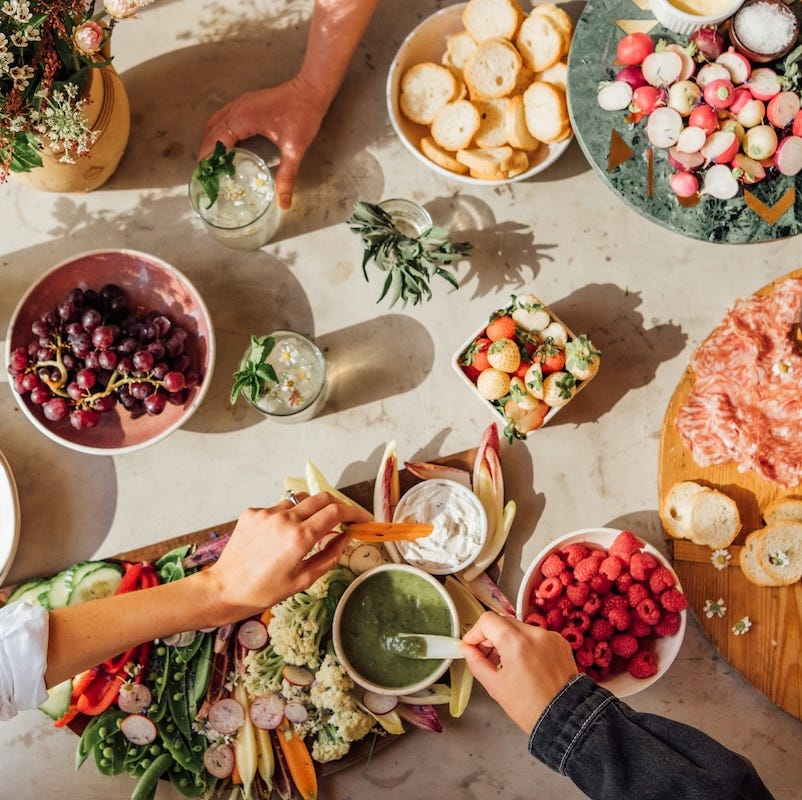
For years, I ate according to rules and systems I’d borrowed from other people. I read every nutrition book I could get my hands on, obsessed over which way of eating was actually right. (Plant-based or protein-forward? Intermittent fasting or never skipping breakfast?) The longer I followed external frameworks, the less I actually knew what made me feel good.
What I’ve landed on this season feels stripped back and genuinely delicious. And it’s worth noting that reconnecting with my love of food and not fighting my cravings actually didn’t mean sacrificing the healthy, fit body I wanted. If anything, it went the other way.
BREAKFAST
For years, I thought I just wasn’t “a breakfast person”. Then I started eating breakfast again, and my metabolism WOKE UP. I’m now starving every morning around 9 am, and I’ve been fully loving that first meal of the day again. Usually it’s one of these:
Toasted Dave’s sprouted bread with full-fat cottage cheese (Good Culture 4ever), a handful of berries, some seed and nut granola, and a drizzle of honey
A couple of eggs scrambled in a little butter, folded into a charred corn tortilla with smashed avocado and cheddar (I could eat this for every meal)
If I have an early meeting and need to take it on the go: a smoothie made with frozen berries and banana blended with a handful of spinach, splash of whole milk, scoop of peanut butter, and honey
LUNCH
If you’re one of those people who sometimes “forgets” to eat lunch, sorry, I can’t relate. 😂 My defaults are:
A big bowl made with leftover protein and roasted vegetables from the night before, tossed with arugula, olive oil, balsamic, and something crunchy on top like toasted nuts or sunflower seeds. OR
Sprouted toast loaded with smashed avocado, apple slices, roasted turkey, a handful of sprouts, and everything seasoning, greens on the side.
Neither takes more than ten minutes, but they truly satisfy me.
DINNER
This is where I’ve really come back to the joy of cooking—not just throwing together whatever’s most convenient, but giving dinner a little extra attention so it feels like an occasion. It’s often still simple, but it’s still intentional.
Lately, it’s been a lot of grilled fish or chicken thighs, good sourdough, whatever tomatoes and stone fruit and summer squash look best at the farmers market. If you want my system for how I intuitively plan healthy and delicious dinners, dive into my weeknight dinner series here.
SNACKS
Faves are: full-fat Greek yogurt with honey and walnuts. Good cheese paired with fruit & Maldon salt: lately I’m obsessed with creamy sheep’s milk feta. A cup of bone broth in the afternoon. Things that feel genuinely satisfying rather than just low-calorie.
The mindset shift: I stopped asking what to cut and started asking what to add. More protein, more color, more things that are genuinely nourishing and make me happy. When you actually feed yourself, the cravings that used to feel urgent just quietly stop showing up, and you’re not relying on willpower.
I love the book The Slow Down Diet, where Marc David talks about what he calls “Vitamin P” (for Pleasure)—the idea that enjoying your food is a critical nutrient, not a reward you have to earn. Depriving yourself of pleasure spikes cortisol, while savoring your meals lowers it, optimizing your metabolism and helping your body absorb nutrients more effectively. It really changed the way I think about how I eat, rather than just what I eat.
When food is really, deeply good—a perfect peach, a tomato that actually tastes like a tomato—that response is your body recognizing nourishment. I spent a long time treating pleasure like something to earn, and I’m so done with that.
I’ve gone through phases of taking ten supplements and phases of taking none, and neither extreme felt right. Too many and it starts feeling like a part-time job; too few and you’re leaving real support on the table. What I’ve landed on is a small, intentional stack I take consistently because I actually notice a difference (which is the whole point).
MORNING
I start every day by filling a big bottle with filtered water, an electrolyte packet, and two big scoops of creatine. (Studies show the real cognitive benefits kick in when you up the dose to 10g.) I sip this throughout the morning and notice a real difference in my mental clarity and focus.
Then, on an empty stomach, I take my Omega-3 (the only one I’ve found that doesn’t taste fishy or make me feel queasy), my aminos, which have made a noticeable difference in my ability to build muscle, and I’ll drink a glass of AG1, which is both my multivitamin and gives me tons of energy through the morning.
EVENING
Magnesium is my non-negotiable for sleep quality and keeping my digestion regular. I like this one because it combines multiple forms that I used to take separately (one less thing to manage). Then my Cortisol Support, because my sleep is noticeably worse when I skip it. And my melatonin gummy, which is not for everyone, but I’ve learned my particular body needs this boost to get a truly good night’s sleep.
The mindset shift: Supplements work on top of real food, real sleep, and real stress management—not instead of them. And you don’t have to take any of them just because someone (me, an influencer, a podcast) says it’s good. Test something for a month or two and see if you actually notice a difference. Because life’s too short, and it’s too expensive, to take an entire supplement stack simply as insurance.
For a long time, working out felt sort of like paying a debt—for the glass of wine, the restaurant meal, or simply because I’d feel guilty if I didn’t. There was always some outcome I was working toward, some version of my body I was trying to earn my way to.
The shift happened when I started actually paying attention to how movement made me feel rather than what it was doing to how I looked. It was a complete reorientation.
What I do now: swim most days because the ocean makes me feel incredible—cold water exposure, minerals, the meditative quality of the waves. It’s the kind of movement that doesn’t feel like exercise. Pilates a couple of times a week—I love the energy of an in-person class, but also use FORM’s virtual platform when I do home sessions. And I’ve been walking more than ever. Some weeks are more structured than others, and I’ve genuinely stopped having guilt around the less structured ones.
A few favorite pieces I’ve been pulling on in the morning to help me incorporate movement throughout the day: this skort in navy paired with a tee or a cropped tank, this incredibly flattering dress that I can wear to golf and dinner afterward, always with these sneakers and vintage-inspired baseball cap (ps—everything at Rhoback is 20% off this weekend so it’s a great time to stock up on some of their beautifully-made activewear pieces.)
The mindset shift: When the goal became feeling high energy, building a strong body, and chasing that specific aliveness that comes from moving well, exercise became something I get to do rather than something I have to do. And that reframe opened up what movement could even look like. It doesn’t have to be a hardcore class that leaves you sore the next day (though there’s a time and a place). It can be a walk, a yoga class, dancing in the kitchen while you’re making dinner, or a cold swim with your kids. It all counts.
Sometime this spring, I took off my Oura ring. Put it in my nightstand one morning and didn’t put it back on. At first, I kept feeling like I was missing something—some data point I needed to make good decisions about my own body.
But slowly over time, that feeling was replaced by one of unexpected freedom. From the low-grade performance anxiety of constantly evaluating how I was doing. From the subtle but constant message that my body couldn’t be trusted without external verification—a message that’s simply not true.
Turns out, my body knew things the ring didn’t, things it had been trying to tell me for years—when I was too busy checking the app instead of listening. And that’s really the whole point. Not a new book or a better system—just the slow process of learning to trust your own body, and discovering that the wisdom inside it knows so much more than you realized all along.
Lots of love,
Camille
Comments
Nothing yet. Say the first thing.
Sign in to join the conversation.