
When did you first realize you wanted to parent more mindfully around technology?
For some parents, it was seeing a toddler imitate using a touch screen.
For others, it was the realization that their child was sharing a story, while they were looking at their phone instead of making eye contact.
However, it showed up for you, many parents eventually start wondering how to build a healthier relationship with technology at home. Research suggests parents play an important role in shaping kids’ habits, and that managing our own relationship with technology matters, too.
That’s easier said than done. Most parents are figuring out how to live alongside increasingly present technology—and for some, including those who rely on connected health devices, opting out isn’t realistic or even desirable.
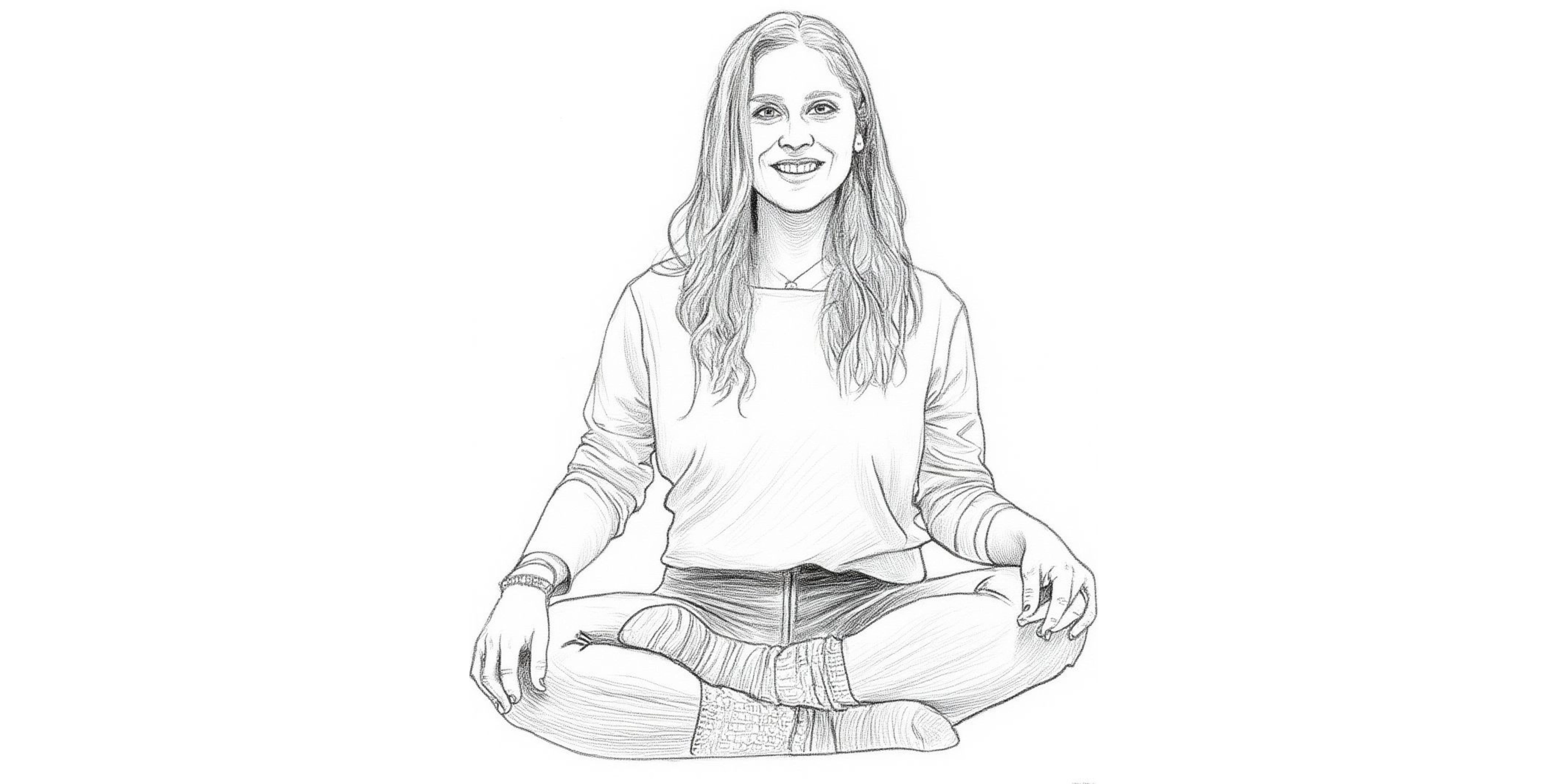
Jesse Bennett knows that tension firsthand. A yoga and pilates instructor and educator, Jesse found that parenting brought her understanding of mindfulness into focus. It also inspired her children’s books, including The Yoga House, which includes the nighttime meditation she still practices with her teens today. In this conversation with our Executive Director, Jesse reflects on modeling balance, staying connected as a family, and making room for technology without letting it define family life.
Carolyn Gan: How did you think about mindfulness before you became a parent, and how has parenting changed that understanding?
Jesse Bennett: For me, mindfulness really came into its true form when I became a parent, because that’s when we’re tested most, right? All of my practice for Pilates and yoga, and all my training and teaching, really came into play once I became a parent. It really trained me for life.
“Mindfulness helps us become less reactive. As a parent, that’s huge. If we can take a moment to breathe deep, and then respond instead of react, we will be able to put forth the best version of ourselves.”
Our kids need a very calm and thoughtful reaction, instead of a reaction. Modeling that for my kids has been huge. I see it in them now.
CG: Your kids are middle school and high school age now. Did that recognition start early, or has it been more recent?
JB: It’s grown with us, and it started early. I noticed very early with my daughter that if I was holding her, she would match my breath. I realized then how powerful breath was. It’s really helped us in so many ways. In the simplest form, mindfulness has been tapping into my breath and teaching my kids to tap into theirs.
We breathe to take back control of our busy minds. It also helps us realize that we don’t have to find [the answer] right away. Sometimes when those big things come up, I say, “Let’s take a breath and think about it. Let’s sleep on it.”

CG: Modeling is something we talk about a lot in the Tech/Life Balance series. Have you had a moment where you realized you needed to be more intentional about technology?
JB: We’ve had it as a family, for sure. Kids see everything, and they take it in, right? We’ve seen a lot if we go out for dinner. My kids will look around and see other families at restaurants [looking at devices]. Or with headphones on. We’ve had friends drive by our house, and we’re waving, “hi!” And the teenagers, they’re [looking at their phones].
I see how [my kids] don’t like to see that. They want to interact. They want to see our eyes when they’re talking to us. Even if I’m checking something which I might think is important on my phone, I realize how they feel if they’re looking at me, and I’m looking down. I’ve totally had to check myself.
Another layer we have in our house is my son’s a Type 1 diabetic. All of his information is available to me 24-7. I’ve had to untrain myself from [looking at his health data]. So there’s also an attachment to technology and devices that I’ve had to kind of undo myself from, because we don’t need constant bombardment [of information].
CG: How have you talked with your son about how you are monitoring his health data?
JB: I’m a safety net. He’s allowed his phone at school [for health reasons]. Every 5 minutes, I have an update on his blood glucose levels on my phone, which is such a blessing.
I actually get coaching, which has been the best thing. I needed help as a Type 1 mom to not be hypervigilant and trust the systems we have in place. So I tell him, “I’m watching your numbers. I want you to go live. Go do you. I’ve got you, and we’ve got alarms in place.” Or I’ll say, “hey, look, the technology is not working on my end today, so I need you to be intuitive with your body and be a little bit more aware of your numbers.”
He’s a 13-year-old that has a phone, right? Because it’s how his body and his devices communicate. But he and my 16-year-old daughter only have each other’s numbers [on their phones]. My daughter and son can communicate [with each other], my number, and my husband’s number. That’s it. They have no other contacts. The point of these phones are for communication [with us] and for safety.
CG: How will that transition as they get older?
JB: My 16-year-old wants to be free as long as she can. She wants to be a kid, and I love that. We’ve talked about how feelings get hurt in group chats, and how people feel when they’re waiting on their response to be read or responded to, and she’s like, “I don’t like that, I don’t want that.”
We’re not trying to say it’s evil. We have to coexist with this, and we want to be able to live our lives, [have it be] not essential. So I think that when she “baby steps” into it, it won’t take over her life.
We do look at Instagram Reels, like dog videos and old SNL sketches. My husband calls it our version of America’s Funniest Home Videos. Things that just make us laugh out loud. And then I’m like, “hey, you know, it’s not great for our brains to look at all these short videos. So, let’s laugh about it for, like, 10 minutes, and then we’re good.”
CG: Do your kids play video games?
JB: The games that we have, we play together: Mario Kart, Super Smash Bros. We’ll sit down, the four of us, and we’re doing it together.
If I were to say we’re not gonna have [videogames] in the house, that would just have the reverse effect. So we live alongside it and do a little of that, and do a little board game, and get outside and play. Balance.
CG: Does balance become harder or easier for you all in the summer?
JB: I really love summer. It’s such a downshift. [During the school year] there are times when I’m driving back and forth to school 5 times. [During the summer] I feel like I can lean in and do more things with [my kids], and play more.
It could look like more technology, but I’m not finding that it does. I don’t look at my watch and say, “okay, that’s enough.” They can feel it, and they crave more than that.
CG: Have there been moments where you’ve helped them see they may be ready for a transition?
JB: Yeah, for sure. I think when they were younger, I would say, “it’s time to get outside,” or “let’s do a craft.” But I think it’s in that modeling. Just talking about it brought self-awareness. Delving into technology all the time makes you numb to it. They can tell when it’s enough, and it doesn’t take much to hit their threshold.
They both play music. They crave that feeling. That’s something my husband’s done a really beautiful job of modeling. [Playing music] is his stress relief. He plays before work every day, he plays when he gets home, he sings.
When [my kids] get home from school, they bring out their instruments. It truly raises your vibration; it makes you feel better, when you’re playing music.

CG: Speaking of vibrations, I’ve heard that when you hum, it helps calm your nervous system.
JB: Yes! I’ve heard when you hum, you can’t have intrusive thoughts. So when I change my son’s insulin pump every 3 days, we hum. That is now ingrained in him as something that we do to calm our minds. It’s just one of those things, because we’re just trying to build this life toolkit.
CG: What else is in that toolkit?
JB: Definitely breath. We’ve had a lot of school anxieties, big feelings. Just growing up, there’s so much chatter, especially for my daughter in high school. Both kids use breathwork to just calm our mind, come back to ourselves, and know that we’re okay and we’re safe.
I actually do meditation with the kids every night before they go to sleep. I do it every night, but that’s something I will do with them always.
“I am” statements. It really matters how they talk to themselves. That’s something that we have to do. It’s not something I was always good at. I realized if I didn’t do it for myself and believe it, that there’s no way I could hope for them to have that in their toolkit. So, I did it for myself.
Movement is great. Just little things that soothe the mind and the heart. In the back of my books, I always kind of put a few things that I notice help [my kids]. Whether it’s just even snuggling with our dog, getting fresh air, doing a little art, playing music.
CG: You mentioned meditation at bedtime. What does that look like, and how did you learn that?
JB: I told you about how we would breathe together when my daughter was a baby. I did the same with my son. And when my daughter was around 7, I remember her having really big feelings, and they’d all happen right before she laid her head on the pillow at night. We’d be reading a story together, and she’d feel a lot.
And so, I said, “breathe with me,” and we’d sit and breathe. It started there. Then I was like, I’m gonna write a meditation, and I’m just gonna read it to you. And I read it to her every night, and my son, every night for 6 months.
I did that, and I was like, wait, that worked. That actually took her out of her busy mind, tapped her into her breath, and she fell asleep. Because the goal was not to be trying to get her to sleep for, like, an hour and a half.
And I thought, what happens if I write a little book around that meditation? That’s how I wrote my first book [The Yoga House]. I do that meditation every night for the kids. That’s how they fall asleep.
CG: I want to talk to you a little bit about movement. For parents who are exhausted, what is the smallest possible movement practice that still counts?
JB: Everything counts. Once I stripped away that it didn’t have to look a certain way, be a certain amount of time, or be fancy, I was free to move.
The easiest way to do it is take a little walk after dinner. Get outside and walk and look around without your phone in your pocket. When you feel overwhelmed, walking is such a beautiful way to get outdoors. Start with 5 minutes. And then be proud of yourself. Instead of beating ourselves up, be like, “I did that. I got outside. I had no time, and I made time.”
And there’s mindfulness, tapping into your breathing. It doesn’t have to be a 20-minute silent meditation. I don’t do that. But I do tap into my breath, and I do take a moment to quiet, and that’s all it takes.
I’m not about hustle. And I don’t define myself by being busy. I don’t fold the laundry sometimes. But I am gonna take a walk with my kids. We might harvest from the hamper for a couple days, and that’s fine!
CG: You mentioned hustle. Young people feel a lot of pressure to be hyperproductive. How have you talked with your kids about hustle culture?
JB: I have to talk to them about this often. My kids have so much drive when it comes to their academics. I feel like there’s a way to coexist with that drive. There’s so much chatter right now [for my daughter] about AP classes, and what college, and this and that. And I said, “look, it doesn’t matter to us where you go. We want you to love what you do, chase the things that light you up, and you are gonna find your way.” I say, “it’s not where you go [to college]. It’s what you choose to do with it, just like you do with everything.”
My husband and I both try to strip away that external chatter and pressure. I actually equipped her with it:
“You’re gonna hear your friends talk about this. They’re gonna go in circles. They might not even know what they’re talking about. Our job is to breathe deep, know who we are, follow what lights us up, and just do our best. Wherever you decide to land, you’re gonna own it. And whatever you put into it, you’re gonna get out of it.”
That’s really our narrative here. Our job is balance.
CG: When your kids look back on their childhood, what do you hope that they’ll remember about what it felt like to grow up in your house?
JB: I hope that they always see our home, no matter what stage of life they’re in, as a place where they feel unconditionally loved and seen and heard. That they can be completely themselves, and infused with love and support.
I want them to feel like our home is a place that’s on the right side of history. A place of love and celebrating everybody. They can be whoever they want here in this home, and that they’re always welcome exactly how they are, and because of that, that is the lens that they go out into the world in as well.
CG: And what role does technology play in that?
JB: Playing a game together. Watching silly reels. Movie night. It’s definitely not like a tech-free house by any means, but I think that they’ll choose their boundaries and how they want to interact with it.
CG: Let’s let technology be additive, something that enhances connection. Thank you for talking with me about your family and your perspective.
JB: I’m so grateful.
Self-regulation can help parents turn down the volume on stress and anxiety, and show up for their families by being responsive (instead of reactive). Jesse Bennett describes these kinds of practices as part of building a “life toolkit”—small habits we can return to when emotions run high. Here are some ideas for building your toolkit inspired by our conversation:
Take a deep breath.
When emotions run high, a deep breath can create enough space to respond more thoughtfully and show up as the parent you want to be. It’s a great strategy to model for the young people in your life, too.Do it for your kids–and yourself.
If you want your kids to use “I am” statements of strength, start by modeling them yourself. They’ll be more likely to adopt the habit, and you may find that it becomes a helpful tool for you, too.Aim for simple movement.
You don’t have to run a marathon (unless you want to). Going for a walk after dinner, stretching, dancing, and getting outside all count. Even small moments of movement can help us feel more grounded.Celebrate small wins.
In movement or meditation, it’s okay to start small. A few minutes outside, a short walk, or one quiet moment can still make a difference. Instead of focusing on what didn’t happen, acknowledge what did.
Use technology together.
When stress runs high, devices can become an easy way to disconnect from what we’re feeling. But technology can also bring us together. Watch some cat videos together, play a video game as a family, or have a movie night. Shared experiences can help technology become something that supports connection even when we’re overwhelmed.
For more perspectives on raising emotionally healthy kids in a connected world, explore these conversations:
Molly Dickens, PhD on parental stress:
“Agency, not control.”
Shafia Zaloom on building trust with young people:
“Our silence speaks louder than words.”
Katia Martha on why Gen Z reaches for devices:
“It’s a lot easier to add in good things than take out ‘bad’ ones.”
No posts
Comments
Nothing yet. Say the first thing.
Sign in to join the conversation.