

In September 2024, California Governor Gavin Newsom signed the Phone-Free Schools Act (AB 3216) into law, requiring public and charter schools to adopt policies limiting or prohibiting student smartphone use by July 1, 2026.
Almost two years later, that implementation deadline arrives next month.
The Phone-Free Schools Act asked communities to decide what works locally and to involve students, educators, and families in shaping those decisions.
In other words, the policies students will experience this fall weren’t written by legislators. They were shaped in school board meetings, PTA conversations, principal offices, and student councils.
That shift may become one of California’s most important contributions to the broader movement distraction-free learning. The question is no longer whether or not schools should restrict phone usage on campus.
The question now is: How should communities design phone-free learning environments, and who should be involved in those decisions?
As districts finalize policies ahead of the July 1 deadline, we’re reflecting on how much has changed since the law passed, and why parents should pay attention to what happens next.
The Los Angeles Unified School District (LAUSD) offers an early look at what implementation may look like across California.
The district launched a districtwide “bell-to-bell” phone restriction policy in February 2025 and deliberately gave schools flexibility in how they put the policy into practice. Rather than prescribing a single model, LAUSD invested in a number of implementation supports and allowed campuses to choose approaches that fit their communities.
Some campuses used locked pouches or device lockers, while others relied on students keeping phones turned off and stored in backpacks.
A month into the LAUSD’s implementation, the Los Angeles Times reported that teachers, district leaders, and some students were already reporting seeing a difference in classroom conditions and experience.
While first-year data from LAUSD has not yet been released, recent national and international studies point to a more nuanced picture. Phone restrictions appear effective at reducing student phone use and improving classroom conditions, with many teachers reporting fewer distractions. At the same time, evidence of immediate gains in academic achievement and behavior has been more mixed.
Those findings suggest that removing phones alone is unlikely to transform students’ experiences at school overnight.
They also raise a broader question: if healthier learning environments require more than removing smartphones, what kinds of digital environments best support students throughout the school day?
In the LAUSD, that question has expanded beyond smartphones to classroom technology and screen time, including proposals to reduce device use for younger students and review how technology is used across schools.

When the Phone-Free Schools Act was signed into law, parents across California had questions about what the new law requires, what role they would have in shaping local policy, and what to expect in the classroom. Listening closely to these concerns and drawing on expert guidance, the California Partners Project presented a workshop on “Smartphones in Schools” at the California State PTA Convention, the largest PTA gathering in the state.
To support families unable to attend the convention, we also created a clear, easy-to-use resource that demystifies the law, highlights different, developmentally appropriate approaches to school device policies, and offers conversation starters to help families engage in policymaking in their local communities. Called California’s Phone-Free Schools Act: What Parents Need to Know, it was shared at the convention and online, and quickly became one of our most-used tools of the year.
This resource helps families understand:
what the law actually requires,
what kinds of policies schools are considering,
what questions to ask,
and how to participate constructively in local implementation.
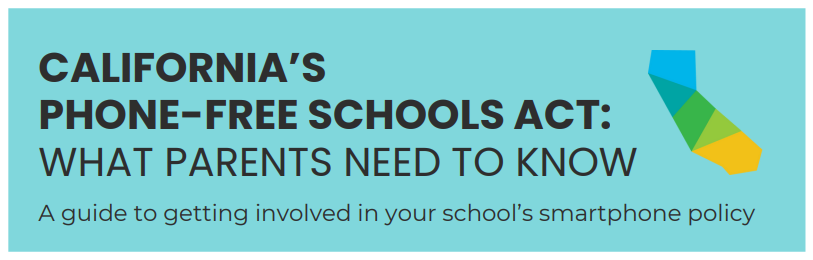
School may be out for summer, but as communities finalize policies and prepare for the fall, the work of creating healthier learning environments is only beginning.
First Partner Jennifer Siebel Newsom captured this sentiment well when the law was signed:
“Reducing phone use in schools is essential for minimizing digital distractions and making space for stronger and more meaningful in-person connections. AB 3216 isn’t only about classroom instruction, it’s about protecting the mental health and social and emotional well-being of California’s kids.”
—First Partner Jennifer Siebel Newsom
With July 1 approaching, this feels like an important moment to shift the focus from what students are losing to what they may gain.
More attention. More face-to-face connection. More opportunities to engage in the real-world experiences that help them grow.
After all, the goal isn’t simply schools without phones. It’s healthier learning environments for all children.
That work is just beginning.
If you’re a parent, this is your invitation to get involved: ask questions, understand your school’s approach, and help shape the learning environments students will experience this fall—and for years to come.
You can start with our resource: California’s Phone-Free Schools Act: What Parents Need to Know.
No posts
Comments
Nothing yet. Say the first thing.
Sign in to join the conversation.