
Online safety is no longer a niche concern; it is a central part of parenting. And it’s a constant source of stress for families.
As one mom explained to us:
“Trying to get my son to do something healthier than watching videos online has been a struggle. It affects the way we communicate, and it’s created a disconnect in our family dynamic.”
For many families, conversations about technology can turn into a power struggle. Parents want to protect family life, and kids want independence, privacy, and freedom. It can feel like a choice between constant oversight and complete surrender.
At the California Partners Project, we champion a third way: one rooted in communication and connection.
That’s one of the reasons we are so thrilled to partner with Stanford Social Media Lab and the Family Online Safety Institute (FOSI) on A Parent’s Guide to Digital Safety.
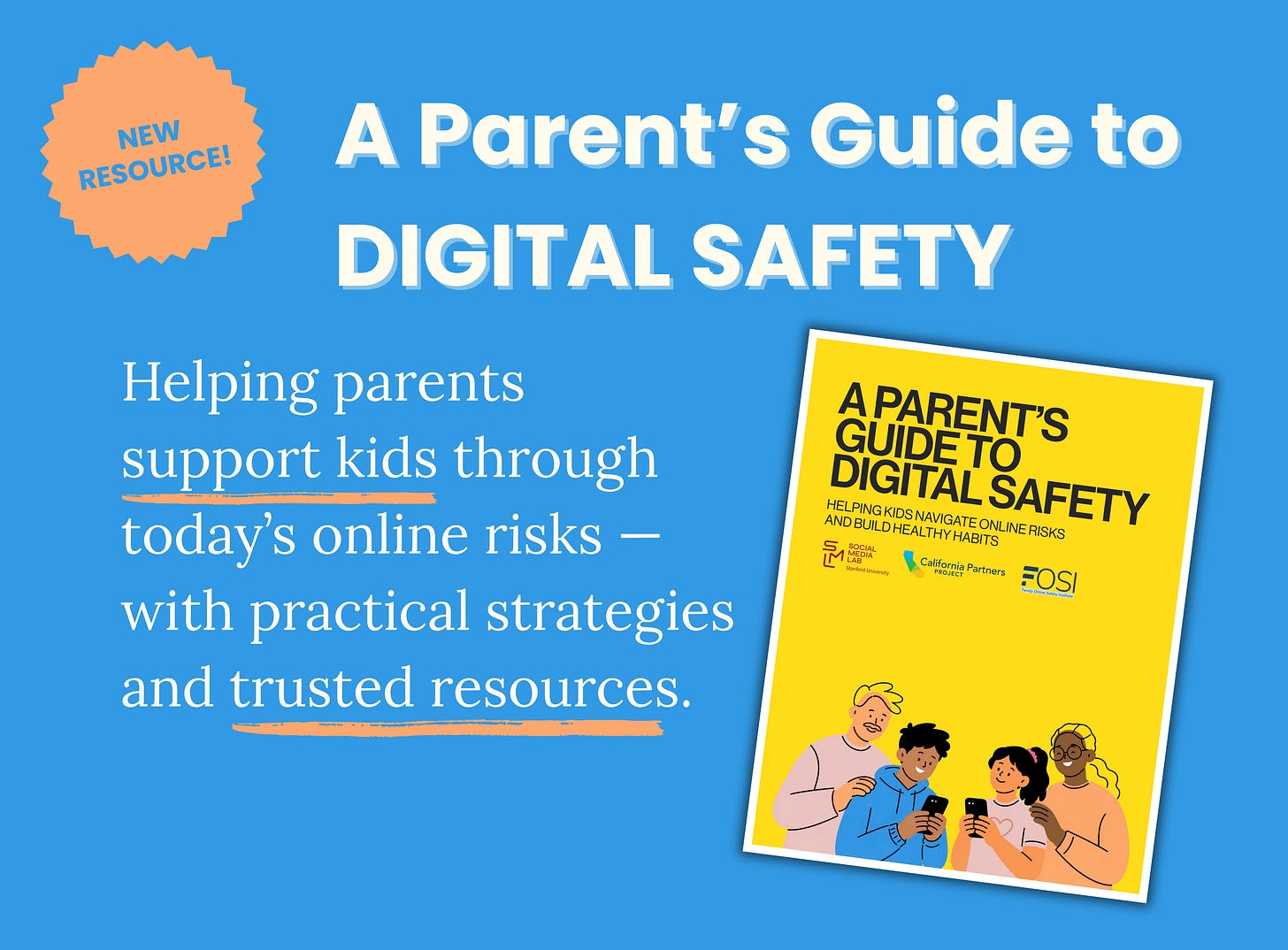
Active, open communication, and a trusting relationship with your child is essential to their online safety. That’s why the guide is built around a simple framework to help strengthen your connection and it doesn’t require you to become the internet police.
It’s called CALMER.
Approach conversations about technology with curiosity rather than judgment. Instead of asking, "Why are you always on that app?" try asking, "What do you like about it?" Children are much more likely to share their experiences when they feel understood rather than interrogated.
Not every online challenge requires the same response. Take time to understand what's actually happening before jumping into solutions. Is this a one-time issue or an ongoing problem? How is it affecting your child's well-being?
You don't need to be an expert on every platform. Ask your child to show you the games, apps, and creators they enjoy. Let them teach you. Listening is one of the fastest ways to build trust and stay informed.
Parents should know where their children spend time online, but monitoring works best when it's transparent. Instead of surveillance, our goal is to help kids learn how to navigate technology safely and responsibly–a 21st century life skill.
Digital safety isn't just about avoiding risks. It's about building skills. Teach children how to spot misinformation, recognize manipulation, protect their privacy, and think critically about how they use technology and what they encounter online.
Some situations require outside help, and parents don't have to navigate serious issues alone. Knowing where to turn for support is part of keeping children safe. Check the “Emergency Resource Guide” for ways to take immediate action.
Digital safety is about helping young people build the skills, habits, and relationships they need to navigate an increasingly connected world. That’s the goal of A Parent’s Guide to Digital Safety—and it starts with curiosity, conversation, and connection. Here are the first 3 proactive steps detailed in the guide:
Using the “CALMER” framework: Approach digital habits with curiosity: Communicate, Assess & Address, Listen & Learn, Monitor & Manage, Educate & Encourage, and Report & Use Resources. Let kids know they can come to you without fear of punishment.
Decide on and set up safeguards as a family: Turn on built-in screen time limits and content restrictions or use comprehensive apps. Disable “in-app purchases” in your device settings. Revisit and adjust these settings as needed. Talk with your child about what you think is appropriate in order to maintain trust and open communication.
Save emergency contacts: Add the Suicide & Crisis Lifeline (988) and the Crisis Text Lime (Text HOME to 741741) to your phone and your child’s device. This way, help is always easy to find.
This week, First Partner Jennifer Siebel Newsom appeared on This Helps Podcast with Marlon Morgan. They talked about youth mental health, social media, parenting, boys and masculinity, and what it takes to build a culture where kids feel more connected, supported, and protected.
“What we’ve been doing in the First Partner’s Office and in partnership with a nonprofit I launched the California Partners Project is really giving families tools and resources for children to spend more time in parks, more time in third spaces, more times in libraries with all of these activities . . . so that they realize there is more than being addicted to a screen 24/7.”
You can hear the whole conversation here:
No posts
Comments
Nothing yet. Say the first thing.
Sign in to join the conversation.