

For many of today’s parents, it meant an awkward unit in biology class or a quick talk about the “birds and the bees”—if it happened at all.
“It was fear, avoidance, and shame-based, which we know is not effective…” says Shafia Zaloom, a nationally recognized health educator, parent, and author of the new Getting Real About Sex Ed.
So what does effective look like?
There’s a growing understanding that Sex Ed goes far beyond biology; it includes consent, respect, dignity, intimacy, and connection to self and others—key foundations of social-emotional health. Shafia is a leading voice in this shift, helping parents and educators rethink how young people learn about relationships and themselves.
That learning starts long before formal education begins. Through observation and media, kids absorb powerful messages about sex, relationships, and values, often before trusted adults have a chance to guide the conversation.
In this interview, Shafia challenges us to rethink Sex Ed—and to become the “askable adults” kids need to navigate what they see and feel, both online and off.
Carolyn Gan: In today’s digital world, what are some of the most powerful messages young people are absorbing about relationships, sexuality, and themselves?
Shafia Zaloom: Digital spaces are very performative. It’s an attention economy. It’s about making money. And relationships aren’t a performance. They’re a felt experience.
When we perform aspects of identity, how does authenticity get eroded? Kids’ brains are so robust for learning and establishing patterns of behavior that are going to follow them into adulthood. These early messages and ways by which they’re being shaped to experience and think of what they see online as a performance vs. what’s real in person, that’s the piece I’m most concerned about.
CG: In your new book Getting Real About Sex Ed, you start from the earliest grades, which I would not have expected. What does that look like?
SZ: When we talk about sexuality, I’m talking from a much broader definition than what most people think of. This book focused a lot on educational spaces, so we start in kindergarten, but this education starts even before that. Once kids start learning about their body parts, how we express and model asking permission and bodily autonomy. But a lot of people assume it’s intercourse education, which it is not. It’s not about sex. It’s about science and how we treat each other. That matters.
“Most people think my work is about consent. It’s really about connection and the capacity to love and be loved. People tend to miss that because we’re so socialized to stigmatize sexuality. We forget that it is really all about how we love ourselves and each other.”
CG: Phones can become a barrier between people. For parents noticing that sense of disconnection, how might you encourage them to think about it?
SZ: There’s been a generational shift, and it’s been quite recent. [Parents] think of digital platforms and in-person platforms as mutually exclusive. And with young people, there’s always some form of interplay.
[Parents] think that the exposure’s coming through a digital device. But what’s now happening is if their parents aren’t talking to [their kids] about what’s happening in the in-person world, they will then seek answers in the digital world.
Our silence speaks louder than words when it comes to what they’re exposed to. If we’re not engaged in dialogue about the meaning of these things, kids will seek those answers in digital spaces, because that’s what we model for them as adults, and that’s what’s available to them as young people.
That’s why we want to pay attention to what kids seem to be really curious about and be askable parents.

CG: What does it mean to be an “askable parent?
SZ: It’s a two-way street. It means we know how to self-regulate ourselves. And if we don’t, we do circle backs, we do do-overs, we really model what it means to restore.
And as adults, we have to take responsibility for working through our own stuff, so we don’t put those things on our children. Easier said than done. I know this is really hard. I have 3 kids. It takes a lot. Which is also why we need to be socially connected, too. We need to be taking care of our own mental health. We need to be regulating our own digital use and noticing how it impacts us.
And then get really good at asking curious questions that don’t have an agenda behind them. Create and hold space for kids to be experts in their own experience.
It’s really important to understand the awesomeness of digital devices for them. If you want to gain credibility, you’ve got to also understand and know where they’re coming from, and have some humility around that. Find and embrace those moments where they can educate you. They have a power you don’t, and that’s to know what’s going on in those spaces when you’re not around.
And if you really want to get real with it, you’re going to have to build that credibility with them. It has to be earned.
“Use sentence stems like: I notice, I wonder, I’m so curious about, tell me more, help me understand. Avoid why. You’ve already made a judgment if you lead with why.”
Being an askable parent is about being present, collecting beautiful moments of connection that you scaffold across time. And naming it [as] intimacy, because that’s what it is. It’s not just what most people think, which is romantic and or sexual-physical intimacy. There’s all kinds of intimacy, and that it’s actually a really important and valuable aspect of our human connection.
CG: I love that idea of associating intimacy with curiosity. That’s such a great message for a young person to go into as they’re thinking about relationships in their life.
I want to double back a little bit, because I love the concept of being an askable parent. But what about those kids that are just really shut down? For a parent who is thinking, “If I ask my kid any curious question, they’re just gonna shut me down.” What would you say to that person?
SZ: I think parents have to get real, and they’re gonna have to narrate what’s going on with that. Say, this is what I’ve observed, and what I’ve noticed. And I’m sorry. This is where I’m hoping we can go. And I realize that we’re going to have to go at the pace of trust. I’m working on these things, and I know you’re working on some things, and I’m hoping we can start to work on those things together.
We have this notion that we are entitled to everything that’s going on in their lives, and that they don’t have a right to privacy. If a kid is shut down, if the relationship between a parenting adult and a kid has been really contentious, it’s important to recognize that the only person we can control is ourselves.
We can narrate and be humble and real, and we can model what it would take to restore. And then repair. And in the meantime, how do you then, as a parent, provide support to your child while you try and mend your relationship or work on it?
I want to recognize multi-adult generational homes and single parents. Who’s your chosen family? Who are the people that can be a part of your kids’ lives? It’s so important that we expand the support network of our kids so that they feel socially connected.
And that takes a lot of personal work for adults to let go of feeling needed, and recognizing that if my kids’ needs are being met by someone who I really appreciate and respect, I have to let go of that. That’s my acceptance, that my kid’s getting this really good information from someone who’s a really awesome person. And I’m having my own feelings about the fact that it’s not me, and they don’t want it to be me.

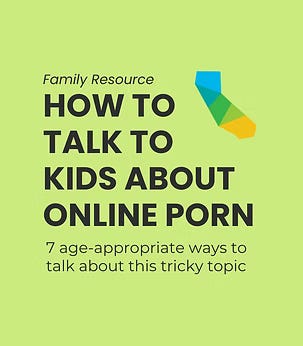
CG: [The] California Partners Project created a toolkit to help families talk with their kids about pornography. You were one of the key experts that we talked to when we were putting that together, and it remains one of the most used resources on our website five years after publication. Why do you think that this topic continues to feel so challenging for parents?
SZ: A lot of us don’t have this education ourselves. Sexuality Education for us was either solely clinical for a couple of days in a middle school science class. It was fear avoidance and shame-based, which we know is not effective in parenting. And that’s if we had it at all.
Sex is everywhere and nowhere all at once in our culture. Pornography is ubiquitous. Even mainstream media is ever more explicit. A lot of content in media is performance-based and porn-informed. It’s also explicit. And people have their own visceral reaction when they think of how they want to talk about this, and I think there’s a lot of fear, which is understandable, around saying the wrong thing, doing the wrong thing, introducing something that, you know, inspires curiosity. Just knowing how to navigate the trickiness of it.
There’s a certain sense of feeling powerless, and resources [like the toolkit] are always helpful and reassuring. Scripts, counter-narratives, things like that, which are all included in the work that we did.
Also it’s not like it was a flash in the pan. Commodifying sexuality has been around forever. Back in my day it was hard to come by, and even if you did, the image was static. It required you to engage your imagination. Now, with the clickbait and everything else, if you have any sort of device, that’s a porn portal in your pocket.
CG: It was reminding me of what you were saying earlier about the way things look vs. the way things feel. Pornography is an extreme example of that.
SZ: I get kids in my office asking about this sometimes. Because they see it, and their intuition tells them there’s something not quite right about this, but their body is being activated in some way, and that can be really surprising or confusing.
CG: What do you think helps you to be an askable adult in that situation?
SZ: They’re the kids who I’ve built rapport with through class. They know that I’m really interested and curious, that I’m in it because I care about them, and I want them to have healthy, caring, pleasurable, responsible relationships in their lives when they’re ready. I’ve built that credibility with them.
They know that I’m always the adult in the room and that I am an adult who’s comfortable talking about these things in a reasonable way. I will offer information so that they can make good decisions, guide them towards their own values, but I’m always the adult. Kids want and need that.
“They need adults to be the grown-ups. They don’t need more friends.”
CG: What advice would you have for a parent who wants to get comfortable talking about these things?
SZ: Talk about it with your friends! Or your partner, or whomever. Say, okay, I’m gonna go out on a limb, feel free to say no, my intention is not to create discomfort, right? And just say, I’m trying to get comfortable talking about these things with my kid. I have these books. Do you want to read one with me and we can talk about it?
We have to actually do these things for ourselves, because we didn’t have the education. If we’re going to disrupt those general cycles of ignorance and stigmatization, we actually have to do something different.
Even with my own kids, it can be challenging. With my partner, I’m like, okay, let’s talk through this first. What are the points? What are the potential pushbacks? You actually have to verbalize it.
I teach this class on how to ask someone out on a date. We start talking about these things [to say], and they’re like, I don’t know if that’s realistic. And we’re coming up with all the different ways you can ask. And I asked, how many of you as performing artists do scales and improv to warm up? How many of you as athletes do skills and drills exercises? You have to practice. And they get it. It’s a vibe! Adults need to take themselves through that process, too.
CG: As you’re talking with young people about how you ask someone out, what role does technology play?
SZ: We recognize all the different ways that young people are trying to connect and communicate. We talk about apps, we talk about the swipe.
There’s this subculture of language and what different things mean. Some of the things I’ve heard of and seen are almost borderline mean in terms of how people flirt in digital spaces. Because there’s not a lot of authenticity. Again, it’s very performative.
We also talk about consent as it relates to hookup culture and negotiating hooking up through digital spaces, because consent has to happen in real time, right? I go beyond consent pretty quickly because most kids know the definition of it now. We really focus more on where their learning gap is, because all of them understand navigating apps, but they don’t know how to actually do it in person.
We just had this book launch event with three former students of mine. Every single one of them brought [the class on how to ask someone out] up. They were like, we’re ahead of the curve! They all talk about the value of that class, that it was something that really served them, not only because they had a common understanding and language amongst each other, but that amongst their peers, they were then offering advice and helping their friends, who didn’t have that education.
CG: That may be a good follow-up book.

SZ: It’d be a good follow-up, or like a little handbook would be helpful. The Making Caring Common Project in their study in 2017 called “The Talk” found that 70% of their respondents really wanted more information from caretaking adults about romantic relationships. What it also found is that they’re grossly underprepared for caring, loving, enriching relationships that are grounded and anchored in intimacy.
Yes, kids should have Sex Ed. Yes, we need to be talking about consent. But what we don’t do is talk about love. That’s something that adults can speak to. Kids eat that stuff up.
CG: Thank you for sharing so much about your book and your work and your approach with us. And for helping us to be curious about it and to take on those courageous conversations that bring connection. It’s always a pleasure speaking with you. I always learn so much.
SZ: I appreciate the dialogue. It’s always fun to connect in the spirit of love, joy, and courage. That’s what it’s all about.
Being an askable parent or adult means creating the kind of relationship where kids feel safe coming to you with the questions that matter most. It’s not easy, as Shafia admits, but when that trust isn’t there, kids will look elsewhere for answers, often in digital spaces that don’t always reflect healthy or realistic relationships.
Here are a few ways to become an askable adult, inspired by our conversation with Shafia:
Respond, don’t react. When we learn to self-regulate and work through our own emotions, we remain the safe adult in the conversation—someone who can handle hard truths.
Lean on community. Practice tricky conversations with a friend, or invite other trusted adults into your child’s world. You don’t have to do this alone.
Ask curious questions. Try: I notice, I wonder, I’m curious about, tell me more, help me understand. Avoid why, which sounds like judgment, even when it’s not.
Let kids be experts. Ask open-ended questions about their experiences and then listen. Make space for their perspective and their feelings about tech and everything else.
Restore. Model what it looks like to own mistakes. Circle back. Do a do-over. Show your child what repair actually looks like.
Go slow. Intimacy builds at the speed of trust. Collect small moments of connection over time—and name them as what they are: intimacy.
For more ideas about how to build communication and connection, check out the Social-Emotional Family Guide from the California Partners Project and First Partner Jennifer Siebel Newsom.
No posts
Comments
Nothing yet. Say the first thing.
Sign in to join the conversation.