
I saw a tree growing out of a crack in a stone wall. Its trunk was bent and twisted, pulled sideways by gravity and wind. Its roots were hidden somewhere inside the red bricks.
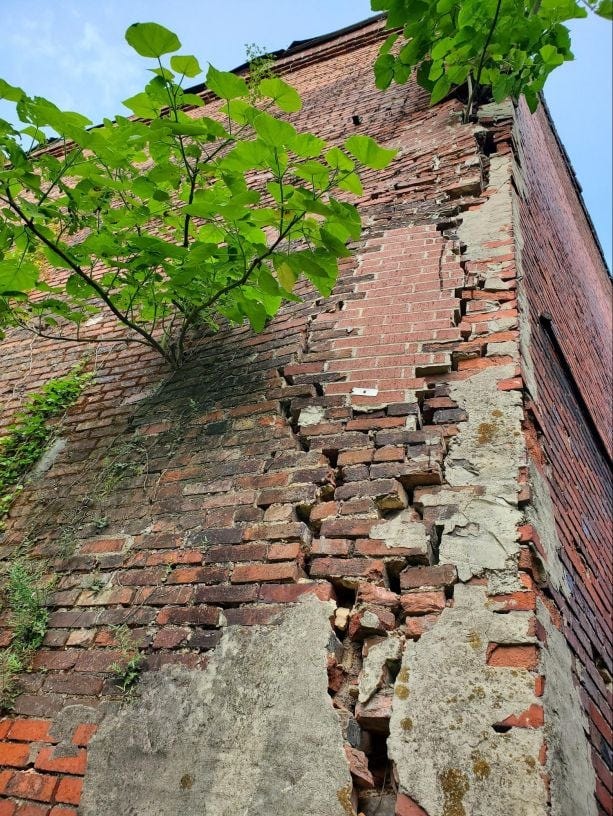
By every sensible measure, it should not have been there. And yet there it was—leafed out, fully alive, and thriving.
I can’t stop wondering how.
How did the seed even get way up there? How could it germinate in a brick wall? How did it survive long enough for roots to find anything at all to cling to? How did it continue to draw nourishment from stone?
Against all odds, it had.
I think I have something in common with that tree.
Considering the circumstances of my upbringing—the scarcity of affection, the instability, the harm, the constant moving, years of addiction, and a long trail of consequences—the odds were not in my favor.
By most reasonable calculations, my life should not have turned into much.
And yet, here I am, doing well.
Not because things were easy. Not because conditions were ideal. But because something in me kept finding—unbeknownst to me—what it could, where it could.
People like to say that life finds a way. That seems obvious. What interests me more is how life does that.
We tend to assume that good growth requires abundance: deep soil, open space, ideal conditions.
Jesus talked about this in a parable describing the Kingdom of God—seeds scattered on hard paths, rocky ground, and good soil. The emphasis is usually on where growth fails. Standing in front of that tree, I find myself wondering if we’ve missed something in that telling.
Everyone knows that for a tree to grow “right,” it needs good soil. When a tree grows tall and symmetrical, we call it healthy. We celebrate it as the model—the ideal.
But standing in front of that twisted tree, it was hard to ignore the possibility that I had the model wrong.
That tree didn’t fail to reach an ideal form. It followed a different logic.
I once assumed a seed carried a static image of the “perfect” thing it was meant to become. But that tree suggests something more subtle is at work: a set of rules for responding to light, moisture, resistance, and gravity.
Roots probe.
What works is reinforced.
What doesn’t is abandoned.
Growth happens wherever there is even a little to draw from.
The final form isn’t a distorted version of the plan. It is the plan carried out under real conditions.
Seen this way, the bent trunk isn’t evidence of damage. It’s evidence of intelligence—of a system capable of organizing itself around what’s available.
We make a mistake when we idealize trees that grow in perfect circumstances and quietly degrade the ones that had to adapt. The difference between them isn’t effort or virtue. It’s environment.
One had the privilege of uninterrupted resources and growth.
The other learned early to make do.
The wall didn’t stop the tree’s growth. It shaped it. The tree didn’t waste energy reaching where nothing would give. Instead, it organized its life around what was available—it made do.
A system that only thrives under ideal conditions isn’t as strong as we like to think. It’s fragile. The capacity to depart from the ideal model isn’t a flaw in the design—it’s the design proving itself.
The miracle isn’t that the tree found a way.
The miracle is how it found it.
And the more I pay attention, the more I realize that way—the quiet logic of life—is already built into us. We don’t have to invent it. We don’t have to make it happen. We don’t even have to understand it.
It just is.
I’ve spent years studying how trauma rewires the brain, how addiction patterns develop under impossible conditions, and how denial operates as a survival strategy rather than a moral failure.
I’ve watched people beat themselves up for being “broken” when what I see instead is brilliant adaptation to circumstances that should have destroyed them.
Standing in front of that tree, I finally understood what I’ve been trying to say all along: what we call brokenness is often just responsiveness under constraint. The crooked path wasn’t the wrong path. It was the only path available that led to life.
I always thought I was supposed to be one of the perfect trees, until I realized I was growing off the wall.
“A bruised reed he will not break,
and a dimly burning wick he will not quench.”
— Isaiah 42:3
Reflection Question
Where in your life have you mistaken adaptation for failure—or judged your growth by conditions you were never given?
Prayer
God of life,
you bring growth where we expect none
and meaning where we assumed there was only damage.
Help us release the false ideals
that tell us we should have grown differently.
Give us eyes to see the intelligence in what adapted,
the grace in what survived,
and the quiet wisdom already at work within us.
Teach us to trust the way life is growing—
even when it doesn’t resemble what we imagined.
Amen.
This reflection grows out of the themes explored in The Lie That Kills Us—how adaptation under impossible conditions is often mistaken for failure.
The book is available now on Amazon
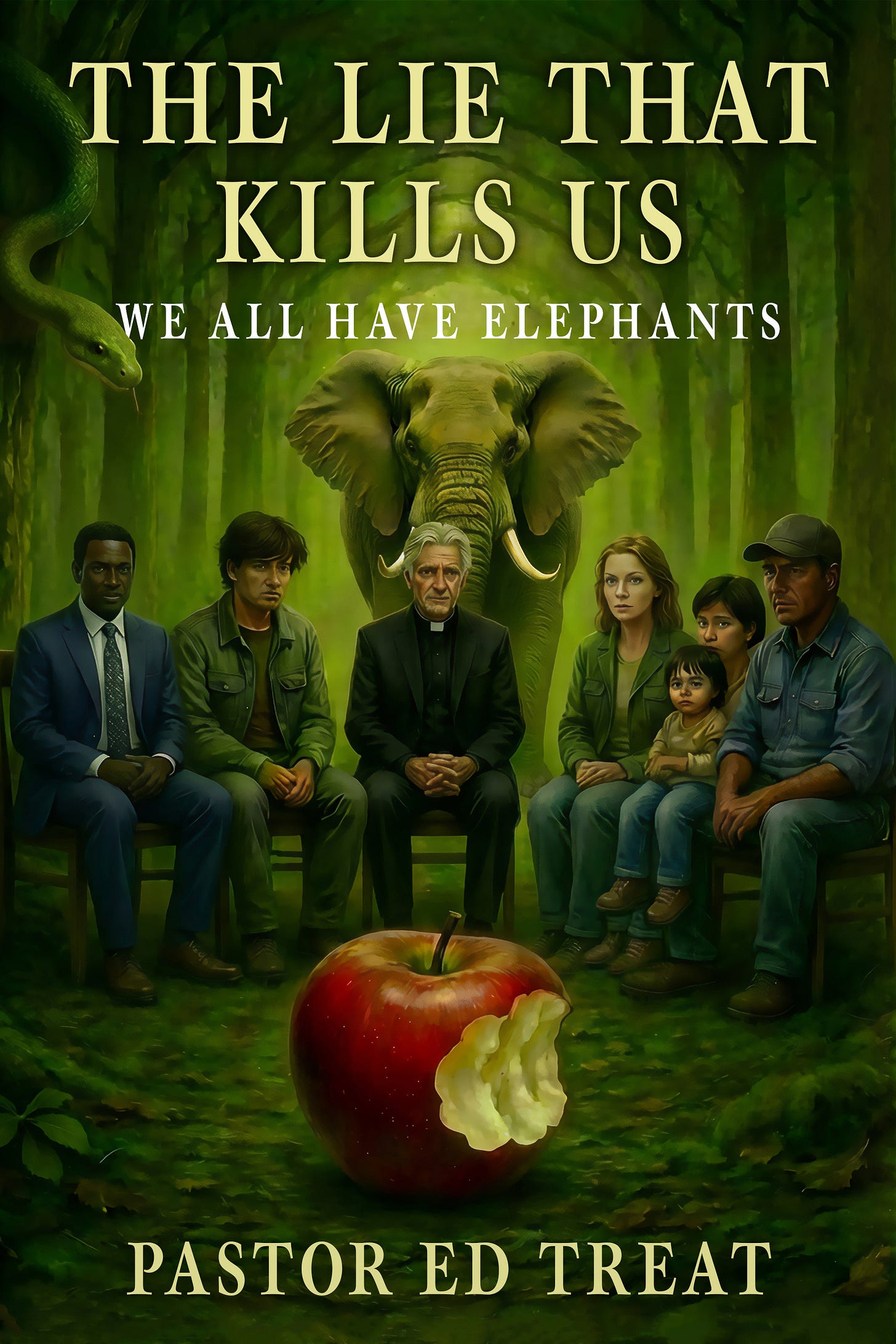
The Elephant Chronicles are meditations based on my upcoming book “The Lie that Kills Us: We All Have Elephants. It explores the elephants we avoid: denial, addiction, trauma, death, and grace.
If you’d like me to let you know when it’s released, send a note to: Pastored@addictionandfaith.com
I’d be honored to keep you in the loop.
No posts
Comments
Nothing yet. Say the first thing.
Sign in to join the conversation.