
In 1988, while working at a small-town newspaper, I was assigned a standard human-interest story. A local man was turning 100, and my job was to gather his reflections on a century of life.
Toward the end of the interview, I asked what I thought was a harmless question:
“Is there anything that really bothers you about the world today?”
He became visibly agitated.
“Yes,” he said. “Down at the VA, they don’t do anything for the Civil War veterans anymore.”
And yet the way he said it wasn’t historical. It was present. Personal. As if a fire started in 1861 was still smoldering in the room.
I sat there in stunned silence. The Civil War had ended more than 120 years earlier. There were no living veterans. And yet the way he said it wasn’t historical. It was present. Personal. As if a fire started in 1861 was still smoldering in the room.
It’s now 2026 and it’s still smoldering.
This past week, another protester was killed in Minneapolis, shot ten times while already on the ground, restrained by multiple officers. I don’t know all the facts; investigations will come.
But watching it unfold, something in me recognized an old story, less about the moment itself and more about the wound beneath it.
I’ve been thinking about how old our national arguments really are and how strangely present they still feel. It feels less like something new is happening, and more like something old keeps coming back to haunt us.
“…old wounds don’t go away just because time passes. Like monsters, the chase us until we deal with them.”
One thing I’ve learned in nearly four decades of recovery is that old wounds don’t go away just because time passes. Like monsters, they chase us until we deal with them. They don’t stay politely in the past; they wait for the right moment to make us bleed again.
There’s an elephant standing in the room of this moment, and I keep wondering if anyone else can see it.

Which brings me to an older story.
Cain and Abel.
Two brothers. Two offerings. One is blessed, the other rejected. Cain’s inadequacy is exposed, and his brother’s very existence becomes unbearable—a constant reminder of what Cain is not.
Before the violence, God sees the storm brewing and speaks to him:
“Why are you angry, and why has your face fallen?
Sin is crouching at your door; it desires to have you,
but you must rule over it.”
— Genesis 4:6–7
What strikes me is how closely this mirrors the story of Cain’s parents.
In Eden, God asks Adam, “Where are you?”
With Cain, God asks, “Where is your brother?”
In both cases, God isn’t gathering information. God already knows the answer. God is inviting honesty. Offering a chance to face shame rather than hide from it. A chance to stay in relationship.
Adam hides.
Cain lies.
Adam deflects.
Cain denies.
Same refusal. Different outcomes.
Cain can’t handle the pain of it. Rather than face his humiliation, he attacks the one who represents his failure.
After the murder, God asks the question that echoes through all of Scripture:
“Where is your brother?”
Cain’s response is chilling:
“I don’t know. Am I my brother’s keeper?”
I know what healing requires at an individual level: facing shame instead of displacing it, staying in relationship with people we resent, telling the truth about our own complicity.
What I don’t know is how a nation does this.
“…I recognize a familiar pattern—the same one that led to the Civil War.”
When I watch us now, I recognize a familiar pattern—the same one that led to the Civil War. Brothers who can no longer see each other as brothers.
On one side, I see genuine losses hardened into rage that targets the vulnerable and reasserts hierarchy.
On the other, I see the comfort of moral superiority—the ease of writing people off as deplorable.
Our own version of fratricide, dressed up as righteousness.
Different expressions.
Same refusal.
Both forms of denial.
I know what breaking this cycle would require.
I just don’t see us doing it.
The wound is too old.
The payoff of having someone to blame is too comfortable.
God warned Cain: “Sin is crouching at your door.”
“…we are standing in that moment now—the heavy silence between the warning and the murder.
I can’t shake the feeling that we are standing in that moment now—the heavy silence between the warning and the murder.
Where is your brother?
I don’t know how we will answer that question.
But I do know we’re being asked.
“Where are you?” — Genesis 3:9
“Where is your brother?” — Genesis 4:9
Where do I feel responsible for my brothers—and where do I quietly exempt myself?
Who do I instinctively count as “my people,” and who falls outside that circle?
What feelings rise up toward those I don’t consider my brothers, and why?
God of presence,
You ask questions not to accuse us,
but to draw us back into relationship.
With you and with each other.
When shame rises in us,
and grief feels unbearable,
slow us down before we turn away
or turn on one another.
Help us face what is happening inside us
instead of finding someone else to carry it.
Teach us what it means to be keepers—
of one another,
of truth,
of the fragile bonds that still connect us.
Give us the courage to answer honestly
when you ask where we are,
and where our brother is.
Amen.
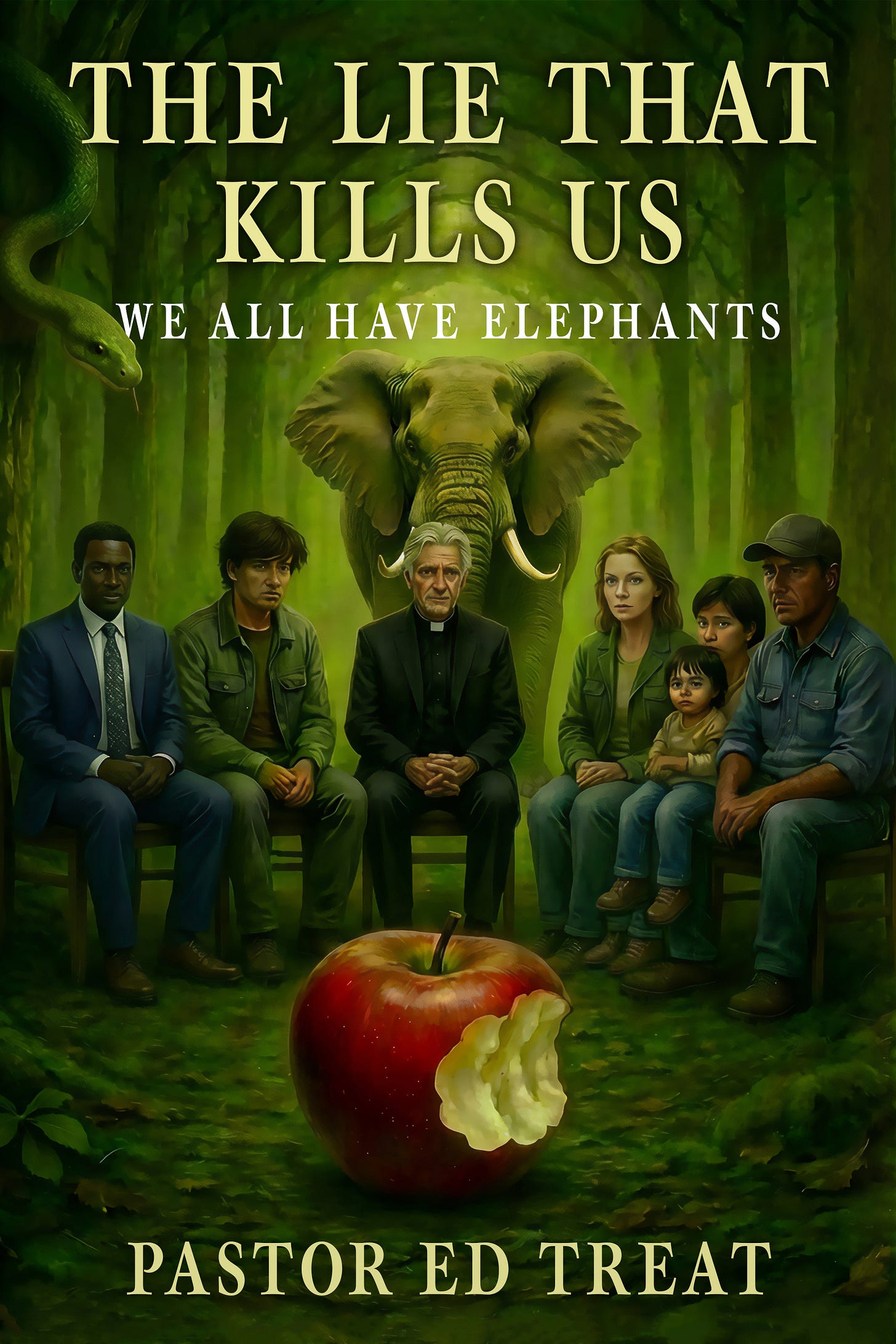
The Elephant Chronicles are meditations based on my upcoming book “The Lie that Kills Us: We All Have Elephants.” It explores the elephants we avoid: denial, addiction, trauma, death, and grace.
If you’d like me to let you know when it’s released, send a note to: Pastored@addictionandfaith.com
I’d be honored to keep you in the loop.
The book is available now at: Amazon
No posts
Comments
Nothing yet. Say the first thing.
Sign in to join the conversation.