
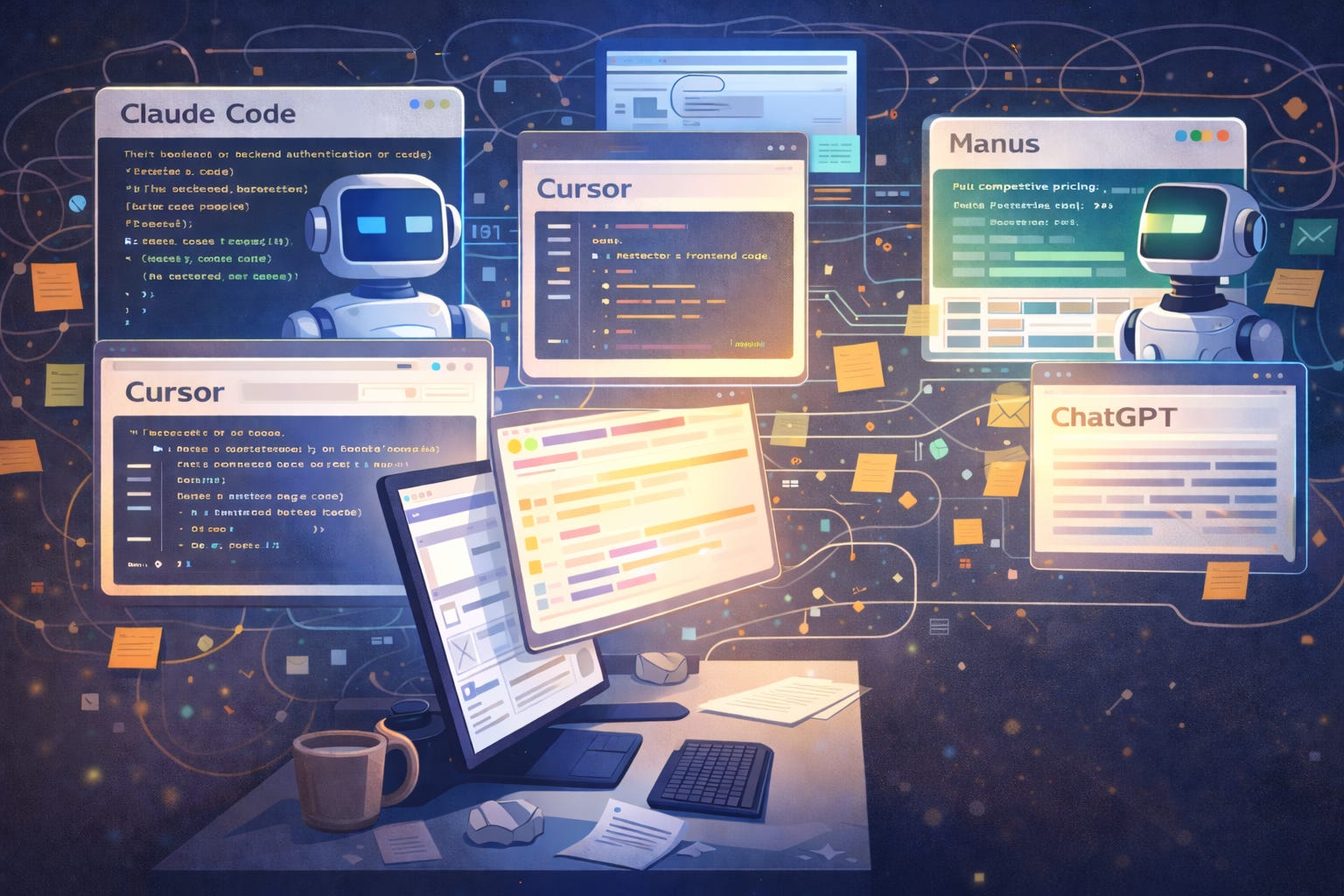
It’s 2pm on a Tuesday. Claude Code is writing a backend auth flow in one terminal. Cursor is refactoring your frontend in another window. Manus is pulling competitive pricing data in a third. And somewhere in a fourth tab, there’s a half-finished ChatGPT conversation about landing page copy that you swear you’ll get back to.
Everything is moving. Every agent is producing. You should feel productive.
Instead, you feel like you’re drowning.
You click into Cursor — wait, did you already approve that last diff? You switch to Claude Code and realize the auth flow hit an error three messages ago. You open Manus and can’t remember what you asked it to research.
Every window is a universe you have to mentally re-enter. And re-entering is expensive.
This isn’t a productivity problem. It’s a cognitive one. And it’s about to become the defining challenge of the AI builder era.
For years, the bottleneck was execution. You had the idea but the coding/designing/shipping took forever. AI collapsed that timeline. I’ve shipped things in a weekend that would have taken months without a technical co-founder.
But nobody warned us: when execution gets fast, coordination becomes the hard part.
I've been to many vibe coding meetups and watched this happen dozens of times. Someone opens Claude for the backend, Cursor for the frontend, ChatGPT for copy, v0 for a component. Each tool is doing great work. But the person in the middle is drowning — not in tasks, but in context.
Every switch forces a mental reload: What was this agent doing? Where did we leave off? Did the output drift from what I asked?
The cognitive equivalent of OS thrashing. Too many processes, not enough RAM.
Everyone says the AI age requires you to be the boss. Delegate. Manage AI workers like a CEO. Sounds great in a tweet.
But human employees are slower — and that slowness gives you breathing room. You assign on Monday, check Wednesday, review Friday. The pace matches your brain.
AI agents finish in minutes. You’re constantly reviewing, redirecting, spawning new tasks, and holding the big picture — all at once. It’s like managing 10 direct reports who finish every 45 seconds and immediately ask “what’s next?”
That’s not delegation. That’s a treadmill.
Now add rate limits to the chaos.
You’re deep in a session with Claude Opus 4.6. Twenty messages of shared context — architectural decisions, edge cases, a mental model of your codebase. The AI gets your project. Then you hit the usage cap.
You can wait hours. Or switch to Sonnet, GPT, Gemini — whatever will take you right now. Most people switch because momentum feels too precious to lose.
But how much context accuracy do you actually lose in that transfer?
You can copy the conversation, write a summary, feed the new model a system prompt. But none of that recreates the accumulated understanding from a real working session. The offhand remark in message 4 that shaped the approach in message 17. The implicit preferences it learned from your reactions.
Context isn’t just information. It’s calibration. And calibration doesn’t transfer.
The case for switching: you keep your human flow state, which matters more than any AI context. Fresh models sometimes catch things the first one missed. And articulating your problem to a new model can clarify your own thinking.
The case against: you’re onboarding a new employee mid-sprint. The new model doesn’t know why you chose Supabase over Firebase, or that you already tried and rejected a certain approach. You re-litigate decisions you already made. The model suggests the exact thing you rejected an hour ago.
What actually gets lost: not the explicit facts — those transfer fine. It’s the implicit stuff. Coding style preferences. The level of detail you want. The tradeoffs you care about. Things you’ve tried that didn’t work. There’s no “context accuracy score” to check. You just feel it — responses slightly off, suggestions generic where they used to be specific, more energy steering and less energy building.
My workaround: save the strongest model for the hardest decisions — architecture, complex logic, tricky UX. Use lighter models for mechanical tasks that don’t need deep context. That way, when you hit a cap, the forced migration costs less.
But it’s all duct tape. The real fix needs to come from the platforms.
The sessions where I’m most productive aren’t the ones where I use the most tools. They’re the ones where I use the fewest. One tool, one problem, one context.
A few things that have helped:
Batch by mode, not by project. Research in one block, coding in another, design iteration in another. One primary AI tool per block. Keeps your brain in one mode.
Write yourself back in. Before closing any session, write 2-3 sentences of where things stand. Not for the AI — for you. Future you needs this more than any prompt engineering.
Three windows max. More than three open means you’re being reactive, not productive.
Resist parallel execution. Sequential, focused sessions almost always beat parallel chaos. The context-switching cost eats all the time savings.
In AI tools won’t be a smarter model. It’ll be a better dashboard. Something that answers at a glance: here’s what you were working on, where each thread stands, what needs your attention now, and what can wait.
And if we’re being ambitious: portable context. A way to export not just a transcript, but the calibrated understanding a model has built — your preferences, constraints, rejected approaches — so you can hand it to any model and pick up where you left off. No re-onboarding. No lost nuance.
Until then, the defense is low-tech: be intentional about how many threads you’re holding, write things down for your future self, and protect your deepest context like the scarce resource it is.
Your brain is a single-threaded processor pretending to be multi-core. Design your workflow around that reality.
No posts
Comments
Nothing yet. Say the first thing.
Sign in to join the conversation.