
Last Tuesday I went to a concert at Het Concertgebouw in Amsterdam. Esa-Pekka Salonen conducting the Swedish Radio Symphony Orchestra, with Yuja Wang on piano.
I didn’t know much about him going in. But there was something about the way he stood at the podium that made me curious. Not the big theatrical conductor energy. Something quieter. Like he was thinking about something and the music was how he was thinking about it.
I wanted to know who this person was.
The program that night: Sibelius’s Seventh Symphony, then a piano concerto by a Finnish composer named Rautavaara, then Ravel’s Piano Concerto for the Left Hand — written for a pianist named Paul Wittgenstein who lost his right arm in WWI — and finally Debussy’s La Mer.
The concert was supposed to end around 10:20pm. It didn’t. Salonen came back out and played two Sibelius encores. Then another. It was close to 11pm and he just didn’t seem to want it to stop. The audience didn’t either.
I only understood what I’d been watching after I went home and started reading about him.
Salonen started as a horn player. As a teenager he heard Messiaen’s Turangalîla Symphony and something clicked — not performing, composing. He eventually sold his horn. That was what he actually wanted to do.
He became a conductor almost by accident. He was driven to it out of sheer necessity: the new works by the new generation needed people to perform them. Nobody else was going to stand up and defend the music he and his friends were writing. So he did. He was part of a group of young Finnish composers — including Magnus Lindberg and Kaija Saariaho — called Korvat Auki, “Ears Open.” They pushed each other. They pushed the institution. Salonen picked up a baton because the music needed defending.
And then I looked at the program again. Sibelius — the shadow of Finnish music he grew up inside. Rautavaara — his actual composition teacher at the Sibelius Academy. This wasn’t just a nice program. It was personal. And the encores made sense too — Sibelius again, twice, like he wasn’t ready to let that world go.
The conducting career took over faster than he expected. In 1983, he stepped in last-minute for Michael Tilson Thomas with the Philharmonia in London — twenty-five years old, barely any notice. He said afterward it wasn’t a big deal to him. The world disagreed.
He never fully resolved the tension between composing and conducting. He talked about almost quitting conducting at one point — after long stretches of writing music alone, going back to standing in front of a hundred people felt impossible. Two completely different modes of being.
But he kept doing both. He said once that composing had become his little kingdom. His sanctuary. “I’m the boss, I make the rules.”
Everything else — the career, the orchestras, the fame — was kind of beside the point. The composing was where he actually lived. The conducting was how he stayed connected to music as something real and alive and happening right now.
“Anyone who composes and conducts at the same time is immediately suspect, because he must be faking one or the other.”
He said it like a joke. He never stopped doing both.
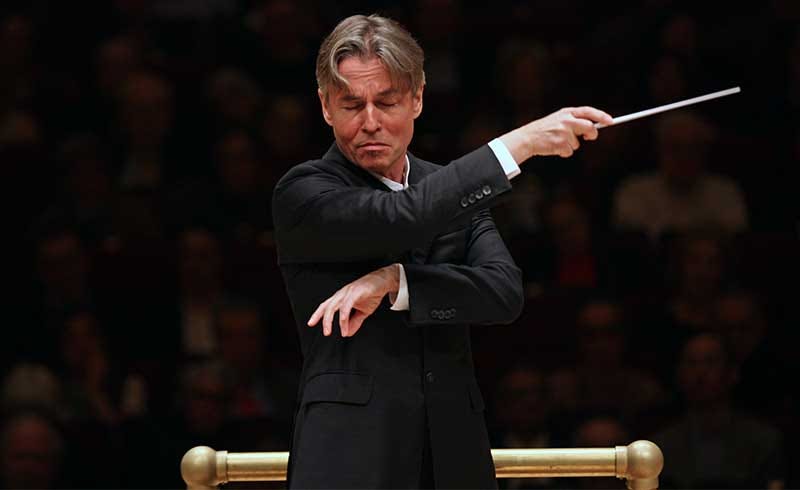
Photo courtesy of Houston Symphony
When he moved to LA in 1992 he came with — his words — a slightly arrogant European idea that he was going to show Americans what culture was. That didn’t last long. He got interested in what he called the “physical properties of music” — completely different from the European tradition he’d grown up in, which he compared to medicine that tastes bad but is good for you. LA got inside him. The music changed.
There’s one story I keep thinking about. He heard Stravinsky’s house in the Hollywood Hills was for sale. Stravinsky was his hero. He went to see it. He walked through the empty rooms, saw the dents in the floor from Stravinsky’s pianos, and got spooked by the ghosts there. He walked away without buying it.
That detail. He knew that living inside his hero’s house would crush something in him. That you can’t find your own voice if you’re standing too close to the person you most admire.
He also got really into technology — long before it was normal for classical conductors. In 2009 he created RE-RITE with the Philharmonia Orchestra, a large-scale installation that let audiences physically step inside the orchestra and conduct it themselves. Then in 2012 he co-developed The Orchestra — an iPad app that let users switch between multiple camera angles, follow a live score, and isolate individual instruments while a performance played. Apple liked it so much they featured him in their global “Your Verse” iPad campaign — a TV ad that traced the birth of a violin concerto from a moment of inspiration while shaving, to a full performance, all aided by his iPad. A classical conductor in an Apple ad. In San Francisco he went further — bringing AI-generated visuals into Ligeti performances and assembling a creative team that included a roboticist.
He wasn’t trying to preserve classical music. He was trying to keep it alive.
San Francisco is where it ended badly. He resigned in 2024 saying he didn’t share the same goals for the institution’s future as the board. What happened: the board was facing a $12.5 million deficit and started cutting — new music commissions, the European tour, experimental programming. His own musicians wrote an open letter. People held signs in Finnish at concerts.
He didn’t say much publicly. He didn’t have to. He’d spent his whole career making one argument: that classical music is a living thing, not a museum. When the institution asked him to act like it was a museum, he left.
Salonen was a horn player who became a composer who became a conductor to defend the music he loved. He walked away from Stravinsky’s house. He let California change him. He left a job when it stopped being a place where real thinking could happen.
And on a Tuesday night in Amsterdam, close to 11pm, when the program was done and the audience was ready to go home — he came back out and played more Sibelius. Because he just didn’t want it to end.
That’s the whole story, really.
The work always came first.
No posts
Comments
Nothing yet. Say the first thing.
Sign in to join the conversation.