
“At the Table” is a series of interviews and spotlight conversations with people I admire from within and outside of the wedding industry. These conversations focus on topics related to building an intentional, relationship-first business alongside a present, connected, values-driven personal life.
I don’t remember how I first met Candice. Correction: I don’t remember how I first started following Candice. It was years ago, shortly after I first moved to South Carolina and was trying to connect within the Charleston wedding market, that someone said, “Do you know Candice?? She knows everyone. You need to connect with her.” She was working at a venue at the time, and we started chatting in Instagram DMs and became friends. We remained IG friends for years before we finally met at a networking dinner in Charleston. Instant bearhug, instant REAL friendship. I have since watched her go from working for other people to working for herself as she works for other people, and I am constantly in awe of her capacity to create incredibly beautiful things while managing the chaos of live events. I’m so happy she said yes to an interview!!
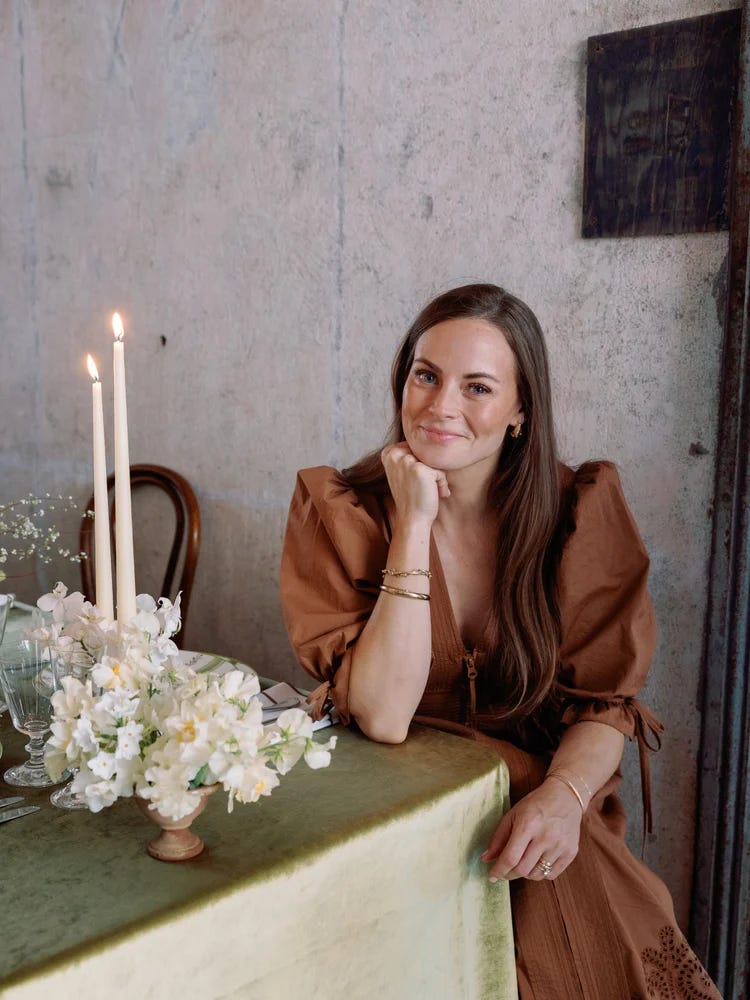
Follow Candice via her website and IG.
→ First of all, tell me in your own words what you do for work, and why you do it?
Goodness, starting with a tough one. I say this allll the dang time: “smorgasbord” is my word. At the core, though, I’m a designer and producer. That part of me finds its way out in many different forms. Sometimes I’m on site freelancing with a planning team, sometimes I’m styling interiors for a photoshoot, selecting paint colors for a custom build, or styling paper goods on installation day.
Some projects I lead from start to finish, while others have me stepping in alongside planners or creative teams to help shape the design vision and oversee production. It truly takes a million forms.
I do it because nothing makes me happier than beauty… in spaces, in details, in the way an experience makes someone feel… in my annoying amounts of instagram stories… life is far too short not to actively pursue what is positive and meaningful. So I tend to run toward those things as fast as I can. Hello Enneagram 7.
→ What does a typical day look like for you?
No two days ever look exactly the same, which is honestly part of what I love most, and part of why I chose this path. My brain thrives on variety, a poster child for ADHD. One day might be spent deep in computer work, building design decks, sourcing tabletop rentals, refining budgets, emailing vendors, or adjusting layouts… another might involve hours with paint fan decks and fabric swatches, client meetings, site visits, or walking a venue to troubleshoot installation details. I might be managing floral placement, directing a production team on site, or solving real time challenges during a build.
Some days are fully creative; others are deeply logistical. My work exists in this overlap between creative vision and operational problem solving. There are palettes, textures, renderings, and visuals, but also spreadsheets, contracts, timelines, and production logistics.I often joke that my brain runs in two lanes at all times (and at scary speeds at both times): one side dreaming up how a space should feel, the other figuring out exactly how to bring it to life.
→ In her book Dare to Lead, Brené Brown says that every person has just two core values that shape everything else that they do or believe. Do you agree with that idea? If you could boil your values down to just two, what would they be? How do those influence how you do your work & live your life?
I actually do agree with that idea. When I think about the values that guide me most, I’d probably say thoughtfulness and integrity.
Thoughtfulness shows up in how I design, how I communicate, and how I care for people. I think details matter (not because they need to be extravagant but because they make people feel seen). I want clients, vendors, and collaborators to feel cared for, respected, and understood.
Integrity shows up in transparency. I’m very honest with clients about budgets, expectations, and limitations. I don’t believe in overselling or promising something that isn’t realistic. In an industry where appearances can sometimes matter more than honesty, I think integrity builds trust… and trust is what creates long term relationships.
Those values influence not just how I work, but how I live. I’m someone who deeply values meaningful relationships, clear communication, and creating things that feel genuine rather than performative. Performative… what a hot topic word in our industry right now.
→ The British author Alain de Botton has this famous quote: “There is no such thing as work-life balance. Everything worth fighting for unbalances your life.” I tend to agree with this idea, that work-life balance is an unhelpful goal, and we should instead think about aligned values and healthy rhythms in all spheres of life. What do you think about the phrase “work-life balance?” How do keep healthy rhythms & momentum going in both work and personal spheres?
I think “work life balance” sounds beautiful in theory, but I’m not sure it’s realistic. Ok, let me be honest— it is NOT realistic, especially for people who care deeply about what they do.
In creative work, there are seasons where life and work blend together. During event season, there are long days, travel, and a lot of emotional and mental energy being poured into clients and teams. Other seasons (ok, maybe one day a week, every other month) feel quieter, slower, and more reflective. I think what matters more than balance is rhythm. Of which… let’s be clear… I do not have much of.
But in theory for me, rhythm looks like understanding when to push and when to pull back. It means recognizing that some weeks are production heavy, and other weeks need to allow space for rest, creativity, or being fully present with family and friends. It means trying to carve in that time, to say no, to stop and to not freak out because sitting still doesn‘t mean you are failing, being selfish, or going backwards. I’ve learned firsthand that burnout doesn’t come from working hard, it comes from working hard aimlessly or without any sight of recovery. So I try (key word, try) to build patterns, block off days (ok, be real: chunks of time) that let me step away, recharge, and come back with non-manufactured energy.
I am not, and will not, ever be good at this subject. But hey, self awareness is important right. Somewhere my therapist is rolling her eyes…
→ Some people argue that a focus on people and a focus on profit are competing priorities, but I love talking about the ways that running a relationship-first business aids in building more profitable, sustainable businesses. What do you think about this idea? Are they competing ideas? Why or why not?
I actually think the strongest businesses understand that people and profit are connected.
A relationship-first business creates trust, and trust creates longevity (back to that integrity bullet point). When people feel genuinely cared for, whether that’s a client, a vendor partner, or a team member, they remember that experience.
Profit becomes sustainable when people want to come back, refer you to their people, collaborate with you again, or talk about your work. I think there’s a misconception that prioritizing relationships means lowering standards or giving in without boundaries. To me, a “people first” business doesn’t mean saying yes to everything. It means building a reputation for reliability, honesty, and consistency. That kind of business tends to last longer because it’s rooted in connection rather than transaction.
→ What are some ways that running a people-first business has benefited you? How has it benefited others?
Some of the favorite opportunities in my career have come from relationships, not marketing, not algorithms, and not chasing visibility.
I’ve found that when you treat people well, show up consistently, and become someone others trust, opportunities naturally grow. Oh and you know, throw in BE A KIND PERSON.
In the wedding industry especially, collaboration matters. Vendors refer one another constantly. Teams work long hours together; it’s brutal, sometimes trauma-bonding, but it’s connecting all the same. There’s a level of vulnerability because we’re often stepping into deeply personal milestones in people’s lives.
And practically speaking, it creates repeat referrals, stronger partnerships, and a healthier reputation. Again, people remember how you made them feel. That becomes part of your brand whether you realize it or not.
→ Our culture and our industry is fast—trends come and go in the blink of an eye, and there’s just so much noise, especially on social media. It can be tempting to believe that the only way to stand out is to add to the noise, to follow trends, to make a bigger flash than our competitors. But what if you’re a quiet brand? I have written about the difference between Fireworks and Fireplace brands here. Would you say that your business is more of a fireworks display or a fireplace? How does that influence how you market?
Hmmm… honestly, I think I’m a little bit of both? The business itself is a fireplace: built more thoughtfully through relationships, trust, and word of mouth. But my personality has a bit (ok fine, a ton) of fireworks in it. I tend to share openly…. way too openly.… because I’ve never been great at pretending life or work is perfectly polished.
I think people connect to honesty more than perfection. They don’t need to see all the guts of the sausage being made, but they like to feel included in the process. There is a fine linebetween being vulnerable with a genuine intent to connect and simply oversharing for the sake of being seen. I try to stay aware of that line.
That balance probably shapes how I market or talk to people about my work. The work itself is intentional and steady, but the way I communicate is personal, candid, and a little emotionally explosive. I’d rather people feel like they know who I am.
→ How do you stay authentic when it often feels that “fake it ‘til you make it” energy is rewarded?
Ugh. This is hard. There’s definitely pressure in creative industries to appear bigger, busier, more successful, or more polished than reality. For me, authenticity means being honest about where I am, what I know, and what I don’t know. It means staying grounded in real relationships instead of perception.
Ironically, I think authenticity becomes a differentiator because people are craving honesty in a world that often feels curated. Especially in this industry. It’s tempting to do the crazy thing, say the thing, make the bold move… but I’ve learned that people can sense when something is performative and not genuine.
I think it’s ultimately about just being real. With where you are, how busy you are, maybe even how scattered you made yourself, instead of acting like you have it together all the time. Wouldn’t you rather people connect with a “real you” than an act you have to keep up with?
→ What is bringing you joy in your work right now?
Right now, what brings me the most joy is my people. My humans are freaking amazing. My tribe is ride or die forever. Not just in my industry inner circles, but the vendors we surround ourselves with. I’ve found myself gravitating toward projects where the team matters just as much (actually probably more) than the work itself: choosing to work alongside planners and creative partners who genuinely bring me life, not just a paycheck.
There’s something incredibly energizing about being surrounded by people who know you, who you’ve walked through seasons of life with, and who you’ve weathered hard moments alongside. That kind of trust creates a different dynamic: one where everyone brings their strengths to the table and there’s a shared understanding of how to support one another.
I also think I’m enjoying the process more than ever. Earlier in my industry years, I was so focused on outcomes and proving myself. Now, I find myself appreciating the relationships, the creative conversations, and the silly meetings, phone calls, side bars, that are just as exciting as the final result.
→ If we were to meet here a year from now, what do you hope we would be celebrating?
A year from now, I’d hope we’d be celebrating a season that felt really intentional, one where things felt aligned, thoughtful, and honest to where I actually want to be headed. Not necessarily bigger or louder, just clearer.
I’d love to feel proud of how I protected my energy, trusted my instincts more, and built a business that feels sustainable instead of constantly reactive. Less scrambling, more choosing. Success to me looks a lot less like endless growth for the sake of growth, and a lot more like being selective: saying yes to the right people, the right projects, and the right pace.
I’d hope it was a year full of more “hell yes” moments and a lot fewer situations that made me think, “why the f did I do this?”
→ Final question: what is the number one book you recommend to every creative entrepreneur?
Honestly, I’m probably not the person to recommend the “must read business book.” I don’t really thrive on business books, and I’d be lying if I pretended I spend my free time reading productivity strategies or entrepreneurial playbooks…. that ain’t me.
When I choose to read, I want to disappear into another world entirely. We already live in such a polished, pretty, happy preppy wedding universe all day long that when I unplug, I want the complete opposite. I usually want something dark, twisted, suspenseful… the kind of book that makes you forget your own life for a few hours.
So my recommendation is less about a specific title and more about giving yourself permission to read what actually fills you back up. For me, the best books are the ones that pull me completely out of my own brain and drop me somewhere unexpected (preferably while drinking wine).
Thanks for reading! This post is public so feel free to share it.
Comments
Nothing yet. Say the first thing.
Sign in to join the conversation.