
“At the Table” is a series of interviews and spotlight conversations with people I admire from within and outside of the wedding industry. These conversations focus on topics related to building an intentional, relationship-first business alongside a present, connected, values-driven personal life.
Sarah Porter and I first connected through an online networking group. We had a virtual coffee date, discovered a million random connections, talked as if we had known each other for our whole lives, and quickly realized that we were “kindred spirits.” That was nearly four years ago. We have since traveled together countless times, photographed weddings for each other, celebrated milestones in life and business, walked through anxiety and loss, and have experienced everything in between together. I heard of people finding their best friends in their 30s and 40s, but I honestly didn’t think I would ever find mine. Until Sarah came into my life. Besides being an incredible friend, she is an extremely talented photographer and businesswoman—someone I respect in all aspects of life. I’m so, so happy to get to feature her today!
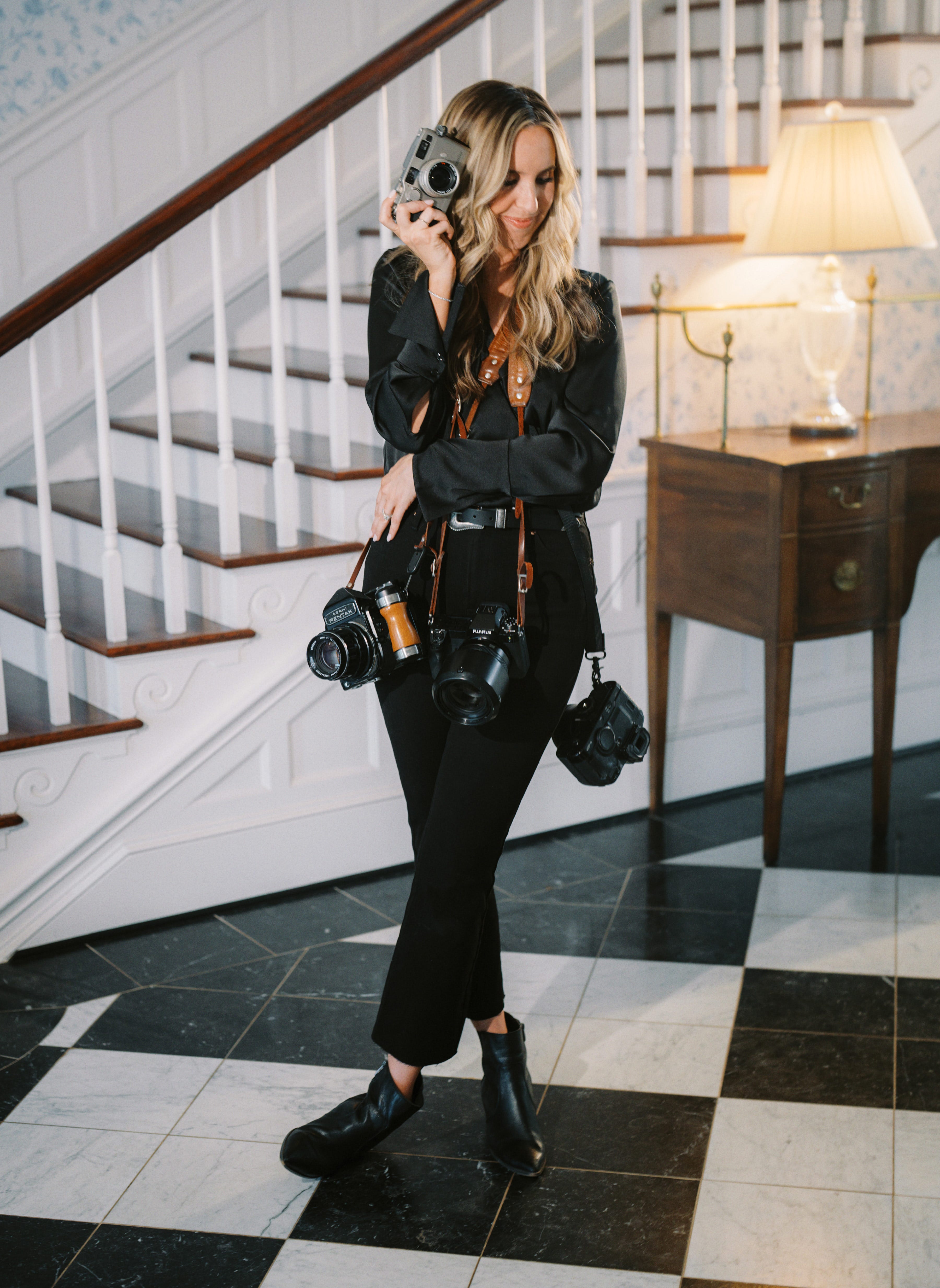
Follow Sarah’s photography business via her website and IG, and her content creation business, Porter Post, via website and IG.
→ First of all, tell me in your own words what you do for work, and why you do it?
I photograph weddings. And I know that sounds simple until you sit with what that actually means.
At many weddings there’s a table, sometimes tucked near the entrance, sometimes right at the heart of the reception, where couples display a single photograph from each generation of family weddings that came before theirs. Great-grandparents in sepia. Grandparents in the styles of their era. Parents in the fashions of theirs. And one day, somewhere on that table, will be one of my images. I’m not just photographing a wedding. I’m contributing to a family’s visual record of itself, the first chapter of a story that will become heritage.
Selfishly, I do it because I love it. There’s an energy to a wedding day unlike anything else. The dopamine hit is addictive! But what keeps me devoted to it, sixteen years in, is the service of it. Will Guidara writes that the best businesses don’t just deliver a product, they make people feel something. That’s what I’m reaching for every time. A couple shouldn’t walk away with just a gallery. They should walk away feeling like someone truly showed up for them, made them feel seen, made them feel trust in the process, on the most important day of their lives.
That’s why I do it.
→ What does a typical day look like for you?
I’m a creature of habit. Routine is where I thrive.
One of my favorite parts of the day during the school year is the twenty-minute drive to school with my kids. We’re intentional with that time. We listen to Proverbs in audio form, everyone shares one thing they’re grateful for, we pray for the day ahead, and then off they go. Before emails, before timelines, before any creative decision gets made, that drive reminds me what actually matters.
After drop-off I head to my office and begin the day quietly. Writing, thinking, making my list. Cal Newport talks about protecting deep work, the kind of focused, uninterrupted time where your best thinking actually happens. I’ve learned I’m a mid-morning person, so I protect that window for the larger challenges in my business. A good day is when the list isn’t so long it feels overwhelming. Focused, not frantic.
Midday I try to step away for a workout. That reset matters more than I used to give it credit for. I come back clearer, whether I’m editing, collaborating with my associate team, or working through details for an upcoming wedding.
By five o’clock my goal is to close the laptop and be done. Dinner, conversations, everyone catching up on their day. Stopping at five is one of my greatest struggles.
We usually finish the night the same way: rewatching an episode of The Office or whatever series we’re currently invested in. Simple, predictable, and I mean that as the highest compliment. There’s something genuinely grounding about ending the day with laughter, familiarity, and my husband next to me.
→ In her book Dare to Lead, Brené Brown says that every person has just two core values that shape everything else that they do or believe. Do you agree with that idea? If you could boil your values down to just two, what would they be? How do those influence how you do your work & live your life?
I do agree, and I’ll be honest, sitting with that question took more work than I expected. When you first look at the list of everything you value, it feels impossible to narrow. Excellence, hospitality, creativity, family, freedom. They all feel essential. But Brown’s process asks you to look deeper, to find which values are the root and which are just expressions of it.
For me it came down to faith and intentionality.
Faith is the foundation. It shapes how I see my work, my marriage, my role as a mother. It’s the reason I care about legacy, about showing up fully, about treating people like they matter. Remove it and nothing else holds the same meaning.
Intentionality is how I live faith out in practice. Nothing about my life or my business is accidental. The way I structure my mornings, the clients I say yes to, the standard I hold my work to, it’s all deliberate. Greg McKeown writes that the way of the essentialist is the relentless pursuit of less, but better. That’s intentionality. It’s not about doing everything. It’s about doing the right things with your whole self.
Together they answer the question I come back to constantly: does this reflect what I actually believe, and am I being deliberate about it? When the answer is yes, I’m usually right where I’m supposed to be.
→ The British author Alain de Botton has this famous quote: “There is no such thing as work-life balance. Everything worth fighting for unbalances your life.” I tend to agree with this idea, that work-life balance is an unhelpful goal, and we should instead think about aligned values and healthy rhythms in all spheres of life. What do you think about the phrase “work-life balance?” How do keep healthy rhythms & momentum going in both work and personal spheres?
I think balance is the wrong word entirely, and de Botton names it well. Everything worth building requires sacrifice at certain junctures. The entrepreneurial life, especially. There are seasons where the work demands more, where a deadline or a wedding season or a business decision requires you to tip the scales. Pretending otherwise sets you up to feel like you’re constantly failing a standard that was never realistic to begin with.
Greg McKeown reframed this for me. His argument in Essentialism is that if you’re always feeling like you’re sacrificing the wrong things, you haven’t done the upstream thinking clearly enough. The goal isn’t to find balance in the moment. It’s to decide in advance what is non-negotiable so that when the hard seasons come, you’re choosing the sacrifice deliberately rather than losing something by accident. “If you don’t prioritize your life,” he writes, “someone else will.”
Cal Newport adds another layer. He’d say intense seasons of focus are not only acceptable, they’re necessary for meaningful work. But what makes them sustainable is a clean boundary on the other end. You have to actually close out. Not half-present at dinner with your phone face down on the table. Actually done.
For me faith and intentionality do the work here. Faith reminds me what the non-negotiables actually are. Intentionality means I’ve thought about it before the pressure arrives. I’m not always perfect at it. But the goal has never been balance. It’s been chosen sacrifice over accidental loss.
→ Some people argue that a focus on people and a focus on profit are competing priorities, but I love talking about the ways that running a relationship-first business aids in building more profitable, sustainable businesses. What do you think about this idea? Are they competing ideas? Why or why not?
They don’t have to compete. But only if integrity is genuinely at the heart of how you operate. Not as a marketing position, but as an actual ethos.
My faith requires me to do all things well. That’s not a bumper sticker. It’s a standard that shapes how I show up for every client, every vendor relationship, every interaction. Wedding photography is a service industry. The people I’m serving have trusted me with something irreplaceable. When I take that seriously, the work gets better, the referrals follow, and the business grows. Not as a strategy. As a byproduct of actually caring.
But here’s the part people don’t talk about enough. I also have a family to serve. And if I’m chronically undervaluing my work, they suffer for it. Eliyahu Goldratt argued in The Goal that the purpose of a business is to make money, and that the path to doing it sustainably is removing the constraints that slow the whole system down. In a relationship-first business, the constraint is trust. When clients trust you completely, when vendors want to work with you, when your team feels cared for, the system flows. You’re not fighting friction at every turn.
People first and profit aren’t opposing forces. Undercutting one always costs you the other eventually.
→ What are some ways that running a people-first business has benefited you? How has it benefited others?
I have to be honest about something first. I haven’t always been people-first.
Early in my career I absorbed some teaching that to operate at a higher level in this industry meant maintaining a certain kind of distance. Protecting your energy. Staying focused on the aesthetic. I chased portfolio shots. I had an inner eye roll when someone asked for a certain group shot. I was building something, but I was building it around the wrong things.
What changed me wasn’t a book or a mentor. It was life.
I got married and understood for the first time what it felt like to be on the other side of the camera. I had my first son and realized I would someday be the mother of the groom. I lost my dad suddenly and felt the full weight of what photographs actually are. My daughter was born and I thought, someday I’ll be the mother of the bride. With each season the clarity sharpened. What actually matters on a wedding day came into focus in a way I couldn’t have manufactured in my twenties.
Will Guidara writes that unreasonable hospitality means caring about the things nobody asked you to care about. That’s what shifted for me. Making sure the mother of the bride got a real portrait with her friends from high school. Pulling nana aside during cocktail hour for a lovely photograph, because it turns out that was her last family function. Nobody put that on the shot list. But it mattered more than almost anything else in that gallery.
The benefit to my clients is more authentic work. Galleries driven by narrative rather than aesthetic. A complete record, not a curated one. And the benefit to me is that I finally feel like the photographer I was always supposed to be.
→ Our culture and our industry is fast—trends come and go in the blink of an eye, and there’s just so much noise, especially on social media. It can be tempting to believe that the only way to stand out is to add to the noise, to follow trends, to make a bigger flash than our competitors. But what if you’re a quiet brand? I have written about the difference between Fireworks and Fireplace brands here. Would you say that your business is more of a fireworks display or a fireplace? How does that influence how you market?
Ralph Lauren once said: “In my mind, I create a world based around the girl. When I design a collection, I have that heroine in mind. She is the star of my movie.” Rodney Smith, one of the great photographers of the last century, put it differently: “I want my pictures to have a quiet strength.” Together those two ideas are basically my entire brand philosophy.
My heroine is a specific couple. They’re guest-focused, a natural host who thinks about the experience of every person in the room before they think about themselves. They love art, culture, travel. The bride is classical, but she knows how to have a good time. She doesn’t need to be the loudest thing in the room because she’s the most considered thing in the room. My pictures should feel the same way.
When you design around a woman or couple like that, the brand question answers itself. I’m not a fireworks display. But I’m also not a fireplace that sits quietly and hopes someone notices. I read the room. If the energy is high, I’m there for it. If the moment calls for stillness, I can hold that too. What doesn’t change is the standard underneath it.
Most of my clients find me through planner referrals. That’s not a marketing strategy I engineered. It’s what happens when you show up for the right people, consistently, over years. You don’t earn a spot on a planner’s short list by posting the right things. You earn it quietly, by being exactly who you say you are every single time.
I’m not trying to be the loudest photographer in the room. I’m trying to be the one they call when it actually matters.
→ How do you stay authentic when it often feels that “fake it ‘til you make it” energy is rewarded?
Imposter syndrome will always rear its head. I’ve made peace with that. Sixteen years in, I still don’t know it all and I never will. I think that tension is actually useful. It keeps you in check. It propels you to be better.
But I’d push back on the premise a little. Is fake it till you make it actually rewarded? We don’t get to see the foundation of every business. We don’t see what’s keeping that person up at night, what’s being said about the experience someone had with them on a wedding day, what’s happening behind the flash of a social media presence. There is always more to the story. What looks like reward from the outside might be a very expensive performance with a very short runway.
What I’ve learned is that real confidence isn’t performed, it’s accumulated. You do the work, you show up, you grow, and one day you realize you’re not pretending anymore.
→ What is bringing you joy in your work right now?
I love this question because joy is actually my filter. My gut check when evaluating anything new, a trend, a technique, a direction, is simple: does this bring me joy? Not does it perform well. Not is everyone else doing it. Does it bring me joy. That question has never steered me wrong.
Slim Aarons once described his entire philosophy in a single sentence: “I was there and they were there and the light was good.” No performance. No curation. Just presence. That’s where the industry is moving and it’s what’s bringing me the most joy right now.
There’s a genuine pull toward more authentic storytelling in wedding photography, away from everything perfectly constructed and toward something that actually happened. That shift is stretching me creatively in the best way. New muscle. New eye. And I’m hungry for it.
I love this industry because I will never get to say I’ve arrived. There are small milestones that keep you on the climb, but the summit keeps moving and I mean that as the highest compliment to the work. Being pushed outside of my comfort zone isn’t something I tolerate. It’s actually what brings me the most joy. It means I’m being stretched, and being stretched means I’m still growing.
The day this stops challenging me is the day I’ll worry.
→ If we were to meet here a year from now, what do you hope we would be celebrating?
Contentment.
I have goals. Weddings I want to shoot, vendors I aspire to work with, publications I’d love to be featured in, clients that feel like the perfect fit. I’m hardwired for advancement. But a year from now I don’t want to be measuring myself against any of that.
There’s a line from Psalm 16 I keep coming back to: “The lines have fallen to me in pleasant places.” That’s what I want to be able to say. Not that I hit every milestone or outpaced anyone. Just that I looked around and recognized how good it already is.
My success will not look like someone else’s. And I don’t want to let their version of winning become the measure of mine.
I won’t get to the end of my life and say I wish I had shot more weddings. What I’ll be reflecting on is the relationships I built, how well I stewarded being a wife, a mother, a community member, a business owner. Quality over quantity. That’s the only scoreboard that matters.
→ Final question: what is the number one book you recommend to every creative entrepreneur?
I intentionally didn’t read most of the other interviews in this series before writing my own. I didn’t want someone else’s answers shaping mine. And I have a feeling Unreasonable Hospitality has already made more than a few appearances, so I’ll go somewhere different.
Steal Like an Artist by Austin Kleon.
In a world where we are drawing inspiration almost exclusively from social media, this book is a profound reset. Kleon’s argument is that nothing is original and that’s not a problem, it’s the point. The most creative people throughout history didn’t invent from nothing. They studied widely, borrowed freely, and combined influences in ways nobody had seen before. When your only input is the same feed everyone else is scrolling, your output starts to look like everyone else’s work.
Read outside your industry. Follow the chain of influence back. Find out who your heroes were inspired by and go there too. That’s where your actual creative voice is waiting.
Thanks for reading! This post is public so feel free to share it.
Comments
Nothing yet. Say the first thing.
Sign in to join the conversation.