
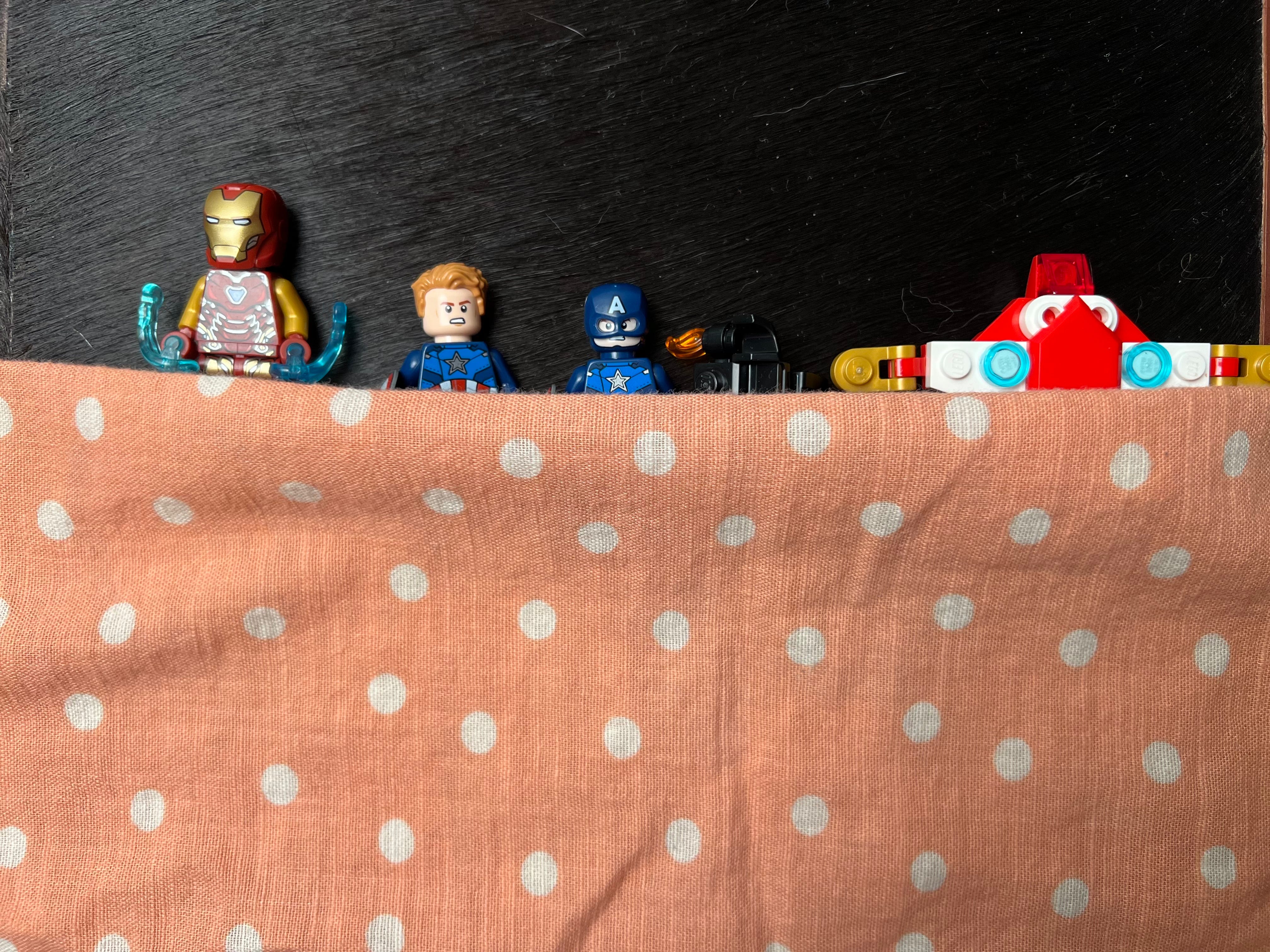
My son put his superheroes to bed last night.
Walking into his room the other morning, I noticed he used my husband's handkerchief to tuck in his action figures. Coming upon this, I smiled, then experienced an overwhelming sense of guilt.
I was rattled with guilt because shortly before, I had grown frustrated with his inability to sit still, do homework, and eat dinner. A common occurrence in our household. When he was in fourth grade, a doctor once told me, “You’ll have to sit on him to complete his homework.”
“For how long?” I asked.
“Around 8th grade, maybe later.”
I will fall on my Mommy Sword right now; if I could go back and redo how I managed reinforcing schoolwork at home, I would. There are two things I’ve always struggled with: first, my mind is nothing like my son's. I relish making lists and checking things off. Second, my brain is not as powerful as his. Not even close. These two truths are my Achilles’ heel in parenting.
The phrase that most accurately describes my son’s mind is “A Ferrari brain with bicycle breaks.”
His personality is magic because he is enthusiastic, playful, sweet, and curious. He has never complained about going to school. The only time he asked to stay home was when a girl refused his Homecoming invite.
We can all agree that high school is hard, but high school as a fourteen-year-old boy is even next level hard. As the struggles to keep up and remain focused mount, and the levels of social pressure and “making it” increase, I’ve been reevaluating my parenting philosophies.
I recognize where I’ve gotten it wrong and where I need to change.
Fourteen years into this thing called parenting, there is something I’m learning. The education goes far beyond our children’s; the learning is ours.
Raising a teenager in today’s educational system is complicated. Ever-present technology creates distractions, and social media complicates relationships. While neurodiversity is gaining traction in the classroom, it poses significant challenges for schools.
How do we, as adults, give our kids agency while instilling the scaffolding necessary to help them create opportunities in life and not close doors too early? We understand the long-term impact of failing and quitting, but kids are still learning this delicate dance.
Text within this block will maintain its original spacing when published
Have we let our son fail?
You bet.
Text within this block will maintain its original spacing when published
Is it hard?
Absolutely.
But something stopped me in my tracks the other morning. It was the group of superheroes my son had put to bed on his nightstand.
Our kids are just trying to find the superhero in themselves.
Superheroes, by nature, have a weakness, a flaw, that motivates them to greatness. A superhero's flaw is a defining quality or weakness they must overcome in their story.
My son is vying to be a superhero.
It’s my job to let him find his superpower.
Something on my must-read list is “The Disengaged Teen.” At the heart of this book is identifying learning styles and embracing a process where our teens have agency in their academic pursuits. “Instead of supporting and praising only outcomes and grades, we have to support growth, resilience, and learning for learning’s sake.”
So, while I raise my voice in frustration about homework and the “basics” (dishes, a clean room, eating), I realize I’ve missed the point entirely.
I’m raising a superhero on his journey to finding himself.
When I spin my morning to this vantage point, the parenting journey is more exciting. I’m no longer consumed by what isn’t happening in the day-to-day minutia; I want to see how this movie plays out.
Will he use a Cape?
Will he be able to Fly?
Whatever it is, I’m here for it.
I'm the mom of a superhero.
Lucky me.
Comments
Nothing yet. Say the first thing.
Sign in to join the conversation.