
Videogames returned to just outside the town’s castle for the third year in a row of Óbidos Vila Gaming, but this edition brought a new initiative to the event: Dev Logs.
Disclaimer: the event paid for two complimentary dinners (Friday and Saturday) and a one-night stay at a nearby hotel. They did not pay for coverage and haven’t influenced this article in any way.
Portugal hosts some renowned gaming events, most notably Gamescom Leadership Summit and DevGamm Lisbon/Madeira, but those are entirely B2B focused. In the consumer-facing front, things are still evolving. We do have multiple events which include games, but those have rarely highlighted the work that is done in the country.
This year’s edition of Comic Con Portugal brought with it the Innovation Lab, featuring some Portuguese-made videogames and a few talks about the industry. Dev Logs in Óbidos Vila Gaming went for a similar approach, but with a bigger focus on letting developers and industry people share their world with both industry people and consumers.
The Dev Logs took place outside of the main event’s venue, but literally right next to it. I agree with this approach and hope it is followed in future events. If you want to host talks and let people interact with developers, do not shove them into the middle of an extremely noisy venue. You might lose a few people in the process, but the ones who show up will most likely stick around.
In this smaller, secondary venue, Dev Logs hosted talks from over 20 speakers from all facets of the Portuguese videogame industry. But before we reached that phase, we did have an industry-only dinner at a nearby hotel with a delicious talk—and equally delicious dinner.
On Swiss Army Knives And Jacks Of All Trades
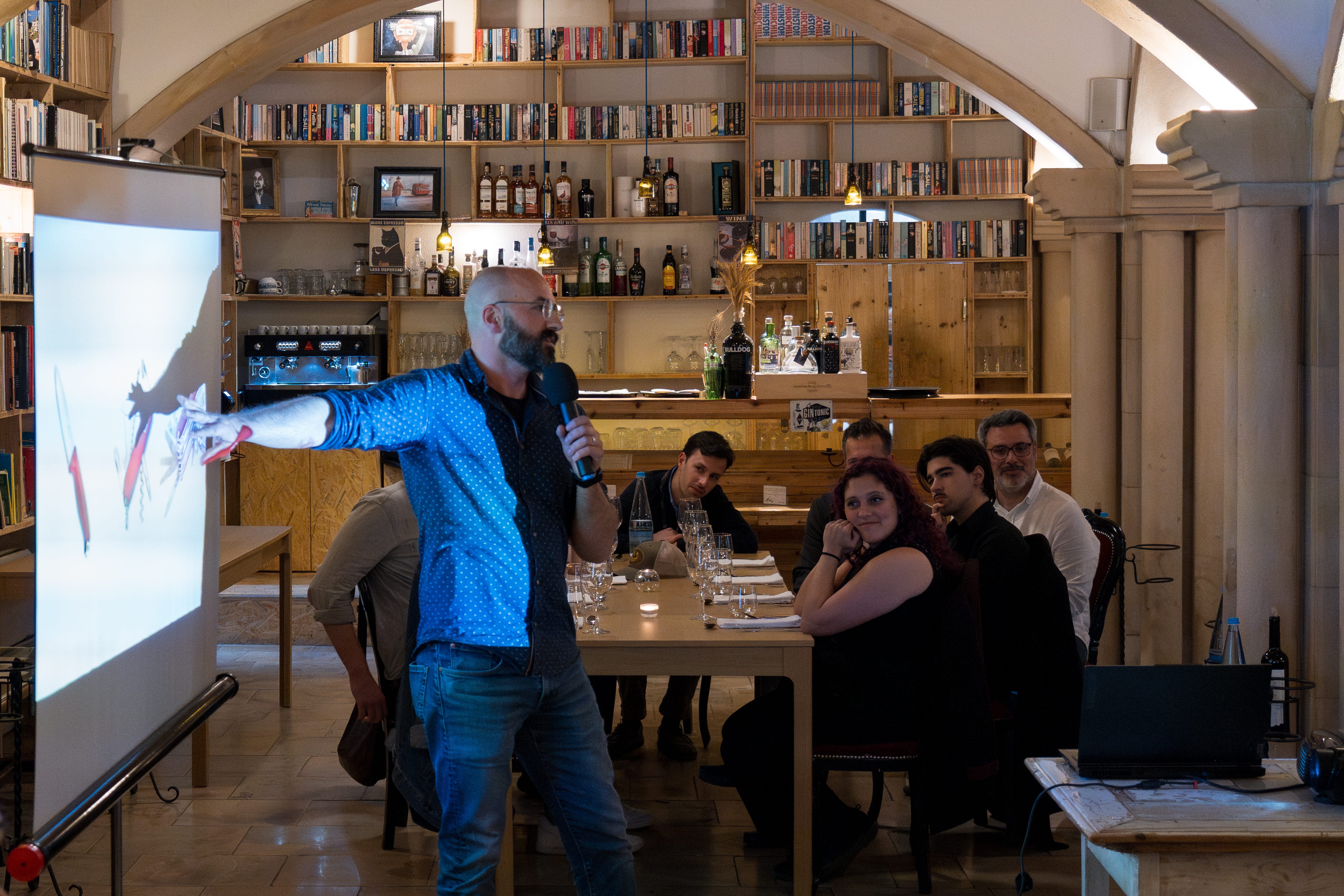
Marco Vale, an absolute veteran in the industry, spoke at length about his journey through the many evolutions of videogames and through the multiple transformations of the industry in Portugal. What stuck with me the most about this talk (I did not have the courage to pull out my laptop to take notes at the dinner table, so this is fresh off my brain) was his repeated use of the Swiss Army Knife analogy.
It fascinated me not just due to the lengths Vale went with it, going so far as to use multiple versions of the Swiss Army Knife, including ones I’d never seen or heard of, but because it echoed a talk from a completely different person in the industry. At the end of February, I attended the Spotlight Awards, where I watched a talk given by Tristan Michael. In it, Michael, who got his start in the industry back in the States, used a different analogy to say essentially the same thing: Jack of All Trades.
Both Vale and Michael highlighted the importance of learning more than one skill, even if you spent the first few years of your career and your formative years honing into something specific. They recognise that the industry has been pulling in the opposite direction to them for a long time. AAA studios have hyper-specialised developers that are the best in the industry at doing a specific thing.
For better or worse, though, we see the industry evolving again into something new. AAA companies are fewer and take longer to make games, so smaller studios and indie projects take center stage more and more often. I’d argue that those studios are the ones that will bring back the Swiss Army Knives and the Jack Of All Trades.
Saturday
The Dev Logs kicked off on Thursday, but I did not get to the event proper until the weekend. I got there late on Saturday but, thankfully, the talks were late too. These presentations were as diverse as their speakers.
I got there in time to attend Rui Guedes’ talk on Desert Race Adventures, Ground Control Games’ most recent title. He gave us a peek at the amount of work that goes into a project that might appear small from the outside.
Afterwards, Vanessa Vieira Dias led a conversation titled "Women Of Videogames: Playing, Creating And Belonging”. Dias took the stage alongside Beatriz Avelino, Catarina Esperança, Diana Pinheiro and Nicole Concha. They spoke about their journey through the industry of videogames in Portugal and what kind of evolution they had and hadn’t seen when it comes to gender-inclusion.
While they agree that a lot of progress has been made, there is still work to be done, including via events like these. Having women on stage discussion their journey in the industry gives the future women in videogames an example of what can already be done.
This was the first talk that got me taking notes, and I want to highlight a quote from Dias that stuck with me, which I’ll paraphrase:
People sometimes say: ‘You play? You don’t look like it!"‘ What does a woman who play videogames look like?
Tiago Franco took the stage around 6PM to tease us with early looks at Shelf Heroes and the bizarre journey that studios go through to get their games made. Franco and the Fun Punch team started working on this game as a sort of self-dare after a publisher doubted their ability to create a first person shooter. After all, they had no track-record.
Instead of sticking to their lane and iterating on the work they’d done with Striker’s Edge, Fun Punch started developing prototypes of FPS based mostly on concept art. Through this exercise, they eventually ended up with Plastic Heroes, renamed to Shelf Heroes after the studio made a publishing deal with Gameforge 4D.
Day Two- Sunday
Jasmine James kicked the stage off with an enlightening talk about Steam and some of its secrets. While this was mostly aimed at developers and studios, it was by no means useless to the public. The main message I want to highlight is: wishlist games you’re interested in, it can really help studios out!
David Ho followed suit with a presentation entirely focused around his first solo-developed game: Bobo And The Chest Of Nightmares. It is a 3D platformer inspired by the classics, including ones you might’ve never heard of, like PS1’s Jinx, which also stars a court jester as the playable character.
At around 3PM, Ricardo Cesteiro told us about Camel101’s journey as one of the longest running videogame studios in Portugal. Found by him and his brother Bruno, Camel101 has been developing games for nearly two decades. They’ve found their expertise in the immersive-horror narrative space since Syndrome in 2016, and are planning to release a new title this year, Dead Stop: No Vacancy.
Cesteiro highlights the fact that, while they’ve stuck to horror for the past decade, it hasn’t been one note. They change subgenres from project to project and, crucially, are intending on shortening development cycles even more. Dead Stop will be an anthology of “one-sitters”, short games meant to be played all in one go.
I managed to listen to the last talk of the event, given by Maria Gomes. Barking Beagle Studios is a small indie team with a handful of ambitious young people. Gomes is the narrative lead for their third game, Buried Within Clay, a Sumerian puzzle adventure.
Gomes spoke with an enthusiasm that was infectious. As the narrative lead, she was tasked with tying together the game’s story. She apparently found that too easy— my words, not hers- so she decided that, instead of simply dropping in some hints about ancient Sumeria and its history, she would create her own phonetic approximation between English syllables and Cuneiform characters.
This dedication infected the other departments, too. All architecture is inspired by real Sumerian buildings and has impacted the entire project.
Conversations
I missed a bunch of talks. Some of those were due to my tardiness, but most of them were because of the developers that kept dragging my attention away, blame them. There were 13 studios and two student organisations present at Dev Logs Óbidos. They were:
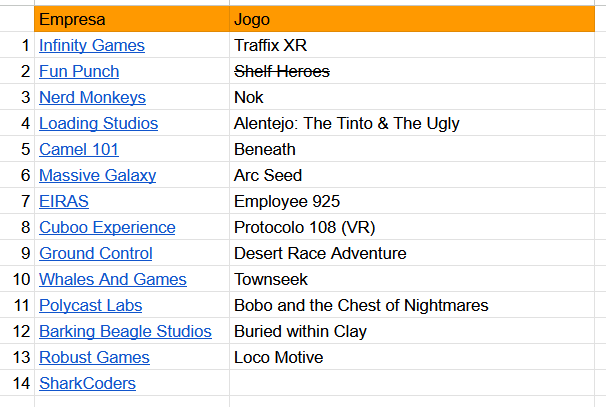
I spoke to almost everyone on this list. João Antunes Eiras developed Employee 925 through many years as a side-project to his full-time positions in the gaming industry. He was fascinated by the unique approaches that certain players took when playing his game right in front of him.
Employee 925 was a unique fit for a setting like the one we were on. You an easily finish a route in under a half-hour, but that was just a taste, leaving you wishing for more. I’m being intentionally vague about the game because summarily explaining it would ruin some of the magic.
Nerd Monkeys were showcasing Nok, a lovely physics-based hidden object game in which you destroy entire locations looking for a handful of items. Massive Galaxy’s Gonçalo Monteiro brought ARC Seed, his take on the roguelite deckbuilder craze with a unique focus on a grid-based tactical combat.
Lastly, I had the pleasure of speaking with the young folks at Loading Studios, which brought a massive functional Gameboy to showcase Alentejo: The Tinto & The Ugly. See for yourself:
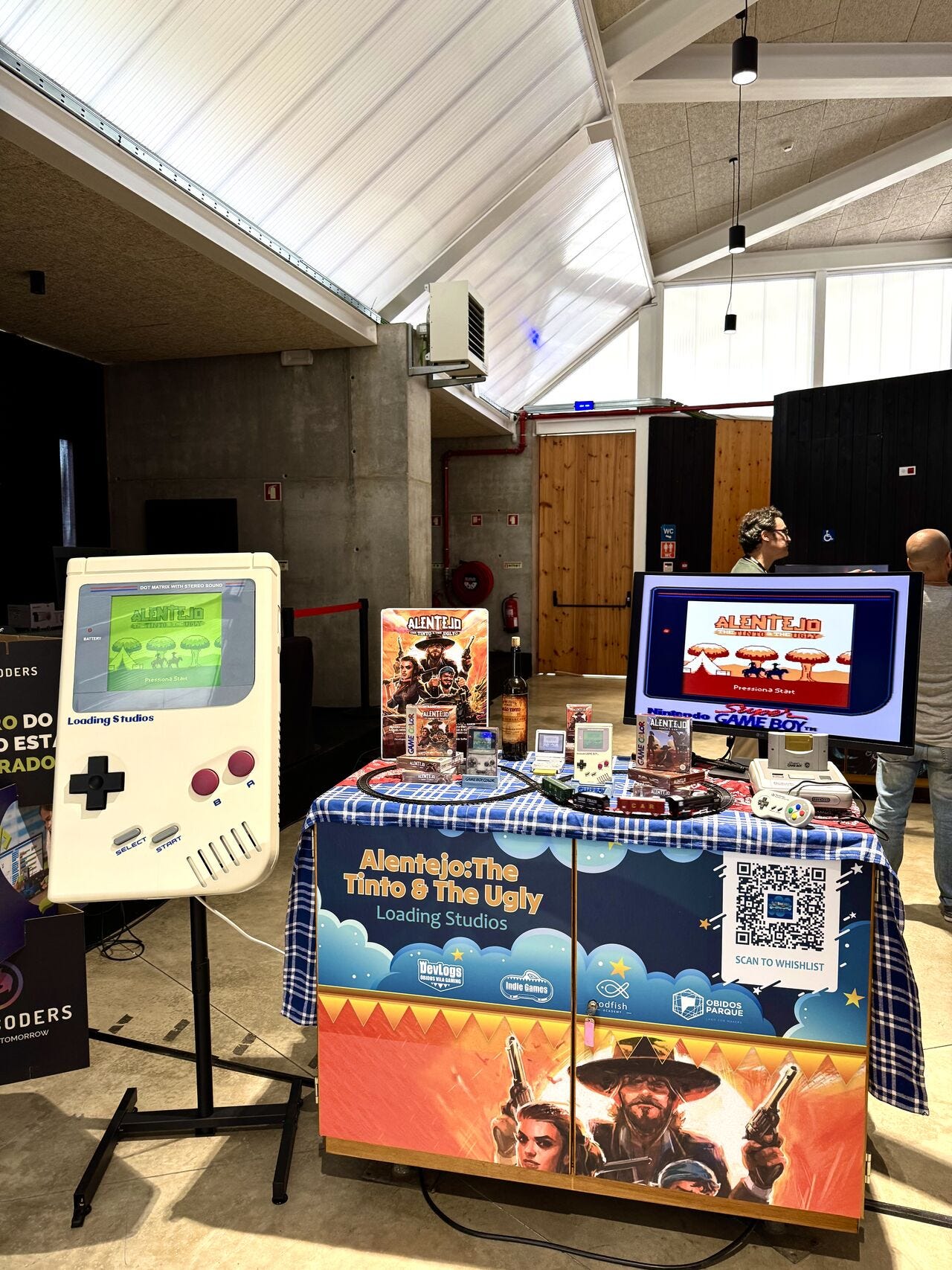
Daniel Penão and Vasco Oliveira had their Alentejo games playable on multiple Gameboy systems (including regular-sized ones) and on a SNES. Following the success of their take on the Western genre set in the lands of Alentejo, Loading Studios is now working on an adaptation of the most famous Portuguese book of all time: Luís Vaz de Camões’ Os Lusíadas.
I did not get a chance to speak with them, but students from Lusófona University were present with their projects. Sharkcoders was also there, showcasing simple projects entirely coded by children and young teens.
Final Thoughts
Dev Logs at Óbidos Vila Gaming was another great step in what I hope we’ll be a new-ish tradition in Portugal. We should obviously highlight the international successes that still dominate the market here, but consumer-facing events should strive to also show what is done in Portuguese soil.
There are multiple exciting and crucial releases coming soon, I hope to see them highlighted more and more in upcoming events.
Comments
Nothing yet. Say the first thing.
Sign in to join the conversation.