
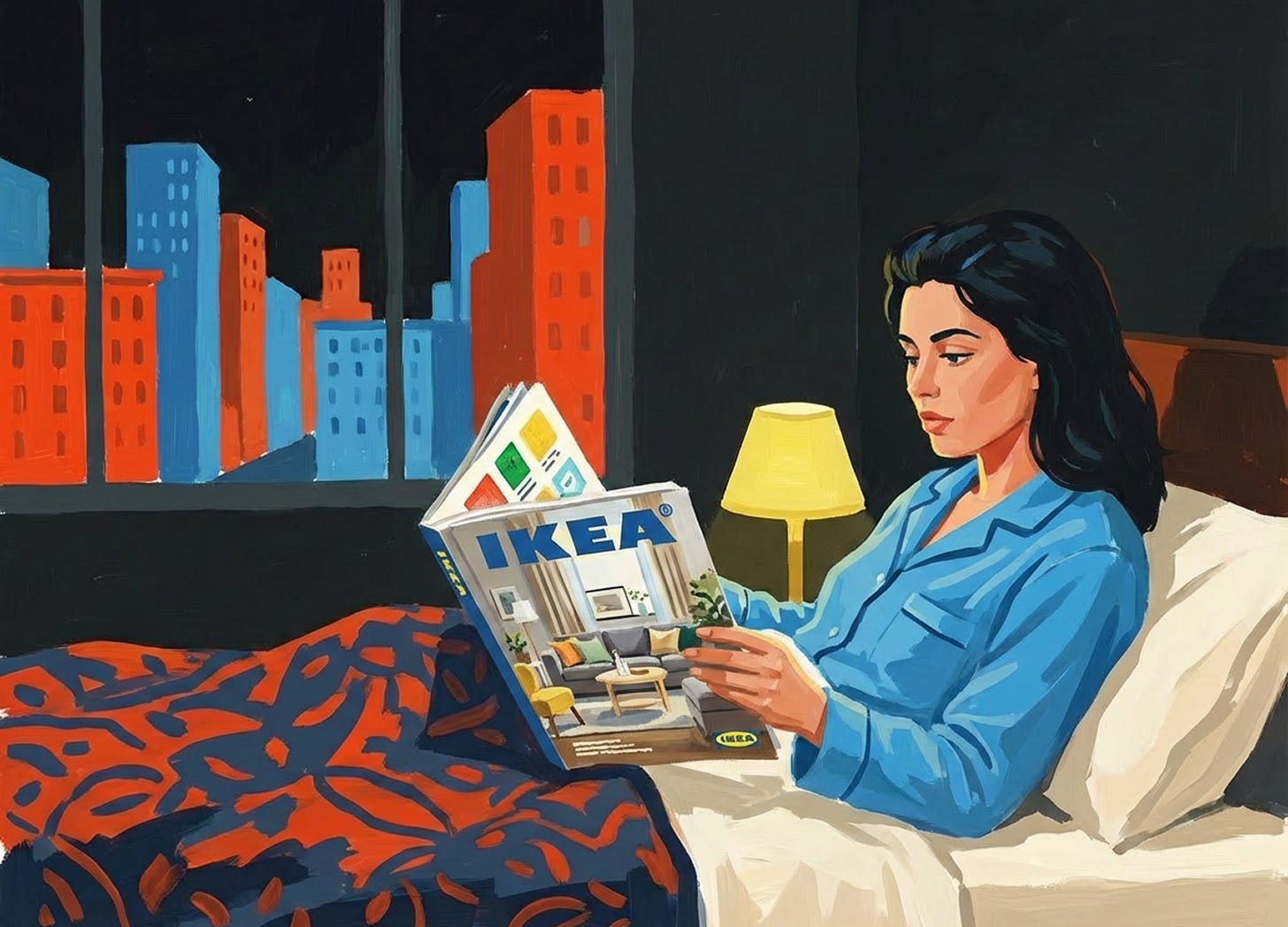
For seventy years, the most-printed book on earth wasn’t the Bible. It was a furniture catalog from a Swedish company most Americans couldn’t pronounce until the 1990s. At its peak in 2016, IKEA printed 200 million copies in 32 languages across more than 50 markets — a run that, in several reported years, outpaced global Bible printing and made it, by volume, the most-distributed commercial publication in history.
Here’s the contrarian part. IKEA built that machine by refusing to advertise the way everyone else did. While competitors bought TV spots and magazine spreads to rent other people’s audiences, IKEA poured the bulk of its marketing budget into a product it owned outright, mailed to your house, and asked you to keep on your coffee table. By 2004, the catalog was consuming roughly 70% of IKEA’s annual marketing spend. Seventy percent. On a single piece of owned media. That’s not a catalog. That’s a thesis about where attention actually lives.
The rest of the industry was renting eyeballs. IKEA was building a library card.
Get weekly breakdowns of how businesses actually grow by learning how they did it.
The world at the time
To understand why the catalog mattered, picture the mid-2000s marketing conversation. YouTube launched in 2005. Facebook opened to the public in 2006. The word “viral” stopped meaning “flu” and started meaning “Dove Evolution,” “Will It Blend,” and every brand scrambling to reverse-engineer a 90-second hit. Agencies pitched decks built around earned impressions and share-of-voice. The new religion was reach you didn’t have to pay for — as long as you paid an agency to chase it.
And against that backdrop, IKEA kept mailing a 300-page book.
By 2013 it was printing around 208 million copies a year — more than double annual Bible output that same period. Each edition took about ten months to develop and was produced out of IKEA Communications AB in Älmhult, the tiny Swedish town where the first store opened. While the industry argued about whether a viral video could replace a TV buy, IKEA was quietly running the largest owned-media operation in the world and letting customers carry it home themselves.
Everyone was chasing virality. IKEA was chasing your bookshelf.
The campaign in detail
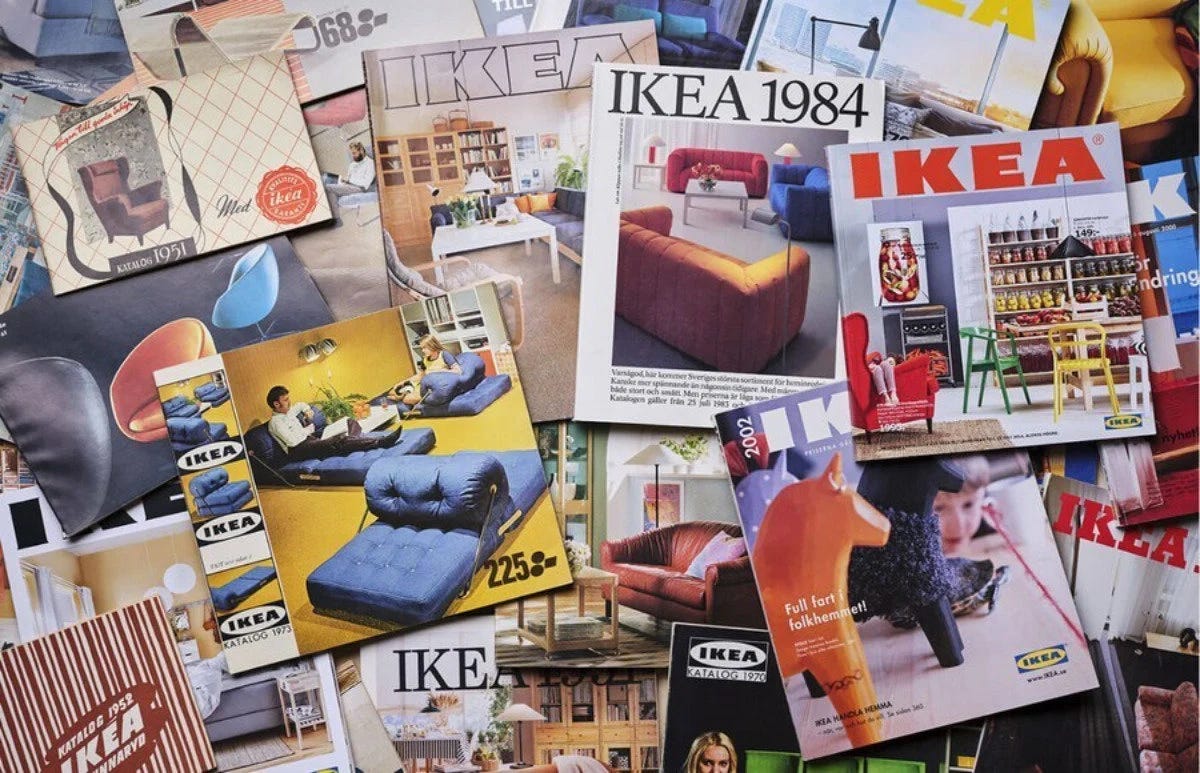
The first catalog, assembled by founder Ingvar Kamprad himself in 1951, was 68 pages in Swedish with a print run of 285,000 copies. The cover featured the MK wing chair in brown upholstery — later reintroduced to global audiences as the STRANDMON. From that regional brochure, the catalog scaled across decades into a production operation most publishers would recognize as a mid-sized magazine empire.
By the late 2010s, each edition contained roughly 12,000 products across more than 300 pages, and regional versions were customized for local range and cultural context — the China edition, for example, depicted smaller kitchens than the US one. In 2017, IKEA was working with five paper suppliers and 31 printers worldwide to produce the thing.
Then came the part almost nobody noticed. Starting with a single rendered wooden chair in the 2006 edition, IKEA began quietly replacing photography with CGI. By 2014, about 75% of product images and 35% of non-product imagery across all IKEA communications were fully computer-generated. Shoppers didn’t clock it. According to IKEA’s head of photography, customers looked at rendered rooms and saw real rooms. The 2013 edition added an augmented reality app that let you project furniture into your actual living room through your phone — years before AR became a standard retail feature.
The catalog’s final edition — the 2021, released in late 2020 — printed 40 million copies. IKEA announced the wind-down the same month, calling it “emotional but rational” and pointing to four billion annual visits to ikea.com as the reason the book no longer had to do all the work alone.
Why it worked
The mechanic at the heart of the IKEA catalog is what marketers now call owned media, but a cleaner word for it is permission. The catalog wasn’t interrupting you. You’d asked for it, or picked it up in-store, or let it sit by the couch for six months because it turned out to be surprisingly nice to flip through before bed. Every minute you spent with it was a minute competitors couldn’t buy, and IKEA had already paid for the space — once, upfront, on paper they controlled.
That’s the first half. The second half is that the catalog wasn’t really selling furniture. It was selling rooms. The photography (and later, the CGI) showed finished, aspirational, achievable spaces — and then quietly told you that the entire room cost less than you’d expect. Browsing became daydreaming became a shopping list. The catalog did the job a salesperson couldn’t: it let you live in the store for ten minutes a night without anyone watching.
The closest parallel is Patagonia’s 1972 Chouinard Equipment catalog — the one that opened with an essay called “A Word” arguing that pitons were damaging the rock and climbers should switch to chocks. Patagonia used its own catalog to tell customers to buy less of a product it sold, and in doing so built a reputation for honesty that has outlived four decades of competitor ad campaigns. Different product, different tone, same insight: a catalog a customer chooses to read is worth more than an ad a customer is forced to see. Owned media, when it’s actually good, stops feeling like marketing and starts feeling like a thing you like. IKEA’s version was friendlier and more commercial than Patagonia’s, but the underlying bet was identical — own the surface, respect the reader, and let the product do the talking at the reader’s own pace.
How Did They Do It?
1951: Ingvar Kamprad assembled the first catalog himself — 68 pages, Swedish only, 285,000 copies across southern Sweden.
Production hub: Every edition was produced by IKEA Communications AB in Älmhult, Sweden, on roughly a ten-month development cycle from concept to print.
Budget commitment: As of 2004, the catalog consumed approximately 70% of IKEA’s global annual marketing budget.
Scale: Peak distribution of 200 million copies in 2016, across 69 editions, 32 languages, and more than 50 markets.
Volume milestone: Fiscal 2013 printed roughly 208 million copies — more than double the Bible’s annual print run that year.
Regional customization: Each market got a tailored edition — product range, room sizes, and cultural context adjusted per country.
CGI transition: Started with one rendered chair in 2006. By 2014, ~75% of product imagery and ~35% of non-product imagery was computer-generated.
AR layer: The 2013 edition introduced an augmented reality app that scaled furniture into a user’s real room via phone camera.
Distribution: Paper was chlorine-free with 10–15% post-consumer waste; in 2017, five paper suppliers and 31 printers handled global production.
Final edition: 2021 catalog (released December 2020), 40 million copies. Wind-down announced alongside a reported four billion annual visits to ikea.com.
How you can apply this today
Meet Dani. She runs a two-person brand studio out of a spare bedroom, takes on about eight clients a year, and — like most small studios — has been posting on Instagram for three years with the same quiet suspicion that it isn’t actually doing anything. Reels get views. Views don’t get leads. Leads come from referrals, the same way they did before she made a single post.
Here’s the IKEA move, sized for Dani:
Instead of treating social as the top of her funnel, she picks one owned surface and commits to it like it’s the whole business. She chooses a quarterly PDF — a 20-page “Small Brand Playbook” — sent to an email list she actually controls. Not a lead magnet. A catalog. Each issue features three client case studies with finished visuals, a teardown of one brand she admires, a single practical framework (naming, color systems, launch checklists), and one short essay on something she actually believes. No gating beyond an email address. No pop-ups. No urgency timers. Just a document someone would voluntarily keep open for ten minutes.
The production move that makes it work is the same one IKEA pulled with CGI: she builds a reusable template in Figma so each issue takes days, not weeks. Photography is swapped for flat illustration and client screenshots so costs stay near zero. She mails it to every past client, every warm lead, and every prospect she’d normally cold-DM. Then she does it again in ninety days. And again.
Within a year, Dani has four issues in the world. Prospects who’ve never met her have read 80 pages of her thinking before a discovery call. Old clients forward issues to friends because the playbook is genuinely useful, not because she asked. The referral engine she already had starts compounding against a surface she owns, on a schedule she controls, with zero algorithm risk. The Instagram account still exists. It’s just no longer the job.
That’s the whole trick. Owned media isn’t about scale — it’s about whether the thing you make is good enough that someone chooses to spend time with it. IKEA printed 200 million copies because they earned 200 million choices. A small studio only needs a few hundred of those choices to change the shape of a year.

But How Did You Do It? is powered by Kajabi, the most robust all-in-one platform.
Claim your 30-day free trial and start creating, selling, and growing.
Thanks for reading But How Did You Do It? This post is public so feel free to share it.
Sources
After 70 successful years, IKEA is turning the page on the Catalog — IKEA Newsroom — First edition specs (1951, 68 pages, 285,000 copies, MK wing chair); 2016 peak of 200 million copies across 69 versions, 32 languages, 50+ markets; official wind-down announcement.
IKEA Catalogue — Wikipedia — 2004 budget figure (70% of annual marketing spend); fiscal 2013 print run of ~208 million copies vs. Bible; 300+ pages and ~12,000 products per edition; ten-month production cycle; regional customization; 2017 supplier/printer counts; paper specs; CGI adoption timeline (2006 first rendered chair; 75% product imagery CGI by 2014); 2013 AR app; 40 million copies for the final 2021 edition.
Ikea to cease printing its catalogue — It’s Nice That — Konrad Grüss “emotional but rational” statement; four billion annual visits to ikea.com cited in the wind-down.
Time travelling with IKEA catalogues 1951–2021 — IKEA Museum — Pre-1951 ikéa-nytt mail-order history and the catalog’s share of total range over time.
1951–2020: Ikea’s 70-Year-Old Catalog is No More — PetaPixel — 1998 first online (business-only) edition; 2000 full print + digital launch; note that Sears Catalog (1888–1971) predates IKEA’s run as the longest of its kind.
Comments
Nothing yet. Say the first thing.
Sign in to join the conversation.