
From the 1960s through the 1990s, if you watched late-night television anywhere on the West Coast, you knew Cal Worthington. You knew his cowboy hat. You knew his jingle. And you definitely knew his dog Spot.
Except Spot was never a dog.
Calvin Coolidge Worthington was born in 1920 in rural Oklahoma during the Dust Bowl, grew up dirt poor with eight siblings, and never graduated from high school. He flew B-17 bombers in World War II, then moved to Texas with $500 and started selling used cars off a gas station lot in Corpus Christi.
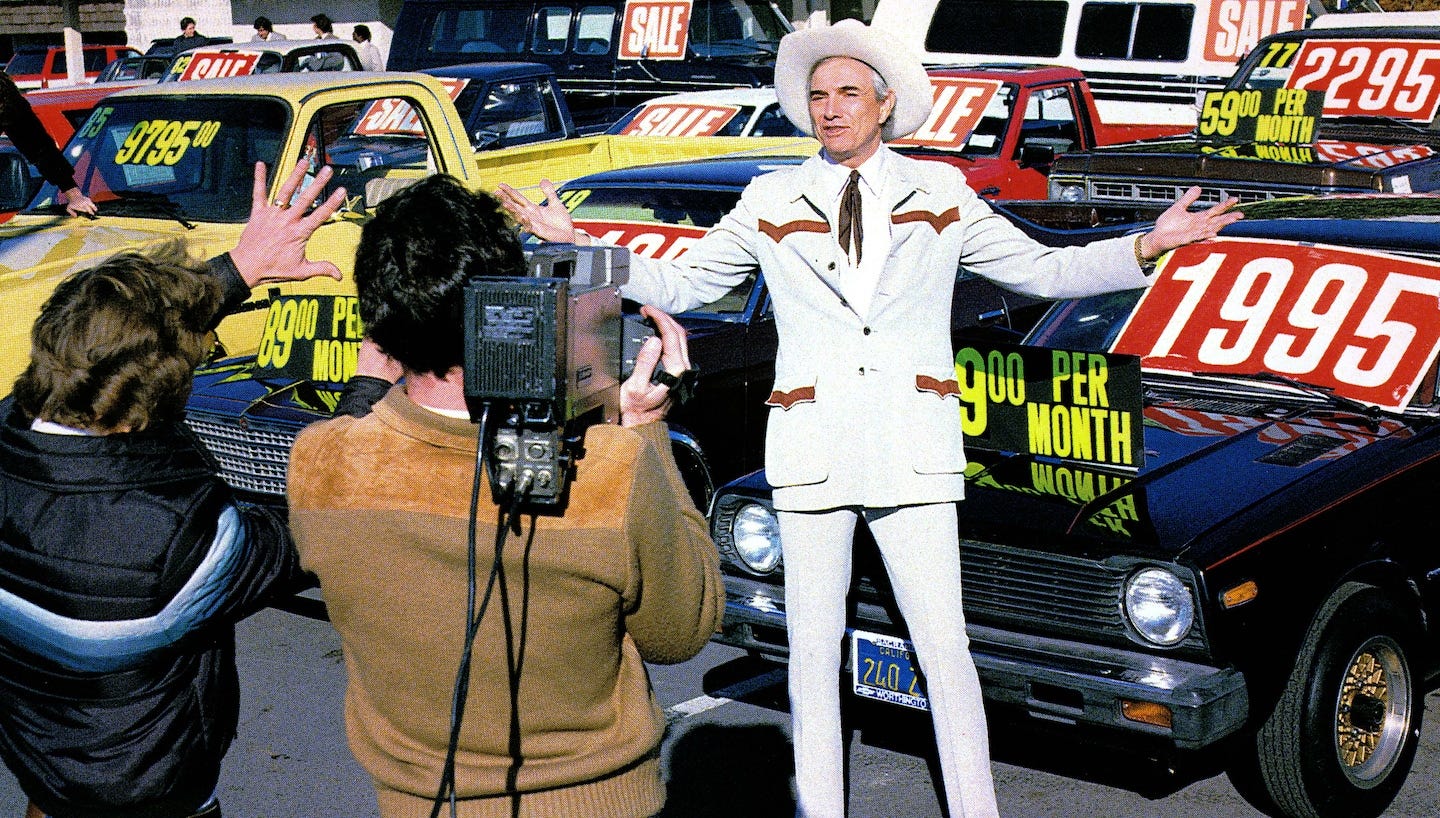
By the late 1940s, he’d moved to Southern California and started buying car dealerships. By the 1960s, he owned the top-selling Dodge agency in the country. At his peak, the Worthington Dealership Group operated 29 locations across five states and grossed $316.8 million in a single year.
Get weekly breakdowns of how businesses actually grow by learning how they did it.
It wasn’t the dealerships that made Cal Worthington famous. It was the commercials.
The “dog Spot” gimmick started as a parody. A competitor named Chick Lambert appeared in his car ads with a German Shepherd named Storm. Worthington decided to one-up him by introducing his own “dog” — except his dog was a gorilla. Then a tiger. Then an elephant, a hippopotamus, a killer whale from SeaWorld, a rhinoceros, a bear, a roller-skating chimpanzee, and once, NFL legend Deacon Jones.
Every commercial opened the same way: “Here’s Cal Worthington and his dog Spot!” Then the jingle kicked in, sung to the tune of “If You’re Happy and You Know It”: “If you want a car or truck, go see Cal. If you want to save a buck, go see Cal.” Cal wrote the lyrics himself.
The ads were low-budget, shot on the dealership lot, and intentionally absurd. Cal stood on airplane wings. He wore flashy Western suits made by the legendary tailor Nudie Cohn. He promised to do stunts to close a deal. The production value was zero. The entertainment value was through the roof.
The campaign ran for over 40 years.
It was so embedded in Southern California culture that some children grew up thinking his actual name was “Go See Cal.” He appeared regularly on The Tonight Show. The character Hal Jackson in the 1993 film Made in America, played by Ted Danson, was directly based on Worthington — a manic car dealer who makes wild commercials with exotic animals.
Worthington’s advertising company, Spot Advertising, spent $15 million a year on commercials. He sold more than one million vehicles over the span of his career. He died in 2013 at 92, still working. His grandson Nick ran the last remaining dealership in Long Beach until the family sold it in 2023.
But How Did They Do It?
Cal Worthington built a regional empire on personality, consistency, and the understanding that being memorable matters more than being polished.
He turned a competitor’s strength into his punchline. The “dog Spot” bit started as a parody of a rival’s German Shepherd ads. Instead of copying the competitor, he mocked the concept — and the mockery became more famous than the original.
He made the ads the entertainment. People didn’t watch Cal Worthington commercials to learn about cars. They watched to see what animal he’d bring next. The entertainment value created an audience that actively looked forward to the ads.
He was the brand. Cal didn’t hire a spokesperson. He was the spokesperson. His personality, his cowboy hat, his voice — they were inseparable from the dealership. You weren’t buying a car from a company. You were buying one from Cal.
He understood the power of a jingle. The “Go See Cal” jingle was so catchy and so repetitive that it literally became how children referred to him. Sonic branding before anyone used that term.
Consistency over decades compounded the effect. The same character, the same jingle, the same format — for over 40 years. Each new ad built on the recognition of every previous one.
How you can apply this today
Cal Worthington proves that you don’t need a big-city agency or a national media budget to build massive brand recognition. You just need a personality, a gimmick, and the discipline to show up consistently.
Parody your competition instead of copying them. Cal didn’t imitate his rival’s dog ads — he made fun of them in a way that was more entertaining than the original. If a competitor has a well-known style or approach, consider playfully subverting it rather than mimicking it. The parody often becomes more memorable than the thing it’s parodying.
Be the face of your own business. Cal was the ad. His personality was the brand. If you’re a small business owner, your face, your voice, and your quirks are your biggest asset. Stop hiding behind a logo. Get on camera. Be yourself. The version of “you” that your friends and family already know is probably your most effective marketing tool.
Create a recurring element people anticipate. The exotic animals gave every new commercial a built-in hook: what animal will it be this time? Think about what recurring element you could introduce that gives your audience a reason to look forward to your next piece of content. A running joke, a recurring segment, a signature opening — anything that creates anticipation.
Write your own jingle — or at least your own catchphrase. Cal’s jingle was so effective that children called him by it. You don’t need a literal jingle, but you do need a verbal hook. A sign-off you use on every video. A phrase you open every newsletter with. Something your audience associates exclusively with you.
Show up for 40 years. Cal’s ads weren’t individually brilliant. They were cumulatively unstoppable. He ran the same format, the same character, the same jingle for four decades. That kind of consistency is extremely rare — and extremely powerful. Whatever format is working for you, don’t abandon it because you’re bored. Your audience isn’t bored. Keep going.

But How Did You Do It? is powered by Kajabi, the most robust all-in-one platform.
Claim your 30-day free trial and start creating, selling, and growing.
Thanks for reading But How Did You Do It? This post is public so feel free to share it.
Comments
Nothing yet. Say the first thing.
Sign in to join the conversation.