
For most of the 20th century, the biggest chocolate company in America ran zero newspaper ads, zero radio spots, zero TV commercials. Not as a stunt. As a policy. Milton Hershey believed that if the bar was good enough, the bar would do the talking — and for nearly 70 years, he was right.
In 1903, Hershey broke ground on what would become the world’s largest chocolate factory in rural Pennsylvania, and he built it on a contrarian bet: quality plus distribution plus a town people wanted to visit would do the work that advertising did for everyone else. No agency retainer. No media buy. Just a nickel bar on every counter in America and a factory you could tour on a Sunday.
Imagine the early 1900s as the mid-2000s YouTube moment in reverse. Back then, mass media was the shiny new thing. Newspapers were exploding, magazines were national, and by the 1920s radio was colonizing living rooms. Every consumer brand with ambition was piling in. Coca-Cola was plastering barns. Wrigley’s was papering streetcars. Camel cigarettes were buying full-page spreads.
The phrase “a good product sells itself” was becoming the thing people said right before they hired an ad agency.Hershey didn’t.
While his competitors were learning to shout, he was pouring money into a company town. Houses, schools, a trolley system, a 150-acre park, a stadium, a hotel on the hill. He built a factory you could walk through, and by 1915 there was a formal visitors bureau handling the tours. By 1970, roughly a million people a year were showing up in Hershey, Pennsylvania to watch chocolate being made.
It’s the oldest growth hack in the book: if you can’t afford to be everywhere, be somewhere worth going.
Calling it a “campaign” is almost a category error — it was a refusal dressed as a strategy. But the mechanics are specific and worth naming.
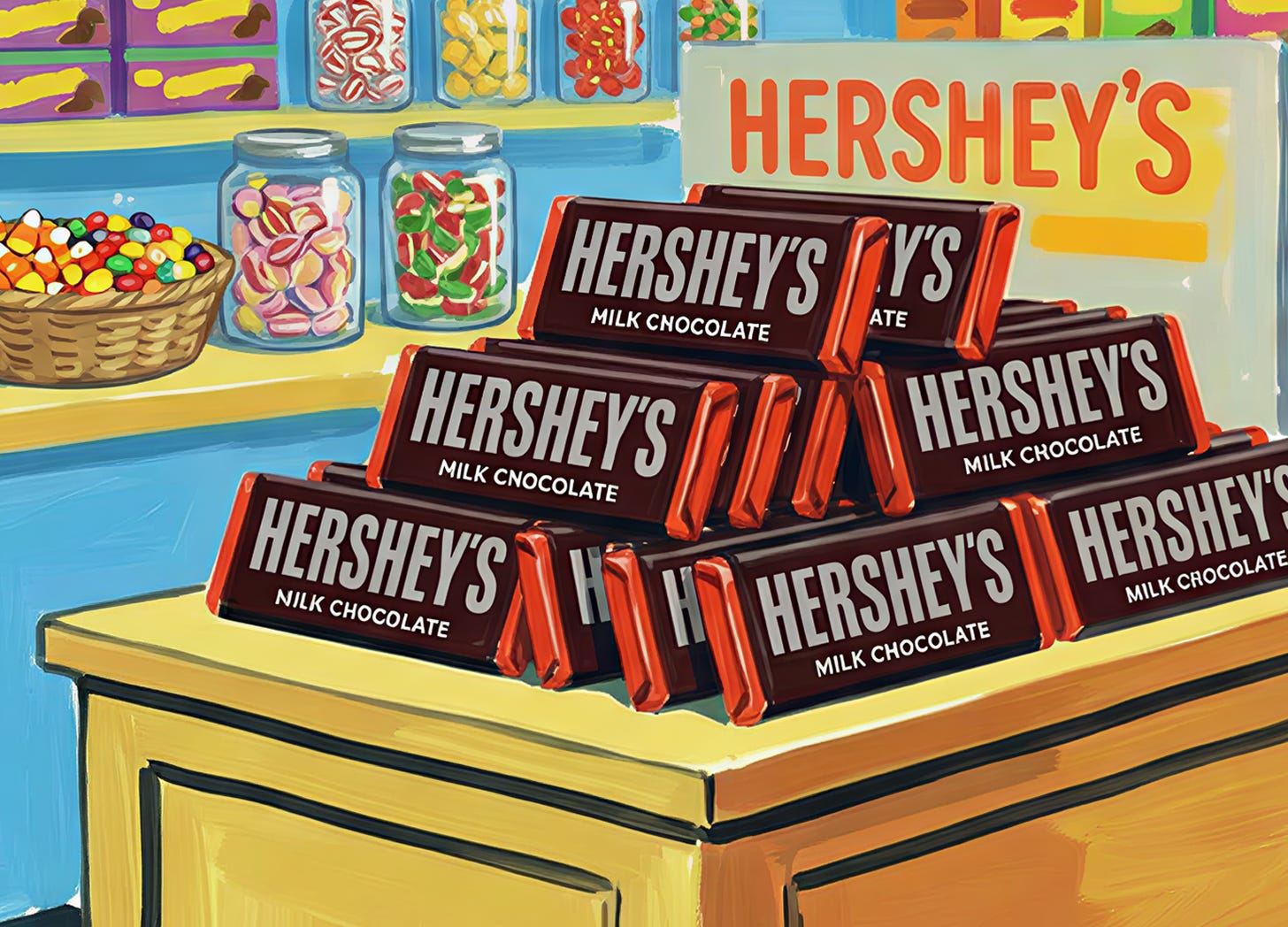
Hershey’s nickel milk chocolate bar launched in 1900 and became the standard-issue American candy bar, priced to be impulse-buyable at every drugstore, train station, and general store in the country. Distribution was the ad budget. The bar itself was the billboard. Wrappers on sidewalks, Hershey liked to say, were his best promotion — free, everywhere, and landing in front of the next buyer.
The factory tours ran from the 1910s until 1973, when the crowds finally got too big and the company built Hershey’s Chocolate World as a replacement visitor center. Inside standard milk chocolate bars, Hershey inserted specially sized postcards showing the factory, the dairy farms, and the model town — postcards that ended up mailed from China, Alaska, Mexico, and France. In 1932 the company produced a 48-minute educational film about chocolate-making, shown primarily in schools. In 1933 came two more short films screened in movie theaters before features. Cooking pamphlets started around 1915, the first cookbook around 1922. Trade and point-of-purchase displays blanketed grocers.
So the “no advertising” line is a myth with a kernel: Hershey did not buy consumer media — no newspaper ads, no magazines, no radio, no TV — until July 19, 1970, when the first Hershey’s Syrup ad ran in 114 newspapers. By then Mars had overtaken Hershey as the top-selling candy in America, and Ogilvy & Mather was already drafting “The Great American Chocolate Bar.” The 70-year silence was over.
The mechanic has a modern name: owned experience as distribution. Hershey didn’t rent attention from media companies; he built a place, a tour, and a product so ubiquitous that the customer journey itself did the advertising. Every nickel bar was a sample. Every factory tour was a brand film. Every postcard was a referral.
Three things made it hold for seven decades. First, the product was genuinely novel. Affordable milk chocolate was new to most Americans, and novelty plus consistency produced the word-of-mouth flywheel that paid media usually has to buy. Second, the town was the story. Reporters wrote about Hershey, Pennsylvania the way they’d later write about Disneyland — as a curiosity, a model, a place. That earned coverage was worth more than any ad. Third, there was the Milton Hershey School, founded in 1909 for orphaned boys, which turned the founder into a folk hero and the company into a cause. You don’t advertise against a cause. You tell your neighbor about it.
But How Did They Do It?
The founder’s rule: Milton Hershey believed a quality product was the best advertisement, and the policy outlasted him — he died in 1945, and the company held the line until 1970.
Distribution as advertising: The nickel Hershey bar (launched 1900) was sold through every available retail channel, making ubiquity the pitch.
Factory tours: Formal visitors bureau established 1915. By 1970, roughly one million visitors per year. Tours ran until 1973, when they were replaced by Hershey’s Chocolate World.
The company town: Hershey, Pennsylvania included a park, stadium, hotel, trolley system, and schools, functioning as a destination and an earned-media engine.
Owned content: Postcards inserted in bars (international reach documented), cooking pamphlets from ~1915, first cookbook ~1922, educational and promotional films in 1932–1933, in-store displays throughout.
The turning point: By 1970, Mars had passed Hershey as the top U.S. candy seller. On July 19, 1970, Hershey’s first consumer ad — a full-page Hershey’s Syrup spot — ran in 114 newspapers. TV and radio followed within months.
The agency: Ogilvy & Mather, New York. Creative director Billings Fuess developed “Hershey. The Great American Chocolate Bar,” which ran from 1970 to 1994.
Fun fact: Hershey was the only Fortune 500 company without a marketing department by the mid-1960s.
How You Can Do This
Picture a two-person branding studio — let’s call them North & Oak — running out of a converted garage in a mid-sized city. Their work is the kind of thing other designers save to Pinterest. But they’re grinding on cold outreach, losing proposals to agencies with slicker decks, and watching their Instagram grow by roughly one follower a week.
The Hershey move, translated: stop treating marketing as a separate line item and start treating the studio itself as the advertising. That means three shifts.
Pick the “factory tour” equivalent. For North & Oak, that’s a quarterly open studio night — actual clients, actual prospects, actual strangers from the neighborhood, invited in to watch a live rebrand critique or a type-setting demo. It’s the physical version of what Hershey did with his factory: make the process visible, and let being inside the room become the pitch. No sales deck required.
Pick the “nickel bar.” The small, repeatable, cheap thing the studio can put everywhere. A free one-page brand audit template. A weekly teardown of a local business’s logo, posted to LinkedIn with the owner tagged. Something distributable that carries the studio’s taste the way a Hershey bar carried Milton’s chocolate. The point isn’t the lead magnet — it’s that the quality of the thing is so obviously high that the next buyer can’t not notice.
Pick the “company town.” The thing people talk about that isn’t the work itself. Maybe North & Oak runs a small scholarship for first-gen design students in their city. Maybe they host a twice-yearly free portfolio review day. Whatever it is, it has to be real, it has to be ongoing, and it has to be something a local reporter would actually write about. That’s your earned-media engine. That’s the Milton Hershey School, sized for a two-person studio.
None of this replaces doing good work, and none of it is free — open studio nights cost time, scholarships cost money, weekly teardowns cost a Sunday morning. But it all compounds in a way a paid ad never does. A Google ad stops working the day you stop paying. A scholarship, a tour, and a cheap distributable asset keep paying for years.
The catch is that owned attention is slow, and slow is the hardest sell in a world trained to sprint. Hershey took 70 years. You probably don’t have that long. But even two years of building the thing people talk about beats two years of renting the thing they ignore.

But How Did You Do It? is powered by Kajabi, the most robust all-in-one platform.
Claim your 30-day free trial and start creating, selling, and growing.
Thanks for reading But How Did You Do It? This post is public so feel free to share it.
Advertising Hershey Chocolate — Hershey Community Archives — the “myth” of no advertising, postcards in bars, 1932 and 1933 films, cooking pamphlets from 1915.
Hershey Chocolate: The Great American Chocolate Bar — Hershey Community Archives — 1970 launch with Ogilvy & Mather, Billings Fuess as creative director, campaign running 1970–1994, Jack Dowd’s 1965 hiring.
Hershey Foods Corporation — Company Histories — July 19, 1970 first ad in 114 newspapers, Mars overtaking Hershey by 1970, 1915 visitors bureau, ~1 million annual visitors by 1970, tours discontinued 1973.
Hershey Foods Corp. — Ad Age — Hershey as the only Fortune 500 company without a marketing department by the mid-1960s, Milton Hershey School ownership structure, founder’s philosophy on product quality vs. advertising.
Milton Snavely Hershey — Britannica — 1903 factory construction, refusal to advertise, 1918 transfer of fortune to the Milton Hershey School.
Hershey Foods Corp — Encyclopedia.com — nickel bar era, word-of-mouth as primary promotional channel, shift in candy consumption driving the 1970 advertising decision.
No posts
Comments
Nothing yet. Say the first thing.
Sign in to join the conversation.