
By the mid-1970s, Bic had a problem that most consumer brands would kill for: their product worked perfectly. Bic lighters were cheap, reliable, and utterly disposable. The problem was that “cheap, reliable, and disposable” isn’t exactly a recipe for brand loyalty. When every lighter does the same thing, how do you make yours the one people ask for by name?
The answer was a slogan that somehow made it past every network censor in America: “Flick My Bic.”
Get weekly breakdowns of how businesses actually grow by learning how they did it.
The campaign launched in 1975, and the double entendre was impossible to miss — and equally impossible to forget. Television commercials showed attractive people in social situations, casually flicking their Bic lighters while the tagline landed with a wink. Print ads leaned into the playfulness. The whole campaign operated in the narrow space between suggestion and deniability.
And it worked spectacularly.
Bic lighters had been competing in a commodity market where no brand had any meaningful differentiation. “Flick My Bic” gave the product something no competitor could replicate: personality. The phrase entered everyday language. People repeated it at parties, at bars, on campuses. It became a genuine cultural catchphrase in an era when those were minted through television, not the internet.
The slogan ran in various forms for decades and is still associated with the brand today. For a disposable product that costs less than two dollars, that kind of brand recognition is extraordinary.
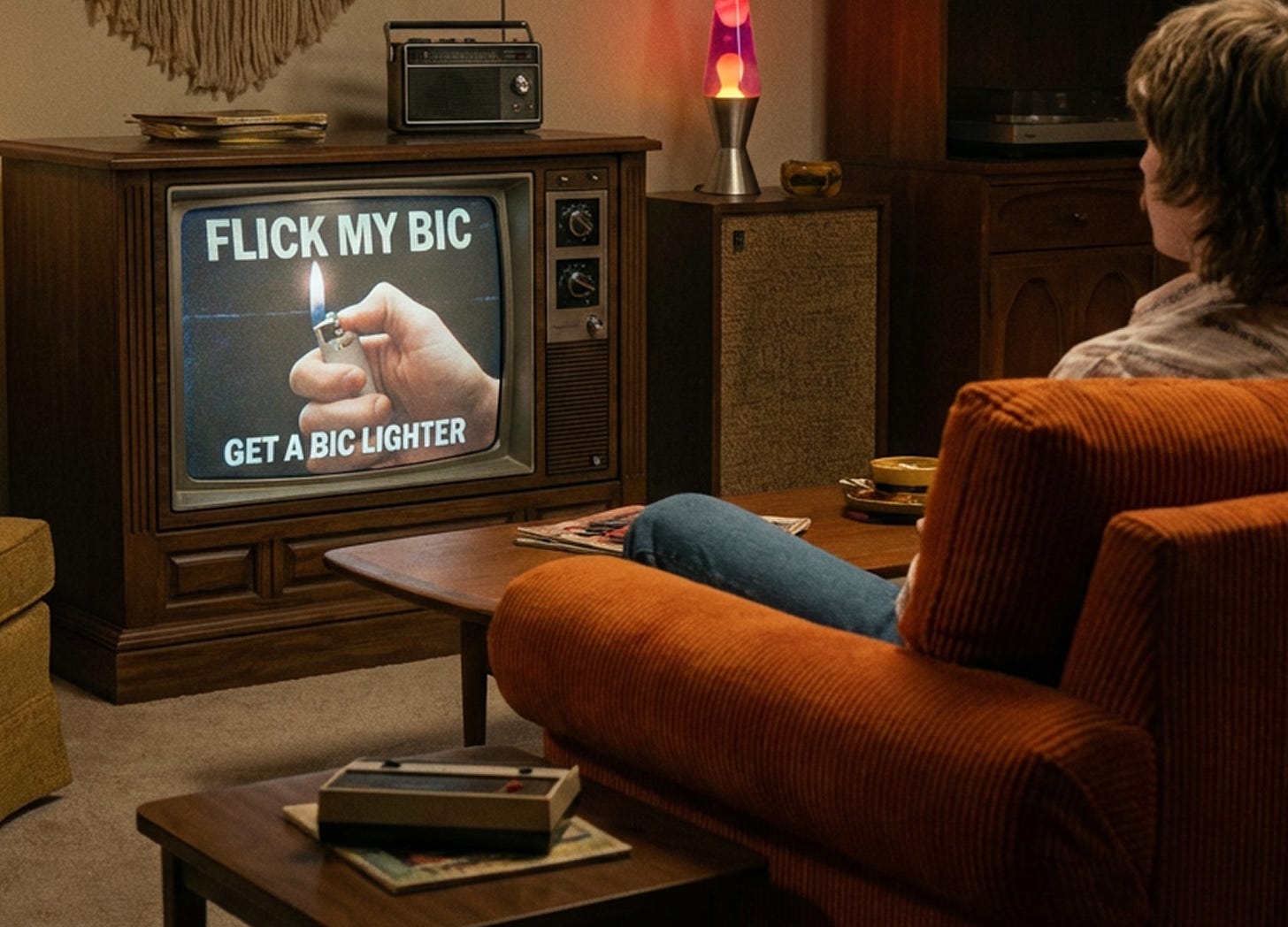
What made the campaign particularly interesting from a marketing perspective is how it navigated the regulatory environment of 1970s network television. Broadcast standards were far stricter than today, and innuendo had to be subtle enough to pass review while obvious enough to land with the audience.
“Flick My Bic” threaded that needle perfectly — it was technically innocent (you do, literally, flick a Bic lighter) while carrying an unmistakable suggestion that made people smile.
The campaign also demonstrated a principle that many commodity brands still struggle with: when your product can’t be differentiated on features, differentiate on feeling. Nobody was going to develop passionate brand loyalty for a disposable lighter based on flame height or fuel capacity. But they could develop a relationship with a brand that made them laugh.
But How Did They Do It?
Bic took a product with zero emotional appeal and gave it a personality that people wanted to be associated with. The strategy wasn’t about the lighter — it was about the feeling of being clever, playful, and in on the joke.
They found the hidden gem in the product name. “Flick” and “Bic” rhyme naturally. The double entendre wasn’t forced — it emerged from the product’s actual use case. The best slogans feel inevitable.
They used innuendo as a Trojan horse. The suggestiveness made people pay attention and remember the slogan, but the literal meaning kept it broadcast-safe. It operated on two levels simultaneously.
They gave a commodity product personality. In a market where every lighter is functionally identical, Bic became the one with swagger. That emotional differentiation was worth more than any technical advantage.
They committed to simplicity. Three words. One action. Totally memorable. The campaign didn’t try to communicate multiple messages or list product features. One idea, executed perfectly.
They made the customer part of the joke. Repeating “Flick My Bic” at a party wasn’t just brand recall — it was a social moment. The slogan gave people a reason to say the brand name out loud, voluntarily, in social contexts.
How You Can Do It
If your product or service feels like a commodity — interchangeable with a dozen competitors — the Bic playbook is your blueprint.
Mine your brand name for hidden creative potential. “Flick” and “Bic” rhymed naturally, and the double meaning emerged organically from how you actually use the product. Look at your own brand name, your product names, your service descriptions. Is there a rhyme, a pun, an unexpected double meaning, or a phrase that’s fun to say out loud? Sometimes the best tagline is already embedded in what you call yourself.
Give people a reason to say your name in social situations. Bic’s slogan worked because repeating it at a party was a social moment, not just brand recall. Think about how you can make your brand name part of conversation. A clever hashtag, a catchphrase on your packaging, a running joke in your content — anything that gives people a reason to say your name voluntarily.
Differentiate on personality when you can’t differentiate on product. Every lighter does the same thing. Every [insert your commodity here] does basically the same thing too. When features are identical, personality becomes the differentiator. Are you the cheeky option? The no-nonsense option? The one with the best sense of humour? Pick a personality and commit to it across every touchpoint.
Use playfulness strategically, not randomly. Bic’s innuendo wasn’t random edginess — it was calibrated to land with the right audience (social, young, fun) while remaining broadcast-safe. If you’re going to use humour or playfulness in your brand, make sure it aligns with your audience’s sensibility and stays within bounds that feel intentional, not reckless.
Commit to one idea, executed simply. Three words. One action. Totally memorable. The campaign didn’t try to communicate multiple benefits or list features. If your current marketing is trying to say five things at once, it’s probably saying none of them well. Strip it down to the single most compelling idea and execute it so clearly that it can’t be missed.

But How Did You Do It? is powered by Kajabi, the most robust all-in-one platform.
Claim your 30-day free trial and start creating, selling, and growing.
Thanks for reading But How Did You Do It? This post is public so feel free to share it.
Comments
Nothing yet. Say the first thing.
Sign in to join the conversation.