
Before Google, before Yelp, before you could pull out your phone and search for the nearest plumber at 2 AM, there was the Yellow Pages. And for an entire generation, it wasn’t just a phone book — it was the internet.
The Yellow Pages had existed since 1886, when a printer in Cheyenne, Wyoming ran out of white paper and used yellow instead. But for most of its history, it was purely functional: a classified directory of businesses, organised by category. It wasn’t until the 1960s and 1970s that the Yellow Pages became a brand.
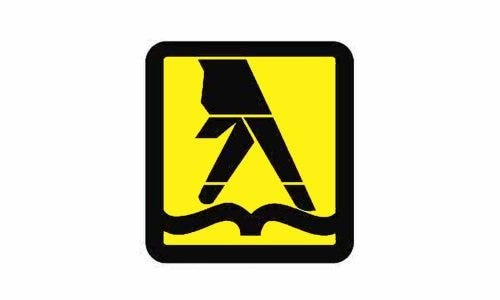
The transformation started with a logo and a slogan. In 1962, an artist named Henry Alexander designed the “Walking Fingers” logo for the New England Telephone Company. Within a year, it had been adopted as the national symbol for Yellow Pages directories across the AT&T Bell System. Around the same time, the advertising agency Cunningham & Walsh — specifically art director Stephen Baker and copywriters Bob Geers and Bob Gross — created the tagline: “Let Your Fingers Do the Walking.”
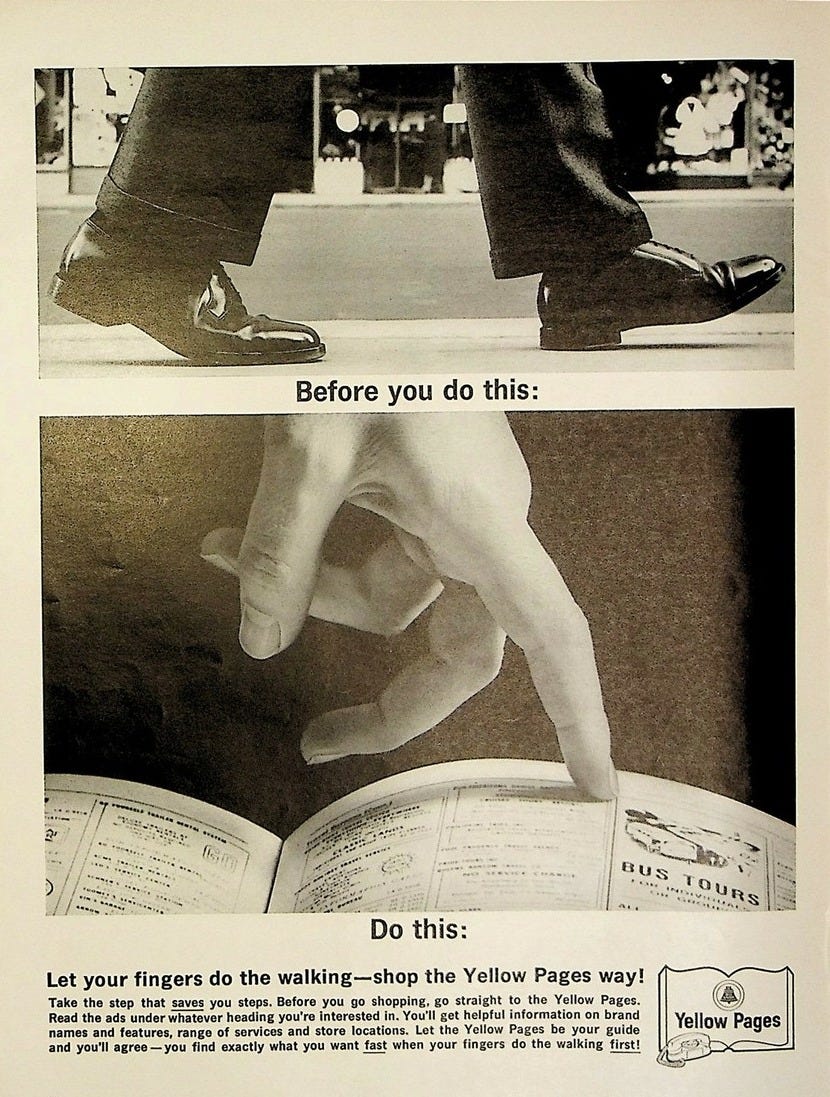
The phrase was a small piece of brilliance. It reframed the act of flipping through a phone book as the modern, convenient alternative to physically walking from store to store. You don’t need to drive across town to find what you need. Just open the book. Let your fingers do the walking.
Throughout the 1970s, television commercials featured a disembodied hand “walking” its fingers across an open Yellow Pages while the tagline played. Print ads showed scenarios of people efficiently solving problems — finding a restaurant, locating a repair service — all from the comfort of their kitchen table.
The campaign ran for decades and the slogan became one of the most recognised in advertising history. The walking fingers logo was used by virtually every Yellow Pages publisher in the world. Ironically, AT&T never trademarked the three-fingered version of the logo, which means it was freely used by competitors and independent publishers. The U.S. Patent and Trademark Office later ruled that the mark had become a generic indicator of Yellow Pages directories and couldn’t be claimed as proprietary. It was one of several trademark blunders AT&T made during this period.
What makes this campaign remarkable from a modern perspective is what the Yellow Pages actually represented: the original search engine. The entire value proposition — organised categories, paid advertising space, discoverability for local businesses — is functionally identical to what Google, Yelp, and Apple Maps offer today. The Yellow Pages just did it on paper.
By the 2000s, print Yellow Pages usage had declined dramatically as internet search engines took over. But for roughly 30 years, from the 1970s through the early 2000s, the Yellow Pages was the primary way consumers discovered and chose local businesses. The “Let Your Fingers Do the Walking” campaign didn’t just sell a product — it trained an entire generation in a behaviour that would later migrate to digital.
The Yellow Pages campaign succeeded by reframing a mundane behaviour — flipping through a phone book — as a modern convenience. They didn’t invent a new product. They changed how people thought about an existing one.
They branded a behaviour, not just a product. “Let Your Fingers Do the Walking” didn’t describe what the Yellow Pages was. It described what you do with it. That’s a critical distinction — it made the directory feel like a tool, not just a book.
They created a universal visual identity. The walking fingers logo was so simple and so recognisable that it transcended language and geography. It appeared on directories worldwide and became synonymous with the concept of business discovery.
They positioned convenience as the value proposition. The alternative to the Yellow Pages was physically driving around town. By contrast, flipping through a book felt effortless. They didn’t compete on content — they competed on ease.
They failed to protect what they built. The biggest cautionary tale here is AT&T’s failure to trademark the walking fingers logo. Their most recognisable asset became public domain, freely used by competitors. Brand protection matters.
They built the mental model for search. Organised categories, paid advertising, local business discovery — the Yellow Pages trained consumers in behaviours that Google would later inherit. The digital search economy didn’t replace the Yellow Pages model. It digitised it.
The Yellow Pages turned a mundane product into a trusted daily habit. You can apply the same principles to make your business the default choice in your space.
Brand the behaviour, not just the product. “Let Your Fingers Do the Walking” didn’t describe what the Yellow Pages was. It described what you do with it. When you’re writing your homepage headline, your Instagram bio, or your elevator pitch, lead with the action your customer takes — not the deliverable they receive. “Launch your dream website in 30 days” is a behaviour. “Custom web design services” is a description. One invites action. The other sits there.
Make discovery easy and make yourself discoverable. The Yellow Pages’ entire value was making it easy to find what you need. In today’s version of that, you need to be where your customers are already looking. That means your Google Business Profile is complete and optimised. Your website clearly states what you do and where you do it. Your social profiles answer the question “can this person help me?” within three seconds of landing. Don’t make people work to find out what you offer.
Create a visual identity so simple it needs no explanation. The walking fingers logo was understood worldwide without a single word of context. Your brand doesn’t need to be that iconic, but it should be that clear. Can someone glance at your logo, your website, or your social feed and immediately understand what you do? If not, simplify. The most effective visual identities are the ones that communicate instantly.
Protect what you build. AT&T’s failure to trademark the walking fingers logo meant their most recognisable asset became public domain. If you’ve built something distinctive — a name, a framework, a visual style, a content format — take steps to protect it. Register your trademarks. Watermark your original content. Document your proprietary processes. The thing that makes you unique is the thing most worth protecting.
Recognise when you’re training your audience for what comes next. The Yellow Pages taught an entire generation to search by category — a behaviour Google later inherited. If your current business model depends on a specific platform, technology, or format, ask yourself: am I building skills that will eventually migrate elsewhere? If so, make sure you’re building a brand and a relationship that travels with your audience, not just a dependency on the current channel.

But How Did You Do It? is powered by Kajabi, the most robust all-in-one platform.
Claim your 30-day free trial and start creating, selling, and growing.
Thanks for reading But How Did You Do It? This post is public so feel free to share it.
Sources
No posts
Comments
Nothing yet. Say the first thing.
Sign in to join the conversation.