
In 1951, a small shirt company from Waterville, Maine called C.F. Hathaway had been making shirts for nearly a century. They were fine shirts. Nobody knew they existed.
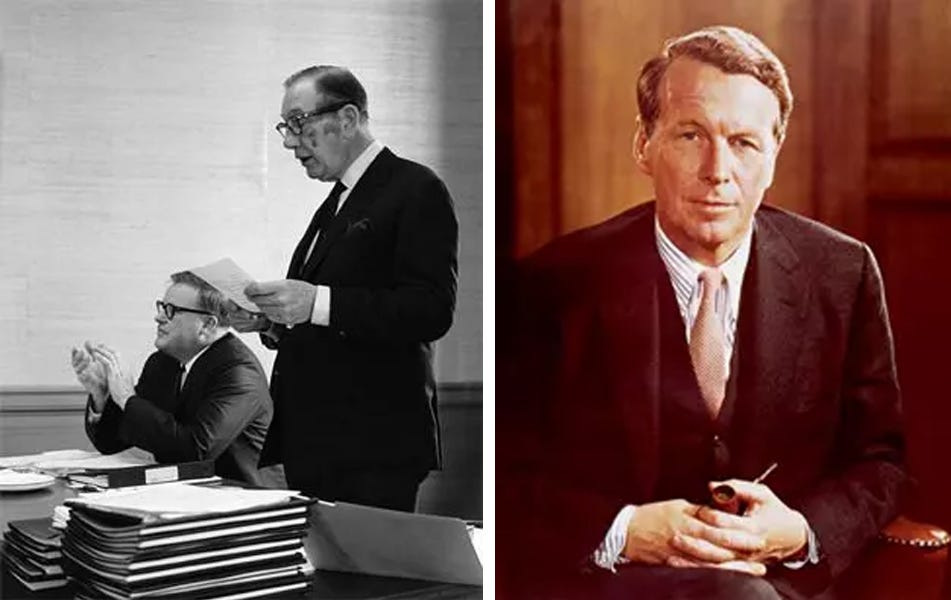
Hathaway’s president, Ellerton Jette, knew he needed advertising. But the company’s budget was a modest $30,000 — nowhere near enough to attract a major agency. So Jette did something clever: he pitched David Ogilvy, the founder of Ogilvy & Mather, with a promise. The money would be small, but there would be zero creative interference. For an agency founder still building his reputation, that was more valuable than a big cheque.
Get weekly breakdowns of how businesses actually grow by learning how they did it.
Ogilvy took the account. And on his way to the first photo shoot, he stopped at a drugstore and bought a handful of black eyepatches for fifty cents each.
The model was Baron George Wrangell, a Russian aristocrat with perfect vision. Ogilvy asked the photographer to shoot some frames with the eyepatch, just to see what happened. What happened was advertising history.
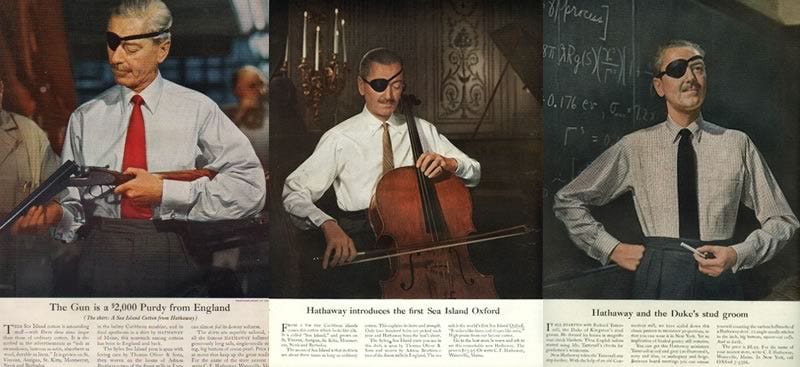
The first ad appeared in The New Yorker. The cost of the insertion was $3,176. Within a week, every Hathaway shirt in New York City was sold out. The ad was reprinted in Life, Time, and Fortune. Hathaway went from a regional unknown to the second-largest shirtmaker in the United States.
The campaign ran for decades. In every ad, the Hathaway Man appeared in different sophisticated settings — conducting an orchestra, painting a canvas, sailing — always wearing the eyepatch, always wearing the shirt. Readers were fascinated. How had this man lost his eye? What was his story? The eyepatch transformed a straightforward product ad into a narrative that people couldn’t stop thinking about.
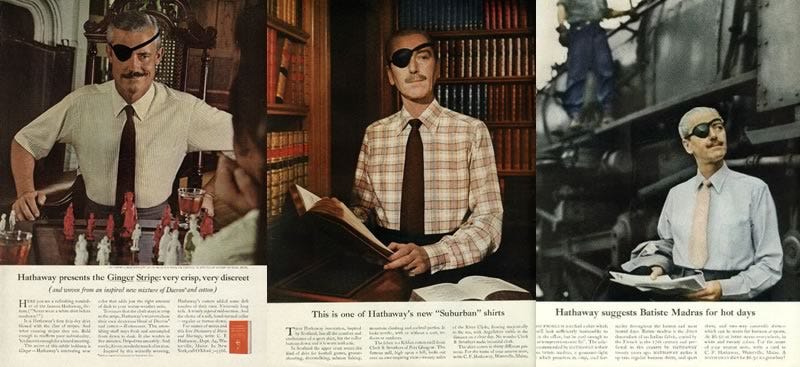
Ogilvy later explained the thinking behind it. He’d read a book by Harold Rudolph, a former research director at a rival agency, which argued that photographs with “story appeal” performed far above average in attracting attention. The eyepatch was Ogilvy’s way of injecting story appeal into a shirt ad. It gave the model an air of mystery, aristocracy, and lived experience that made readers lean in.
Ogilvy himself was characteristically modest about it: “For some reason I’ve never known, it made Hathaway instantly famous. Perhaps, more to the point, it made me instantly famous.”
The Hathaway Man was selected by Advertising Age as number 22 on its list of the greatest ad campaigns of the twentieth century. It launched Ogilvy’s career into the stratosphere and established principles — story appeal, visual intrigue, the power of one unexpected detail — that are still taught in advertising schools today.
Hathaway itself eventually closed in 2002, unable to compete with cheaper Asian manufacturing. But the campaign that made them famous outlived the company by decades.
But How Did They Do It?
The Hathaway campaign is a masterclass in doing more with less. A $30,000 budget, a fifty-cent prop, and a single magazine ad turned an unknown shirt company into a national brand.
One unexpected detail changed everything. Without the eyepatch, the Hathaway ad was just another well-dressed man selling shirts. With it, the ad had mystery, intrigue, and a story readers couldn’t stop thinking about. The prop cost fifty cents and generated millions in sales.
Story appeal beats product appeal. Ogilvy didn’t talk about thread count or stitching quality in the headline. He created a character people were curious about. The shirt was almost incidental — you bought it because you wanted to be like the man wearing it.
The small budget forced creative excellence. With only $30,000, Ogilvy couldn’t run massive media campaigns. He had to make a single ad so compelling that it did all the work. Constraint breeds creativity.
The CEO’s pitch was as smart as the ad. Ellerton Jette sold Ogilvy by offering creative freedom instead of money. He understood what motivated the agency and structured the deal around that. A masterclass in knowing what your partner actually values.
Consistency compounded the effect. The Hathaway Man appeared in ad after ad, always in a new setting, always with the eyepatch. Over time, the character became a brand asset more valuable than any single advertisement.
How You Can Do It
You don’t need a Russian baron or an advertising legend. The principles behind the Hathaway campaign apply to any business operating on a tight budget.
Add one unexpected element to your brand. The eyepatch was the entire campaign. It cost fifty cents and made people stop, look, and wonder. What’s the visual, verbal, or experiential equivalent for your brand? A signature colour no one in your industry uses. An unusual format for your content. A recurring character or prop in your social media. One distinctive detail, applied consistently, can do more than a polished but forgettable presentation.
Create a character, not just a message. People didn’t remember the Hathaway shirt. They remembered the Hathaway Man. If your brand were a person, who would they be? What would they wear, how would they talk, where would they show up? Build a brand persona with enough depth that people are curious about it — and then let that persona carry your messaging.
Use constraints as creative fuel. A $30,000 budget forced Ogilvy to make one ad that was so good it didn’t need a massive media buy. If your budget is small, don’t try to do more — try to do one thing exceptionally well. One incredible piece of content, one unforgettable visual, one post that stops the scroll. Quality at small scale beats mediocrity at large scale.
Sell the story, not the specs. Ogilvy could have written about Hathaway’s century of craftsmanship, their fabric quality, their manufacturing heritage. Instead, he created an image that made men want to be the person in the ad. When you’re writing about your product or service, ask: am I describing features, or am I painting a picture of who my customer becomes?
Offer creative freedom when money is tight. Jette couldn’t outspend competitors, so he offered something more valuable: no creative interference. If you’re hiring a designer, a copywriter, or a content creator and your budget is modest, consider what else you can offer — speed of approval, creative latitude, a great portfolio piece. The best creative people are often motivated by the work itself.

But How Did You Do It? is powered by Kajabi, the most robust all-in-one platform.
Claim your 30-day free trial and start creating, selling, and growing.
Thanks for reading But How Did You Do It? This post is public so feel free to share it.
Comments
Nothing yet. Say the first thing.
Sign in to join the conversation.