
This week, I’ve covered a range of topics that I think might be of interest to you:
The coming crunch point between production costs, audience expectations and ad income on platforms like YouTube
Netflix reducing the amount of performance data it makes public
Google’s shared a report explaining how it is purging AI video slop
A new streamlined process for docs distribution plus the importance of infrastructure in video channel management
YouTube confirms using uploaded content to train its AI models
Concerns and criticisms about gen AI getting louder
Non-human internet traffic has taken over human - what does that mean for us all?

Heading to this year’s Edinburgh TV Festival?
The Festival returns from 25–28 August, bringing together the biggest names in TV and the brightest emerging voices for four days of unmissable conversations, industry insight and unrivalled networking. From headline keynotes to curated sessions and networking events, the Festival is the place to connect, collaborate and shape the future of television.
Business of TV subscribers can secure 20% off Festival passes in the month of June using the code B20DIS26. Buy your Passes here.
There is a narrative which goes something like this: YouTube (and digital video in general) is about producing high volumes of content far more quickly, more authentically and at a far cheaper price per video than TV. From that, there is a broad conclusion that TV is slow, cumbersome, bureaucratic and expensive. Meanwhile, the global streamers like Apple and Netflix are spending vastly more than TV traditionally can, on high profile, premium glossy titles.
Following through on this logic, the argument is that audiences want either the premium world of Apple and Netflix, or the high volume, quick to produce, cheap content of YouTube. Almost as an evolutionary leap on from the middle ground of the slow yet too expensive but also not expensive enough world of TV.
And so, what you are seeing in the recent Netflix coverage (more on that in a moment) is a sign of the company trying to also get into the cheaper/higher volume content market via podcasts and partnerships with the likes of Buzzfeed.
Obviously, economics drive editorial decisions for every TV channel, streamer and creator business. Looking at YouTube in particular: creators spend what they spend on their videos because on average, a £50k video needs roughly 10m views to wash its face. So you can see how the size of a TV production budget would be hard to recoup solely via ads on YouTube.
This is why those who are specialists in running YouTube channels have a whole host of techniques up their sleeves to drive up the revenue per thousand views (RPM) - say longer videos with more ad loads, selecting highly lucrative niches or focussing on valuable audiences or territories, compiling and clipping episodes into new packages, watching views and income rack up over years not months. And in general, you can see why creator businesses have multiple revenue streams such as brand partnerships, merch, live events, subscriptions and so on, because they have to, to make the numbers add up.
If it was true that people didn’t want to watch TV shows any more, then this world of ultra low budget on YouTube and high cost premium on Netflix would all make sense.
I think the fly in the ointment is that it isn’t true. Or perhaps more accurately, isn’t true for a wider range of audiences than those who traditionally have been the heavy users of YouTube (teens, younger males, and kids). As an example, this post by James Marriott celebrates a fairly highbrow list of videos he’s enjoyed on YouTube - however, what is notable is how the vast majority on the list are documentaries or programmes that were broadcast on TV:
In other words, it is likely that a significant amount of the watch time on streamers and YouTube is of content that originated in the TV pipeline. And the more the platform tries to appeal to a wider demographic, the more TV-like their tastes might be. If YouTube grows its audience to be more mainstream, does the demand for TV-like content increase as a share of watch time too?
We have known for years the level to which audiences watch TV shows on streamers in comparison to originals. And it is also likely a good chunk of dwell time on YouTube is spent watching TV shows too. How much? They don’t say (another great example of looking for what companies don’t say, compared with what they do!), however Thinkbox estimate 41% of traffic on YouTube is professionally produced content, with half of that being music videos. So does that mean 20% of viewing is of TV shows? And indeed, if you strip out music channels that behave more like radio stations, toddler content and wallpaper channels of fireplaces, how much of the viewing is of TV content, rather than content that didn’t originate within the TV ecosystem?
The TV series I often think of is One Born Every Minute, as I had the good fortune to work on the multiplatform aspects of the first series when I was at Channel 4.

At the time, this was a very expensive show to make - the first time the rig was used, plus of course dealing with women and their babies at the most private moments of their lives. But it wasn’t just a technical and contributor management feat. It was also a triumph of storytelling - where the time in the edit enabled the producers to create the most intimate, warm, funny and beautiful portraits of the people involved - where each episode is guaranteed to bring a lump to your throat.
And that time in the edit costs money, which isn’t affordable in a YouTube world where that first seven part series would need around 350m views to cover its costs via advertising alone.
The point is: if people don’t want to watch TV shows on these platforms then all is fine. But if the reality is that they do, and at the same time the TV pipeline for financing these shows is squeezed, then the challenge is trying to make TV-like shows within a YouTube economic model. In other words, there is a mismatch between 1) how much it costs to produce TV-level shows 2) the quality and breadth expected by the audience, and 3) the advertising revenues on platforms like YouTube that can fund this content. Together, it feels like this is going to hit a crunch point.
Does this resonate with you? Here are two recent pieces I saw on similar or related themes, which are both worth your time - one on cinema/movies and YouTube, and the second on comedy and sitcoms:
Last week as you’ll remember there was all sorts of noise about Netflix’s performance, and the underlying question marks around a whole range of aspects of its content and publishing strategies; not least, that there is a sense that their output is lacking solid cultural resonance, possibly because many of the shows are not telling deeper, character driven stories, and instead are designed for audiences who are doing something else simultaneously.
This week, Netflix’s quarterly earnings were released, and again there were a few details in there that illustrate why investors are jittery about their potential for growth.
But perhaps far more striking was the announcement that instead of publishing viewing metrics with its earnings, they will publish them annually instead (you can browse the current set here on What’s On Netflix). Netflix said this has been driven by a desire to ‘keep the focus on our primary financial metrics’.
This is a perfect illustration of how different the TV market is from tech: in TV, you live and die by the ratings. For all producers grumble about poor scheduling, good weather meaning people aren’t watching TV, or being up against some sort of sporting event, in general everyone accepts that viewing figures are the single measure of truth. Or ‘a’ truth perhaps more accurately, which is applied evenly to everyone.
While of course, TV commissioners and networks might change their strategies too (we want fewer crime shows, or more cooking or fewer shows with conflict in them), it is rarely of the scale of the pivots that tech companies can and do perform.
And yet here is Netflix, changing what data they release. Why? Well, because they can. This is a great example of the art of the pivot. Tech companies change their strategies whenever they feel like it - and for them, they’ll have very compelling reasons for doing so. So in Netflix’s case, it can be assumed that the level of analysis and deep diving being done into their performance data by the likes of Entertainment Strategy Guy. Emily Horgan and Kasey Moore is making for uncomfortable reading.
So while this pivot is specific to Netflix, it is a timely reminder that all of the tech companies can and do make similar strategic shifts. The big takeaway is to be wary when building your business on rented ground that is heavily dependent on a particular tech company’s strategy staying as it is….
This is also a great illustration that unlike public service broadcasters in the UK, these companies are only answerable to their shareholders, and therefore they are duty bound to protect the interests of the company. As a result, it is often important to look for what these companies are not saying, rather than just focusing on what narratives they are pushing us to focus on.
Having said that, this messaging has gone down poorly with the market. As Julia Alexander said:

julia alexander@loudmouthjulia
Nothing says everything is good and totally fine like deciding to give less data less than four years in.

8:22 PM · Jul 16, 2026 · 2.67K Views
1 Reply · 3 Reposts · 29 Likes
And there has been a whole number of stories about the share price dropping in response to these earnings and announcements. Here it is today - bounced back slightly, but still down 6.87% in the past five days.
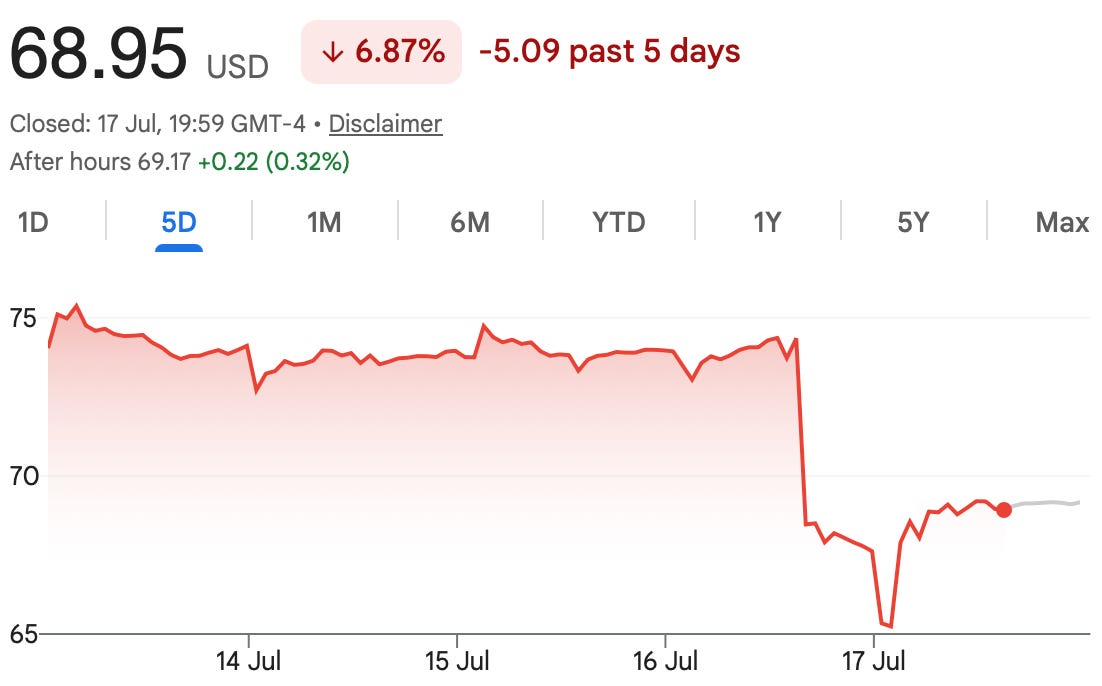
And here it is over the past year, down nearly 43%:
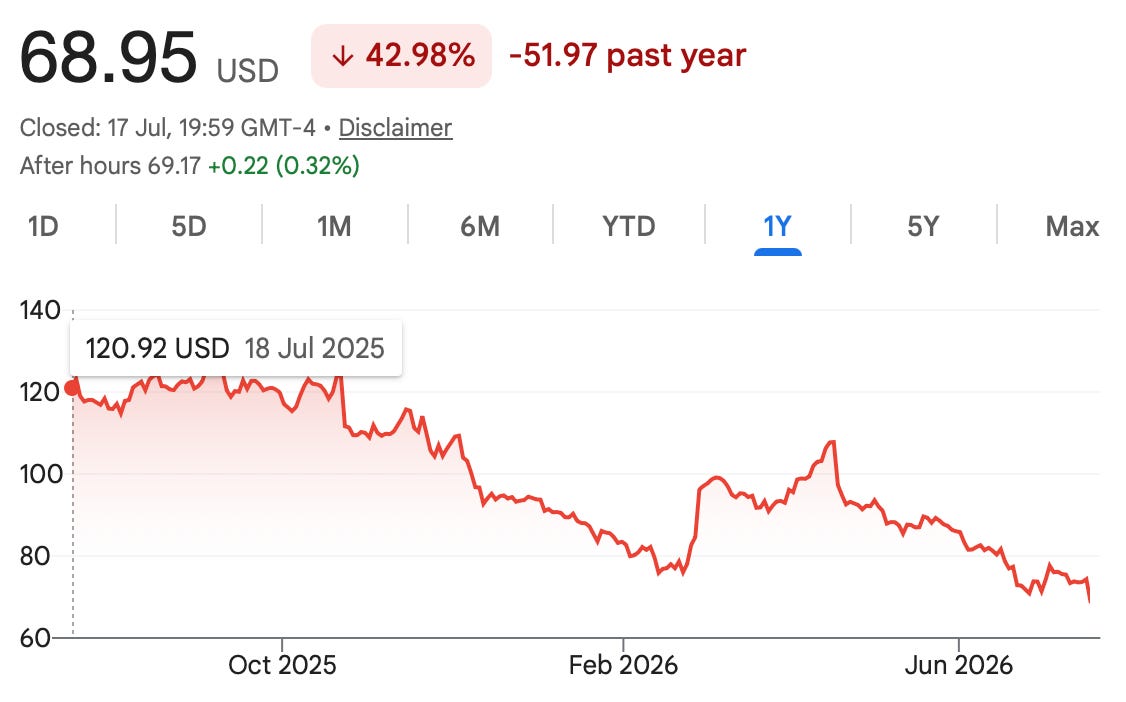
What I think we are seeing here is the journey that Netflix is on, moving from being a hyped tech story stock as highlighted in detail by Wade Major, to becoming a normal business, just like any other.
Wade wrote about the price/sales ratios (when comparing the studios like Disney, Sony and WBD with Netflix):
All are studios with extensive and prestigious libraries going back as far as a century, combined with valuable studio lots, broadcast holdings and, in the case of Disney and Comcast/Universal, theme parks and resorts. Netflix has none of those things, yet exhibits an explosive growth completely disproportionate to how entertainment companies are historically valued. Disney peaks in 2020 at 5x revenue while Netflix has continued its rise, now trading at an astronomical 12x actual revenue.
If you update the data to include these recent shifts in share price, you can see that Netflix is now looking at 6x, down from 12x just a few months ago. Health warning that this might change again, in the same way it did after the 2022 jitters around subscriber numbers and general tech selloffs.
I wrote at length about the process of de-hyping a few months ago, and how essential it is for all of us to treat the new tech players in the TV market - Netflix, Amazon, YouTube, Meta - as normal businesses, where we apply the same level of critical thinking to their strategies, rather than giving them a free pass or repeating their PR talking points too easily.
Speaking of Julia Alexander, she also made the important point that there are real longer term risks in Netflix chasing the free-with-ads dragon, adding in vertical scrolling, podcasts and more digital shorts from partners like Buzzfeed. She said:
Look — it’s hard to decipher the difference between Reels/Shorts/TikTok is at this moment. Which would be a problem if they were paid services. But chasing that same kind of non-differentiated experience rather than doubling down on what does work is defensive, not offensive.
…
But I think the more free shit bleeds together, the more valuable “premium” SVODs become, and the less competition means maintaining true differentiated products. Not next-day pods.
Last week, I asked you to vote whether you think Netflix is a broader entertainment service or a premium streamer, and those who voted firmly ended up with the latter:
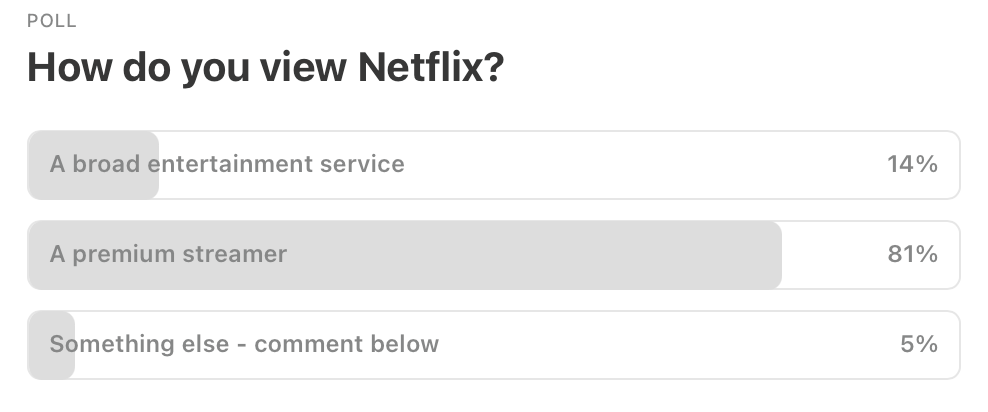
I think this is such an important point, not just for streaming businesses, but for everyone thinking about where to position themselves in the content market. If Netflix goes broad but also simultaneously can’t maintain its premium brand position, how does it measure up to the other broad/cheap/creator/TV offers out there - not just YouTube, but CTV apps, Tubi, Instagram for TV and so on?
There have been a few interesting shifts in the world of AI and slop, and how the platforms such as YouTube are handling this behaviour. YouTube CEO Neal Mohan did an interview recently on this subject, outlining the company’s efforts in trying to deal with AI slop being uploaded, while also wanting it to supercharge human creativity:
There also has been some discussion around a new book called Dream Machine: The next creative economy which is the basis of this Fast Company piece below: that some sort of slop ceiling is being hit on certain platforms - and is that caused by user rejection, by some sort of algorithmic deprioritisation or discovery challenge?
The book’s research says that the 50,000 music tracks uploaded to Deezer each day, only 1 - 3% got any streams. Is this the same for gen AI video content that isn’t music?
Meanwhile, Jim Louderback’s Inside the Creator Economy went into detail about a new report published by Google, where it is explained how it is looking for patterns of behaviour in what it calls ‘Scalable Cluster Termination System’ (S-CTS). rather than analysing individual pieces of media. The type of things it is looking for is geographical location, upload timings, frequency of publishing, account relationships, shared scripts, titles and descriptions, seeking patterns to take down entire portfolios of channels. Read his full post below:
As Jim wrote:
Good news for individual creators. But a HUGE red flag to larger creator studios, podcast networks, kids media companies, localization operations and anyone that runs multiple channels from a single production stack. All the things that media companies do to publish at scale, including shared templates, synced upload schedules and a common infrastructure also make them look like a coordinated slop factory.
I’ve written at length about these slop farms before - who can forget the 150+ near identical videos of a Viking raid on the nuns of Lindisfarne (which never actually happened)?
Or the village in Pakistan where 10,000 people are working on YouTube channels, using AI to create faceless videos targeting US and UK audiences with themes such as crypto, finance, cars and health. Where doctors, lawyers and teachers are earning more via YouTube than in their professions:
What is interesting re-reading these old posts is how many of the videos highlighted have been deleted. And yet, going looking for more videos on these themes find many others - in other words, YouTube is engaged in a game of Whac-A-Mole, and unless the incentives are massively altered, then people are going to continue to try to stay one step ahead of the algorithm.
It is important to remember that all of these platforms have different strategies, and have different ways of communicating their strategies to audiences. So for example, the research paper from Google doesn’t name YouTube, rather says ‘This paper presents a novel, scalable defense system deployed at a major Online Video Platform (OVP) to identify and terminate clusters of coordinated accounts exhibiting a prevalence of adversarial synthetic content.’ Which you’d think must be YouTube, surely?
Compare this to X, where head of product Nikita Bier is regularly communicating all the various changes to the algorithm and their policies to reduce view farming and repetitive slop. For example, here is a recent post where he outlined changes to the creator rev share programme which punishes soliciting engagements or copying content from other original creators.
This isn’t to say that YouTube, Meta et al aren’t making similar level of changes to the algorithm, rather it is to highlight the shapeshifting nature of all these platforms, and that while policies change, they also are trying to balance audience demand and advertising income at the same time.
Jim’s advice to anyone with channels is to read the report below, and then plan for how they can avoid what he calls ‘S-CTS’ tentacles of doom’.
For those with a YouTube partner manager, then this puts you in a better position. However for those without a partner manager, then this exposes you to being terminated by YouTube, and then having to go via the automated system to appeal (Google says that less than 1% are reinstated following an appeal).
A truth we should always remember is that what happens to news and music can often then come at a later date to TV and movies. And last week, Google told a US federal court that YouTube’s terms of service grant their own AI models broad rights to use music uploaded to the platform for training purposes.
The case has been brought by a group of indie musicians, and in a legal filing attorneys for Google argued that a) the plaintiffs couldn’t prove their claims that Google used their specific works to train its AI models and b) if Google had done so, it wouldn’t be illegal. Variety reported the filing saying:
Plaintiffs each granted YouTube, and Google—which provides the service—a broad license to use the uploaded content. That license, present in YouTube’s Terms of Service, authorized the conduct alleged in the Complaint.
This is a different argument compared to other legal cases regarding copyright, where Suno or Anthropic for example are citing fair use.
While this case is about music, it reflects concerns already raised by creators where they are seeing their content being resurfaced in AI answers having been uploaded in video format to YouTube. This is different to materials being used to train generative video AI tools like Nano Banana (which YouTube has already confirmed is the case).
Instead, it is where videos are used to provide AI answers, which means the user doesn’t have to watch the video to get the information. While at the moment it is creators who make information dense or how to tutorial videos that are most concerned, this could also apply to a whole wider range of information and educational content such as history, science, news and so on.
Two interesting developments have been launched in the last few weeks by Little Dot Studios, which both have wider relevance for the TV, film and distribution markets.
Firstly, they have a new HyperLaunch tool, which uses AI, machine learning and automation, to rapidly increase the ingestion, analysis and distribution of large volumes of video content.
Dan Jones, CEO of Little Dot Studios, is quoted in the C21 article below:
For many partners, the challenge isn’t a lack of content, it’s the complexity and speed required to effectively monetise archives across YouTube.
…
By automating the heavy operational lifting, we increase inventory and returns faster, while freeing up our teams to focus on the human side of audience growth: building communities and driving fandoms.
This announcement is a reflection of how increasingly important tech, automated workflows and operational efficiencies are to making money especially when dealing with video assets online. For many of the production companies I’ve been speaking with of late, there is a growing realisation that operating in the direct-to-consumer market is as much about operational efficiencies and tech infrastructure as much as it is about creative video production.
Secondly, there has been a gap in the market for producers or filmmakers with single documentaries or short run series rather than large catalogues. The options to be able to get these titles out there and viewed by audiences were self publishing via YouTube or Amazon, and then attempting to do wider offline or marketing activity to raise awareness - and certainly, in the case of YouTube, this type of material typically doesn’t do well algorithmically. Alternatively, go to one of the various distributors and hope to be picked up.
So Little Dot recently launched a new Self-Submission Portal for smaller independent producers and filmmakers looking to pitch directly to be part of LDS’ digital media network. Using this system doesn’t guarantee making it onto their platform, but hopefully it will help streamline the process and increase the opportunities for those independent filmmakers who might not have the capacity or capability to self-publish their films themselves:
I’ll do more on distribution partners and options in the future - I’m especially interested in what Google and YouTube are up to in this space (thinking of Iron Lung in particular), so if you have thoughts on where distribution is going, please do share!
I’ve covered this for some time now, but it is interesting to watch the conversations and criticisms around the generative AI arms race that the various companies have engaged in, and how many view the fundamental business model as having major flaws.
As Ed Zitron said:
The generative AI business model does not work. Anthropic and OpenAI encourage wasteful token spend with no way of measuring ROI, brazenly copy other companies’ ideas, and their costs increase linearly with their revenues. They’re antithetical to good software and good business.
Here is Ed’s full interview, it is 8 minutes and worth watching:

Ed Zitron@edzitron
Here's my full interview with CNBC, covering my bear case against generative AI, OpenAI's questionable finances, AI's lack of ROI, and how all of this is a symptom of the tech industry running out of hypergrowth ideas. It's great to see the mainstream media discussing this.
3:28 PM · Jul 2, 2026 · 1.89M Views
263 Replies · 772 Reposts · 4.78K Likes
Why does this matter for content businesses? In several ways. Firstly, if you are baking these tools into your business and workflows, there is a huge danger than they will hike prices to try to improve their margins - and if you’ve become reliant on these tools they this can eat into your own profits. Secondly, they are training on your IP, and already we are seeing all sorts of criticisms about data being used in ways that is not what was intended.
According to hosting and infrastructure company Cloudflare, AI agents now generate 57.4% of all web traffic.
What are these non-humans? Put simply, they are either good or bad bots. The good bots are AI agents, trawling the web and looking for information for LLMs like Gemini, Claude and ChatGPT. The bad bots are software programmes that perform dodgy tasks online such as fraud, data scraping and DDoS attacks to try to crack systems or take down services.
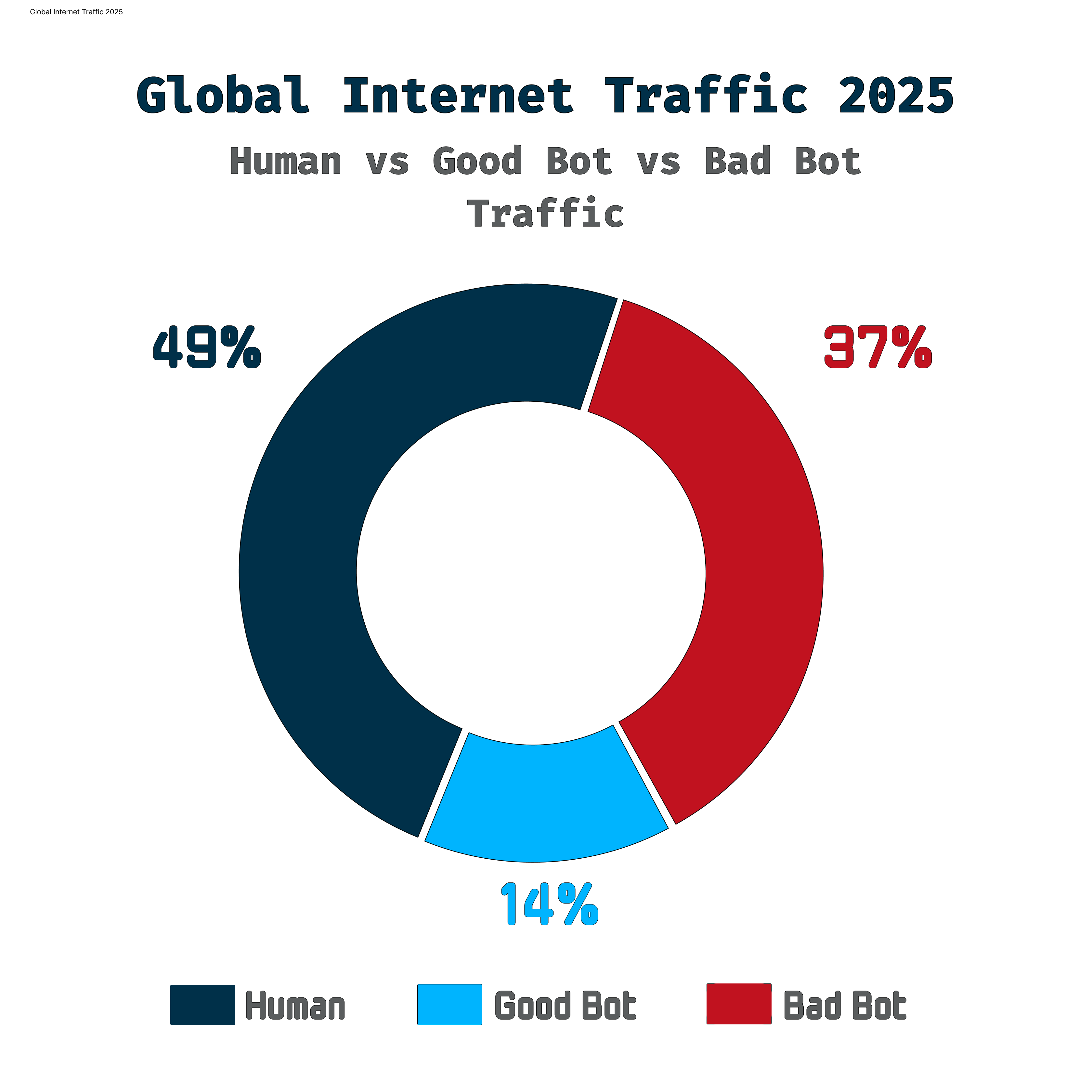
This really matters for how everyone approaches content, marketing and distribution, as for the first time in the history of the internet, the bulk of users are non-human. And therefore, when everything is designed to appeal to the eyes, hearts, and minds of humans, then this means a root and branch reworking of everything from data through to interfaces, monetisation and much more besides.
As Andrew Yeung said:
The dead internet theory is coming true. This means two things for entrepreneurs and marketers:
1. If you’re selling a product, you now have to market to agents, not just humans. e.g., many companies have already started writing blog posts specifically designed for AI agents to read.
2. In-person experiences and marketing will become critically important. It’s the ONLY channel where you’re guaranteed to reach real humans.
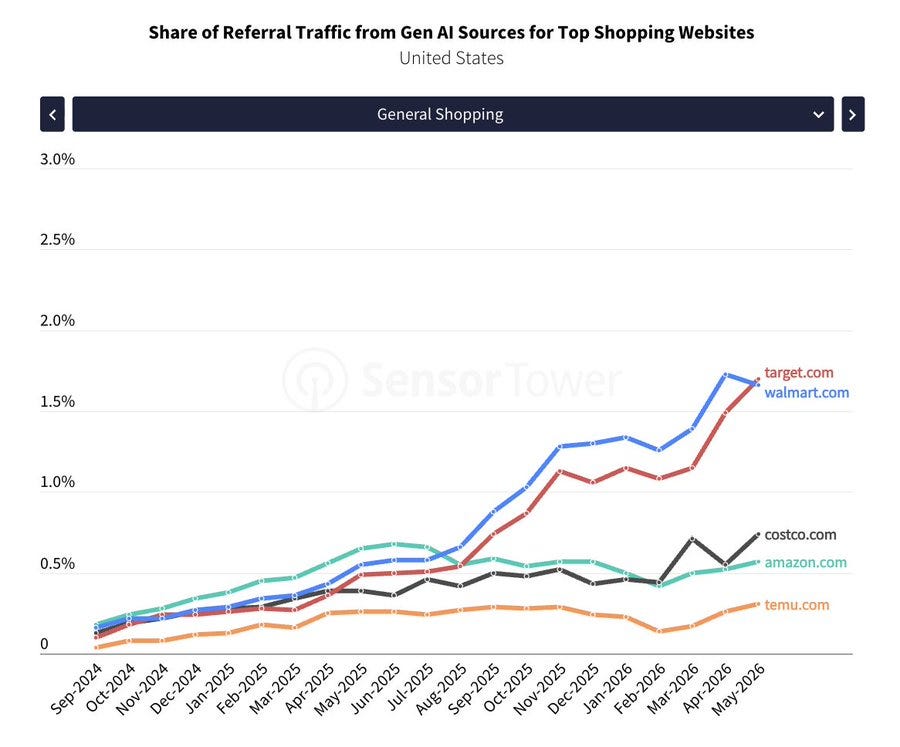
Here is an example of how this rapid this transition is, and how it is upending so much activity and spheres. Olivia Moore of A16Z shared this below:
LLMs are now responsible for nearly 2% of referral traffic to top retailers like Walmart and Target 👇
This has more than tripled in the past year
Categories that are seeing the most AI pickup are research-intensive - electronics and home & garden lead the pack
This major behavioural change is why I keep coming back to digital and video advertising, which play such a significant role in the streaming, creator and TV VOD markets.
I saw someone online pull back the curtain on the spend made by travel companies on Google Ads. The example they used was Booking Holdings, which owns Booking.com, KAYAK, Priceline and others. They spend in totally, $5 - 7bn per year on Google Ads, which is between 2 - 3% of Google’s $250bn ad revenue.
So this is evidence both of how dependent travel operators are on the Google ecosystem, and also how hard it is for new players to enter the market. Up until now.
There are all kinds of new travel businesses emerging, who are seeing that with the rise of AI, it creates a whole new world where the current dominance of Google and these big operators might come under pressure.
Again, this might feel peripheral to the TV production industry, but it is directly important for two reasons:
If Google and Meta have their existing search and advertising businesses disrupted by fragmentation and new AI models, what does that do to their video businesses - YouTube and Instagram for TV/Reels?
This same type of AI driven disruption is coming to TV and online content too. How does this affect customer discovery of TV shows, news, live sports coverage and more?
Thanks for reading Business of TV! This post is public so feel free to share it.
Comments
Nothing yet. Say the first thing.
Sign in to join the conversation.