
Over the last few months, I’ve done a lot of deeper dives into specific themes - all well and good, but that means there have been all sorts of details, data or announcements that could be indicators about the future of our market, so are important for all of us to be aware of.
I’ve got a whole bunch of these interesting points for you to consider - too many for one email - so here is the first set, and I’ll share the rest over the next few weeks.
This week, I’ve included:
Is Netflix’s model showing signs of stress, and is that a warning for us all?
What Backrooms, Obsession and Iron Lung mean for cinema (and why Terrifier 3 should be included in this bunch)
Is Google’s biggest strength its biggest risk?
Is the gamified vertical drama model waning already
BBC and Channel 4 in discussions to merge streaming platforms
More on the CTV battle and the rise of agents
Fads, fads, fads
And a fan has created a walkthrough of The Criterion’s Closet.
There have been strong signals that the so-called streaming wars have been entering a new phase for a while - indeed, here is a post I wrote last year about (one of) the next battlegrounds:
A semi-regular theme of this newsletter has been sharing online chatter as possible indicators of audience frustrations with aspects of the content industry’s propositions, for example:
If this was a true frustration and not just internet noise, it would show up in the numbers. Which appears to be the case - first, in Entertainment Strategy Guy’s streaming ratings report for May, where he said:
Netflix is absolutely having a dismal second three months of 2026. If this Nielsen data is any indication, and I think it is, I think this will show up in Netflix’s engagement report, and maybe even their financial outcomes.
And this week, Lucas Shaw at Bloomberg has written a piece that has caused some waves, where he’s documented how Netflix’s top shows have been losing 30-70% of their audience between seasons 1 and 2.
As Hernan Lopez of Owl&Co said about their Streamonomics report:
Our preliminary findings indicate Netflix Top 10 viewing hours declined ~4% YoY in 1H26 (though doesn't mean overall viewership has dropped as much, or at all). We've observed only 11 shows crossed 100 million viewing hours in a month, and only two crossed 200 million. Meanwhile, Instagram and TikTok are adding time spent at a neck breaking pace.
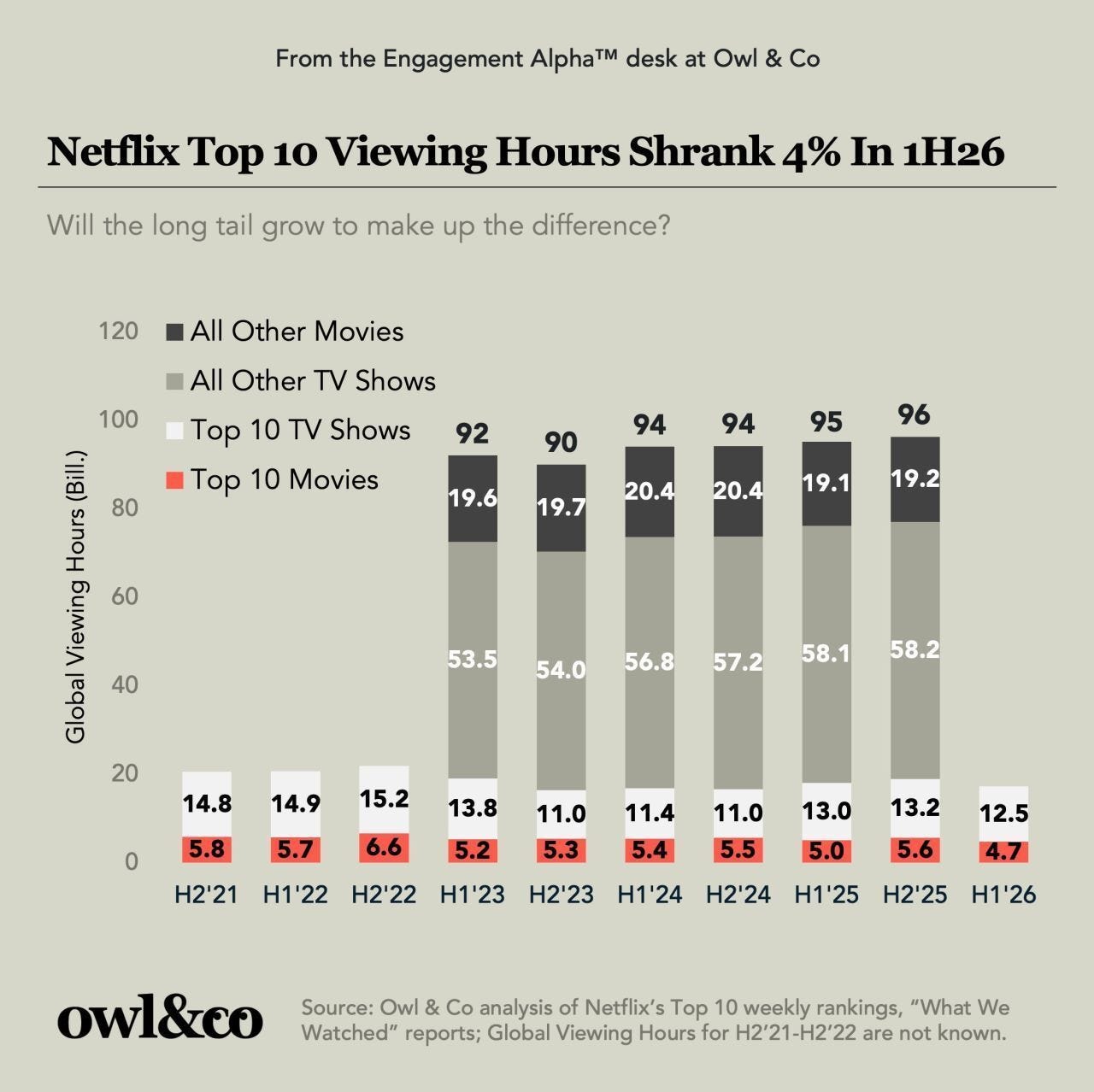
Wall Street is also raising an eyebrow, with Wells Fargo reportedly calling the stock a ‘fallen angel’, as investors are worrying that these indicators could hint that longer term revenues could slow.
This latter point is important because of how Wade Major described Netflix as a ‘story stock’, saying:
Contrary to popular myth, Wall Street investors and analysts are not all brilliant financial wizards who make their choices based on complex spreadsheets, time-tested formulas and algorithmic investment analyses. Sometimes they just tell themselves fanciful stories about what they want to believe — and make gut calls once they’ve managed to convince themselves that the “story” is true.
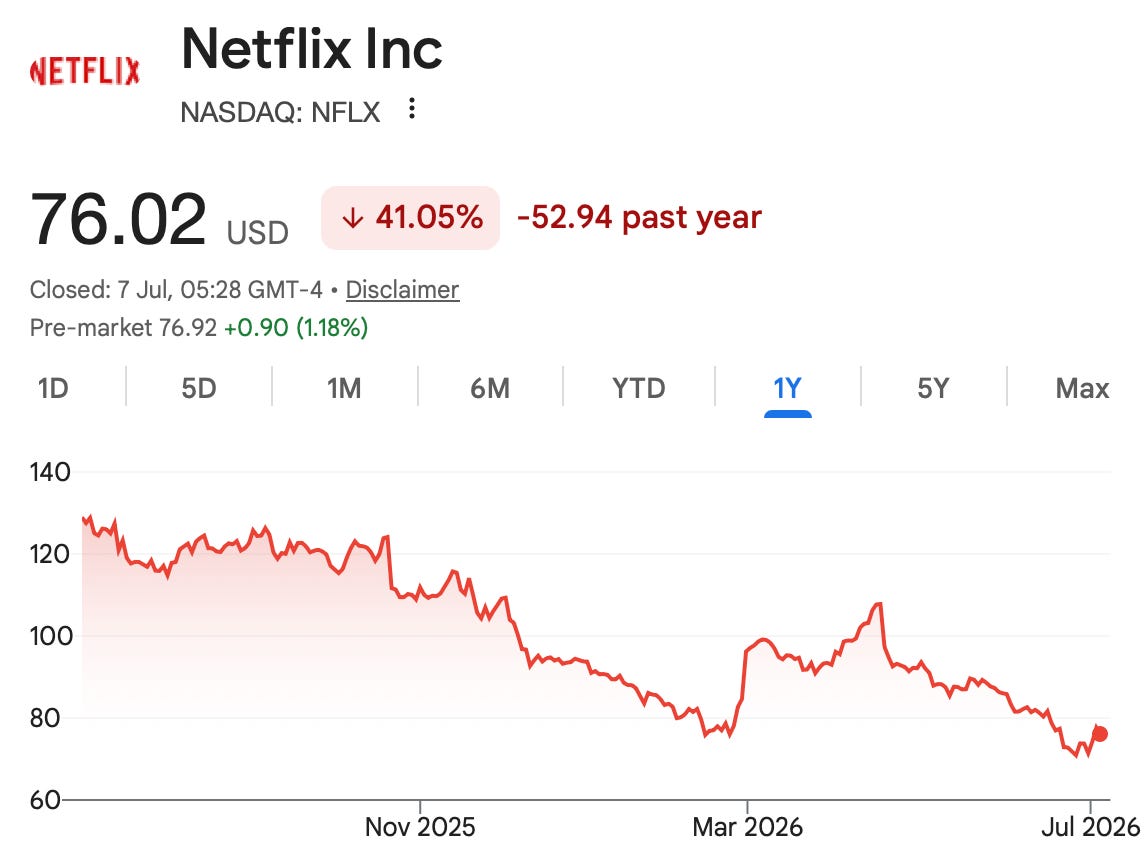
In other words, is this an indication that Wall Street is having a more analytical look at Netflix? While the share price has rebounded slightly in the last week, overall it is down 41% in the past year. This could be related to something I wrote about previously, where the failed attempt to purchase Warner Bros, combined with Fox buying Roku might have encouraged Wall Street to take a fresh - and perhaps more of critical - eye to Netflix’s business.
So, how to think about these reports? As many others have noted, audience loss between series is hardly a new phenomenon, and indeed is quite common for returnable TV series as well as other streamers beyond Netflix - although the businesses of TV broadcasters and networks are different to standalone subscription and ad supported streaming services.
As ex-head of research for Viacom, David Giles said, in response to Kasey Moore begging commentators to do comparisons with old cable shows, other streaming services, and traditional TV:
I mean, wasn’t it exactly NOT doing that that facilitated all the pompom waving all the way up this rollercoaseter ride?
…
Metrics obfuscation has been a major catalyst in the streaming revolution.
I think these reports are interesting because they help reveal how audiences perceive - and can be frustrated with - the current streaming model.
The theory of what is happening comes down to several factors, most of which I’ve written about before:
Series being too short (around eight episodes) and vast gaps between seasons,
Audiences being trained to expect series to be cancelled early or not finished well, and therefore discouraging them from investing their time,
The creative being designed for audiences doing something else who are not really paying much attention,
Whole series being dropped in one go, thus no momentum, sense of expectation or word of mount is allowed to develop.
To give a flavour of the types of thoughts flying around:

Just Having Fun@jko567
@EmpireCityBO @netflix It’s the entire model Netflix runs on. When you program your fans to wait years for 8 new episodes of “TV” eventually the house of cards this model is built on comes crumbling down.
10:59 PM · Jul 5, 2026 · 57.4K Views
6 Replies · 2 Reposts · 331 Likes

Kyle Robarts@kylerobarts
@Lucas_Shaw We got 120+ episodes of LOST in 6 years. We got 42 episodes of Stranger Things in 9 years.
2:10 AM · Jul 6, 2026 · 37.3K Views
6 Replies · 51 Reposts · 1.92K Likes

Derek C. of Earth-23@PopRelics
@Lucas_Shaw "We intentionally make shovelware for "2nd screens" so people can text or do laundry and not really have to watch, and we wait 2-3 years between seasons, and we can't figure out why people stop watching."
11:53 PM · Jul 5, 2026 · 24.7K Views
3 Replies · 31 Reposts · 618 Likes
Of all of these causes, it is number 3 listed above that I think is the one to focus on, as increasing episodes per series, building in shorter gaps and turning to a weekly release schedule rather than binge viewing is within Netflix’s gift to shift towards. In other words, moving more towards a TV network’s output (but of course without the business structures that made all that work).
However, the point in number three is about the storytelling itself, and the assumptions about audience behaviour that underpins it, which I feel is a much bigger issue. And here is where you can see Netflix being pulled in two different directions - not unlike its competitor YouTube, who on one side is wanting to be a quality streaming service, and on the other is going toe-to-toe with vertical scrolling players like Reels and TikTok.
For Netflix, on the one side, they are a premium offering, where users have been conditioned to expect high quality A list talent and output, almost movie-like in gloss and feel (indeed, some suggest treating their series like movies is part of the reason why they’ve ended up in this situation, as opposed to treating their series like TV).
On the other, they are chasing time spent and advertising performance - which is where they are competing with YouTube and Instagram. Best evidenced by the various creator deals plus an announcement this week of partnerships with BuzzFeed, Condé Nast, Hearst Magazines, People Inc and, Tastemade, in addition to Penske Media’s brands including The Hollywood Reporter, Billboard, Eater, Indiewire, Rolling Stone and Variety.
The above article says:
The video offerings, which range from three-minute shorts to 20-minute episodes, will be “discoverable directly from the Netflix homepage” beginning Aug. 3. Topics will include travel inspiration, cooking ideas, fashion trends, celebrity profiles, home and gardening tips and viral conversations.
For some, they feel this is the wrong direction, as this ‘…is what YouTube holds over them. Nobody’s subscribing or staying subscribed for stuff like this’, said in reference to Netflix commissioning some specials of Hot Ones.
For others, like Colin & Samir:
First it was podcasts, then it was making shows with creators like Mark Rober, and now they're licensing "premium" digital shows.
Colin's next prediction is that they could open the platform up to UGC like a partner program just like YouTube...
How you view this depends on how you see Netflix. Either it is doing the right thing by trying to become the world’s entertainment service of choice, covering TV, movies, podcasts, games and UGC, high and low brow, and everything in between. Alternatively, it is a premium streamer, and the lower brow material, such as the Buzzfeed et al deals announced this week, cheaper games like Solitaire, plus any suggestion of UGC, dilutes the brand…
Speaking of podcasts - do we know how this strategy is working for Netflix? Kasey Moore has suggested perhaps the overall slate of titles has been less than stellar, saying:
Podcasts haven't had much appearance in the Netflix top 10s anywhere but The Rest is Football is a massive winner in the UK plus a few other regions.
He then goes on to suggest that he’s worried in the next published engagement reports, Netflix might report each episode individually rather than as a title, and therefore as so many will fall under the 100k views qualification, we won’t be able to do a 1:1 comparison of all hours watched per podcast.
And also, remember the global vs local nature of all of these streaming players. Here is a comment from a Brazilian user, making the point how in LatAm, Amazon is trying to take market share off the main eCommerce and payment company in the region (and are using Prime to do it):

Andre Kenji de Sousa🇧🇷🌐@andkenbr
@TVGrimReaper They don't have a lot of space to grow the number of subscribers, specially now, that Amazon is leveraging Prime to go after Mercado Libre in LatAm. And live sports is too complicated and expensive. It looks like they are hitting a wall.
12:05 PM · Jun 23, 2026 · 145 Views
It isn’t just a content issue, of course it is price point too, where while growth has happened in the US, it is at a slower rather than free competitors like YouTube and Tubi.

Ben Koo@bkoo
I just logged into Tubi for the first time in a long time, and I’m kind of floored at the movie selection. I knew they had a solid catalogue, but for my taste at first glance this is way more packed than any paid streaming service.
4:04 AM · Jun 24, 2026 · 56.3K Views
34 Replies · 27 Reposts · 288 Likes
From a business perspective, the question remains: if there is no growth to be had in subscriptions, then the other place to look is advertising, which brings Netflix into local competition with all the BVOD players, plus global competition with the other streamers especially Amazon, plus of course YouTube, Tubi and Meta.
As mentioned, it is worth keeping in mind that cancelling seasons or losing audiences is hardly new, as any channel controller well knows. However, what is notable about this situation is how it is the disruptive business model itself which appears to be making this situation more pronounced, combined with the overall lack of cultural impact that these shows are having.
So yes, much this sits with Netflix and its strategy, and therefore in theory, can be changed. However, what has been foundational is the extent to which TV catalogues and TV’s strategies have underpinned the success of the disruptors to our market, while simultaneously the wider narrative has been TV is old hat, and the removal of gatekeeping means a flourishing of a broader range of better creative outputs in the future. And that this is what audiences want. But what if they don’t?
So streamers will talk about the importance of soaps, procedurals, sitcoms and live events - all of which have been staples of the TV ecosystem for decades. While companies like YouTube highlight the rise of creators, however haven’t (yet) pulled back the curtain to reveal to what extent it is existing TV shows doing some heavy lifting in terms of views and engagement. Industry experts estimate it could be around 40% of YouTube viewing that is ‘TV-like content’ (of which, more than half is believed to be music videos).
So some questions to ponder could be:
Do audiences want to watch TV-like content, meaning 20+ episodes per year, more familiar formats like procedurals, sitcom and the like along with sports, documentaries, news, current affairs - in other words, the staples of the TV schedules,
And TV catalogues have been driving the uptake of Netflix et al (after all, Cord-cutters stream library titles 3 times as much as originals), along with the thrill of the newer premium shows that people might be starting to tire of,
And TV shows and professionally produced content is also providing the foundations of viewing on YouTube (which is also the viewing that is more valuable to advertisers),
Well, if all of this is true, what happens when that pipeline of TV content is constrained due to the economics of the TV networks, and/or the people who are expert in making these shows leave the industry?
On this latter point, Ian Whittaker recently made an observation about what has happened with advertising trading desks over the last 20 years, which have ended up as a barbell with a squeezed middle (sound familiar?). At one end, heavily automated, electronic ad trading where profits were derived from the vast volumes of ads being trafficked. And at the other end, bespoke, hugely creative high margin individualised creative. So what went was the solidly capable middle of the workforce. He wrote (my bold):
That is the lesson the optimistic reading skips. The barbell is not two healthy ends. It is one dominant automated end and a small surviving premium niche, and the people in the middle did not glide gracefully to either pole. Most of them left the industry. High touch headcount fell hard, and it never came back.
So when an agency points at its senior strategists as proof the human still matters, it is pointing at the niche that survives. The craft endures but not the workforce.
As an observation, (and very late to the party) I started watching Landman recently, and right from the get go, it was stark how different this series felt to a Netflix scripted series. It immediately harked back to the sensibilities of the golden age of TV - Breaking Bad and Sopranos - rather than the gourmet cheeseburger gloss but not much depth of the streaming era.
It brought to mind this comment I spotted recently, where someone said I have watched whole series on Netflix or Prime Video, and yet it had not next to no cognitive impact on their memory:

𐌁𐌉Ᏽ 𐌕𐌉𐌌𐌉@OrevaZSN
Am I the only one who’ll watch an entire series on Netflix or Prime Video, then, a little time passes and I have absolutely no recollection of it? Not the plot. Not the characters. Not even how it ended. Just a vague memory that I liked it.
11:00 AM · Jun 28, 2026 · 1.26M Views
897 Replies · 1.36K Reposts · 28.5K Likes
I feel there is something in this - not just for Netflix and Amazon, but also for the volume of content being produced for digital platforms like YouTube, TikTok, Instagram and so on. How the processes and approach of TV production has the power to connect with audiences in a way that this more ephemeral content doesn’t.
Last thought, and it relates to the speed of change, which the head of Instagram, Adam Mosseri, talked about recently when he was asked to identify the single scenario that would see Instagram losing culture relevance in the next five years. His answer wasn’t a competitor or a new tech, rather he said:
We probably just moved too slow.
I think in TV, because the companies and corporations have been around and relatively stable for so long, it is easy to assume the same will be the case for the new tech companies entering the market, and that everything will continue in one way or another. But, the speed of change, the hype cycles, the fads, the trends suggest otherwise. Which makes it all the more difficult to plan for a world in which those currently riding high might not in the future. Hell, they might not even exist.
My big takeaway: for the last 10 years Netflix disrupted TV and many took a view this is a superior model. Noises started over the last few years that perhaps there were weaknesses, and so here we are, where there are warning lights flashing on the dashboard that this new model has its issues too, for audiences, producers and the future of the industry itself.
One to keep in mind about all those other disruptive platforms, companies and models who are at play…
I’m firmly in the ‘I bloody love the cinema’ camp, so it is great to see the three recent films - Backrooms, Obsession and Iron Lung - knock it out of the park so resoundingly at the box office (although, sadly as I can’t do horror, they shall remain unwatched). An acre has been written already on their successes, which I won’t repeat here, except to make one point.
While it is an obvious YouTube to cinema pipeline for these three movies and the directors, can I add in a fourth, which is Terrifier 3. This knocked it out of the park last year at the box office, from a production budget of $2m, it did $90m globally, and triggered much surprise wondering why these fans showed up. And the answer, is the same as the three YouTube directors: where Cineverse, the company behind the title, has a horror fanbase via their websites (Bloody Disgusting), podcast network (Bloody FM) and horror streamer (ScreamBox). They talked about the making of Terrifier 3; priming their audience to make a stampede to the cinema when it was released. And hey presto, that’s exactly what happened. So I’d suggest it isn’t just a YouTube to cinema pipeline (although for obvious reasons, YouTube is a natural platform for many), rather it is the online fanbase to cinema route that is the big learning here.
Indeed, as Curry Barker said:
I never thought of myself as a YouTuber. My journey isn’t that much different from the greats we know[who] started by making short films until somebody finally gave them a chance. YouTube was just a platform.
And as John Squires who runs Bloody Disgusting said:
There has truly NEVER been a better time to make a killer horror short and upload it to YouTube. EVERYONE is prowling YouTube for great horror shorts both old & new. This one was uploaded over 10 years ago! If you’ve ever wanted to make a horror short... don’t miss this moment.
Here is another great sentiment from Curry Barker, on what Hollywood should know about Gen Z audiences:
I wish they understood that we’re tired of slop. We want good movies back. People are still hungry for movies that are original without some big IP, as long as the story is good.
An idiom in business has long been that a company's greatest strength is often the source of its greatest weakness. And I’ve long been pondering how that relates to Google. After all, it is dominant in all sorts of areas: search, search advertising, maps, Android, YouTube, its Chrome browser. It is now competing in a whole host of markets with a range of highly effective competitors: AI foundation models with Gemini, cloud computing, digital advertising, self-drive autonomous vehicles, consumer hardware, specific AI chips.
For some, they believe this diversified strategy creates a moat for Google to take on a whole breadth of competitors across these markets: so OpenAI and Anthropic for models, Nvidia for chips, AWS & Microsoft for cloud, Meta for digital advertising, Tesla for autonomous vehicles, Apple for devices.
However, in a recent discussion on this subject, Brian Chesky, Airbnb’s founder said:
Google’s biggest strength is also its biggest risk. The sprawl buys diversification and a compounding ecosystem, but the cost is focus, execution, and product coherence.
And here in lies the exam question. If you look at each market where Google is competing, they all involve a major battle against highly focussed competitors. And some of these include markets where Google has dominated and there hasn’t been meaningful competition for many years. To pick a couple:
Search - for the first time in decades, search behaviours are being disrupted, with many users turning first to Claude or ChatGPT rather than Google as the default
Advertising - Meta is making serious inroads in this territory, along with big plays by others such as Amazon, as well as pushback by broadcasters in certain countries
YouTube - here is where each area of YouTube is facing stiff competition as discussed before; long form with streamers, vertical with TikTok and Reels
Foundation models - tech entrepreneur Naval said ‘Google has lost it’ against Anthropic and OpenAI.
The big question is whether all of these are together coherent and reinforcing, or whether they are a hodgepodge of disconnected activities. The bullish position says Gemini (powered by their own chips and cloud not Nvidia) drives search which in turn increases ad income and YouTube usage, plus there is a feedback loop of website content being indexed plus using all the material on YouTube for Gemini’s learning, then together this creates a loop that is reinforcing, and thus creates competitive advantage.
Conversely, even if these activities are coherent, if one part doesn’t fire, it can also have a wide range of knock-ons: For example, if Google’s DeepMind doesn’t create a market dominant LLM in Gemini (as Naval has suggested above), then audiences will use other LLMs for search, thus hitting the foundation of Google’s business which is search and search advertising.
The bear position is that there is a risk of trying to do too much that is too independent of each other, especially when in each market there are highly focussed competitors. So for example, Meta’s ad business is growing faster, Anthropic’s models are better and so on.
Of course, there are no prediction guarantees here, but just it is interesting to see that while for some, they see Google as this all-striding behemoth, for others - especially those in tech leadership positions, albeit perhaps competitors - they are starting to see chinks in Google’s armour.
And if the latter position is true, especially considering a) the huge volumes being spent on AI infrastructure and b) how dependent Google is on advertising income… Well, the reason to track this is it could have a knock on to their wider business including YouTube, which leads back to the content industry.
More Cineverse news, which I’ve long been fascinated by as a model to blend genre fans, digital content, a dedicated horror network, with cinematic releases (as outlined above).
I’ve written about their microdrama JV several times before, because of the blend of Hollywood studio executives with understanding of building brand loyalty through content combined wi the foundation of Cineverse’s horror business which include (quoting this C21 article)…
… 150 million fans of genres including horror, sci-fi, anime, true crime and romance; a library of more than 70,000 assets, including series, films and podcasts, “some of which may be adapted into micro-series”; and Cineverse’s streaming infrastructure and 100-person team in India, plus its marketing capabilities.
Two weeks ago, it was announced that Cineverse has shifted from a JV partner to a passive minority stakeholder in the studio and platform operation (now called aTwist):
The same week, it was announced that PocketFM has also pulled out of the microdrama arms race (this is a great summary of the challenges and opportunities of the Indian market for this content):
CEO of Cineverse Chris McGurk said the company revised its thinking after seeing a huge level of investment in the overall market. He noted (quoted in the above Deadline article) that players in Asia are…
spending like $1 million a day to market their platforms and their channels.
…
You’ve seen a lot of the big Hollywood players get involved. And I just think our gut feeling at the end of the day was that we should be selling picks and shovels to that business, versus getting involved in an arms race in that business and spending at the levels that the competitors are spending.
This is a echoes the rumoured monthly churn figures of these types of gamified drama apps being north of 95% (meaning each month, 95% of users cancel), and that the annual marketing spend/customer acquisition cost of one company is said to be north of $100m. In other words, the company is spending a vast sum each month trying to get their content into the social video feeds of users to to try to lure them back to watch and pay for more content, or try to entice new users to their service. Well, this has long felt rather shaky as a business model.
That doesn’t mean there isn’t audience demand for vertical video content - far from it. We all have mobile phones, and reaching audiences when on these devices isn’t going away. Rather - as often is the case with the internet - it is both the longevity of a particular app or behaviour that can be faddish in nature, and also even when there is audience demand, business sustainability does not always follow suit.
In news that will surprise no one who follows this closely, the BBC and Channel 4 are in talks to combine their streamers to compete with global tech companies.
The new DG, Matt Brittin this week appeared before a parliamentary committee and outlined the need for the uK to have a ‘sovereign platform’, going on to say ‘We have had an approach and have had a discussion with Channel 4.’
He added ‘There are an array of commercial, audience, public service, and technical issues, but what we’ll do is explore that as quickly as we are able, because I think that’s something that’s going to be important for public service media.’
For long time readers, you’ll be familiar with my hobby horse about the technical infrastructure of streaming, and why sharing the content distribution and platform costs is the best chance UK broadcasters have in competing at scale with global players.
I wrote about this at length a few months ago:
And by way of a quick summary:
There is a key principle to understand here, which is that broadcasting is a fixed cost model - where whether one person or one million people watch the show, the distribution costs remain the same (and therefore, the profits can be huge).
In comparison, video streaming is a variable cost, where providers pay depending on how many bytes of video data are watched by a user. The more they watch, the more the costs go up.
This is why the underlying technical infrastructure of these streaming businesses really matter to their profitability, especially in a world where some of these streamers have their own content distribution networks (Netflix, the BBC, YouTube, Amazon), while most others are paying a third party to distribute this content - often, the third party being Amazon web services.
Why does this matter - well, it isn’t just about the cost saving potential, it is also about how the commercial broadcasters can work together on ad sales and data. This is why the new Sky/ITV/Channel 4 advertising marketplace is so interesting.
And thanks to Justin Lebbon for highlighting the example of Norway. He says that Tenk TV - the association representing Norway's three main broadcasters - have helped grow total TV advertising faster than the overall advertising market, to the point that broadcaster VOD advertising spend is now larger than YouTube's (and he says that just a few years ago, it was around half the size).
How did they do it? Well, Justin said they won the political argument, and then aligned themselves around a common objective to win back budgets from social media, and went about a whole host of activities to do so, including targeting the SME market, while also modernising their measurement and reporting approach.
And Anne-Laure Dreyfus - Coutinho from EGTA (the international trade body of multiplatform TV and audio businesses) made the point that the thought leadership provided by the UK’s commercial TV tradebody Thinkbox has been a valuable gift to the global industry, which has helped support the efforts in countries like Norway. The discussion is worth reading, which is here. Of course, Norway has the benefit of the language barrier giving something of a leg-up in comparison to English-speaking territories. Even so, it is a fascinating example where strategic alignment through to delivery can achieve significant results.
The two big market-defining features of the next 5+ years are both clearly summarised in a post by Marion Ranchet.
Firstly, how the ad market is being reconfigured from CTVs out in every direction - to retail, but also who can buy ads, how they buy and what agencies, marketplaces and tech platforms gets a slice of the action.
And secondly, how video discovery is not configured for the age of AI. What happens when it is non-humans making the decisions, when the whole internet is built around appealing to human discernment?
I wrote this previously on how and why ownership of the operating system of CTVs is the next big battle here, if you want a longer read:
I saw this visual shared, and I thought it was helpful to remind us all of the need to keep our heads. The point being, for all of the faddish talk each year, often the most successful company launched at the time specialises in something else… So in 2013 when the industry was talking about wearables, it was Canva, the Australian online graphics company that is the success story of that era.
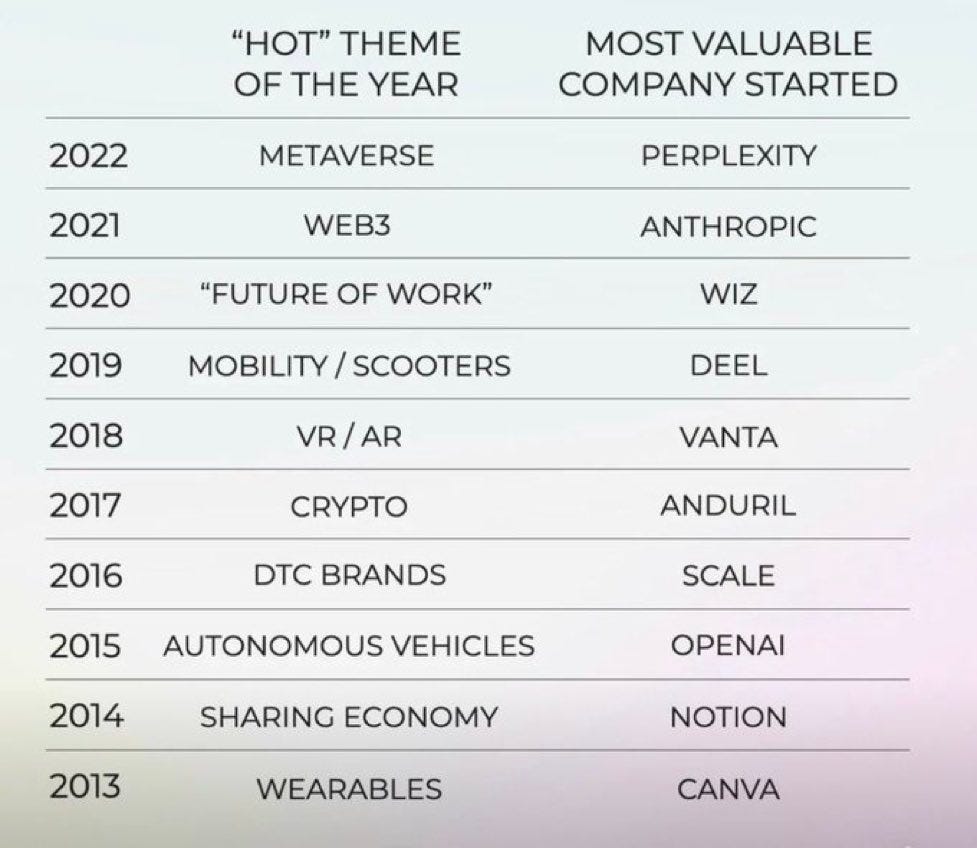
The point being, for all the talk of say vertical drama or gen AI, it is possible or even likely that the successful companies being started now might come from a whole different place.
On a similar theme, this below made me laugh - how McKinsey is saying that AI agents will take over retail shopping to the tune of $5tn in the next four years, and Ed Zitron shared this rather glorious previous prediction of the same sum by the same year, but this time the spending on the Metaverse…

Ed Zitron@edzitron


Rohan Paul @rohanpaul_ai
Mckinsey report - AI agents are quietly taking over the retail shopping cart and could mediate $3 Tn to $5 tn of global consumer commerce by 2030. Instead of just suggesting a product, an AI agent can now scan multiple stores, check inventory, and build a ready-to-buy shopping
4:02 PM · Jun 26, 2026 · 827K Views
115 Replies · 926 Reposts · 10.3K Likes
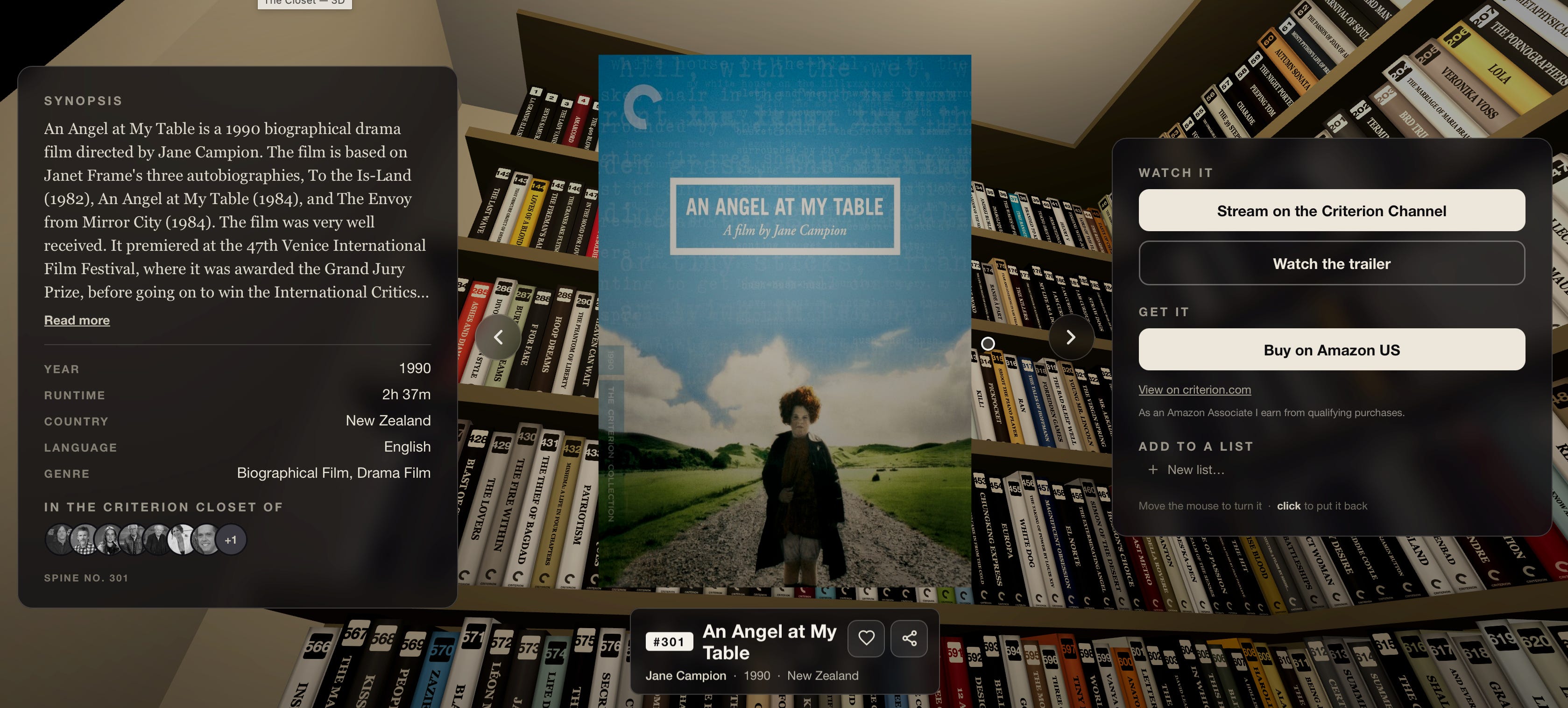
Love this. A fan of The Criterion Collection on Reddit (called olievans) has turned the entire Criterion Closet into a website, where you can browse all 1247 films by walking through the shelves (and thanks to Lost In Film for sharing).
Here is the entry for Jane Campion’s 1990 film An Angel At My Table, which includes a synopsis, details of who included it in their closet, plus the ability to stream the Criterion Channel or buy on Amazon.
Thanks for reading Business of TV! This post is public so feel free to share it.
Comments
Nothing yet. Say the first thing.
Sign in to join the conversation.