
This week, I’ve covered the following:
Bad actors, AI & prediction markets are a terrifying mix
More lessons from online news operations as Reach PLC shifts from chasing volume
Xbox: the announcement of major job cuts and restructuring
In the age of abundance, scarcity matters
Instagram as the home for scripted comedy
I’m on leave next week, so paid subscribers will be getting a post next Wednesday, however there won’t be a Friday free post until the following week.

Heading to this year’s Edinburgh TV Festival?
The Festival returns from 25–28 August, bringing together the biggest names in TV and the brightest emerging voices for four days of unmissable conversations, industry insight and unrivalled networking. From headline keynotes to curated sessions and networking events, the Festival is the place to connect, collaborate and shape the future of television.
Business of TV subscribers can secure 20% off Festival passes using the code B20DIS26. Buy your Passes here.
Of many of the worries I have, there are two (well three) that have come crashing together in an example this week that has been written and shared by Stephen Follows. The three are:
The rise of bad actors online, and our collective inability to spot them
The volume of non-human activity online, and how AI makes it exceptionally easy for anyone, anywhere to create and deploy bad bots
The growth of prediction markets, and how vulnerable to manipulation anything that is outside of strictly regulated activities such as elections.
The story Stephen shares is about thenumbers.com - a film industry website that for nearly 30 years has collated box office grosses, budgets, streaming data across 78,000 films. It is treated, as Stephen describes it, as ‘THE definitive authority’.
However, over the last months, the site has been deluged by vast amounts of AI bot traffic, and eventually it collapsed under the weight. However, this wasn’t just ChatGPT or Claude doing searches, instead, 80% of the traffic was coming from other sources, and on investigation, the team at The Numbers say that some ‘…were looking for back doors, most likely so they could get to the data before it appeared on the site, or to manipulate the data presented to users.’
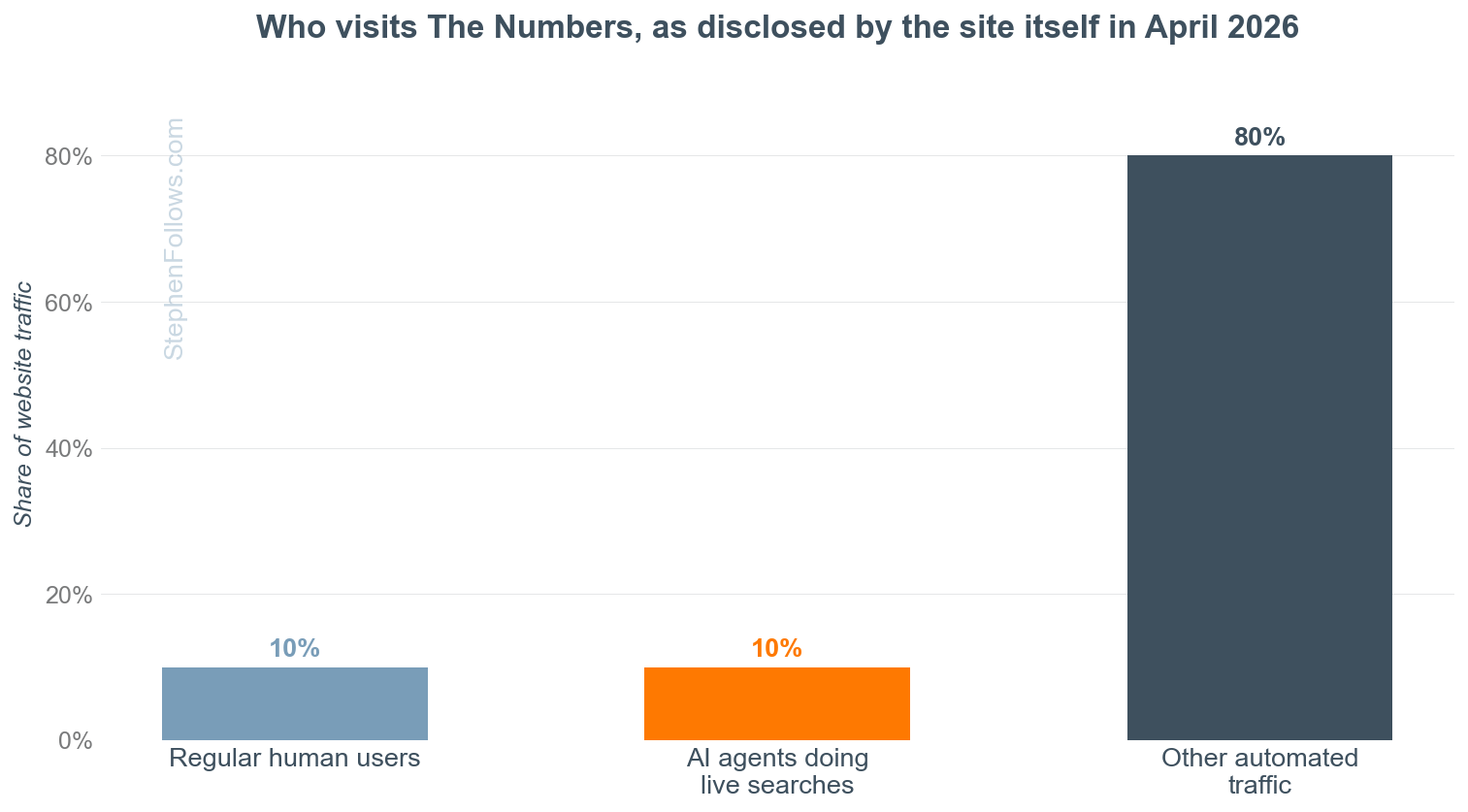
Why would someone want private access to this data before it is published? The theory goes that because Polymarket runs weekly markets on opening weekends (and uses The Numbers to validate the results) then you can see how and why someone would want to know this information in advance of it being made public.
As Stephen summarises, the idea that people are using AI to try to get an advantage in a prediction market is entirely plausible:
We now live in a world where a movie statistics website is worth hacking because prediction markets empower anyone to turn almost any data into money.
Hacking websites is now something anyone can do with a cheap AI subscription.
The web, as we have it, is incredibly fragile in the face of large-scale swarms of agentic AI bots.
His point on fragility is so important, as demonstrated by the infamous xkcd meme below:

I would urge you to read Stephen’s piece above, and then think more widely about what this means - it isn’t just about prediction markets manipulation, but disinformation in general, dead internet theory, and many of the norms and practices are being upended by the ease of AI to be used in ways we can see (content creation for example), but also in ways we can’t.
For further reading, here are three posts I’ve written on the above themes:
It is nearly 18 months since I wrote this deep(ish) dive into the world of local news, and what it can tell TV producers.
Much of what I covered in the above piece still stands: the race to the bottom of the high volume/page impression/digital advertising business model, and combined with the rise of independent newsletter and publishers using low-fi platforms like Substack, or for larger publications, new membership/RSS/newsletter platforms like Passport (which is what is powering The Ankler since is moved from Substack).
One of the companies featured in the above post is Reach PLC, which is the old Mirror Group, owner of national newspapers including The Mirror and the Daily Express, plus a whole host of regional titles. Back in November last year, I wrote that Reach PLC was reportedly…
… to be encouraging its journalists to increase the amount of stories they publish when on shift.
As reported by Hold the Front Page, journalists (when not out on stories) are being asked to increase the volume of articles they produce, with one editor saying eight stories per shift is an optimal number. The piece goes on to report an internal email from the editorial director of Reach’s Live network:
“And at the risk of reducing journalism to pure maths, the page views we generate are a compound of the number of articles we produce, and the number of times that each one is read.
“To increase page views, we need to increase either the number of articles we produce, or the number of people who read each one (or both).”
This week, it has been announced that Google’s referral traffic is down 55% year on year to its 120 online news brands, and overall website traffic is down 40%, which is attributed to changes in Google Search and Discover.
Press Gazette say that news that revenues and profits are down caused Reach’s share price to drop a quarter.
Why does this matter to TV and TV producers?
The arc of the page impression business has been a long one, from the early days of the internet, until now. The play is: get snappy headlines to appear in search results » get clicks » people read the page » view all the display and video ad formats on a page.
However, this model has long been under pressure, and you can see how some publishers got locked in this cycle, as to change while in flight is very hard. So page volumes were increased, article lengths shortened, automation and AI generation were used to speed up production. Meanwhile, the downward pressure on the advertising price points continued - as higher value advertising shifted to video and premium streaming over display, plus of course sponsorship packages and the like.
At some point this hit a wall for individual businesses.
And all this matters for TV, as you can see so many similarities with the video content market, and therefore, there are many warnings to heed here.
For example, video volumes that are intended to reach lots of eyeballs, but that have lower value to advertisers, is a risky play.
Why? Because this treadmill needs increasing amounts of content to keep up with the changing market. The content that can be produced at volume in this way is easy to copy, and therefore is increasingly undifferentiated. This creates a loop where it is lower value to advertisers, and therefore you need to produce more content to keep pace. Layer on top AI automation, and more and more players will be able to replicate your offer, and so there is a real danger of an engaging in a downward spiral.
Last lesson relates to relying on a third party to deliver traffic. Looking at online local news in particular, and it is Google that has been essential for their performance. Google pivots, and their routes to audiences are cut off. Plus, in this instance, search is also itself being disrupted by the rise of AI agents like ChatGPT, so it is a double whammy.
It is graphs like this one from last year (from SimilarWeb) which is the cause of concern - showing how AI is triggering zero-click searches (i.e. the answer is provided within the search context, and doesn’t require users to click through to the web page or video to find the answer).
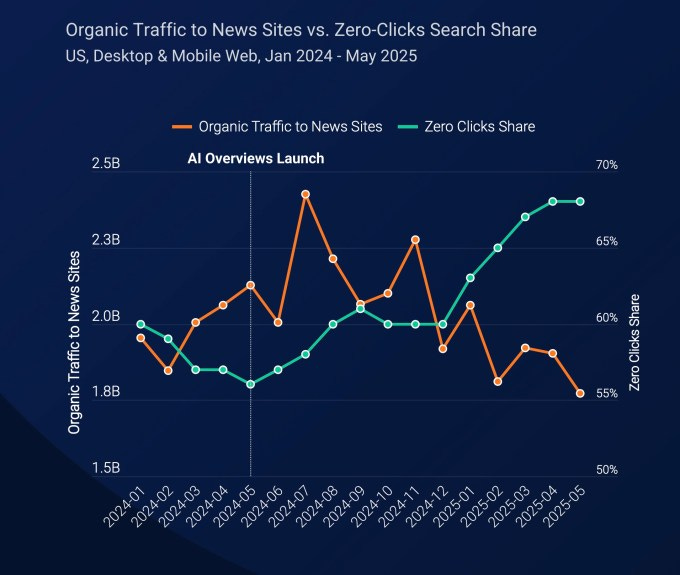
Meanwhile, the AOP (Association of Online Publishers) had a report out this week that UK publishers are widely expecting search traffic to halve in the next year.
This issue of renting vs owning your audience is a common conundrum of this era of the internet. On the one hand, the extraordinary reach of social video platforms, search, AI LLMs and so on give enormous opportunities to build audiences and make money. On the other, the risk of the underlying company pivoting or vertically integrating to take away your competitive advantage is very real.
And it isn’t just big tech versus smaller content companies. I wrote earlier in the week about Meta, and how they too are facing this same conundrum, which explains so much of their investment strategy.
The new CEO of Xbox, Asha Sharma, made a recent announcement about major job cuts and a fundamental restructuring of the businesses - this involved making 3,200 roles redundant, and also five studios being moved out of Xbox ownership.
What was the cause of this situation? Well a number of things, but crucially the biggest bet was on creating a gaming subscription model called Gamepass - similar to Netflix or Spotify - where people pay a monthly subscription to play a whole bunch of games that previously they would pay a high individual price for. So for example, the new Call of Duty was put on Gamepass, which would traditionally sell 10s of millions of copies for $70 each. These types of AAA games cost northwards of $450m to produce and then market.
This WSJ video below is six minutes, and does a great job of summarising what went wrong:
I thought I’d flag this to you for three reasons.
Firstly, it is a reminder that a strategy that is successful for one market and audience doesn’t automatically copy to another. In this case, while subscriptions have worked for say music or video (although even here, we’ve seen limitations on audience appetite within the streaming market), it didn’t follow that the same would apply to games. Plus it is also a reminder of audiences’ tolerance for subscriptions in general - we are seeing fatigue in all sorts of places, so one to keep in mind if you are thinking of membership clubs or podcast or newsletter subscriptions.
Secondly, it suggests that it is not just the TV and content industries that are undergoing major upheaval. Gaming is also undergoing seismic shifts, as best outlined by Matthew Ball, where a chunk of the male gamer userbase is shifting to iGaming, which blends crypto, prediction markets with the game play itself.
Thirdly, as Asha explains, the demands on hardware by AI compute investment is hitting game console manufacturers (as well as TV manufacturers too):
While the entire industry is facing a components crisis, we believe we have been impacted more greatly than many of our peers due to the choices we made over the last half decade. We are currently unable to make as many consoles as players want to buy, and we need a new business model and partnerships for hardware as we remain committed to Helix.
The fourth reason is to highlight what clear pieces of corporate communications her two emails are:
Within them, they include details such as:
We are operating at margins that are 3-10x lower than comparable platform and publishing businesses. We entered Gen 9 with a smaller install base and a higher cost structure.
…
We have also learned that we are not the best home for every type of studio; in a typical year, we lost 64 cents for every dollar we invested.
…
Today, in some parts of the company, work passes through as many as 14 layers of management. Our platform teams are 40% larger than they were at the start of this generation, even as our player base and playtime have declined.
Speaking of those 14 (!) layers of management, this is quite a fun visual representation of what that means:

Gadfly@TheTrueGadfly
XBOX CEO @asha_shar stated work sometimes “passed through 14 LAYERS of management” YouTuber @LukeStephens demonstrates this…
7:00 PM · Jul 6, 2026 · 475K Views
86 Replies · 370 Reposts · 5.57K Likes
Final point, as our markets converged, Xbox has long been intertwined with the TV and movie businesses, carrying streaming apps and DTO content from studios and IP owners. Thinking beyond Gamepass, part of the Xbox strategy was about seeing if there would be appeal to become a wider entertainment device in the home. So yes, it was a console for gamers, but it also was to become a general entertainment platform with a broader range of TV and entertainment experiences.
Some commentators have viewed this recent announcement from Xbox as final confirmation that this idea hasn’t held much water. One to keep in mind as the CTV operating system wars heat up.
A quick little nugget that relates to the points above about content abundance. There has been much noise of late about the price of tickets for sporting events, especially in relation to the World Cup.
Marc Andreessen made the following observation in response to someone questioning where people get the money for LA 2028 swimming tickets that are priced at $4500 each:
As one thing (digital content) becomes cheap and plentiful, another thing (in-person experiences) becomes expensive and rare.
The price declines for the cheap and plentiful, create new spending power for the expensive and rare. Day follows night. Many such cases.
This is something for all content businesses to ponder, and see if there is a genuine opportunity around live and in person. For example, just today saw this announcement in Broadcast:
Last thing, here is a great post by Natalie Jarvey and features Jon Stahl talking about the rise of new shows on Instagram:
Thanks for reading Business of TV! This post is public so feel free to share it.
Comments
Nothing yet. Say the first thing.
Sign in to join the conversation.