
Claude 3.7 Sonnet introduces hybrid extended thinking, while DeepSeek-R1 proves pure RL incentives for problem-solving.
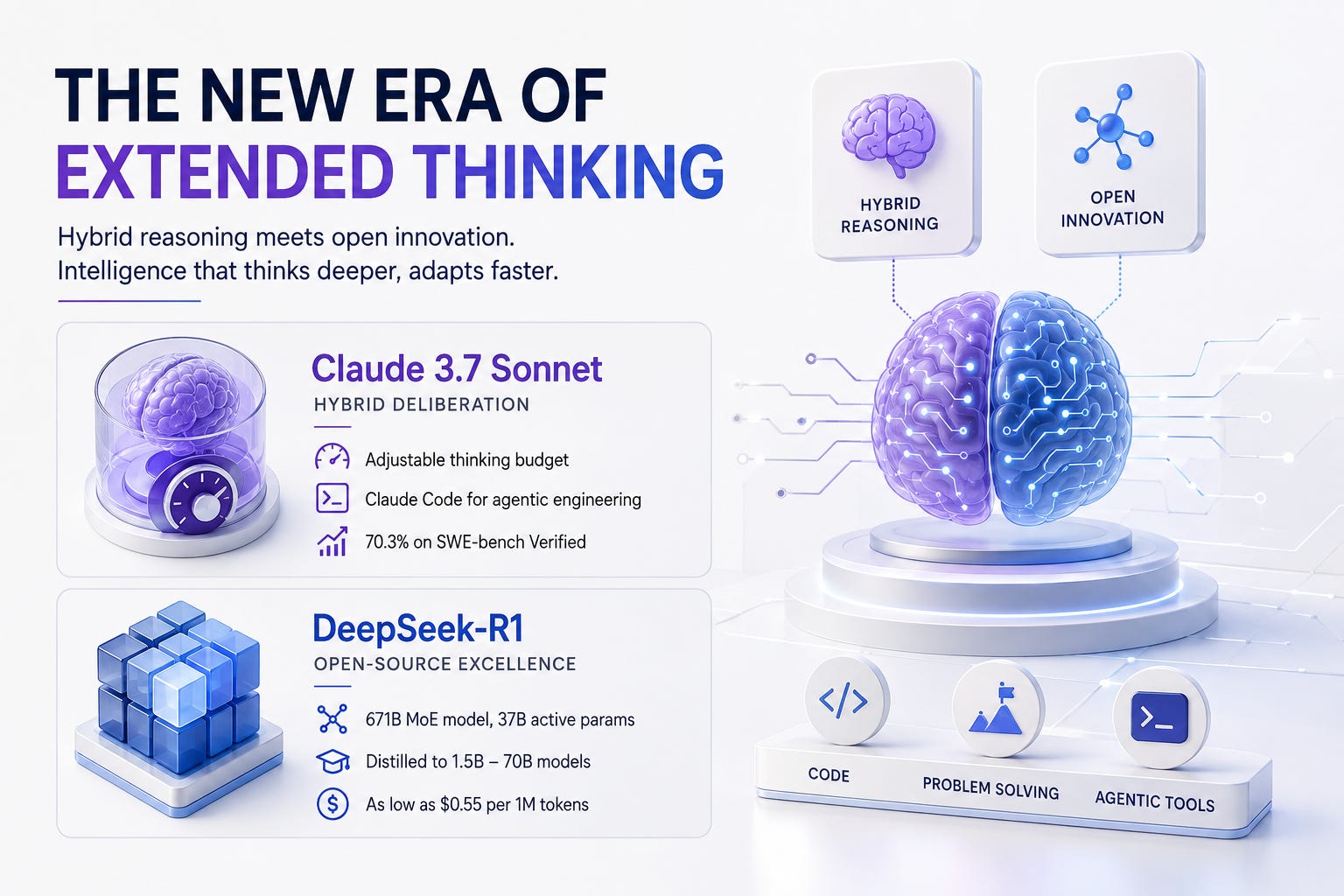
The artificial intelligence ecosystem is undergoing a major paradigm shift, transitioning from static token prediction toward dynamic extended deliberation architectures. Rather than relying strictly on fixed per-token latency, modern frontier models allow systems to scale inference-time compute dynamically depending on task complexity. This evolution is spearheaded by two complementary approaches: closed hybrid models like Anthropic’s Claude 3.7 Sonnet, which merge rapid response capabilities with adjustable deliberation budgets, and open-weights achievements like DeepSeek-R1, which demonstrate that deep logical behaviors can emerge purely through large-scale reinforcement learning. Consequently, engineering teams are transitioning from basic prompt chaining to sophisticated orchestration graphs and agentic terminal tooling. This edition analyzes these state-of-the-art model architectures, evaluates the economic implications of open model distillation, and provides actionable engineering strategies for building robust agentic systems.

Claude 3.7 Sonnet and Claude Code: Hybrid Deliberation Architecture
What Happened: Anthropic introduced Claude 3.7 Sonnet, establishing a hybrid deliberation architecture that integrates standard rapid-response generation with an adjustable extended thinking mode. Operating with a 200,000-token context window and supporting up to 128,000 output tokens, the model allows software developers to specify precise thinking token budgets via API parameters. Alongside the model release, Anthropic introduced Claude Code, a research preview command-line interface tool designed for autonomous engineering tasks directly inside terminal environments. Technical benchmarks indicate Claude 3.7 Sonnet achieves a state-of-the-art score of 70.3% on SWE-bench Verified while demonstrating superior multi-turn performance on TAU-bench for agentic tool manipulation. The model is deployed across the Claude Developer Platform, Amazon Bedrock, Databricks, and Google Cloud Vertex AI.
The Technical Primer: Conventional language models process every input with a uniform number of computational steps regardless of difficulty, akin to answering a trivia question and proving a mathematical theorem with the exact same effort. Claude 3.7 Sonnet functions more like an adaptive problem solver that toggles between instant recall and deliberate scratchpad computation prior to formulating a final output. By allocating specialized output tokens specifically for internal deliberation steps, the architecture resolves intermediate sub-problems prior to visible user token generation.
Why It Matters:
Architectural Flexibility: Unifies standard generation and extended deliberation within a single weights structure, eliminating the need to maintain separate endpoints for fast chat and complex analytical tasks.
API Compute Budgeting: Grants engineers granular control over latency and operational token expenditure by exposing explicit parameters to cap deliberation token budgets based on SLA requirements.
Agentic Engineering SOTA: Demonstrates high autonomy in software maintenance, achieving 70.3% on SWE-bench Verified and enabling direct multi-file editing via terminal workflows.
Key Takeaway: Claude 3.7 Sonnet establishes dynamic inference-time compute management as the technical standard for enterprise AI deployments.
DeepSeek-R1: Open-Source Problem-Solving and Model Distillation
What Happened: DeepSeek released DeepSeek-R1 alongside its precursor DeepSeek-R1-Zero under a permissive MIT license, providing fully open research and weights for frontier extended-thinking models. DeepSeek-R1 utilizes a Mixture-of-Experts (MoE) base architecture comprising 671 billion total parameters with 37 billion active parameters per token, built on the DeepSeek-V3-Base foundation. DeepSeek demonstrated that step-by-step thinking patterns generated by the 671B model can be distilled into smaller, dense architectures ranging from 1.5B to 70B parameters based on Qwen and Llama checkpoints. The distilled DeepSeek-R1-Distill-Qwen-32B achieves state-of-the-art dense model performance, surpassing OpenAI-o1-mini across math and coding benchmarks.
The Technical Primer: Large Mixture-of-Experts models operate like an enterprise composed of specialized domain teams, where a routing mechanism directs incoming data tokens strictly to relevant expert sub-networks rather than engaging the entire network. Distillation acts as an intensive training curriculum, taking the structured output traces created by the massive 671B teacher model and using them to fine-tune compact student models to perform complex logical deductions locally.
Why It Matters:
Democratized Frontier Performance: Enables research institutions and enterprise teams to deploy frontier-class mathematical and logical problem-solving models on self-hosted infrastructure.
Drastic Economic Efficiency: Delivers API inference cost reductions down to $0.55 per million tokens while enabling local execution of 14B and 32B distilled variants on consumer hardware.
Mitigation of SFT Bottlenecks: Validates that distillation of high-quality deliberation traces yields stronger student models than direct reinforcement learning on small parameter bases.
Key Takeaway: Open-weights distillation drastically lowers the financial and infrastructure barriers to deploying high-performance logical LLMs.
OpenAI o3-mini: High-Efficiency Logical Processing for Enterprise Workflows
What Happened: OpenAI released o3-mini, a specialized model engineered to deliver high-performance logical processing with optimized speed and cost efficiency. Operating with a 200,000-token context window, o3-mini integrates advanced deliberation capabilities into latency-sensitive application pipelines. Benchmark evaluations highlight o3-mini’s strength across technical disciplines including competitive programming, advanced mathematics, and scientific analysis, providing enterprise developers with scalable endpoints across platforms such as Azure OpenAI.
The Technical Primer: Rather than relying solely on raw parameter scaling, o3-mini leverages specialized post-training optimization to compress structural problem-solving pipelines into a lean architecture. This allows the model to perform extended internal search and verification steps at a fraction of the compute required by larger baseline models.
Why It Matters:
Latency Reduction: Optimized inference speed enables real-time integration of deliberation pipelines into interactive applications and developer tooling.
Enterprise Deployment: Native availability on cloud platforms such as Azure OpenAI simplifies compliance and governance for enterprise adoption.
Cost-Effective Tooling: Lowers operational token expenditure for automated code analysis, mathematical auditing, and structured data extraction.
Key Takeaway: Specialized compact deliberation models bridge the gap between heavy logical processing and real-time enterprise operational requirements.

DeepSeek-R1: Pure Reinforcement Learning and Emergent Problem-Solving Patterns
What Changed: The release of DeepSeek-R1-Zero and DeepSeek-R1 marks a landmark breakthrough in machine learning methodology by proving that advanced logical problem-solving capabilities can be incentivized in base language models purely through large-scale Reinforcement Learning (RL) without relying on preliminary Supervised Fine-Tuning (SFT). DeepSeek-R1-Zero was trained directly on the DeepSeek-V3-Base checkpoint using Group Relative Policy Optimization (GRPO) paired with rule-based reward functions for mathematical correctness and code execution validation. To resolve initial limitations regarding output readability and language mixing, the complete DeepSeek-R1 training pipeline incorporated a targeted cold-start dataset prior to RL, followed by secondary RL stages designed for human preference alignment.
Why This Matters: Historically, artificial intelligence laboratories depended heavily on costly human-annotated SFT datasets to teach models how to structure step-by-step solutions. DeepSeek-R1 demonstrates that reward signals based strictly on verifiable outcomes allow models to autonomously discover reflection, self-correction, and dynamic problem-solving strategies without human demonstrative bias.
Technical Breakdown (Easy to Understand): Consider teaching a student chess without providing instructional strategy books. Instead of presenting step-by-step master game histories, the student is given the basic movement rules and rewarded solely when winning a game. Over thousands of matches, the student naturally learns to pause, evaluate potential counter-moves, re-check tactical errors, and formulate long-term strategies. In DeepSeek-R1-Zero, training with outcome-based rewards caused the model to spontaneously allocate more thinking tokens when facing difficult problems—an emergent phenomenon where the model re-evaluates its initial logic autonomously.
Industry Impact: This structural innovation radically alters the economics of frontier AI development. Pre-training the underlying DeepSeek-V3 base required only 2.664 million H800 GPU hours (~$5.6 million), proving that outcome-based RL can bypass multi-hundred-million-dollar human annotation pipelines.
Opportunities Created: Engineers and technical organizations can leverage the six open-sourced distilled models (1.5B to 70B parameters) to execute task-specific logical processing locally, drastically reducing cloud API bills and enabling offline privacy-compliant software tooling.
What Happens Next: Research communities are actively expanding rule-based reward mechanisms beyond verifiable fields like code and mathematics into open-ended domains such as legal document analysis, structural engineering design, and automated scientific hypothesis generation.

LangGraph
What It Is: A stateful framework designed for constructing multi-actor agentic applications using cyclic computational graphs, inspired by Pregel and Apache Beam execution models.
Why It Matters: Moving beyond simple Directed Acyclic Graphs (DAGs), LangGraph provides native support for cyclical looping, persistent state management, fault-tolerant execution, and human-in-the-loop validation checkpoints.
Potential Use Cases: Enterprise workflow automation, autonomous multi-repository code refactoring pipelines, and complex legal document verification networks.
Explore more: Official Website , Documentation
smolagents
What It Is: Hugging Face’s lightweight Python framework engineered for building code-first agents that execute programmatic actions directly through clean Python scripts.
Why It Matters: Minimizes framework abstraction and system overhead by allowing agents to author and run raw Python code calls rather than relying on complex JSON tool-calling schemas.
Potential Use Cases: Web research synthesis, automated repository exploration, and local data analysis tools running on edge infrastructure.
Explore more: Official Website, Documentation

DeepSeek-R1 Research Paper
Technical documentation detailing Group Relative Policy Optimization (GRPO), outcome-based reinforcement learning rewards, and open distillation methodologyAnthropic Claude 3.7 Sonnet System Card
Architectural evaluation covering hybrid extended thinking mechanisms, SWE-bench Verified scaffolding, and safety protocols .DeepSeek V3 vs R1 Technical Comparison
In-depth architectural analysis comparing Mixture-of-Experts routing efficiency, token pricing, and local deployment options.

1. Dynamic Test-Time Compute Is the Primary Scale Vector: Allocating dynamic deliberation token budgets during inference is replacing raw parameter size as the primary driver of complex logical performance in frontier models.
2. Open Model Distillation Democratizes Advanced Logic: DeepSeek-R1 proves that problem-solving patterns from 671B architectures can be effectively distilled into 14B and 32B dense models running locally on standard hardware.
3. Hybrid Architectures Simplify Model Operations: Single models capable of toggling between standard rapid text generation and deep structured thinking eliminate the operational complexity of managing separate multi-model endpoints.
4. Code-First Frameworks Are Replacing JSON Tooling: Modern agentic orchestration is shifting toward stateful graph engines like LangGraph and code-executing frameworks like smolagents to drastically improve action execution reliability.
5. Outcome-Based RL Reduces Supervised Data Needs: Rewarding models strictly on verifiable correctness (math and code) successfully triggers emergent self-correction behaviors without requiring massive human-annotated datasets.

Tool: Claude Code CLI Enables terminal-based agentic software engineering directly inside existing git repositories.
Research Paper: DeepSeek-R1 Technical Report Details how outcome rewards and GRPO incentivize spontaneous self-correction and reflection without SFT.
GitHub Repository: DSPy Framework Provides declarative programming for language models, replacing fragile prompt strings with automated prompt optimization and compilation pipelines.
Explore: https://github.com/stanfordnlp/dspy
Comments
Nothing yet. Say the first thing.
Sign in to join the conversation.