
AI’s Next Bottleneck Can’t Be Bought
What You’ll Learn From This Edition
Why the shift from chip scarcity to power scarcity is a change in kind, not degree, and why that distinction matters more than any gigawatt figure
A reusable test for telling whether a resource in any value chain is market-cleared or permission-cleared, and why that test predicts who wins
Which unglamorous companies are quietly becoming as strategically important to AI as the labs themselves
Why ordinary electricity ratepayers are now a stakeholder in the AI race in a way chip buyers never were
How to read the next eighteen months of AI infrastructure announcements without being fooled by megawatt numbers
A framework for where founders, consultants, and investors should actually place bets as this shift plays out
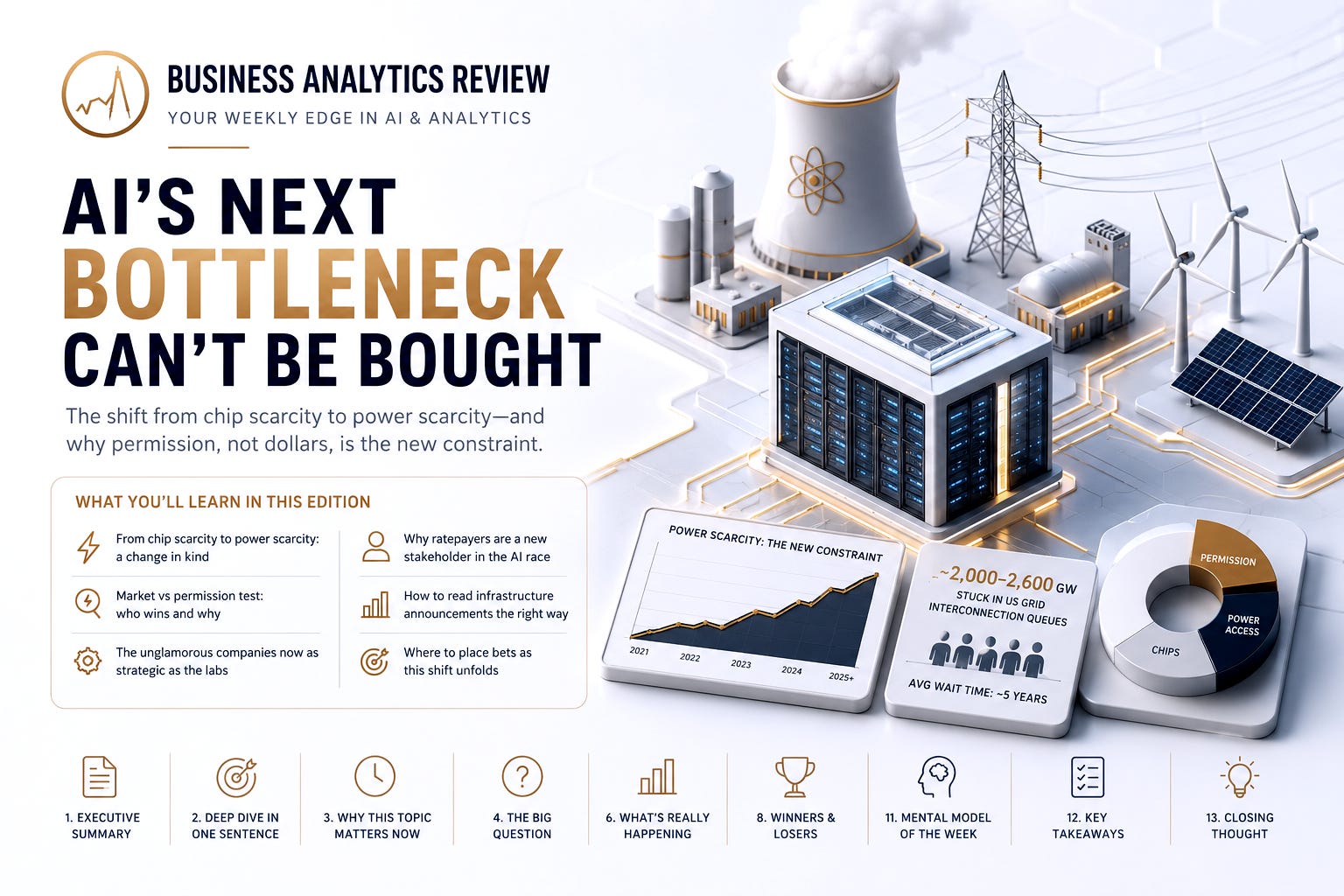
Table of Contents
Executive Summary
Deep Dive in One Sentence
Why This Topic Matters Now
The Big Question
The Conventional Narrative
What’s Really Happening
The Economics Behind the Shift
Winners and Losers
Second-Order Effects
Strategic Implications
Mental Model of the Week
Key Takeaways
Closing Thought
Executive Summary
Chip scarcity was a market problem, solvable with capital: pay more, order earlier, fund more fabs. Power scarcity, at the point an AI data center actually needs it, is a permission problem, solvable only through queues, hearings, and public consent.
US grid interconnection queues hold roughly 2,000 to 2,600 gigawatts of stuck projects with average wait times near five years, and even the turbine industry’s own executives say equipment is not what’s gating buildouts.
Value is fragmenting away from a single chokepoint supplier toward old-economy incumbents: turbine makers, merchant generators, nuclear operators, and energy-rich jurisdictions.
Comments
Nothing yet. Say the first thing.
Sign in to join the conversation.