
Climate Risk Intelligence for Insurance: From Transfer to Reduction
Climate Risk Intelligence (CRI) has been a core focus for Buoyant since we launched in 2020. From the beginning, we’ve invested in several companies shaping the space while keeping a close eye on emerging opportunities. This piece focuses on acute climate risk and the role of insurance, which is adapted from Alex Behar’s presentation on this topic at our LP Summit earlier this year.
What’s changing:
Losses are rising and the protection gap is widening. In the U.S., ~60% of catastrophe losses go uninsured, while reconstruction costs have outpaced CPI in many markets.
Insurers are retreating from high-risk areas, pushing more homeowners onto overstretched FAIR plans; pricing that can’t reflect risk keeps capacity on the sidelines (see California).
This cascades into the broader financial system. Disasters weaken local tax bases and can raise borrowing costs—just when communities need to invest in resilience.
So what: Transferring risk isn’t enough. $1 invested in resilience can save ~$6 in losses, but incentives are misaligned and action must scale beyond individual properties to neighborhoods and towns.
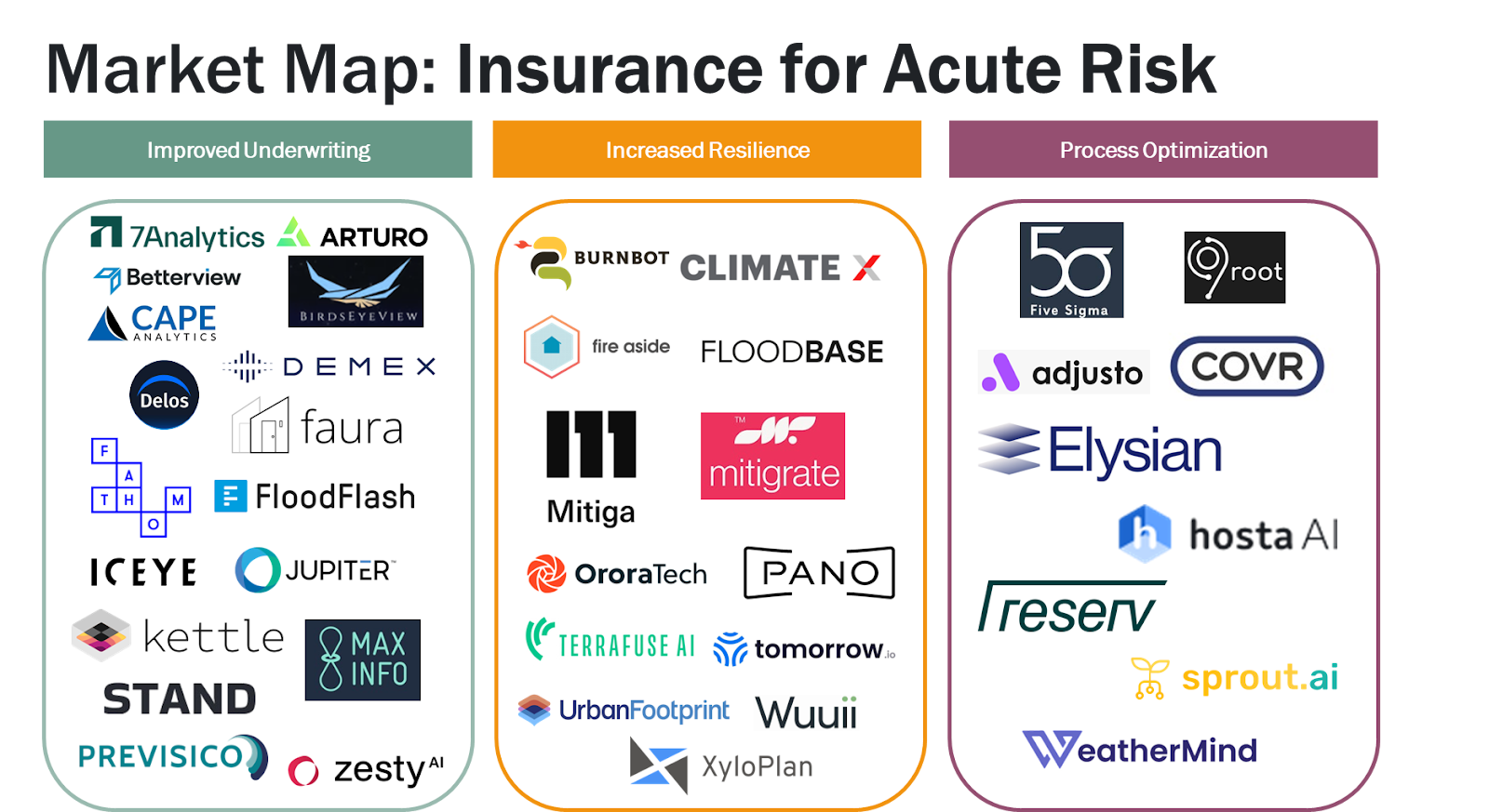
We see three areas of digital innovation:
Improved underwriting with richer property data and forward-looking climate models to find lower-risk pockets in high-risk regions. Key question: how do portfolios diversify to manage correlation risk?
Increased resilience via tools that prioritize high-impact retrofits, verify work, and coordinate at the community level. Key question: how do we align incentives across stakeholders?
Process optimization to handle complex claims following natural disasters. This includes automating intake, remote assessment, and documentation to speed up claims and recovery. Key question: does efficiency alone bring carriers back, or must it pair with better underwriting and measurable mitigation?
Read the full breakdown on The Lighthouse here.
Beyond the Climate Headlines: Analyzing the Investment Gap Around Chronic Risks
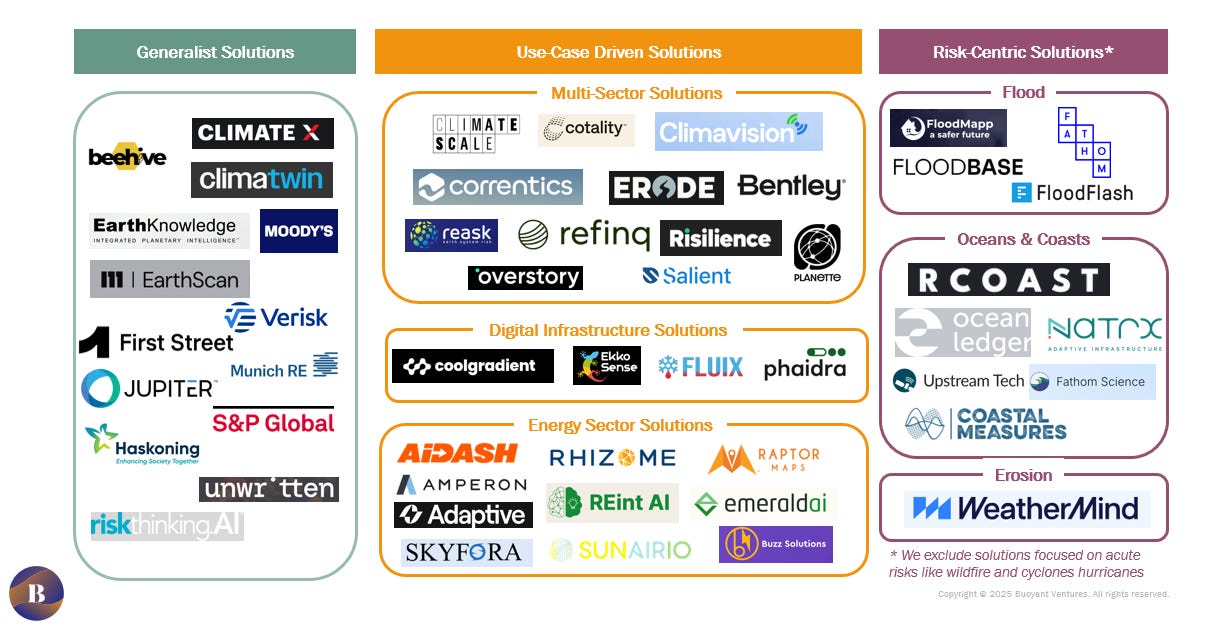
Our incredible summer MBA Fellow, Sarah Devermann, from UC Berkeley added tremendous value to the team over the summer – screening deals, working on diligence, and most importantly, leading a body of research on chronic climate risk. Chronic climate risk is defined as ongoing, gradually-increasing risk, separate from acute tragic events like wildfires and hurricanes. Here are a few takeaways:
Acute events capture headlines, but chronic risks can quietly erode business value. In particular, chronic risks associated with extreme heat, water stress and fluvial flooding could account for over 90% of physical asset losses in the next 30 years. The energy, utility and telecommunications sectors are the most likely to be impacted, representing close to $1T in annual fixed asset losses by 2035
Innovation to address extreme heat and water stress has been historically underfunded. Only an estimated 5% of climate finance goes to adaptation, and within that, extreme heat and water stress have the highest potential losses but the lowest investment.
Willingness to pay for climate risk solutions is still unclear. Regulation and recent exposure to a climate event can spur business leaders into action, but for the most part, these risks do not appear to be at the forefront of decision-making
Buoyant is focused on finding investment opportunities that solve for these unaddressed risks, particularly focused on the sectors most impacted, i.e. energy and digital infrastructure
Read the full breakdown on The Lighthouse here.
Buoyant Team Spotlight: Alex Behar
We often use this space to spotlight the incredible founders and portfolio companies building the future of climate-tech. But this month, we’re turning the mic on ourselves. Meet Alex Behar, the “newest” member of the team who joined in early 2024. He’s got a unique blend of experience in climate and innovation that complements the rest of the team.
Alex’s academic curiosity about agricultural markets led him to a career dedicated to sustainability, innovation, and venture investing. From publishing early research on seed technology and market risk to advising on agriculture and energy at Deloitte, Alex’s path has consistently intersected with industries core to climate. After building a corporate venture arm focused on impact, he moved into early-stage investing at Sandbox Industries in 2019. Alex joined Buoyant in 2024 because of the potential for software to provide timely solutions to climate change.
Read more on the full interview here.

Service Provider Spotlight:
Looking for a strategic fractional CFO to help scale your company? We highly recommend Planetary Scale. Luke Baker and his team work with multiple of our portfolio companies, and we’ve been consistently impressed. From building budgets and fundraising models to strategically navigating debt financing, acquisitions, and more - Planetary Scale brings sharp financial insight and execution every time.

Portfolio Company Highlights:
HData sold its compliance business to Systrends, press release here.
Shifted Energy was acquired by Resource Innovations, press release here.
Sunairio launched Sunairio ONE, which adds short-term forecasts to its offering. Sunairio can now forecast weather conditions and net load on the power grid anywhere from hours ahead to 15 years ahead. Press release here.
Gravity earned the highest overall scores in an independent evaluation of 22 carbon management software providers (more here).
Gravity also launched its Energy Management Marketplace, giving customers access to actionable projects that cut both costs and carbon (more here).
Outweighing Impact over Optics by Hack Summit, featuring Buoyant’s Alex Behar!
Climate Intuition: Power Rewired: The new map of energy and geopolitics by Dr. Sarah Kapnick at JPMorgan
Dodging The Firm Fixation For Data Centers And The Grid by Energy Innovation
Both sides of the AI bubble conversation by Plain English
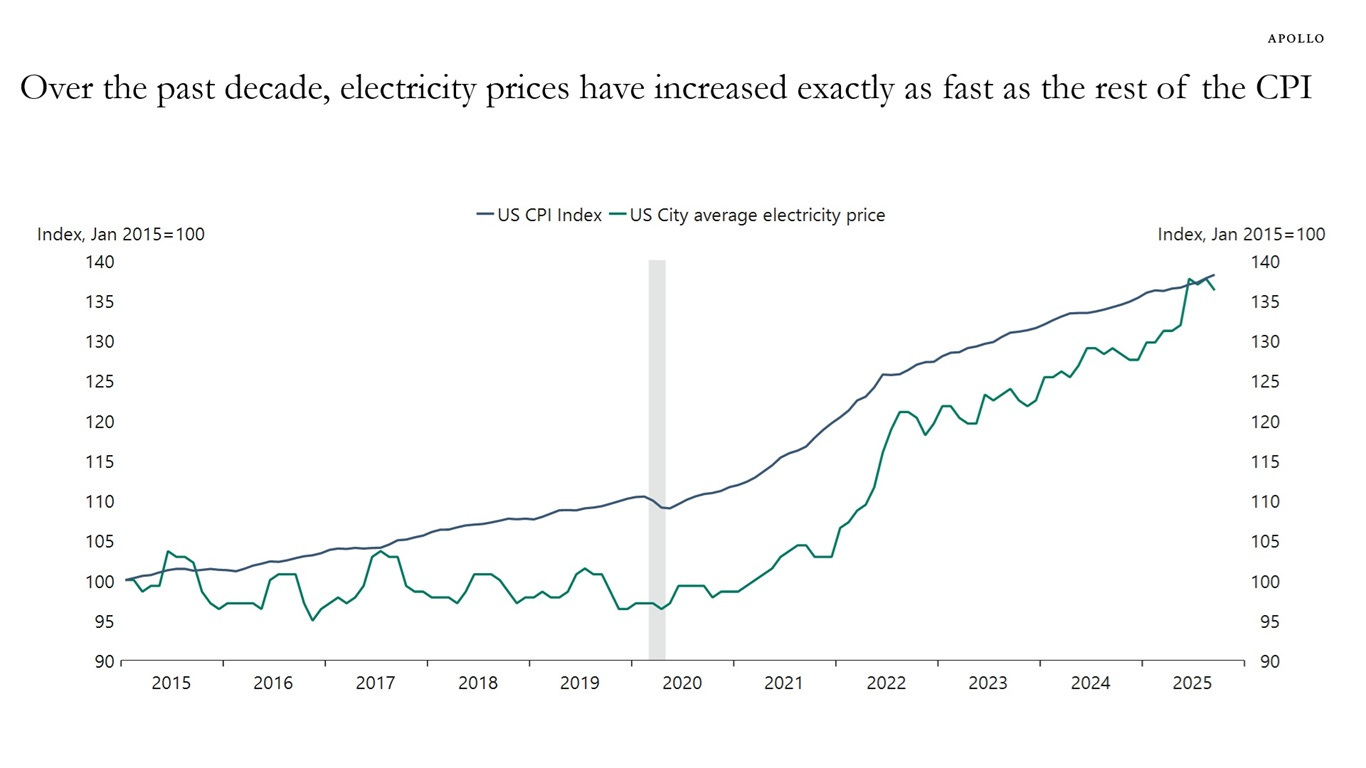
Electricity prices, which have grown in line with overall CPI according to Apollo Chief Economist
No posts
Comments
Nothing yet. Say the first thing.
Sign in to join the conversation.