
AT A GLANCE
BL2026-1423 - The Nations
Misrepresented timeframes: Residents were told the public hearing process wouldn’t begin until late summer or fall. Instead, CM Horton filed for a first reading in June with no community notice. The second reading is tonight, July 7.
Ignoring the Master Plan: The proposal forces 60-foot apartment monoliths into a two-story neighborhood where the city's own zoning requires mixed use. The site is labeled SP(MU), Mixed Use, surrounded by residential. This amendment strips the mixed use and keeps only the density.
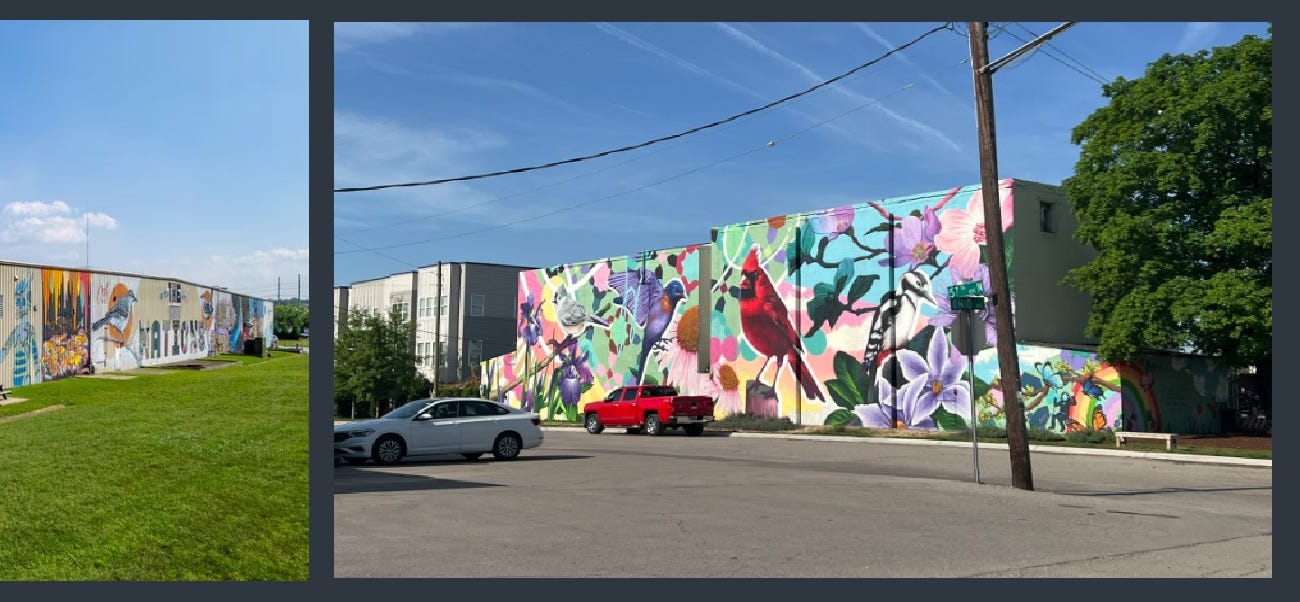
A token bait-and-switch: An art wall preserved under a prior approved plan would be razed and replaced by the developer’s prototype. The token trade-off offered to the community? A parking lot for food trucks.
Overriding voters: The neighborhood voted 66% “No.” CM Horton made the motion to advance it anyway, despite receiving campaign contributions from project influencers and refusing to recuse himself.
Why this matters to all of Davidson County:
The “dwelling need by 2034” justification collapsed in 2024. Nashville has a record-high apartment vacancy rate and single-family housing supply. The 2025 planning reports lean on outdated 2020 and 2022 data.
Bypassing the public: New RN/RL zoning tools would allow future residential projects to bypass public hearings entirely—no Planning Commission, no City Council. If this passes, every neighborhood is next.
Community and Neighborhood Voice Should Matter: The neighborhood voted 66% No. CM Horton motioned to advance it anyway, despite campaign contributions from project influencers and a refusal to recuse.
Author’s Note This article is one more last-minute post, as the effort would not be necessary if Council Members would simply do their job. My optimism proved too high. The status quo remains: they are still doing to the neighborhood. So let’s get into the facts and why this matters to the whole of Nashville.
The Nations is a Nashville neighborhood asking for something simple: development done right. Gentle density. Mixed-use livability. Gathering spaces. A neighborhood center in the truest sense of the word. When a mixed-use site is surrounded on all sides by residential, it becomes the place people walk to, not drive past. The city zoned this site SP(MU) for exactly that purpose.
Councilmember Rollin Horton hears something different. His goal, demonstrated repeatedly, is to build as much dwelling density as possible: no conditions, no compromise, and no public input that alters the script. For him and by default his own leadership, the process exists to be managed, not to inform. The result is a pattern so consistent that the neighborhood has come to expect “Hortoning,” what happens when an elected representative invests in his own agenda rather than the suffering and expectations of the district he was sworn to serve. Within District 20, the one-square-mile area called The Nations, plus some planning spillover into Charlotte Park, is CM Horton’s sole district focus. Yet try as they might, residents find representation is entirely about CM Horton’s dream, whatever that may be. It’s not the art of placemaking. For CM Horton, it’s just a place to densify.
It is a testing ground for him to maximize bedroom counts at the expense of community connection, local character, its cool vibe, and resident stakeholders. Tragically, this mindset is infectious within the broader City Council, where civic vision rarely extends beyond a spreadsheet driven by a national density zoning reform pattern playbook.
I write this from 12 years on Metro Boards related to zoning and building. I have over the past two years watched this pattern repeat across neighborhoods that believed they had a voice.
Why do good-faith interactions with informed constituents consistently devolve into manipulation? In the end, residents in The Nations are handed a mere illusion of participation, with the terms dictated by the very individuals sworn to represent them.
This project is not only an in-progress case study; it is one more approval that further conditions our elected body to believe that bad habits are acceptable, as long as the Council sticks together. Has Nashville evolved into us vs. our elected? The context and project in question here will become everyone’s street and neighborhood if apathy is allowed to be interpreted as approval.
The newest proposal is a Specific Plan (SP) to pile even more monolithic apartment buildings onto a two-story neighborhood where the same kind of densification has already saturated the area 1,000 feet (three football fields) north of the subject site along Centennial Boulevard. The north side of The Nations is overbuilt with these scaleless walls of apartments and, frankly, residents are fatigued and worried about the impact of thousands of units built over the last five years.
How badly are these mammoths needed? The apartment vacancy rate is high. Single-family housing supply here and in Tennessee sits at a ten-year to all-time high because supply has outpaced the number of families who can qualify for a mortgage or to rent. The Council’s justification for forcing massive vertical density onto communities is a manufactured, required “dwelling need by 2034” (according to Metro) argument, which collapsed in 2024 (had anyone checked the math), before the political justification script was fully engineered in 2025. 2024 data was available, it tells a completely different story.
While affordability needs focus, the distraction and harm for displacement and land and tax inflation from the density narrative grows. No one should fear asking about the mismatch of the political narrative to Nashville, present day reality. The elected fallback to date is “misinformation,” well, I shit you not, and my comments should not be taken as an opposition attack; it is simply pointing out when city officials do not read the details in their own reports. The carefully curated slogans that emerged just can’t stand up to scrutiny. The numbers show it, everyone sees it, but CM Horton and the Planning Commission drive on, tethered to poorly interpreted and antiquated 2020 and 2022 data used for the two 2025 reports that planning, Council Members and the Mayor, hang their hats on.
In present-day real estate conditions of historic vacancies and the highest per capita living unit availability in Nashville’s history, how can planners and city officials even entertain the vision of violating and replacing the city’s master planned mixed-use vision with more vertical bedroom warehouses in buildings large enough to be called vertical neighborhoods? Planning’s role should be to build authentic places; today’s preferred planning method, a spreadsheet for bedroom count and tax production will never produce people places without planning and design guidance.
Some ask me, why would a billion-dollar developer want to build it? Because they have piles of investor cash to spend, need to deploy it, and once constructed, will sell it to a Wall Street fund and carpet-bag back home. What remains is not their problem, so why would we believe handing them the keys is a good plan?
None of the above slows the Planning Commission, which advanced projects with its present-day and now customary enthusiasm for bedroom count, abrupt scale change and zero sensitivity to preservation, protection, place-building or the “gentle density” it only claims to champion if measured by the West Nashville experience. There is nothing gentle about vertical bedroom warehousing that is 60 feet tall in two-story neighborhoods and always dressed up in the manufactured emergency need for more luxury housing.
Then came the vote that should have settled it. The Nations Neighborhood Association held its second meeting. Residents reviewed the proposal: the massive scale, the absence of mixed-use, the loss of an art wall that had been preserved under a prior approved plan, now to be razed and replaced by the developer’s prototype. In response to area residents, the proposal added a parking lot for food trucks, a developer token to satisfy the neighborhood’s desire for adaptive re-use or mixed-use. A food truck is not sticks and bricks, not a sandwich shop, hardware store, small service business, or a bodega, or the incidental, sometimes messy places where people authentically connect. When legitimate planning occurs, plans connect places to people and to each other.
Between the neighborhood association meeting and the Planning Commission meeting, a building the size of a shoebox (relative to the apartment scale) was submitted as a “future option” with no actual commitment behind it. Ultimately, the neighborhood vote to support the apartments and abandon the mixed-use vision was 66% No, even after a project lobbyist and CM Horton campaign contributor had worked the voters.
The Nations Neighborhood Association planning committee carried that result to the Planning Commission. What happened next was the kick in the cranium.
When a Council Member has received contributions from project influencers, ethics rules recommend voluntary recusal from the vote. In my years on Metro Boards, members recused even when the opportunity for that perception existed. CM Horton did not recuse or mediate. He leapt forward with the first motion to advance the project from the Planning Commission to the Metro Council.
After the Commission meeting came the now-familiar pattern of Hortoning. Residents were told there was plenty of time for public input. The process wouldn’t really begin until late summer or fall. Nothing to worry about.
Once constituents had become comfortable with the apparently reasonable time frame, without notice, CM Horton submitted the project for first reading almost immediately, in June, with no community notice of the filing to the area residents. See the video clip below the header above.
The second reading is today, July 7, on the same night as the highly charged Data Center. What is the chance of the citizens of The Nations competing with that? And of course, the bill’s sponsor is CM Horton, chaos is great cover for the top downing his constituents again.
For the last two-plus weeks, residents of The Nations have asked CM Horton for one simple thing: defer. Hold a legitimate community working meeting. Let residents review the gap between what the neighborhood meetings actually produced and what the Hortoning of the new narrative claims they produced. The answer has been no, compounded by a scheduling maneuver where the meeting is already so charged you must register to speak.
The Nations, Charlotte Park, and Nashville today have a mutual antagonist and common denominator. Nashville can no longer rely on Councilmanic Courtesy for the “protection” the neighborhoods need, historically a shared charge of the Planning Commissioners but that too appears lost, so friends, no longer, not when new zoning tools have been codified and are ready to deploy.
What does that mean? Once new RN or RL zoning classifications are approved on a property in your neighborhood the first time, the next residential category change has all the conditions prescribed for the planning department to approve the project without any public notice or hearing. Not before the Planning Commission. Not before the City Council. The conditions are broad; within one classification both single-family and commercial-scale projects are allowed. Your protection by Council’s design is your Council Member. Ask the residents of The Nations or Charlotte Park how that is working for them.
While The Nations continues to have zoning done to them rather than with them, the Hortoning of the Planning Commission looks no different. The method: manufacture data and distraction, override constituent input, advance the project, repeat. That behavior is not the charge of the Planning Commission, the Planning Department, or the Metro Council.
Today’s focus, or the focus of this article, however, is that the city’s own General Plan identifies the site for BL2026-1423 in The Nations for a future mixed-use neighborhood center, not for more bedroom warehousing. The neighborhood agrees with the masterplan. The only key actor who doesn’t is the one whose job is to represent the neighborhood itself.
The proposed landing of apartment monoliths offers nothing to satisfy the adopted general plan/masterplan except for creative interpretation that can’t even pass a common sense test. This project is a full legal play on the zoning methodology itself with a complacent Planning Department, Commission, and antagonist at the helm.
The Nations is not anti-development. The neighborhood has said, loudly and repeatedly, that it wants reasonably scaled mixed-use development: done with sensitivity to place, done in a way that builds community rather than stacking warehouse bedrooms monolithically, without the planning and design keys passed off to the developers.
My perspective, from working similar projects for years, is that to have a neighborhood ready and willing to explore and create unique livable places is itself unique, and an opportunity trampled when their own leadership is too weak or too proud to work within the civic crucible that builds great places and cities.
A 66% “No” vote by CM Horton’s preferred neighborhood association on this specific proposal is not obstruction. It is a community telling its representative what representation should look like. Why is the honeymoon not over?
The situation above is what Nashville is up against. Here is what Nashville leaders should bring to community meetings, and what stakeholders deserve. If leaders follow this approach, stakeholders will not arrive angry. But make no mistake: the City Council created this condition, and it is now the Council’s job to correct it:
When a community only asks for time to be heard by their Councilmember, the member should attend those meetings to become better informed.
When a community wishes to express a vision for its neighborhood, sit down and listen.
When a community asks for time to raise the bar on the status quo and to preserve landmarks (like the existing art wall in the example above), champion that effort.
When a community wants development to participate in legitimate planning and placemaking, hold developers to that exact standard instead of buffering them from the community.
These and other similar expectations are not only reasonable; they should be the minimum price of admission for an elected official tasked with community building, the responsibility of Council Members.
Trust begins with listening from the bottom up.
A special thank you to Members of Voices of District 20 and The Nations Neighborhood Association for assembling a chronology of events. To see the detail, connect via the link below.
Lost in the Shuffle: Are We Building a Place, or Just Warehousing Bedrooms?
·
Jun 5
It is incredibly easy for massive zoning fights to get lost in the shuffle of daily life, mainly because the bureaucratic timeline is built to help you forget or lose interest. You might have assumed the battle over the 8-acre Altera development (the massive 296-unit apartment fortress proposed at the triangular center site with the art wall on Californ…
Christopher Remke [AIA ret.] brings an unusual combination to real estate analysis: the quantitative rigor of a veteran Design-Build-Development Advisory Professional merged with the cultural awareness of a Context-Sensitive Urbanist. As Principal of Linked, L. L. C., he’s the rare voice who can deconstruct a pro forma, read municipal debt structures, and simultaneously ask whether the project destroys or enhances the neighborhood’s social fabric.
This dual perspective - analytics meets urbanism - allows Chris to expose what architects, planners, builders, and conventional real estate experts miss: how financialization, zoning manipulation, and tax policy don’t just change property values, they fundamentally alter how cities function as communities.
As President of Save Our Nashville Neighborhoods (SONNinc.org), Chris fights extraction-urbanism’s standardized templates and champions genuine neighborhood diversity. Through his writing, he operates in “Decoder Mode,” making complex policy accessible while revealing the truth behind political narratives.
His mission is simple:
Neighborhoods need a voice, Working People need a voice, and the City needs a Council that connects with constituents.Because transparency builds trust. Manipulation destroys it.
No posts
Comments
Nothing yet. Say the first thing.
Sign in to join the conversation.