
Built-to-Think_“Zoning Talk” 7/9/2026
AT A GLANCE: BL2026-1423, The Nations
Neglect is a cover, not a cause. CM Horton framed a structurally sound building as the victim of vandalism and of unhoused occupants, then used that framing to cancel the 2023-adopted vision of a mixed-use community anchor. What he called damage is a renovation line item. What the amendment calls a modification is a rezoning that runs counter to the destination Nashville officially envisioned and to the neighborhood that was promised.
66% voted No. The Nations Neighborhood Association voted 66% against this proposal. CM Horton moved to advance it anyway.
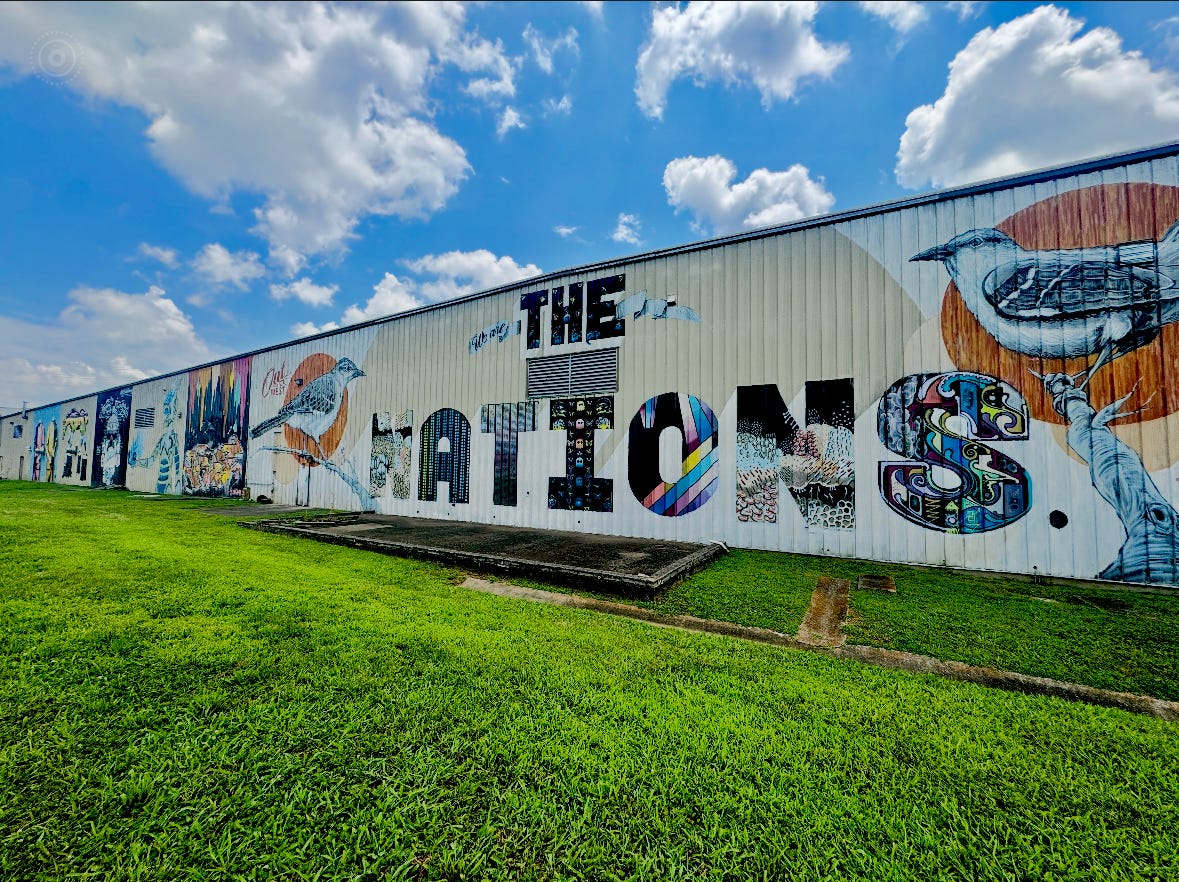
• The 2023 adopted plan required adaptive reuse. This amendment removes that requirement and demolishes the building, including the neighborhood’s public mural wall. - See Planning Staff Review that memorialized the mural use in Reference 1, below.
• The mural promise is not in the plan. CM Horton promised on the floor to preserve the mural and framed it as a developer commitment, though the mural preservation had never surfaced publicly before that night, not as a developer’s concept, not as a proposal, and never as an amendment before the Planning Commission. He then acknowledged that he will need a future amendment to codify it. The plan being voted on contains no such protection. Until a floor commitment becomes a plan condition, the developer is under no obligation to honor it.
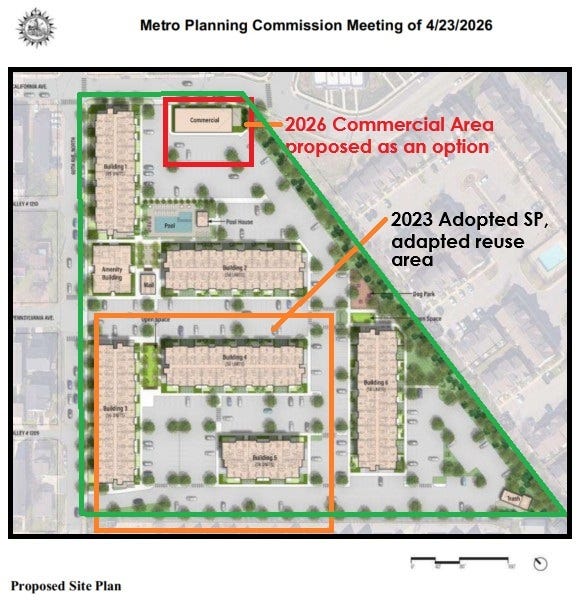
• 50,000 sq ft of mixed-use, lost. The original approval included approximately 50,000 sq ft of commercial space and an outdoor room. An option for approximately 6,000 sq ft of commercial flex remains a future allowed use and is not part of the commitment.
• Third reading is next. Contact your council members before the final vote. Details below.
July 7, Councilmember Horton advanced BL2026-1423, the Altera California SP amendment, through its second reading. He did so knowing the neighborhood he represents had voted 66% “No” on the proposal. He did so on the same evening as the data center hearing, when public attention and speaking slots belonged to the most charged item on the calendar. And he did so after residents had spent two weeks asking for exactly one thing: a deferral long enough to hold a legitimate community meeting and address their concerns about the narrative misalignment and concerns for the public mural the proposal would demolish.
CM Horton has characterized his community meetings as engagement. The video from the ONE April 6 neighborhood meeting dedicated to this project tells a different story. At that meeting, the neighborhood vote was taken, developer Woods Partners proposed food trucks in lieu of a commercial building, and CM Horton was notably absent. The food-truck floater was a developer's pitch, not a planning consultation, and the 6,000 sf commercial "option" that later appeared in the amendment is a reserved outparcel, not a required build. Other meetings were regular neighborhood association sessions in which NNA members were assured that their wishes would be honored. What the Council heard Tuesday night was a curated narrative, not the record of those meetings.
The answer to the deferral request was no.
The issue that troubled me most during this week’s Council meeting was not the vote. It was the silence around it. Statements were made in the chamber that the project record does not support. No planner rose to correct them. No council peers asked a clarifying question. Councilmanic courtesy prevailed over accuracy and integrity, and members voted on a record that had been shaped rather than shared. I spent twelve years on Metro boards related to zoning and building. I know what a body correcting its own record looks like.
That is not what we saw.
There is something larger here that this article can only name in passing. The second reading of a bill is supposed to be the moment the Council votes on what the Planning Commission reviewed and the community reviewed. But when the material solution offered to community concerns, the mural preservation in this case, is introduced on the floor after the public hearing has already closed, and has never been seen by the Commission, the community, or any binding document from the developer, the second reading becomes performative. The public was already in the room. The public hearing had ended. The offer came from the developer's side of the table through the councilmember; the developer never presented it directly. And third reading requires no additional public hearing. The vote just taken was the last one the public could address, and the offer that moved it forward arrived only after the public had lost its microphone. The Council is voting on a promise made in the room by a person who has no authority to make the developer honor it. That is not a review. That is a ratification of a solution no one had a chance to test. And when a councilmember advances that ratification, he is representing the developer whose preference the ratification serves. Who is representing the community?
Decode the City - Stay Informed
One moment Tuesday night deserves close attention, because it reveals exactly how this process works and how a building’s future can be rewritten in a single evening.
Here is Councilmember Horton’s full statement from the floor:
“This is not a new project. This is an amendment to an existing SP that was approved by my predecessor back in 2023. The SP is being amended to modify a provision that requires the reuse of the existing building. That provision is being modified due to damage that the structure has incurred while it’s remained vacant, both due to vandalism and an unhoused community who’s been residing on the premises. The existing building is primarily remarkable because of the cool mural that’s on the side of it.
“Ironically, that was not part of the structure that was going to be preserved in the original SP, but it will be preserved in this current one. It is the developer’s intent to reuse the mural in the new development. And well, I’ll bring an amendment to codify that intent on third reading and can defer it if necessary, if we need more time to get that amendment in.”
Let’s read what he actually said.
The original SP required the reuse of the building. Those are his words: “a provision that requires the reuse of the existing building.” That is not a plan that leaves the building to chance. It is an explicit adaptive-reuse mandate, written into the approved plan for a site that anticipates commercial use as a primary component. The mural is painted onto the wall panels of that building. If the plan required the building to be reused, the mural was preserved by definition and as noted in the February 9, 2023, Planning Department Staff Notes:
Reference 1 - Planning Department Staff Notes from the 2023 approved rezoning, February 9, 2023 - see the last sentence.
SITE CONTEXT AND PLAN DETAILS
The application consists of one parcel (Map 091-02, Parcel 239) totaling 8.12 acres and bounded by California Avenue on the northeast, 60thAvenue North on the northwest, Treaty Oaks Drive on the southwest, and the West Mill Townhomes development on the east. The multi-family developments to the east and south are zoned SP. To the north, across California Avenue, is an area of CS zoning that governs a restaurant and a single-family home. The residential area across 60th Avenue North is zoned R6. The subject property contains a light manufacturing use that features a community mural along the 60th Avenue North frontage.
https://maps.nashville.gov/sp/2023/2023SP-009/PC_Minutes_2023SP-009.pdf
His own testimony contradicts itself. He told us the plan required the building's reuse, then claimed the mural, which is physically part of that building, was never part of what was being preserved. Both statements cannot be true, and the adopted 2023 plan settles it: reuse was the condition shown in the official 2023 project notes above.
His justification for removing the reuse requirement deserves an equally careful read. Vandalism. An unhoused community on the premises. Speaking as an architect, contractor, and developer, I can tell you that it is not structural damage. Vagrants do not compromise a building’s bones. The owner also testified that copper wiring had been stolen, but in any adaptive reuse or retrofit, that wiring or the majority of it would be obsolete and replaced regardless. Stolen copper is a renovation line item, not a case for demolition. The cure for vagrancy is maintenance: securing the building, cleaning and painting the building, the basic responsibility of ownership during vacancy, and a certain outcome of any renovation.
The building was not ruined. It was neglected. And now, neglect becomes the justification for tearing it down and abandoning the adopted plan’s commitments.
There is something else the testimony misses entirely. CM Horton describes the building as "primarily remarkable because of the cool mural." But the building itself, even as a light industrial structure, is doing something valuable: it is holding the ground. If it continues in its current light-industrial use, it preserves the site for the mixed-use future that the city's own zoning already assigns it, as confirmed in 2023. The West Nashville Community Plan calls maintaining space for the Nations' maker economy critical: small businesses that design, build, and sell, concentrated in neighborhoods that mix residential, retail, and restaurants. A building like this, with its mural intact, continues the Nations' cool vibe, the authentic, slightly messy character that people are drawn to, until the site matures into its intended contribution to the community. That character is not decoration. It is the policy. NashvilleNext defines Urban Neighborhood Maintenance as retaining the neighborhood's general character when buildings are expanded or replaced, and that character includes scale. A commercial one-story building with a mural is exactly the scale the plan calls for as opposed to tall buildings abruptly changing scale.
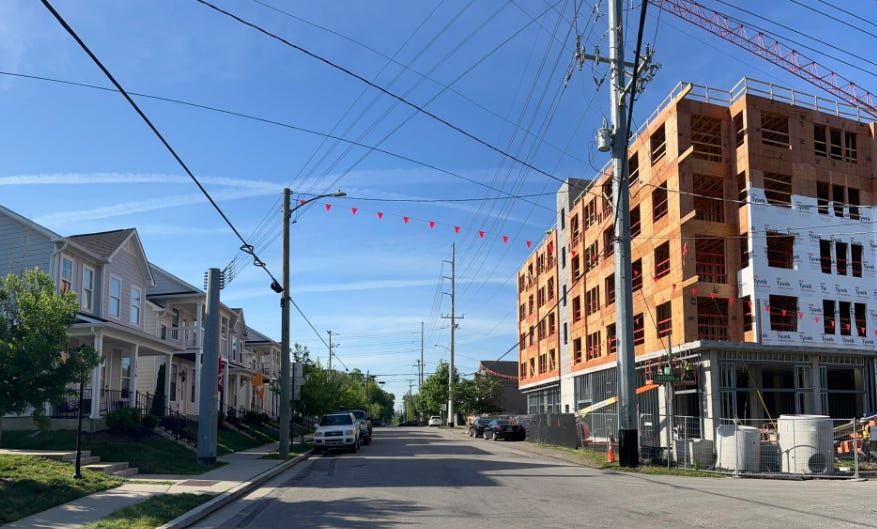
Example 1: The Nations - leading the charge for 60 foot tall buildings, Metro’s version of “gentle density” colliding with two and three story residential structures.
Yet here is what we are asked to accept instead: tear down a building the original plan required to be preserved, replace it with apartment structures two to three times as tall as anything around them, and trust a mural commitment that the councilmember’s own words reveal is not in the plan being voted on.
He promised to “bring an amendment to codify that intent on third reading.” If the mural will be preserved under the current plan, why does he need a future amendment to make it so? Because the protection is not in the document that the community, the Planning Commission, or the Council is voting on. He said so himself.
And notice the asymmetry: the neighborhood asked for a deferral and was denied. But the councilmember’s own amendment to protect the mural? That gets an open-ended timeline: “can defer it if necessary.” The community’s and artists’ concerns were not worth a delay. The developer’s talking point is. The motion is a simple developer’s tactic to remove the neighborhood from the table, and once again, a deferral opportunity was rejected that would have demonstrated both common and community business sense.
So we ask, plainly and before the third reading: Where in the plan is the mural wall preserved? Which drawing? Which condition? What makes it enforceable? If the commitment is genuine, this is straightforward to provide. The artists who created the work, the neighbors who championed it, and the constituents who were told it would be saved all deserve to review the details well before the final vote. If the plan cannot deliver what was promised on the floor, a departure from what was presented at the Planning Commission, then the chamber was told “a story,” again.
Decode the City - Stay Informed
It matters to say clearly what the neighbors are for, because the Council Member’s framing of “opposition” is the label used to dismiss the majority of his constituents, even as the existing inventory of luxury apartments he champions sits short of tenants.
When you peel away the legal mechanism (an amendment to a previously approved SP), what has actually changed is staggering. The original SP approval included approximately 50,000 square feet of commercial adaptive reuse space, roughly the footprint of a Kroger or Publix, and a companion 6,000-square-foot dedicated outdoor room, about the size of two tennis courts. Together, a full acre-plus of mixed-use commitment with an “outdoor room”. The 2026 proposed option for approximately 6,000 square feet of commercial flex space remains a future allowed use, not part of the commitment - an incidental outparcel on a drawing to check a box. This was not an amendment. It was a cloaked do-over, a legally clever application dressed as an amendment to avoid addressing the mixed use the approved SP purposefully requires.
The “mixed-use commercial area” from the 2023 adopted plan is in the orange box, and the 2026 optional flex commercial option is in the red box.
Several planning commissioners said from the dais that they would prefer adaptive reuse here. Not one moved to require it. Preference was voiced; nothing was conditioned. The community’s vision was acknowledged in the room but absent from the approval.
A note on roles, because this is where public frustration often lands on the wrong desk. The developer's attorney submitted a clever application. That is what good counsel does. A council member's job is the inverse: to be the community's neutral buffer, not the developer's advocate. Metro can reject applications that fall short of the General Plan or the zoning map's intent. The question is whether the institutional gatekeepers are willing to say so. In this case, the council member himself was double-seated as both a District Council Member and a Planning Commission Council Representative. That concentration of authority makes him, not the applicant, the constituent's primary line of protection. The Planning Commission Council Representative role exists to bring independent Council scrutiny to the Commission and to bring planning discipline back to the Council. When a single seat holds both the liaison role and the district vote, it becomes the pressure point that developers work hardest to shape, and a first-term member without institutional muscle memory is exactly the one who gets shaped. When the Council Member seat carrying both roles abdicates, and staff, the Planning Commission, and peer Council yield to that double-seated authority, action and policy get "handled" by the development community at large, and the constituents pay the price.
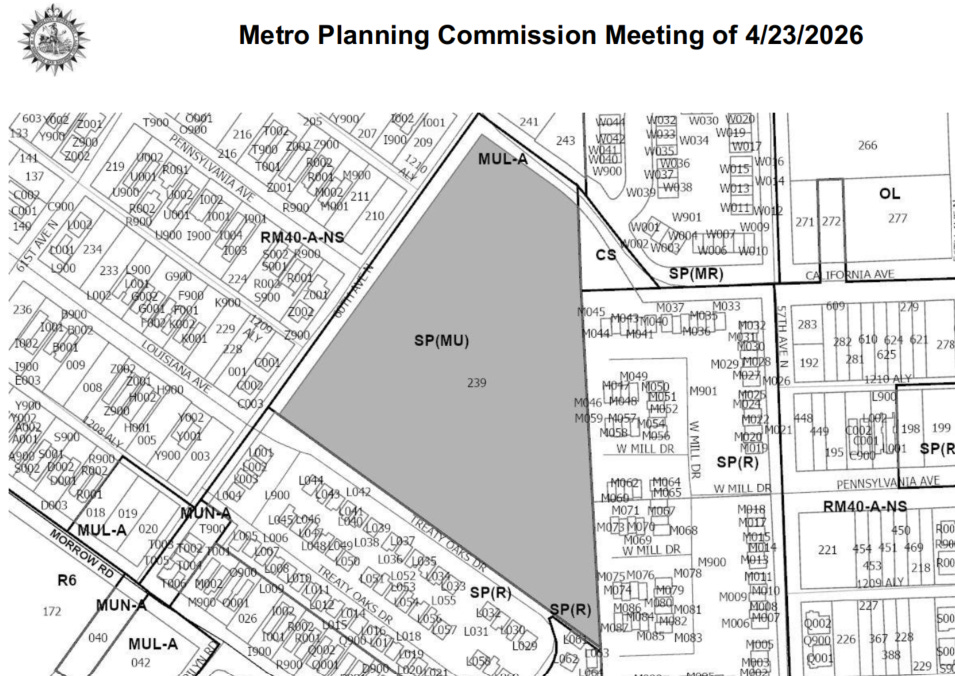
Look at Metro's own zoning map. This site is labeled SP(MU), Mixed Use, and is surrounded by neighbors zoned SP(R), Residential, or similar residential classifications. When a mixed-use site is surrounded on all sides by residential, it becomes the neighborhood's center by definition: the place people walk to for the small daily things that make a neighborhood feel like one. Coffee, a bite, a hardware run, a place to meet a friend. When the anchor delivers those, residents walk. When it does not, they get in the car and drive somewhere else to find them, and the neighborhood loses its center to the next zip code that built one.
The mixed use is not the neighborhood’s wish list; it is the site’s legal identity, adopted in 2023 to implement the General Plan. It is also the reason this project was approvable at all: converting an allowed nonconforming industrial site to commercial and residential use is what brought the property into closer conformance with the city’s adopted plan. Remove the commercial, and you remove the justification that the approval stood on.
This site sits in a policy area whose very name is Urban Neighborhood Maintenance. What remains in the new proposal application is, in fact, a residential project wearing a mixed-use label. Real mixed-use by definition shapes the street and the daily life of a place. It is not an optional or accessory line item “trick” on a site plan that no one is required to build.
The neighborhood agrees with the city’s plan, a rare thing in any city, where residents are actually asking for real mixed use. Through adaptive reuse, or new construction substantial enough to anchor a gathering place where people walk to a destination, bump into each other, and linger: a destination for our new economy of single-parent families and young professionals hoping for convenience to social connections. That is not an exotic demand. It is the plan Metro already adopted. A patch of grass where the dog can relieve itself is not a gathering place. The neighbors know the difference. They have asked, loudly and repeatedly, for the version of this project that builds one.
That is not an obstruction. That is a community raising the bar and inviting its representative to meet them at the table.
Strip away the technical vocabulary, and this is a bait-and-switch. The 2023 plan promised the neighborhood a mixed-use anchor with a preserved, adaptive-reuse building. The 2026 amendment delivers apartments two or three times as tall as the surrounding scale (in a zone the plan directs to “maintain the neighborhood character”), a demolished building, and a mural commitment that the councilmember’s own words concede is not in the document being voted on.
That is the deal. And when a promise made on the record does not survive to the plan being voted on, the reader is left with a narrow set of explanations: the promise was never meant to hold, the representative did not have the experience to hold it, or the representative was handled. None of those three is a defense of the process. And a fourth possibility should be tested against the record: whether this vote is an outlier or a pattern. A representative’s voting record against his stated constituent positions is publicly available, and constituents are entitled to check it. Each of these is a reason to raise the bar for who sits in the seat next.
Tuesday night made one thing clear: Nashvillians cannot rely on the public planning process to protect the General Plan or neighborhoods. So we change how we qualify the people who run it. In a coming article, I will lay out the three questions every Nashville neighborhood should carry to candidate forums, community meetings, and public hearings: the standard by which we measure whether our leaders are building places or just counting bedrooms for a fake dashboard. That piece deserves its own space. For now, the standard begins with what we do this week.
Treat this week as a diagnostic, not a defeat. We now know exactly how the current process measures up. The frequency is too harsh to ignore; the behavior is a habit, not an exception. Here is what to do with that knowledge:
1. Contact your council members before the third reading. Ask them to defer BL2026-1423 until a legitimate community working meeting is held, and until the mural-wall commitment made on the floor is delivered in the plan, reviewed by the artists and the community, and enforceable. (Contact information below.)
2. Demand the plan details now. CM Horton testified that Woods Partners will reuse the mural and promised an amendment on third reading. The testimony was public; the follow-through should be too. Which drawing? Which condition? Before the final vote, not after.
3. Speak up, show up, and stand with your neighbors. Connect with Voices of District 20, the Nations Neighborhood Association, and Save Our Nashville Neighborhoods. The chronology these volunteers assembled is the reason a public record exists at all.
4. Demand integrity. Demand that Council Members give their community the unvarnished facts.
5. Demand that planning officials plan with vision. Every plan begins with a spreadsheet. That is the starting place, not the finish line. When the goal of both the Council and the Planning Commission is to populate a data dashboard with luxury living units, that alone is not a solution for affordability, nor for building livable, gathering communities. We will continue to chip away at that, too. It is simply the potatoes without the meat.
6. Share this. The process counts on exhaustion and short memory. A shared record and an invitation to friends defeat both.
Tuesday night, the neighborhood learned it cannot outsource its protection to Council Members. Fine. Then we become the standard ourselves.
One last observation, because it is the one that will not leave me. A council member facing this vote had two open paths. He could have accepted the deferral, required the developer to present the actual concept and design to the community for consultation, delivered a plan that codified the mural, and walked out of the chamber as the representative who turned a contested project into one his neighborhood could stand behind. Instead, he advanced a bill on the developer's timeline in exchange for a mural commitment that lives only in his voice and cannot be enforced against the party who has to deliver it. The developer bears no obligation to a floor promise. The neighborhood bears the consequences if the promise fails. The council member has bet his own credibility on an outcome he has no authority to guarantee. That is not a win. That is exposure, taken on by the one person in the room whose job was to protect the community from exactly this kind of risk.
Trust begins with listening from the bottom up. Raise the bar.
T4 Urban Neighborhood Maintenance (T4 NM), the policy area covering this site, is defined in the West Nashville Community Plan:
“T4 Urban Neighborhood Maintenance (T4 NM) is intended to maintain the general character of existing urban residential neighborhoods. T4 NM areas will experience some change over time, primarily when buildings are expanded or replaced. When this occurs, efforts should be made to retain the existing character of the neighborhood.”
Zoning: SP(MU), Mixed Use, adopted 2023, Case 2023SP-009-002.
Sources: West Nashville Community Plan (NashvilleNext); Metro Planning Commission staff reports, 2023 and 2026.
Decode the City - Stay Informed
Click on the image below to link to Council Members:

Christopher Remke [AIA ret.] brings an unusual combination to real estate analysis: the quantitative rigor of a veteran Design-Build-Development Advisory Professional merged with the cultural awareness of a Context-Sensitive Urbanist. As Principal of Linked, L. L. C., he’s the rare voice who can deconstruct a pro forma, read municipal debt structures, and simultaneously ask whether the project destroys or enhances the neighborhood’s social fabric.
This dual perspective - analytics meets urbanism - allows Chris to expose what architects, planners, builders, and conventional real estate experts miss: how financialization, zoning manipulation, and tax policy don’t just change property values, they fundamentally alter how cities function as communities.
As President of Save Our Nashville Neighborhoods (SONNinc.org), Chris fights extraction-urbanism’s standardized templates and champions genuine neighborhood diversity. Through his writing, he operates in “Decoder Mode,” making complex policy accessible while revealing the truth behind political narratives.
His mission is simple:
Neighborhoods need a voice, Working People need a voice, and the City needs a Council that connects with constituents.
Because transparency builds trust. Manipulation destroys it.
No posts
Comments
Nothing yet. Say the first thing.
Sign in to join the conversation.